I was searching through my old idea file today looking for the original synopsis I wrote for Ghost Writer when I found this partial scene I wrote back in 2012:
“Lunch.” I handed Lucy a wrapped sandwich. At her hurt look, I added, “It’s an all-veggie pita with no-fat dressing.”
“I love you. If you weren’t a girl, I’d have your babies.” She stopped to rip paper and take a huge bite before taste-bliss made her lashes droop. “Oh, God. Maybe we could adopt.”
Lucy had been dieting since high school; I knew because we’d been best friends since the first day of freshman year. I never kept any secrets from her, either, which was making it tough to decide what to tell her about my luncheon appointment.
“So?” She took a bottle of protein water from her bag. “What happened at the bank?”
“Nothing much.” I sat down in the client chair next to her desk and eyed the scuff mark on one side of my right shoe. “Anyone call?”
In mid-chug, Lucy nodded and passed me a small stack of message slips. Because she was the world’s finest receptionist, they were all neatly and beautifully written, and because I was the head of Accounts Receivable, I’d have to call them back.
“You look like someone just kicked your dog,” she told me after she swallowed. “What’s nothing much?”
“It’s just a family thing.” I sorted through the slips, shuffling them according to accounts and making some predictions about what they wanted to tell me. “No money, no money, probably filing Chapter Eleven, no money . . .” I came to one from the bank officer I’d just seen. “Oh.”
“He needs you to mail him a copy of your birth certificate.” Lucy balled up the empty sandwich wrapper, expertly tossing it into the garbage can in the corner of her cubicle before she gave me the eye. “You gonna tell me, or do I have to spread a rumor about you having the hots for Dale Bilmer in Collections?”
“Dale Bilmer is sixty-two.”
She nodded. “And still single. And looks upon you with lust simmering in his pacemaker while he adjusts his toupee.”
I wanted to laugh, but I was too depressed. “I’ve inherited something.”
Lucy leaned close. “Something like what?”
“A French chateau.”
“A what?” Lucy whooped, jumped up and dragged me to my feet before she danced me around. “You’re rich, you’re rich, you’re rich!”
I let her spin me a few more times before I stopped her. “I’m not rich.”
“Oh, sure.” She laughed. “You’re so poor you own a chateau in France. The true definition of poverty.”
“It’s not in France.” I eased out of her arms. “It’s in California.”
“Huh?” Now she looked perplexed. “What’s it doing there?”
“Someone moved it there.” I sat back down and gestured for her to do the same. “It’s in the mountains in the north part of the state.” I hesitated before I added, “I inherited a couple of mountains, too.”
My best friend grinned. “In California? Girl, trust me, you’re rich now. You’re so rich that you could—”
“I have to live there,” I told her, shutting her up instantly. “I mean, if I want the land and the money and stuff, I have to move to California and live in the house.”
“For how long?”
“A month.”
I believe this was the first incarnation of the idea I had that resulted in Breath of Ice, and what's odd is that after I wrote it I never looked at it again until today. So my Accounts Receivable protag (never got around to naming her) heiress morphed into a property manager named Stephanie and the French chateau she inherited because a not-actually-haunted uber McMansion prison for a yeti. I don't recall what I had planned to have haunt the chateau, but I'm sure it would have been something just as strange.
I like haunted house stories, but I don't like how most of them end, and I think that was why I wanted to take a crack at writing one of my own. I liked my two girlfriend characters (actually pretty rare for me; I don't especially like BFF characters) and the dialogue seemed snappy enough. Once I got to the month residency requirement I remember my interest in it quickly evaporated, and I stopped and filed it away.
It's not a horrible idea, and some of it obviously stuck with me long enough to simmer itself into Breath of Ice, but I'm glad I didn't write more. Sometimes an idea is just supposed to be an idea. Do you save your partials and unfinished stories? Ever go back and read them? Do they have any value for you as a writer? Let us know in comments.
Tuesday, June 23, 2015


Monday, June 22, 2015
Days of Spontaneity
From the Collins English Dictionary - Complete & Unabridged 2012 Digital Edition:
spontaneity /ˌspɒntəˈniːɪtɪ; -ˈneɪ-/ noun (pl) -ties
1. the state or quality of being spontaneous
2. (often pl) the exhibiting of actions, impulses, or behaviour that are stimulated by internal processes
I am not spontaneous by nature; my usual creative method is to think/research/plan/test/check/recheck and only then do. I don't think it's a bad thing; I tend to get lots accomplished and nearly always finish what I start. For example, I generally plan, write and schedule for publication all the posts for PBW two weeks in advance. That gives me a forever floating fourteen days to add/change/delete things, and it keeps the blog automatically updating every day if/when I'm offline working.
It's not always a positive, however, The past few months I've been so busy with building my client list that I've been neglecting to adhere to my two week advanced posting method, which is why there were no posts when I went off to write last week. I suddenly ran out of pre-written posts, didn't have time to restock my post inventory and couldn't think of anything in the short time I had to work on the blog. My lack of spontaneity suddenly became more of a hindrance than a help.
Since I want to change that (and I still don't have time to restock) this week I'm going to write my non-feature posts the day before I post them, with no advance planning, and see if I can be a bit more spontaneous with my content.
Here's what a planner I am: as I was writing this post I opened another window so I could search for articles to read on how to be more spontaneous. About two-thirds of what I found before I realized what I was doing related to sex, and while I love you all that's simply not helpful in a blogging situation. Being addicted to research is an occupational hazard as well, but I think I've programmed myself to research anything I'm not sure of because I'm self-educated. I've read enough about artistic writers to know that to be more spontaneous you have to set aside your fears, forget about planning and organizing, and try new things. So for the next few days PBW will be my hub of spontaneity, and we'll see how I do.
To kick things off, let's talk about books. I just finished Consumed by Fire by Anne Stuart, which was an interesting American spin-off of her popular Ice series. I'll have to go back and try to read the last Ice book that was released as a Kindle-only e-book, as I never finished that one due to the pre-surgery eye problems. My next book is a re-read of Derelict by L.J. Cohen, as the sequel, Ithaka Rising, is coming out next week, and I am planning to write a revisited reads post about it because I can't not plan everything.
I've been very restless with my reading this summer, and currently bouncing all over the place with what I'm buying. The owner of the indy bookstore I frequent recommended one of her book club titles, The 100-Year-Old Man Who Climbed Out the Window and Disappeared by Swedish author Jonas Jonasson, so I grabbed a copy of that. I have one more Jack Reacher to read and then as it's never going anywhere but in cookie cutter circles I think I'm done with that series. Because I'm missing Europe I invested in Bella Tuscany by Frances Mayes and new copies of all the Peter Mayle books someone borrowed from me and never returned, may a million silverfish infest their library. And finally, I bought a remaindered novel titled Happily Ever After about a housewife/single parent who secretly writes erotica and meets a hunky stranger in Target because of how it absolutely shrieks realism. Kidding. I bought it because I'm apparently a masochist.
So what are you reading, and why? Let us know in comments.
Sunday, June 21, 2015

Saturday, June 20, 2015
Just Write Stuff
I didn't notice that the one-year anniversary of my Thursday Just Write feature whizzed by at the end of May, but it came up in e-mail conversation with a reader who didn't know I was publishing new works on the blog.
So for the benefit of the not-so-regular visitors, in the year since I began writing and posting new stories on PBW, I've managed to publish three new works with my byline: Breath of Ice, In the Leaves, and Club Denizen. At present I'm working on Ghost Writer, which I expect will take me a couple of months to finish as it's definitely turning into a novel.
As a ghost writer I've been knocking out on average 71K in contracted work per month, which is pretty much equal to what I was doing for traditional publishers in my heyday. This month I'm about to wrap up an extended series for one client, and begin my ninth short series for another. As a result the time I have to write stories that aren't going to pay the bills is very limited.
I am aware that some readers don't want to read the .pdfs on the computer, or find them a hassle to download on their particular e-readers, and that it's frustrating to follow a story in progress when you're used to reading only finished works. I wish it could be different, but this is the best I can manage right now -- and since anyone on the planet can access my Just Write stories for free, I feel that's a fair trade-off for any inconvenience involved.
Thursday has become my favorite day of the week now because I can take a few hours to write whatever I want, and share it with you all. That's important to me, and lots of fun, and I hope you'll stop in when you get a chance and check out the latest story in progress.
Friday, June 19, 2015
If the Shoe Fits
The story of Cinderella is well known around the globe; some scholars believe up to three thousand versions of the story are told by nearly every culture on the planet. Here are a couple of interesting spins presented by the Victoria and Albert Museum (with narration and background music, for those of you at work):
Cinderella's Shoes from Victoria and Albert Museum on Vimeo.
Thursday, June 18, 2015
Just Write

Today I'm back! and off to write something new and post it online before midnight. Everyone inclined to do the same is invited to join me.
My link: More on Ghost Writer, with new material beginning on page 70.
For more details on Just Write Thursdays, click here to go to the original post.
Image credit: windujedi
Wednesday, June 17, 2015
Tiger Eyed
I'm back, and thanks to everyone for your patience while I was off writing and dealing. To have some fun today (and find out how sharp your color vision is) try this online eye test and discover which animal shares your range of color vision.
I was expecting to score badly, but the new and improved eyes actually did pretty well with a score of 21 and no errors:


I'm pretty sure most tigers can see anything better than me, but it was an interesting test.
So which animal's eyesight do you have? Let us know in comments.
(Test link swiped from Gerard at The Presurfer)
I was expecting to score badly, but the new and improved eyes actually did pretty well with a score of 21 and no errors:
I'm pretty sure most tigers can see anything better than me, but it was an interesting test.
So which animal's eyesight do you have? Let us know in comments.
(Test link swiped from Gerard at The Presurfer)
Tuesday, June 16, 2015

Monday, June 15, 2015

Sunday, June 14, 2015
Off to Write and Clean

I need to unplug from the internet for a couple days to finish a project for a client, tidy the office and clean the rest of my house. I've run out of pre-written posts to put up in my absence, and I'm kind of sick of doing the blast from the past thing, so expect a repeat of this along with some pretty images to fill in while I'm away.
See you in a couple of days.
Saturday, June 13, 2015
Sub Op
Cantina Publishing has an open call for their upcoming Untethered: A Magic iPhone Anthology: "iPhones are magic. I mean, do you know how yours works? Could you take it apart and put it back together? We can’t go out without our smartphones. They organize our lives, find our locations, and sync with all our other tech. We sleep with them beside our pillows. Yet… their workings are a mystery. What does “magic iPhone” mean to you? Consider the supervillain who mind-controls a city’s populace, or the employee who stamps the runes that make your iPhone 8s so lightweight. This anthology is based on the success of anthology editor Janine A. Southard’s recent novel, Cracked! A Magic iPhone Story, which stars an explicitly magical iPhone (found by story gamers in modern-day Seattle). That iPhone comes pre-loaded with a romance finder app of dubious morality that not only sends its users on terrible dates, but also sucks their life forces. Editor’s Note: I’m looking for stories that cleverly incorporate the idea of a “magic iPhone” into any setting you like. I will, of course, be psyched to read variations on my crazy romance app, but I’m also excited to read something totally different. I’m accepting all genres except straight-up erotica or hard-core horror. (We’re aiming this anthology at general audiences, after all.) I think the idea lends itself well to comedy and dark fantasy, but… I guess that was obvious already." Length: 3-7K, Payment: $100.00, no reprints, electronic submissions only, see guidelines for more details. Deadline: October 1st, 2015.
Friday, June 12, 2015
Pale & Precious
This fascinating film from the UK's Victoria and Albert Museum offers a gorgeous overview of the history of pearls as adornments and jewelry (narrated and with background music, for those of you at work):
Pearls from Victoria and Albert Museum on Vimeo.
Thursday, June 11, 2015
Just Write
Today I'm off to write something new and post it online before midnight. Everyone inclined to do the same is invited to join me.
My link: There isn't one this week, as some bad weather and other vastly annoying difficulties kept me offline all day and night. Since it's 1:52 am on Friday I'm simply going to cancel this week's Just Write. I apologize and promise to do better next week.
For more details on Just Write Thursdays, click here to go to the original post.
Image credit: windujedi
Wednesday, June 10, 2015
Wait for It
 Author Anne Frasier just announced that Pretty Dead, her third novel in the Elise Sandburgh series, will be released September 1st. This book was #1 on my summer reading list but I don't mind waiting a couple of extra months for it. Some authors are worth the wait, and the first two books in the series were among my favorite reads of 2014.
Sometimes I lose track of long series that follow a chronology of events, which frustrates me. I was doing okay with Rachel Caine's vampire novels until I stopped at the fifth, sixth or seventh book and then lent the series to someone who never returned them (which also aggravates me, but I know better, so that's my fault.) I can't remember who I gave the books to or where I left off. I'm going to start over with that one by checking out the first books from the library and read them again until I can figure out which book I need to pick up next.
There are a lot of series that are readable from any point because there is very little chronology or no timeline at all, and/or the protagonists and support crew seldom undergo any big changes. Janet Evanovich's Stephanie Plum series is a prime example of this; same thing with Lee Child's Jack Reacher -- in ten or so books I think the only things that have changed about Reacher is how he banks his money and that he broke his nose. I'm not especially faithful to cookie cutter series, but I do think many readers like them simply because they can miss a book or two and not really miss anything important happening.
As for the other series I'm currently following, I might start making up and maintaining lists of the books I've already read. How do you guys track the series you read? Share some tips in comments.
Tuesday, June 09, 2015
Sub Op
Strangelet is "a journal of speculative fiction that publishes fiction, poetry, nonfiction, graphic stories/comics, and artwork six times a year with an anthology at the end of each year. We showcase the intersection where genre and literature collide. We want works to reveal compelling, universal truths that speak to us—from starship computers, from dragons’ mouths, and from everyday worlds tinged with miracles.
Guidelines for Submissions
We use Submittable for our fiction and poetry submissions. Please contact us directly for comic and art submissions. There is no fee for submitting your work to us.
When submitting, please include a brief cover letter with a short bio. Do not include any identifying information on the manuscript.
We do not accept unsolicited reprints. We do accept simultaneous submissions, but please notify us immediately if your submission has been accepted elsewhere.
Submissions are accepted on a year-round basis. Published works are featured both in the print and electronic editions of Strangelet.
In addition to payment (see below for our rates), we will also give you 2 electronic copies and 1 print copy of the issue you are published in.
Our goal is to notify all submitters of acceptance or non-acceptance within four months of submitting. We look forward to reading your work!
Rights
We acquire first world English rights for digital and print publication. Rights revert to the author upon publication. We also acquire first anthology rights for our end-of-the-year anthology. We may occasionally publish excerpts of accepted or published pieces on our website and social media.
Short Fiction
Short fiction should be between 2,000 and 7,500 words. Please query for anything longer. We currently pay $0.01 per word for short fiction. According to Duotrope, we are offering semi-professional rates for fiction (defined by them as $0.01 to $0.049 per word).
Accepted Document Types: doc, docx, txt, rtf
Flash Fiction
We define flash fiction as anything under 2,000 words. We currently pay $2.50 per page (1-250 words 1 page) with a minimum payment of $5.00. According to Duotrope, we are offering semi-professional rates for fiction (defined by them as $0.01 to $0.049 per word)."
For more information see the submission guidelines page here.
Monday, June 08, 2015
In a French Kitchen
 As I mentioned last month I received through Library Thing's Early Reviewers Program an ARC of Susan Herrmann Loomis's In a French Kitchen ~ Tales and Traditions of Everyday Home Cooking in France, which I promised to review in exchange. Here's me keeping the promise:
As the daughter of a chef I learned to cook from an expert who was happiest in the kitchen. If Dad taught me anything, it's that there is no better meal you can serve your family than one you prepare at home with a little time, thought and love. I didn't inherit my father's wizardry with food (although I am an excellent baker), but for the last thirty-odd years I've cooked meals nearly every day at home. No matter how hectic life becomes I do believe home cooking is the best food in the world.
With In a French Kitchen Susan Herrmann Loomis does for her readers what my Dad did for me, and shows us the many sides, secrets and little sorceries of home cooking in France. From her own kitchen to those of her friends and colleagues, Ms. Loomis demystifies and illuminates how ordinary people carry on the well-known and often obsessive love affair the French have with food while looking after their families, perpetuating traditions and creating more than a few of their own. That she covers so much in just thirteen chapters, all of which include dozens of recipes, helpful lists and topical spotlights, is just as fascinating as her stories.
I wouldn't say this is a traditional cookbook. It's something of a memoir, as the author offers plenty of tales about her own experiences in France, but it's also an intimate guide to how we can all learn a little from French home cooks to make our cooking lives a little fresher, livelier and fun. I don't see myself whipping up homemade mayonnaise -- I'm a Hellmann's girl from way back -- but I definitely want to try out many of the delicious-sounding recipes, particularly in the chapters on breads and desserts. There are a great many terms in French in the text, but Ms. Loomis deftly translates all of them directly or within context. I particularly appreciated seeing all the various quantities listed in both US and European measurements, which when not offered can be a pain for either side to convert.
Among other things the author is a trained chef who runs a cooking school (in France!) so this is not going to read like your Mom's Betty Crocker or the last issue of Taste of Home. She's a pro, guys, and while she does want to develop her readers' inner French cooks, many of her techniques are fairly advanced. While the dedicated gourmands probably won't bat an eyelash over Lapin Aux Pruneaux D'Edith, if you're a Hamburger Helper-dependent cook you're probably going to feel a bit intimidated. Don't be. Everyone has to start somewhere, and you can try something simple, like the homemade hot chocolate in chapter eight, or the poached pears in chapter thirteen. Once you've tackled a few of the easier recipes (and there are a lot of those, too) you can try something a little more complex, like Edith's Rabbit with Dried Plums.
I recommend this book to anyone who enjoys French cooking and culture and wants to take some adventures with their own cooking -- and if you simply love reading about cooking as I do, then you're in for a treat. This book is scheduled for release on June 16th, 2015. If you'd like to get your own copy, here's where you can shop:
Amazon
Barnes & Noble
Sunday, June 07, 2015
SF/F Contest
The 2015 N3F Amateur Short Story Contest is now open for entries, and here are the rules:
"1. This contest is open to all amateur writers in the field, regardless of whether they’re members of the National Fantasy Fan Federation. For the purposes of this contest, we define an amateur as someone who has sold no more than two (2) stories to professional science fiction or fantasy publications.
2. Stories entered in the contest must be original, unpublished, not longer than 8,500 words in length—and must be related to the science fiction, fantasy, or similar genres in the opinion of the judge.
3. Send all manuscripts to the contest manager: Jefferson Swycaffer, P. O. Box 15373, San Diego, CA 92175-5373; abontides@gmail.com. Emails with the story attached in word format are preferred. Paper manuscripts are acceptable. All entries must be received or postmarked no later than Dec. 31, 2015.
4. Manuscripts on paper should be typed, single sided on 8 1/2″-by-11″ white paper, double spaced, with pages numbered. The name of the author should not appear anywhere on the manuscript to ensure impartial judging. Photocopies are acceptable, if they are of good quality. Computer printouts must be legible.
5. Email entries will be accepted. Send to Jefferson P. Swycaffer at abontides@gmail.com. No guarantee can be made of email receipt. Privacy and property rights will be absolutely respected. No one other than the Short Story Judge will ever see the submission. The name of the author should not appear anywhere in the manuscript to ensure impartial judging.
6. Contestants can enter up to three stories. Enclose a self-addressed, stamped envelope (SASE) if you would like your story returned at the end of the contest. Stories will not be returned without an SASE. Do not send your only copy in case of accidental loss. We are not responsible for lost manuscripts.
7. There are no entry fees.
8. Cash prizes totaling $100 will be awarded as follows: First prize is $50, second $30, and third $20. Honorable mentions and semi-finalists will receive a certificate of award.
9. The Short Story Judge is a published science fiction professional, and also a loving fan of the sf and fantasy genres. All comments and critiques are solely the Short Story Judge’s opinion, but he promises to be constructive and polite.
10. The NSF may want to publish an electronic book including top entries from one or more years of publication. You will not be contacted about this until after the contest is over and prizes have been awarded. If we want to publish your story, you will have to sign over to us first world serial rights. Your willingness to do sign over rights cannot affect whether or not you win the contest. Royalties will be divided evenly between all contest entrants once publishing costs are covered. Winners will be notified as soon as the judging is completed. Announcements and notifications of winning entries will be made in March 2016. Please take your time and submit your best work. You can resubmit stories previously entered. All entries will be kept confidential and will be judged fairly and anonymously. The deadline for all entries is Dec. 31, 2015. Good luck!
Please supply on a separate page the following information as your entry form.
Title of story (for identification):
Author’s name and address:
Author’s email address:
I have read the above rules for the 2015 N3F Amateur Short Story Contest, and I agree to them.
Signature:
Date: ________________________________________________________________________
Mail to: Jefferson Swycaffer, P. O. Box 15373, San Diego, CA 92175-5373 ; or email abontides@gmail.com"
Saturday, June 06, 2015
What the Heck, Answered
If you've ever seen or taken a picture of something you were unable to identify, Wolfram's Image Identification Project may be able to help. I used it to upload a photo of a bird I didn't recognize at the beach, and it named it for me:

It doesn't always get the identification right, of course:

That's a zentangle I drew, not lace, so IIP does make mistakes. Still, if you're researching something and need to ID an image, this might be a quick way to get some help.
(Link to IIP swiped from Gerard over at The Presurfer)
It doesn't always get the identification right, of course:
That's a zentangle I drew, not lace, so IIP does make mistakes. Still, if you're researching something and need to ID an image, this might be a quick way to get some help.
(Link to IIP swiped from Gerard over at The Presurfer)
Friday, June 05, 2015
Global
If we're not careful this beautiful and scary little film could be our story (with background music, for those of you at work):
The Rise and Fall of Globosome from Filmakademie Baden-Württemberg on Vimeo.
Thursday, June 04, 2015
Just Write
Today I'm off to write something new and post it online before midnight. Everyone inclined to do the same is invited to join me.
My Link: More on Ghost Writer, with new material beginning on page 66.
For more details on Just Write Thursdays, click here to go to the original post.
Image credit: windujedi
Wednesday, June 03, 2015
Free Writing Apps

While off hunting freeware somehow I ended up redirected to this big list of free writing apps for (I think) Android devices, some of which looked pretty neat. Since I don't own any devices I can't check them out, but maybe you folks with Androids of your own will find them useful.
Tuesday, June 02, 2015
Sub Op
Horrified Press has an open call for their upcoming Detectives of the Fantastic antho: "Send me your stories of those trying to use some kind of science, technology, magic powers, anything that allows them to solve mysteries surrounding supernatural occurrences. What is the final verdict? Truth? Hoax? Something in between—the claimant was experiencing something but it has an explanation? Or– often the scariest of all—the inconclusive result so common on ghost hunting shows. You decide. If there is ultimately an explanation, however, please provide suspense or scares along the way. This is a horror/fantasy/sc-fi anthology so please provide elements of these genres. As stated above regarding your desire to explain it away, even if your tone is largely comic or all in good fun, there still needs to be some sense of a supernatural threat springing the story forward. Old school Pulp Fiction might be a fun way to go also. Beyond that, let your collective imaginations run wild and bring me investigators from divergent time periods, settings (even ones of your own creation), male, female, no need for them to be human either – your mind is the limit." Length: 2-5K; also: "Flash fiction or a story shorter than 2000 is fine as long as it tells a story, and is not just a scene or vignette. If your story is over 6000 words, please send me a short synopsis first and explain why it needs to be longer. I will accept a few longer ones." Payment: "Exposure and Royalties". Reprints okay, electronic submissions only, see guidelines for more details. Deadline: when filled.
Monday, June 01, 2015
Toes and Throws
Sometimes writers have to stop writing. It happens, usually when you have to deal with a problem or event that can be best described by adding the letters sh to the first word in this sentence. I did last year in between my eye surgeries, first because I was too blind to write, and then I was healing and still a bit fuzzy-sighted (and by the way, if you ever need someone to put drops in your eye, I'm your girl.) Once you do stop writing often it can be difficult to start again, especially after a long hiatus from the page.
I learned what to do from another surgery that got between me and the work many years ago. I lost most of the use of my left hand after having a tumor removed, and since I was left-handed I had the additional burden of relearning how to do everything right-handed. Anyone who has been forced to do this will tell you it's not much fun. Hand writing was out of the question until I learned to write as a righty, and my typing was restricted to whatever I could do with one-finger pecking. That's why I didn't write anything for almost a year. I even stopped thinking about writing so I could wrestle the larger issues.
 When at last I did have a functioning right hand and semi-functioning left, I sat down to write. I remember how disconnected from the work I felt, too. It was still in my head, like a huge inner ocean of stories, but I hadn't gone for a swim in so long that simply eyeing it scared me. I decided to cautiously dip my toe back in the writing waters by composing a first page. I'd just start a story and see what happened. What happened was three hours of sitting there and sweating and fussing over every word until I'd produced about 200 of them. Which were collectively so bad that I immediately trashed them.
The next day I was back to square one with nothing to show for my first try. I considered writing another cautious toe-dip partial, and promised myself it was purely practice, and gave myself carte blanche to write crap in hopes that would jump start my mojo -- all the bargains writers make with themselves to get back on the horse. And I wrote another toe-dip page with some lukewarm setting and some action about as exciting as yawning, and trashed that, and started to seriously question myself.
On the third morning I sat in my writing space for a while staring at the keys. Desperation hovered, wanting to set in. Or maybe it was writer's block; I'm not sure. One thing I did know was that I couldn't dip my toe in to test the waters again because that wasn't working. Neither were the bargains and promises I'd made with/to myself. So I decided to hell with it, and defaulted to the last resort. No more toe-dipping and thinking about it and worrying. No more thinking about it, period. I'd throw myself in the water and write a novel. A fun novel. A novel for me and no one else.
 Four months and 468 manuscript pages later I typed the last page of that novel, gave myself a week off, and then finally read it. The beginning was complete and utter crap, and the middle crawled more than it should have, and the twist at the end was more of a wrinkle, but it was a novel -- a finished novel. And the next one I wrote was better, and the one after that was much, much better. As for that lame, for-fun novel I never published or even showed anyone, it remains the most valuable story I've ever written. If I hadn't thrown myself into it, I know I would have quit writing altogether.
The process still works for me, too. Last year In the Leaves was my 2014 post eye-surgery throw story. Rain Lashed was a throw story after another, earlier eye surgery. After I broke my foot and cracked some ribs during a bad fall down the stairs back in 2003 writing Deimos threw me back into the work.
Whether you use toes, throws or something in between, maybe the most important thing you can do after taking a long break from writing is to write anything, really. Whether it's 1 page, or 468 of them, you're doing your job, and bottom line: writing is what makes you a writer.
Image Credits:
Toe dip: warrengoldswain
Leaping dolphin: vitaliy_sokol
I learned what to do from another surgery that got between me and the work many years ago. I lost most of the use of my left hand after having a tumor removed, and since I was left-handed I had the additional burden of relearning how to do everything right-handed. Anyone who has been forced to do this will tell you it's not much fun. Hand writing was out of the question until I learned to write as a righty, and my typing was restricted to whatever I could do with one-finger pecking. That's why I didn't write anything for almost a year. I even stopped thinking about writing so I could wrestle the larger issues.
When at last I did have a functioning right hand and semi-functioning left, I sat down to write. I remember how disconnected from the work I felt, too. It was still in my head, like a huge inner ocean of stories, but I hadn't gone for a swim in so long that simply eyeing it scared me. I decided to cautiously dip my toe back in the writing waters by composing a first page. I'd just start a story and see what happened. What happened was three hours of sitting there and sweating and fussing over every word until I'd produced about 200 of them. Which were collectively so bad that I immediately trashed them.The next day I was back to square one with nothing to show for my first try. I considered writing another cautious toe-dip partial, and promised myself it was purely practice, and gave myself carte blanche to write crap in hopes that would jump start my mojo -- all the bargains writers make with themselves to get back on the horse. And I wrote another toe-dip page with some lukewarm setting and some action about as exciting as yawning, and trashed that, and started to seriously question myself.
On the third morning I sat in my writing space for a while staring at the keys. Desperation hovered, wanting to set in. Or maybe it was writer's block; I'm not sure. One thing I did know was that I couldn't dip my toe in to test the waters again because that wasn't working. Neither were the bargains and promises I'd made with/to myself. So I decided to hell with it, and defaulted to the last resort. No more toe-dipping and thinking about it and worrying. No more thinking about it, period. I'd throw myself in the water and write a novel. A fun novel. A novel for me and no one else.
Four months and 468 manuscript pages later I typed the last page of that novel, gave myself a week off, and then finally read it. The beginning was complete and utter crap, and the middle crawled more than it should have, and the twist at the end was more of a wrinkle, but it was a novel -- a finished novel. And the next one I wrote was better, and the one after that was much, much better. As for that lame, for-fun novel I never published or even showed anyone, it remains the most valuable story I've ever written. If I hadn't thrown myself into it, I know I would have quit writing altogether.The process still works for me, too. Last year In the Leaves was my 2014 post eye-surgery throw story. Rain Lashed was a throw story after another, earlier eye surgery. After I broke my foot and cracked some ribs during a bad fall down the stairs back in 2003 writing Deimos threw me back into the work.
Whether you use toes, throws or something in between, maybe the most important thing you can do after taking a long break from writing is to write anything, really. Whether it's 1 page, or 468 of them, you're doing your job, and bottom line: writing is what makes you a writer.
Image Credits:
Toe dip: warrengoldswain
Leaping dolphin: vitaliy_sokol
Sunday, May 31, 2015
PBW's Book of the Month
 In May I tried to read every day, primarily to practice focusing the new eyes but also to get back to a more normal-for-me reading routine. I also tried some new-to-me authors and finally tackled a novel that I've been dithering about reading for about a year. Turns out my favorite read from the whole pile is the book I dithered over, The Brief Wondrous Life of Oscar Wao by Junot Díaz, which was also the winner of the Pulitzer Prize for Fiction in 2008.
I should note that prior to this month I've read exactly three Pulitzer-prize winning pieces of fiction:
#1: Hemingway's The Old Man and the Sea (1953 winner) which an English teacher assigned in school. Honestly, I skimmed it and thought it was boring, but I was thirteen and at the time interested only in sonnets and YA science fiction novels.
#2: Steinbeck's The Grapes of Wrath (1940 winner) which an English teacher assigned in school two years after Hemingway (seeing a pattern here?) which still ranks #2 on my top ten list of reading experiences that emotionally scarred me for life. That particular novel was actually so upsetting to me I silently vowed never again to read Steinbeck, even when it got me an F the next year for flatly refusing to read a single word of East of Eden -- and to this day I have kept that vow.
#3: To Kill a Mockingbird by Harper Lee (1961 winner) which I read voluntarily much later on in life when I didn't expect everything to be Shakespeare, feature space ships, or offer decent endings. Okay, I had to read it to help my kid do her homework because her English teacher had assigned it.
Now you understand my dithering, yes? I didn't want to be Grapes of Wrathed again. Had quite enough of that in school, thank you very much. Fortunately Oscar's author is not a Steinbecker. He probably would have felt right at home growing up poor with me and mine in the Cuban-Haitian-Jamaican melting pot of South Florida, however, which is the other reason I liked this book so much. It was a bit like going back home and hanging out with the chicas.
While I wax nostalgic that wasn't an easy life, and The Brief Wondrous Life of Oscar Wao is likewise not an easy book to read. It's fun and funny in a sad, sort of desperate way, the way too many people who come to this country have to live. In this story, the characters are from the Dominican Republic, and it's full of their lives both there and here, in a crazy almagum of Spanglish and superstition and some truly horrific stories about the country and the atrocities they left behind. Lots of footnotes, lots of family drama. As a genre lover and the first goth in my high school, I certainly identified with the title character, Oscar. For most of the book he was like a mirror in which I watched a clumsy, hostile teenage me burying herself again in A.M. Lightner and Shakespeare and Star Trek.
The writing is simply amazing. Very real and funny and poignant and like having a conversation with the characters. I think Faulkner himself would be impressed by the effortless stream of the narration, and how it conveyed the story. I also think this story is important because it chronicles with an unromantic eye the lives and experiences of people who don't often get books written about them. So those are the dazzling points.
On the flip side, the story had two things that bugged me: zero quotation marks and innumerable footnotes. I like quotation marks; they're a visual aide that helps me hear the story in my head, and while excluding them may be more hip the text becomes textbookish to read. Also, while I don't mind a few footnotes, too many of them aggravate me because a) footnote type fonts are so damn small I can hardly read them and b) very long footnotes wholly interrupt the read and c) nearly all of the footnotes in this book are very long, and d) why footnote fiction with fictional footnotes? I don't get it.*
Sidebar practical suggestion: if you ever see a footnote crop up in your own fiction story? Stomp on its pointy little head until it turns to dust and work what you're trying to footnote into the story so I don't squint and mutter bad words when I read it.
I didn't mind how depressing the book was, probably because I knew going in it was a prize winner and that's almost a guarantee it's going to be a downer. Also, the footnotes kept my temper at a medium-high simmer, which is too hot for depression to set in. But despite all this, as the story progressed I actually forgot about the footnotes and became very invested in the title character. I wanted Oscar to prevail in his quest. I knew from the beginning what his fate would be (see title) but by the second half of the story I began silently cheering him on and hoping I was being lied to and that it would all work out in the end. I'm not going to spoil the ending, but it was true to the title and perfect. Genius. Absolutely deserved a Pulitzer, just for the ending.
I doubt I'm going to break my Steinbeck vow, and maybe this was just a fluke, but after reading Oscar I think I may try reading another Pulitzer Prize winner. I'll also be investing in every this author writes, because it's never a chore to read an amazing novel -- even if the next one has a million footnotes and no quotation marks, too.
*Probably because I've never taken a single writing class.
Saturday, May 30, 2015
Sub Op
Cohesion Press has an open call for their upcoming Snafu: Future Warfare antho: "For this military/sci-fi/horror anthology, we want warriors competing on a futuristic battlefield, fighting against forces threatening humankind, the balance of the galaxies, or life itself. Think Aliens, Halo, Predator, Starship Troopers, and Terminator. Have your heroes defending their way of life against inconceivable odds. Take us along for the ride while your future soldiers take the fight to their enemies. Expect casualties! We want ORIGINAL military-style combat with strong elements of future technology/sci-fi, and we want horror. Give us fear… suspense and tension… we want originality and speculation about future aspects of war. Most of all we want action, action, ACTION! We want something jaw-droppingly amazing." Length: "2,000 – 10,000 words (query for shorter or longer)"; Payment: "AUD4c/word and one contributor copy in each format released" No reprints, electronic submissions only, see guidelines for more details. Deadline: August 13th, 2015.
Friday, May 29, 2015
Sky Power
This time-lapse video by Enrique Pacheco will whisk you off to Salar de Uyuni in Bolivia, which at 10,582 square kilometers is the largest salt flat on the planet. It also contains about half of the world's lithium, so there's a good chance that the lithium in the batteries in your various devices came from Uyuni. During the rainy season water pools and reflects the sky to create stunning illusions (with background music, for those of you at work):
Reflections from Uyuni from Enrique Pacheco on Vimeo.
Thursday, May 28, 2015
Just Write
Today I'm off to write something new and post it online before midnight. Everyone inclined to do the same is invited to join me.
My link: More on Ghost Writer, with new material beginning on page 60.
For more details on Just Write Thursdays, click here to go to the original post.
Image credit: windujedi
Wednesday, May 27, 2015
LT Early Reviewers, GW Cover
Last month I mentioned that I signed up for Library Thing's Early Reviewer program, which allows me to request ARCs and gratis copies of books I'd like to read being offered by participating publishers and LT members in exchange for a review. Since there are inevitably more requests from ER participants than available copies there are no guarantees you'll get any book, but like any giveaway there's always a chance you will, too. I was selected to receive an ARC of In a French Kitchen ~ Tales and Traditions of Everyday Home Cooking in France by Susan Herrmann Loomis, which arrived yesterday:

Honestly, it's like Christmas without the decorating, and I can now say with certainty that yes, you actually can get cool free books from LT's Early Reviewers. To keep my end of the bargain once I've read it I'll post an official review here, at LT and a couple other places.
I'm also tinkering on cover art for Ghost Writer, my current Just Write Thursday story, and have narrowed a bunch of possibilities for the image down to these four (which will all need some tinkering, titles, bylines, etc.):


Which do you like best? Let me know in comments.
Added: As I mentioned in comments I could also combine a couple of these images, like so:

Image Credits:
Vintage writing: Miiisha
Laptop screen: pogonici
Writing hand: Syda_Productions
Lake Sunset: Yours Truly
Honestly, it's like Christmas without the decorating, and I can now say with certainty that yes, you actually can get cool free books from LT's Early Reviewers. To keep my end of the bargain once I've read it I'll post an official review here, at LT and a couple other places.
I'm also tinkering on cover art for Ghost Writer, my current Just Write Thursday story, and have narrowed a bunch of possibilities for the image down to these four (which will all need some tinkering, titles, bylines, etc.):
Which do you like best? Let me know in comments.
Added: As I mentioned in comments I could also combine a couple of these images, like so:
Image Credits:
Vintage writing: Miiisha
Laptop screen: pogonici
Writing hand: Syda_Productions
Lake Sunset: Yours Truly
Tuesday, May 26, 2015
Sub Op
Local Hero Press has an open call for their upcoming superhero-themed antho Caped: "We are now accepting submissions for an anthology of original superhero fiction short stories, called Caped. Here is what we’re seeking: Original superhero fiction stories that get into more depth about being a superhero than basic secret origin tales or superhero-versus-supervillain. Who are these people who have strange and wonderful powers and choose to use them for great justice? What makes them tick? Your characters should be original creations. We cannot consider work utilizing licensed characters." Length: "Up to 5000 words"; Payment: "$0.01 per word, rounded up to nearest $5.00 USD, paid via PayPal upon final acceptance of the contract by all parties." No reprints, electronic submissions only, see guidelines for more details. Deadline: August 31st, 2015.
Monday, May 25, 2015

Sunday, May 24, 2015
Just Call Me Lyn
You can find out what your name might be if you were born today (and at every decade dating back to 1890) by entering your name, birth year and gender in this name popularity generator.
My results:

Oooh lala. I also like my 1970's name (Terri) and my 1920's name (Opal). This might also be a fun generator to use to come up with some alternative names for your characters.
So what would your name be if you were born today? Let us know in comments.
(Name generator link nicked from Gerard over at The Presurfer.)
My results:
Oooh lala. I also like my 1970's name (Terri) and my 1920's name (Opal). This might also be a fun generator to use to come up with some alternative names for your characters.
So what would your name be if you were born today? Let us know in comments.
(Name generator link nicked from Gerard over at The Presurfer.)
Saturday, May 23, 2015
Personal Legends
 Here's something you don't know about me: Back in the eighties I was a lab rat for Quaker Oats. Or to be more precise I was one of the many volunteer consumers on whom Quaker tested several variations of their new chocolate-covered granola bar product before deciding on the final product.
I was actually approached by a consumer product tester while I was out shopping, and she asked if I'd like to take part in her group. I agreed because free food was involved; also, I loved granola and chocolate, so I didn't think it would be awful -- and it was actually really neat. I was given several boxes with different versions of bars, had to taste each one, rate them, mark a survey sheet and then report my opinions over the phone. I took it very seriously and answered honestly (and got to eat a lot of chocolate-covered granola bars, another happy memory.) The Quaker Oats people in turn treated me with respect and thanked me for helping them out. Since the product has stayed on the market for like thirty years, and it's the version I picked as the best of the test lot, I like to think my opinion helped bring the best form of the product to the shelves.
Most everyone has a personal legend or two in their lives, I think -- being remotely involved with some huge product as I was, or finding something enormously valuable at a garage sale, or having a brush with fame by meeting celebrities under ordinary circumstances. According to family lore, my grandfather, who came down with osteomyletis when my mom was a little girl, was among the first Americans to receive penicillin after the antibiotic was first approved for testing on patients in the U.S. Because at the time osteomyletis was a death sentence, it also saved his life. On the much lighter side of family legends, my mom once bought a dirty but pretty pearl ring at a flea market that she later had cleaned and appraised. Since it was made of platinum and had two nice little diamonds along with the pearl the jeweler valued it at $2,500.00 -- which was ten thousand times what she paid for it. Yep, she bought it for a quarter.
Although I've never met a celebrity under ordinary circumstances I think that would be pretty cool. Singers seemed to gravitate toward my family; while working the makeup counter at a drug store my mom waited on Roberta Flack, who was lovely to her. I definitely envy my brother, who along with being a minister runs an appliance repair business; one time he was called out to Gloria Estefan's house to fix her dishwasher and got to talk to her. Probably the most famous singer-celeb encounter story in our family is the time when my daughter and her classmate ran into rapper/actor Will Smith while they were on a school field trip, and he was kind enough to stop and talk to them, and answered a question my daughter asked him (which is why I will always love Will Smith. He was nice to my kid.) The unifying note in all these celeb personal legends is how kind famous people are when they deal with non-famous people. Generally speaking celebs tend to be very nice people under ordinary circumstances, as long as you're not shoving a camera or something to sign at them.
When you're building a character, consider adding a personal legend or two to their background. This doesn't have to tie into your story if you just want to add it to flesh them out, but very often personal legends do motivate us after they happen. My mom always pokes through jewelry boxes at every garage sale, rummage sale or flea market she goes to, hoping to find another treasure for a quarter. To this day I still buy Quaker Oats products and feel good every time I do. I also try to see in the theater or buy on DVD every film Will Smith makes (there's an example of how kindness to a child affects the kid's parent.) I suspect even my minister brother has a personal collection of Gloria Estefan's albums stashed away behind his Bibles. Connect a personal legend to your character's present and you add depth, realism and fun.
Friday, May 22, 2015
Dream Always
Here's a look at the sketchworks of Palma Rea, a self-taught artist whose watercolors and sketches are filled with color, drama and beauty (with background music, for those of you at work):
The Sketchworks by Palma Rea from PalmaRea on Vimeo.
Thursday, May 21, 2015
Just Write
I'm back! And today I'm off to write something new and post it online before midnight. Everyone inclined to do the same is invited to join me.
My link: More on Ghost Writer, with new material beginning on page 57 (and sorry I'm late posting this; had to finish up a client project first.)
For more details on Just Write Thursdays, click here to go to the original post.
Image credit: windujedi
Wednesday, May 20, 2015
Blast from the Past #3
From Focus to Palette
After reading my Story Palettes post last month, some of you asked if I would give some working examples of how I create a character palette.
Simone, who is a female protagonist in an upcoming novel of mine, has been gradually developing over the course of the last six months while I've put together her backstory, built her personality and figured out who she is, what she wants and, of course, what is the worst thing I can do to her. Simone is a woman of contradictions; everything about her is new and old, yesterday and tomorrow, fire and ice. The problem with all those lovely contrasts is that they make her very hard to nail down. Despite all the character development I'd done, I still had trouble seeing her in my head.
Recently at an art festival I had the pleasure of meeting and talking with watercolor artist Peggy Engsberg Furlin, who painted this little gem (click on any image to see a larger version):

As soon as I saw it I knew it was the focus piece I needed for Simone's character. I can't tell you why; most of the time there isn't a why, it just clicks and I know. So I bought the painting and brought it home, at which point I began building the character palette. First, I took a photo of the painting and cropped it so that no other colors showed:

I then ran the image through DeGraeve's Color Palette Generator to get a working palette, and set up the page for my novel notebook. From there I cut and pasted the DeGraeve palette, and began adding images from my digital collection that I felt suited Simone and worked inside the framework of the palette, until I had this page of visuals:

Colors are an important part of my process. They're symbolic and evocative, and so are the real world elements that I associate with them. They also create new ideas when I combine them. All of these images and colors echo different aspects of Simone's character and what she has to face in the story; defiance, temptation, risk, silence, loneliness, endurance, realization, fruition. They relate to each other, too: Old death, new life; the transition from winter to spring; flowers blooming in snow, what ends to begin/what begins to end, etc etc.
I could go on for pages because now that I have Simone's colors, I know her better. I feel as if I can make her come to life on the page now. Because while I can imagine all the character elements I want, if I don't make the connections between them I can't feel the character or get inside her head. Having a character palette often helps me navigate my way through a lot of uncertainty.
As for inspiration, you should always be ready for it to come at you from any direction or source. Take these gorgeous lampwork beads, which I purchased last week from Pond Art Glass Studio:

I have been revising and updating Korvel, a character who has appeared in the Darkyn series, to serve as one of the protagonists in the new trilogy (there, you have some insider info no one else but my editor has, too.) I never created a character palette for Korvel, and I needed one, but I kept dithering around with old visuals I had from the original series notebooks, none of which were really tailored to his character.
It wasn't until the lampwork beads arrived and I was photographing them for an appeciation shot that I saw Korvel's colors gleaming at me from the intricate swirls in the glass. Twenty minutes later I had put together this palette for him:

For most character palettes I usually narrow it down to three colors, but Korvel and I have a lot of history together, so that's probably why he got a wider range. Readers know a lot about him as a secondary character; now they need to rediscover him as a protagonist, which requires a different approach than presenting a brand-new character. This palette will definitely guide my choices and help me shed some light on the Korvel no one but me yet knows.
I think the key to creating palettes that help you with writing is not to cheat on the focus factor. Inspiration is not something you can artificially generate by throwing together all your favorite colors. You'll be creating a pretty palette that looks nice, but you'll find it does nothing to help you explore your character. Instead, look for something (and not just art, it can be anything at all) that inspires you to think of your character in ways you haven't before you saw it. That's when you know you've got the beginnings of a great character palette.
(Originally posted on PBW on 2/9/11)
After reading my Story Palettes post last month, some of you asked if I would give some working examples of how I create a character palette.
Simone, who is a female protagonist in an upcoming novel of mine, has been gradually developing over the course of the last six months while I've put together her backstory, built her personality and figured out who she is, what she wants and, of course, what is the worst thing I can do to her. Simone is a woman of contradictions; everything about her is new and old, yesterday and tomorrow, fire and ice. The problem with all those lovely contrasts is that they make her very hard to nail down. Despite all the character development I'd done, I still had trouble seeing her in my head.
Recently at an art festival I had the pleasure of meeting and talking with watercolor artist Peggy Engsberg Furlin, who painted this little gem (click on any image to see a larger version):

As soon as I saw it I knew it was the focus piece I needed for Simone's character. I can't tell you why; most of the time there isn't a why, it just clicks and I know. So I bought the painting and brought it home, at which point I began building the character palette. First, I took a photo of the painting and cropped it so that no other colors showed:

I then ran the image through DeGraeve's Color Palette Generator to get a working palette, and set up the page for my novel notebook. From there I cut and pasted the DeGraeve palette, and began adding images from my digital collection that I felt suited Simone and worked inside the framework of the palette, until I had this page of visuals:

Colors are an important part of my process. They're symbolic and evocative, and so are the real world elements that I associate with them. They also create new ideas when I combine them. All of these images and colors echo different aspects of Simone's character and what she has to face in the story; defiance, temptation, risk, silence, loneliness, endurance, realization, fruition. They relate to each other, too: Old death, new life; the transition from winter to spring; flowers blooming in snow, what ends to begin/what begins to end, etc etc.
I could go on for pages because now that I have Simone's colors, I know her better. I feel as if I can make her come to life on the page now. Because while I can imagine all the character elements I want, if I don't make the connections between them I can't feel the character or get inside her head. Having a character palette often helps me navigate my way through a lot of uncertainty.
As for inspiration, you should always be ready for it to come at you from any direction or source. Take these gorgeous lampwork beads, which I purchased last week from Pond Art Glass Studio:

I have been revising and updating Korvel, a character who has appeared in the Darkyn series, to serve as one of the protagonists in the new trilogy (there, you have some insider info no one else but my editor has, too.) I never created a character palette for Korvel, and I needed one, but I kept dithering around with old visuals I had from the original series notebooks, none of which were really tailored to his character.
It wasn't until the lampwork beads arrived and I was photographing them for an appeciation shot that I saw Korvel's colors gleaming at me from the intricate swirls in the glass. Twenty minutes later I had put together this palette for him:
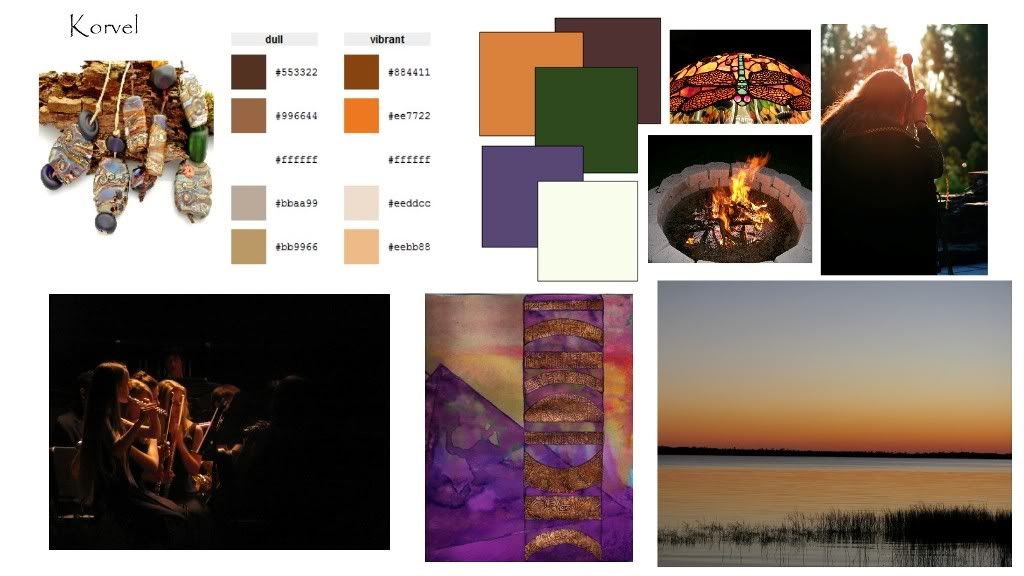
For most character palettes I usually narrow it down to three colors, but Korvel and I have a lot of history together, so that's probably why he got a wider range. Readers know a lot about him as a secondary character; now they need to rediscover him as a protagonist, which requires a different approach than presenting a brand-new character. This palette will definitely guide my choices and help me shed some light on the Korvel no one but me yet knows.
I think the key to creating palettes that help you with writing is not to cheat on the focus factor. Inspiration is not something you can artificially generate by throwing together all your favorite colors. You'll be creating a pretty palette that looks nice, but you'll find it does nothing to help you explore your character. Instead, look for something (and not just art, it can be anything at all) that inspires you to think of your character in ways you haven't before you saw it. That's when you know you've got the beginnings of a great character palette.
(Originally posted on PBW on 2/9/11)
Tuesday, May 19, 2015
Blast from the Past #2
The Fabric of Inspiration
In 2007 a friend sent me some specialty watercolors made by LuminArte Inc., which I started playing with while painting. One of the first pieces I painted with them was this one (which I then sent to the friend, as thanks):

I get mildly obsessed with colors and patterns, and since 2007 I've painted the same concept over and over -- a tower, towers, castle or ruins made of opal bricks -- like this one I mentioned back in May:

Recently I was at my favorite fabric store, looking for a dark green batik to finish a holiday project, and I pulled about twelve different bolts out to compare colors when I found one bolt with about two yards of this fabric on it stuck in the back of the display cabinet:

I've been in that store at least fifty times over the last two years, and have never seen this fabric in the past. I've never seen this fabric before in my life -- and I've been pretty much painting it nonstop since 2007. So either I've become a fabric psychic, this is one cosmic coincidence, or the universe has been trying to tell me something.
I bought the fabric (how could I even resist?) brought it home and put it on the sewing table. Immediately I began cutting it and making part of it into a book bag -- it just wanted to be a quilted book bag. The rest of the yardage I hung on the wall in my office until the universe figures out what it wants me to make out of it.
I know my watercolor paintings aren't going to set the world on fire, but I'm a little better with fabric. The bag (almost finished) is turning out nicely. The fabric sings through my sewing machine. It pairs beautifully with this deep amethyst broadcloth that I'm using to line the bag. It dances in front of my eyes. It's even started telling me stories I need to write. I can only work on it an hour a day or inspiration intoxication would hit me and I wouldn't leave the sewing table until someone dragged me away.
This is what writing is like for me -- why I don't talk about this part of it very often. When you try to explain your inspiration, or your process, or your joy in creation to others, it generally sounds like this. Like you're a little nuts. And writing is like having an entire store filled with hundreds of bolts of fabric in your head that you've been painting for years before you even saw them or tried to make something out of them.
Whatever anyone says about the fabric of my inspiration, it came to me. It belongs to me, but it's also up to me to make something out of it. Something that makes me deserve finding it and having it. When that work is finished, then I can show it to the world, and hopefully the job I do is good enough that they'll see what I saw, and feel what I felt, and know what I knew.
(Originally posted on PBW on 12/03/08)
In 2007 a friend sent me some specialty watercolors made by LuminArte Inc., which I started playing with while painting. One of the first pieces I painted with them was this one (which I then sent to the friend, as thanks):
I get mildly obsessed with colors and patterns, and since 2007 I've painted the same concept over and over -- a tower, towers, castle or ruins made of opal bricks -- like this one I mentioned back in May:
Recently I was at my favorite fabric store, looking for a dark green batik to finish a holiday project, and I pulled about twelve different bolts out to compare colors when I found one bolt with about two yards of this fabric on it stuck in the back of the display cabinet:
I've been in that store at least fifty times over the last two years, and have never seen this fabric in the past. I've never seen this fabric before in my life -- and I've been pretty much painting it nonstop since 2007. So either I've become a fabric psychic, this is one cosmic coincidence, or the universe has been trying to tell me something.
I bought the fabric (how could I even resist?) brought it home and put it on the sewing table. Immediately I began cutting it and making part of it into a book bag -- it just wanted to be a quilted book bag. The rest of the yardage I hung on the wall in my office until the universe figures out what it wants me to make out of it.
I know my watercolor paintings aren't going to set the world on fire, but I'm a little better with fabric. The bag (almost finished) is turning out nicely. The fabric sings through my sewing machine. It pairs beautifully with this deep amethyst broadcloth that I'm using to line the bag. It dances in front of my eyes. It's even started telling me stories I need to write. I can only work on it an hour a day or inspiration intoxication would hit me and I wouldn't leave the sewing table until someone dragged me away.
This is what writing is like for me -- why I don't talk about this part of it very often. When you try to explain your inspiration, or your process, or your joy in creation to others, it generally sounds like this. Like you're a little nuts. And writing is like having an entire store filled with hundreds of bolts of fabric in your head that you've been painting for years before you even saw them or tried to make something out of them.
Whatever anyone says about the fabric of my inspiration, it came to me. It belongs to me, but it's also up to me to make something out of it. Something that makes me deserve finding it and having it. When that work is finished, then I can show it to the world, and hopefully the job I do is good enough that they'll see what I saw, and feel what I felt, and know what I knew.
(Originally posted on PBW on 12/03/08)
Monday, May 18, 2015
Off to Finish Up
I'm going to bail on you guys for a few days in order to slay a deadline for a client. So that your stop here was not entirely wasted, here's a PBW archives blast from the past:
Know Thy Hub
While I've been reading Mr. Ray's book on writing, I realized why he is so object-obsessed. He encourages writers to make noun lists and use them to spark ideas because he uses objects as story hubs, or that thing around which everything else in the story revolves. Once you know what a writer's favorite or most frequently used hub is, you can begin picking them out (for Ray Bradbury, the playroom, the carnival, the tattoo, the planet Mars and the book have all served as hubs.)
The object as hub is an effective device: Guy de Maupassant likely used a beautiful diamond necklace to write one of the most miserably ironic short stories of all time; Stephen King used a '58 Plymouth Fury named Christine for a novel that made most of us give our cars an uneasy look or two (two more of his vehicle-as-hub works are From a Buick 8 and Trucks.)
My story hubs are almost always characters (the faceless man, the girl-knight, the golden assassin) or character-based concepts (the doctor who can never get sick or die.) This is probably because I find people more fascinating than objects, settings, events, etc. I've used one character as the hub for a ten-book series, and seven characters as the hub for a single novel. Even in my one dog story, Familiar, the shepherd who serves as the hub used to be a person and still retains most of his human qualities.
Some writers may argue that they never use a hub, and that's a possibility, although I think in those cases the hub may be tucked away in the subconscious. The process of discovering the story as they write it may be more important than knowing the hub up front. Organic writers who just sit down and let it flow might not want to name their hub is because it could kill their momentum. Hubs are not always great things, either; they can repeat on you, and if you're not careful, they can take over your work. This may be why those writers reuse the same hub for their books over and over ad nauseum end up becoming cookie-cutter novelists; they can't escape that one hub that sinks its claws into their brains.
Knowing your hub isn't a requirement of writing, but I think it helps to know what you were planning to write around whenever you get stuck. At times when I falter, stumble or otherwise get mired down in a story, I usually end up thinking about the hub character and asking myself questions as to how my problem relates to them and their situation. Everyone and everything in the story serves the hub, and if it doesn't, I've gotten off-track and wandered away from my story, usually with another character who distracts me (nine times out of ten, that's always the case.)
If you're not sure how to determine what your hub is, think about what inspired you to write the story, or make a list of those elements that are most important to you and/or that you spend the most time developing. If knowing doesn't squash your enthusiasm, having a good grasp of what your hub is gives you some advantages, especially when you write up your story premise for a query or a synopsis for a submission package.
(Originally posted on PBW on 1/15/11)
Sunday, May 17, 2015
Farm & Write
Here's an interesting residency that offers a scholarship for a writer interested in writing about farming to spend a couple of weeks working and writing on a farm:
"Noepe Center for the Literary Arts in partnership with The Farm Institute at Katama Farm is offering a special two-week residency scholarship between September 16-October 31st, 2015. Application is open to writers of any genre interested in learning and writing about the intersection of agriculture and community on Martha’s Vineyard. Applicants need not have previously written about agriculture nor do they need a farming background, merely demonstrate a desire and curiosity to explore the intersection between farming and writing. The scholarship provides two-weeks residency at Noepe as well a living stipend of $200.00 per week.
The Farm Institute is 15-year-old educational nonprofit dedicated to connecting people of all ages and circumstances with agriculture through the diverse operations of a working farm. Located on the 180-acre historic Katama Farm (a quick walk, bike ride or bus ride from Noepe Center) The Farm Institute hosts over 1000 children and youth at farm camp every summer, year-round programs through the Island schools, learning events for adults and also opens the farm to some 2500 people visitors from all over the country and world who stop by.
At the Farm Institute the working farm is the curriculum. Katama Farm is one of the largest farms on the Martha’s Vineyard and, with its beautiful grassland environment, it is one of the largest livestock producers as well. With some 60 head of cattle, 65 breeding ewes, chickens, pigs and an occasional goat, The Farm Institute plays an important role in the renewed interest in agriculture and local food on the Island. At one time, Martha’s Vineyard produced all its own food. Today, only 3% of food purchases are Island-grown products. There is much to think and write about in these facts.
The staff at the Farm Institute is passionate about food and the business, science and magic of the agriculture that produces it. With the hectic summer over, fall is a time not just for harvest, but to assess and share ideas. The farm welcomes the opportunity to include a writer in that process.
Requirements of Noepe on the Farm Resident
CHORE RESPONSIBILITIES: The Noepe Farm resident will be part of either the morning or afternoon chore team at the Farm Institute five days per week. Chores equal work, the backbone of the farm: feeding and watering animals, gathering and packaging eggs, weeding or harvesting in the garden, cleaning out the greenhouse, mucking livestock space, moving animals, moving fence. Morning chores in the fall are usually from 8 to 10, afternoon chores from 3 to 5. No prior skills are needed. An experienced staff person will always be on the team and chore assignments may vary from day to day.
In addition to chore time, the Noepe resident is welcome to take part in any other activities or even work at the farm, schedule meetings with staff, read about the farm history, or just watch what goes on.
WRITING RESPONSIBILITIES:
The Noepe Farm resident will make use of his or her writing time to explore issues around agriculture, food production, ethics, sustainability and the past, present and future of farming. The farm staff will be happy to provide ideas for additional resources and experiences on these topics.
READING RESPONSIBILITIES
Toward the end of the residency, the participant will do a reading based on the farm experience. The reading will be open to the public, and invitations will go out to other writers, farmers and supporters of Noepe and The Farm Institute."
I don't see a deadline but I imagine it will be sooner rather than later. For more information and to apply online, go to the information/application page here.
Saturday, May 16, 2015
Well
I always reserve the right to make fun of anyone who SPAMs me. You have been warned many, many times, yes?
Hi,
Hope you are well.
No, you don't. You don't know me. I could be in an iron lung and you'd be completely clueless. So get on with it.
We have a dedicated team of 50 professional’s who are backed by experience and expertise.
Marvelous. Maybe they could teach you how to use contractions correctly.
Has your website become the victim of Google Panda and Penguin update, resulting the down ranking in search engines?
I have no idea what my ranking was, and what it is now is equally of no interest to me. I am intrigued by the idea of being a victim of pandas and penguins, though. What does Google make them do, cute people to death?
Do you want to get more targeted visitors on your website?
I should ask first. Hey guys, do you want this SPAMmer to paint bulls-eyes on your heads for me? Let me know.
If yes, please let us know your domain name which you want to optimize.
Sure. Go with www.pbwdoesn'tcare.com (<-----See? Contraction used correctly)
We will analysis your website and send full SEO proposal with plan and activities which will be implemented on your website.
As opposed to say, taking a couple more classes in English to analysis your fluency?
Most firms overseas have achieved a significant amount of savings by outsourcing either complete or part of their SEO.
Alas, not a firm. Not overseas. Don't SEO anything. Write my own schlock. Haven't spent a dime on the blog, either. So really nothing to save or outsource. I know this will make you hate me, but there you have it.
Let me know if you are interested I would be Happy to send you more details.
While you're At it, Ask your Dedicated team of experienced, expert professional's if they Know anything about how to Eliminate Random capitalization.
Friday, May 15, 2015
Innovation
How does textile weaving and paper sculpting help someone design shoes? Here's a master of shoes to explain (narrated by the artist and with background music, for those of you at work):
The Innovator from Cineastas on Vimeo.
Thursday, May 14, 2015
Just Write
Today I'm off to write something new and post it online before midnight. Everyone inclined to do the same is invited to join me.
My link: More on Ghost Writer, with new material beginning on page 49.
For more details on Just Write Thursdays, click here to go to the original post.
Image credit: windujedi
Wednesday, May 13, 2015
Sub Op
Brain Mill Press has an open call for unsolicited fiction submissions about love in all its variations:
"MAY 2015 BRAIN MILL PRESS OPEN CALL FOR SUBMISSIONS — OPENS APRIL 30
Submissions open April 30, 2015
Submissions close May 30, 2015
Submit at brainmillpress.submittable.com
Brain Mill Press invites authors to submit their original, unpublished, complete manuscripts during our first open call of 2015. Complete manuscripts in any genre, including commercial genres (romance, suspense, science fiction, young/new adult, among others), and mainstream and literary genres, are welcome. Illustrated children’s literature is welcome (please submit completely illustrated children’s manuscripts), as is middle grade. Completely illustrated graphic novels are welcome. Novellas and short stories are welcome, but if the editors are interested in your shorter work, you must be prepared to develop a longer project or collection with editors.
Do not submit queries, proposals, pitches, or incomplete manuscripts during this call. Do not submit scripts or screenplays, visual art, or poetry manuscripts during this call (poets should submit to the Brain Mill Press Mineral Point Poetry Chapbook series. For more information, go to brainmillpress.com). Do not submit non-fiction during this call.
Brain Mill Press publishes “Love Books for Humans.” Love Books are books about experiences with love. We’re seeking books that explore love in many different ways, or explore entirely different kinds of love. These are books about humans, all humans, and are meant to reach readers who define humanity based on their own lived experiences, of all kinds. Our purpose as a press is to build a catalog of stories about all facets of the human experience with love. Our upcoming titles include a historical LGBTQ+ novel, a literary novel about an urban vigilante, a late-life love story, a collection of short stories that includes a story about a teenager in love with Valentino, and a romance novella about a musician and a friend from childhood he never forgot. For more information about our philosophies, other open calls, or editors, go to our website at brainmillpress.com.
Your electronic submission will be accepted at the Brain Mill Press submission portal at brainmillpress.submittable.com/submit/40703. Incomplete submissions and manuscripts, or manuscripts that are discovered to not meet the guidelines of this call, will be automatically rejected. All other submissions will be read by the editors in a timely manner. Authors who have not heard from the editors eight weeks from the end of the open period are welcome to inquire about their submission to inquiries@brainmillpress.com. Form rejection should be anticipated by authors whose submission does not meet the needs of the editors at this time, but comments and feedback may be occasionally offered per the editors’ discretion.
Good luck, and direct inquiries not answered in this call to inquiries@brainmillpress.com."
Tuesday, May 12, 2015
Gone Post
 Today's original post about building characters was actually just eaten by Blogger's Delete option. It was an anecdotal thing about me and my Dad and Neiman Marcus, only remotely related to characterizations, and while that might sound interesting it was actually beyond depressing. Now that's it gone forever, no copy saved, no printed out version to tuck in the personal journal, I'm glad I erased it out of existence. That stuff was between me and my dad, and Neiman Marcus was only peripheral. The unhappiness of the past needs to be released, not relished. And I wrote really because I was just missing Dad more than anything, and wishing I'd had more time with him in this place.
You know who my Dad was? The only person in my life who was always glad to see me. Always. No matter how or when or why I showed up on his doorstep, he smiled and hugged me and was genuinely happy to have me there. Every single time. Never once did he welcome me with anything but joy and delight. You think that may be a very small thing but actually it was huge for me; on a few occasions it was all the love I thought I had in my life. Think about everyone you know, and try to pick one person who felt or feels the same about you, and you'll understand how rare that is. That's really what I want to remember about Dad when I miss him: how blessed I am to have known someone as kind and sweet as he was. How I wish I could be more like him, too.
So here's today's bit of unsolicited advice for all of you: the next time you see someone you care for, be happy to see them. Welcome them with joy and delight. Let me know they are loved. It doesn't cost anything, it won't hurt you, and it will be something they remember when they think of you after you've moved on to the next place.
Monday, May 11, 2015
No Cost Noting
The free/Basic version of Debrief is "PC software to handle note overload. Keep your notes in one place, saved in your PC. With Debrief, organization can becomes habit, while hardly even trying. Debrief provides a significant step toward remembering what you know, and where you put it. The goal behind Debrief is to organize notes in different contexts and formats with simple mouse clicks. Examples include: daily notes, meetings, to-dos, assignments, issues, changes, risks, decisions, research, contacts, and more."
Features:
"Arranged by Date
To imitate how you may be taking notes today, Debrief automatically dates each note when it is created. Your notes can be viewed by date, similar to how you may do that today in a written notebook. To display notes from a particular day, click on that date in the calendar. If you need to write a status report, highlight the entire week on the calendar to review what you did during that week.
Arranged by Subject
Do you like notes with similar subjects grouped together, like folders in a desk or file cabinet drawer? Then drag them to Debrief folders, similar to how you may drag email notes to folders in your email software. This is convenient for reviewing several notes on similar topics in a single view.
Note-Based Reports: Dated Journals, and Organized Files
Do you like notes printed, or saved to a file for word processing? The Reports features offers several different formats, such as by date or folder. If you print them by date, they are in a similar format to what you may have in a spiral binder.
If you kept notes all your life in this format, you could print them in date order and have a journal. Or, print them by subject folder and have a biography. It is fast can can be done with just a few mouse clicks.
Arranged like Note Cards
If you would like to rearrange your notes like note cards, try the Note Deck feature. Arrange notes by dragging them in a new order, and a new draft document is automatically created. This can be useful for using your existing notes to draft a whitepaper, a research paper, a script, or a novel.
Associated with Reading Material
If you have reading material, like books and magazines, mention these in Debrief and let Debrief start building a virtual library. You can take notes pertaining to specific reading material, while the notes are also organized by subjects and date. The items in the library can be viewed as a reading list, and printed as end note material for research papers.
Indexed like a Book
Sometimes notes contain many ideas. In these cases, you can create an index to notes, similar to an index in the back of a book. On a project at work for example, you may want to list lessons learned. In this case, create an index for "Lessons Learned." When you have noted material that you want to later refer to in this context, click the index when editing these notes. Then later refer to them in one view, no matter what their dates or subject folders.
Grouped by Action Items
Sometimes it is useful to keep a thread of notes that cover tasks or issues spanning days, or even weeks. In these cases, associate these notes with tasks and issues. Later, you can review to each entire note thread, even if it spans multiple subject folders and months.
Quick Reference
It is useful to keep some notes only a click or two away, such as a glossary, timesheet, expenses, or file locations. In these cases, tag notes with the Favorites attribute. That keeps them within a click or two with the Favorites button.
Find
Now just where did you store that note. When you need to search notes for keywords, try the Find feature, one click away. Imagine being able to search all your notebooks.
Speak to Debrief
Are you using speech recognition software on your current PC? If so, point it to Debrief. With speech recognition and your mouse, talk to Debrief and drag paragraphs to folders. Notes are automatically dated, and instantly organized."
(OS: Windows: 98, Me, NT4, 2000, XP, or Vista)
Sunday, May 10, 2015

Saturday, May 09, 2015
Sub Op
Ylva Publishing has an open call for lesbian fiction for their upcoming Halloween-themed antho:
"Werewolves, vampires, ghosts, fairies, djinns, goblins, trolls, witches, brownies, banshees—beings that are not of this world. Or maybe they are.I love Halloween, and I love stories about supernatural beings. I’m a publisher. We had a blast doing Halloween anthologies in the past two years. So why not combine my love for both and publish another anthology in October 2015 with stories that involve Halloween in one way or another? Yes, let’s do that. Let’s put out a submission call and let’s do it again.
Here you go:
We are looking for lesbian fiction. That hasn’t changed. All submissions must have either Halloween or supernatural beings as the main theme. The stories can be romantic, humorous, enthralling, spooky or erotic.We accept only short stories that haven’t been previously published.
Word count:
We are looking for stories between 4,000 and 10,000 words in length.
Payment:
Writers whose stories are selected for the anthology will receive a one-time payment of $40 (via PayPal) plus a free e-book of the anthology in each format (epub, mobi, pdf).
Deadline:
The deadline to receive submissions is May 31, 2015.
Submissions:
Electronic submissions only. Please send your story as an e-mail attachment (.doc, .docx, or .rtf) to info@ylva-publishing.com. Put “Halloween Anthology” in the subject line of your e-mail. In the body of your e-mail, please include your name, the title and word count of your story, and a two-or-three-sentence summary of your story.
It will take our editors about three weeks to review your submission; then we’ll get back to you.
We are looking forward to receiving your stories."
Friday, May 08, 2015
Uh-Oh
This deceptively cute short film reminds us that sometimes a little fear can be quite healthy (with background sounds and music, for those of you at work):
Fears from Nata Metlukh on Vimeo.
Thursday, May 07, 2015
Just Write
Today I'm off to write something new and post it online before midnight. Everyone inclined to do the same is invited to join me.
My link: More on Ghost Writer, with new material beginning on page 45.
For more details on Just Write Thursdays, click here to go to the original post.
Image credit: windujedi
Wednesday, May 06, 2015
Sub Op
Christina Escamilla Publishing has an open call for their upcoming The Deep Dark Woods horror antho: "What could possibly lurking in the woods? It’s up to you to find out! Craft the scariest, most diabolical story you can. Your tale can be a horror that is based around a central moral theme or it can be a straight up splatterpunk that is only meant to shock! We only care that your story is well crafted, original, and gives a new take on the mysterious forest trope." Length: "We are looking for both flash fiction of around 500 words to short stories up to 8,000 words." Payment: "0.05 per word and a contributor copy of the book" No reprints, electronic submissions only, see guidelines for more details. Deadline: May 31st, 2015.
Tuesday, May 05, 2015
Freely Sticky

Hott Notes is a "free sticky notes reminder program for your desktop. It´s simple, yet attractive interface makes it intuitive and easy to use. Not only can you post sticky note reminders, you can make checklists, set alarms, draw on your notes, and archive. Other features include a Notebook to organize your notes, a backup system to keep your notes safe, and much more." (OS: Windows 2000/XP/Vista/7)
What I thought was interesting about this freeware is the notebook option -- if you use sticky notes for organizing scenes, characters or what have you with your writing you could turn them into virtual versions with this program and keep them saved in the program's notebook (you can see the notebook window in the center of the screenshot up there.)
Monday, May 04, 2015
Get Out
I took this shot while my guy and I were walking down by the lake the other day:

It was nice to go down there and watch the sunset, which was actually my guy's idea. I haven't been getting out much, what with the now quite busy work schedule and two weeks of nursing a fairly nasty case of shin splints (yes, my ambition to walk more every day ended up stressing my tibias and fibulas all to hell.)
I really don't think about it, maybe because my mind is always wrapped up in things with the family and the work and the house. My guy thinks of watching sunsets; I think about Chapter Three Project One and laundry and giving the pups a bath and Chapter One Project Two what I need to make dinner and if we're ready for the termite inspection next week. I think since I shut down the photo blog I haven't been thinking quite as much about getting out to take some pictures, which I still enjoy and should still be doing.
Since June is our worst month for rain and thunderstorms I think I need to write "get out of the house" once or twice a week on the calendar or I'll miss these lovely last days of spring.
How are you getting yourself out of the house these days?
Sunday, May 03, 2015
Better Writing Days
Gerard over at The Presurfer put up a link to this article by Peter Economy (great handle) which details seven things you can do to improve your work day. I agree with all of them, but I think writers (especially those who work from a home office) face some additional challenges when it comes to productive work sessions.
We always consider the things we can do to make the work better but rarely think about how to make the work better for us. After seventeen years of writing full time from home I've hit on some things that always work for me. So here are:
Seven Things I Do to Improve My Writing Day
1. Meditate: Because writing requires intense focus meditation before I begin work helps me to clear the cobwebs and distracting thoughts out of my head. Simply sitting and relaxing in silence for fifteen to thirty minutes also works.
2. Unplug from Everything Else: I began writing before there was an internet, which is why it's always been easy for me to log off and stay off the internet during my writing day. With all electronica in our lives now I think it may also help to switch off the smart phones, tablets, television, radio or any other powered source of distraction and temptation.
3. Set/Follow Reasonable Goals: Setting a goal to write a certain number of words each writing day may not seem very artistic or organic but it does help with productivity and establishing a writing routine. I've always done this and to this day it's still the primary reason I finish every project. If you don't care to set a daily goal by word count you can also go for page, scene or chapter goals.
4. Take Short & Long Breaks: For every two hours I write I take a ten-minute short break, and after four hours I take a thirty-minute long break. Working for hours and hours at the computer without taking a break is definitely unhealthy and an open invitation to burning out.
5. Keep a Running To-Do-Later List: While I'm writing I always think of something else in the story that I've already written and now need to change/fix/add on/edit out etc. Stopping to backtrack and do that wrecks my forward momentum, however, so I keep a notepad in my work space and jot down brief notes about whatever I need to do and save them to work on during my evening editing session.
6. Stretch Regularly: Sitting for long periods of time is the new health horror, and that can definitely be said of writing. I'm now working part of the day at my makeshift standing desk, but I also stretch regularly whenever I sit and work. Web MD has a nice list here of some stretches and other exercises you can do at your desk.
7. Have a Reward Ready: I work better and more cheerfully if I have something to look forward to doing or having once I'm finished for the day. Usually it's sewing or quilting, but I also use books I want to read, music I want to listen to or even a nice hot bubble bath to motivate me.
What is something you do regularly to improve your writing day for you? Let us know in comments.
Saturday, May 02, 2015
Sub Op
Ylva Publishing has an open call for their upcoming lesbian romance and erotic antho: "Chef R.G. and sous chef Andi have fired up the burners again and are looking for more cooks for the kitchen! In this follow-up volume to the Lambda finalist anthology All You Can Eat: A Buffet of Lesbian Romance & Erotica, you are invited to submit your best food-related story. Whether it’s a romantic homemade dinner, a randy romp with a stranger, or slow-burning attraction, tell us a tale that we will want to devour.
Guidelines:
Word count: 3,500-5,000 words.
Payment: USD 50.00, plus two contributor’s copies
Editors: R.G. Emanuelle and Andi Marquette
Deadline: August 1
Publication date: November 2015
Rights: None-exclusive First English Anthology Rights for a period of five years, plus First World Anthology Rights
Format: Times New Roman or Arial, 12 pt, single-spaced, saved as a Word or RTF file. Number your pages.
In the body of your e-mail AND on first page of your story, include story title, author name, pseudonym, address, phone, e-mail address, and word count.
E-mail submissions and questions to: ayce2@ylva-publishing.com
1) Original, unpublished stories only. We will not accept reprints.
2) All forms of erotica and romance are acceptable, with the exception of bestiality, incest, and rape. Characters must be at least 18 years old.
3) Stories must incorporate food and/or cooking in some way and, yes, it may take place in a food-related setting (restaurant, kitchen, etc.).
4) Female characters can identify as lesbian, heterosexual, bi, or male-to-female, but the sex/romance must be F/F.
5) We encourage the inclusion of an original, unpublished recipe that is appropriate/relevant to the story in some way. It will be included at the end of your story and will be part of your word count if you do include one. The simpler and shorter the recipe, the better. All recipes must be your own. We will not accept recipes taken from other sources – i.e., books, magazines, blogs, websites, etc. (Note: If you want to use someone else’s – such as your mother’s or grandmother’s–original recipe, we will need express written permission from that person.)
Give us your best original work. We want well-crafted, polished stories with interesting characters and strong narrative. Don’t just give us a quickie hook-up in a 7-Eleven bathroom over a doughnut. Don’t just have your character whip a zucchini out of the nightstand. Be creative. Combine your love of food, sex, and romance in a story that will crank up the heat beneath your readers. Whether you can barely boil water or are you ready for Iron Chef, we want you to cook something up for us. Fast food or gourmet meal—what’s your pleasure? We hope you show us."
Friday, May 01, 2015
A Movable Feast
Anthony Howe makes sculpture come alive by working metal to react with wind, and the illusions created by his kinetic art are out of this world (narrated by the artist, with background music, for those of you at work):
Anthony Howe's Otherworldly Kinetic Sculptures from The Creators Project on Vimeo.
Subscribe to:
Posts (Atom)
