First I'd like to thank everyone for the comments you've left here and e-mails you've sent. I've not yet had the chance to respond but I want you to know how grateful my family and I are for your thoughts and prayers during this difficult time.
Also, I just learned that author Rob Thurman has been seriously injured in a car accident. From the reports being posted to her blog that I've read she is still in ICU but is making some steps toward recovery, which is encouraging (and Buddha, I am lighting a candle for you every night while I talk to the Almighty. You have to come back from this and get better. Please.)
If you would, do keep Rob and her loved ones in your thoughts and prayers
Wednesday, August 31, 2011


Saturday, August 13, 2011
Hiatus
My dad has been very ill for some time, and today he had a stroke that he can't survive. He's not in any pain; the doctors have made him comfortable and he'll be moving to hospice on Monday.
Somehow I have to say goodbye to this amazing man who has been such a wonderful father to me, so I'm going to unplug for a while. Any good thoughts and prayers you can send our way will be much appreciated, especially for my mom.
Somehow I have to say goodbye to this amazing man who has been such a wonderful father to me, so I'm going to unplug for a while. Any good thoughts and prayers you can send our way will be much appreciated, especially for my mom.
Friday, August 12, 2011
Character Keywords
 While I was out last week taking care of school shopping, my kid diverted me into Claire's so she could get a new keychain. I wandered around marveling at all the stuff I am now too old to wear when I found a selection of antique-look necklaces sporting decorative skeleton keys. I saw one I really liked, grabbed it on impulse and went to hurry the kid along so we could move on to the shoe store.
It wasn't until I got home and took out the necklace again that I saw there were words welded to some of the keys on the necklace; mine had keys that read Peace, Hope and Dream. As those are definitely three of my favorite words, it was a neat surprise (and after checking Claire's web site, I found this listing for it. They call it the Inspiration Keys necklace; excellent name.)
Discovering these -- pardon the pun -- keywords on my necklace also made me think of another way to work on one character I've been tinkering on for my next novel. I know almost too much about him, and I've been getting mired down in all the details and backstory, so I've been wanting to distill all this info and somehow summarize it to get a better handle on who he is. Taking a cue from my new necklace, I thought about how I would describe him using just three words; words that are keys to who he is.
The first would be chimerical because of the complicated aspects of his character, the manner in which he's evolved as a person, and (depending on how you look at him) his life has been a chimera of dreams and nightmares. Resolute is also a central aspect to his character, as his determination is both unwavering and defining, and drives him so much in the story. The final keyword for him would be valorous. He is the embodiment of this word, not just in how he conducts himself, but in that he constantly inspires the same in others.
All right, now it's your turn. What three keywords would you use to describe a character from one of your stories (or, if you're a reader, from a book you love?) Let us know in comments.
Thursday, August 11, 2011
I Robot
Sometimes you just need a robot, right? Thanks to Robohash, now you can generate "provide unique, robot/alien/monster/whatever images" by just visiting the site (your IP address generates one) or by typing in some text.
Here's what I got:

Don't be fooled by the single red eye or the television antenna on his head; he's 100% ready and able to wipe out the laundry for me.
Link swiped from Gerard over at the Generator Blog.
Here's what I got:
Don't be fooled by the single red eye or the television antenna on his head; he's 100% ready and able to wipe out the laundry for me.
Link swiped from Gerard over at the Generator Blog.
Wednesday, August 10, 2011
RedNotebook
While hunting for freeware I decided to download and test drive RedNotebook, which the designer describes as "a modern journal. It includes a calendar navigation, customizable templates, export functionality and word clouds. You can also format, tag and search your entries."
The Features:
Tagging
Format your text bold, italic or underlined
Insert Images, files and links to websites
Links and mail addresses are recognized automatically
Spell Check on Linux
Live-Search
Automatic saving
Backup to zip archive
Word Clouds with most often used words and tags
Templates
Export the journal to PDF, HTML, Latex or plain text
The data is stored in plain text files, no database is needed
Translated into more than 20 languages
As impressive as the features sounded, I just liked the look of it; it's very uncluttered and seemed like it would be easy to use. Which it definitely is. The download went so fast I didn't realize it was done, and the installation was a breeze (completely virus-free, too, when I scanned it.) When I started it up it came with instructions preloaded in the first work area, but you can delete these easily.
The program is calendar-based, which means you work under the date of your choosing (handy if you're looking for a virtual diary or task manager.) You can input text and images in the work area, which I really like a lot, and do things like bullets and titles and so forth. Here's a screenshot of my first entry (click on any image to see larger version):

There aren't a huge amount of options; just enough for a working writer or someone who wants to organize their info. On the downside you can't print direct from RedNotebook, but you can easily export to .pdf, text file, html, etc., which is the next best thing. I really like that you can export a range of as much data as you want, anywhere from one day to all the days stored in the program.
Another feature I thought was truly neat was a statistics option, which pops up in a little window to analyze your data. Here's what it looks like:

It not only tells you how many words, lines and letters you've typed on a selected day, it keeps running totals for your entire wordcount, distinct words, the days you've edited, the days between your first and last entry, the average number of words you're writing and what percentage has been edited. If you use RedNotebook for writing or as a mirror depository for your daily work, the statistics make it almost the perfect virtual notebook for monitoring your progress on a project (extremely handy for something like NaNoWriMo.)
This would also be an excellent program to keep as a drafting area and/or a mirror archive for blog content, daily/weekly/monthly to-do lists, reminders and schedules. Another option would be to use it as a daily ledger to track your expenses, especially as at the end of each month you could export your data to a .pdf, print it out and have a printed version to serve as your ledger.
RedNotebook is 100% free and available to download for Windows, Mac OS X and Linux, plus a bunch of other distributions (which you can read about here.) For those of you who are on the go, there's a portable version, too.
The Features:
Tagging
Format your text bold, italic or underlined
Insert Images, files and links to websites
Links and mail addresses are recognized automatically
Spell Check on Linux
Live-Search
Automatic saving
Backup to zip archive
Word Clouds with most often used words and tags
Templates
Export the journal to PDF, HTML, Latex or plain text
The data is stored in plain text files, no database is needed
Translated into more than 20 languages
As impressive as the features sounded, I just liked the look of it; it's very uncluttered and seemed like it would be easy to use. Which it definitely is. The download went so fast I didn't realize it was done, and the installation was a breeze (completely virus-free, too, when I scanned it.) When I started it up it came with instructions preloaded in the first work area, but you can delete these easily.
The program is calendar-based, which means you work under the date of your choosing (handy if you're looking for a virtual diary or task manager.) You can input text and images in the work area, which I really like a lot, and do things like bullets and titles and so forth. Here's a screenshot of my first entry (click on any image to see larger version):
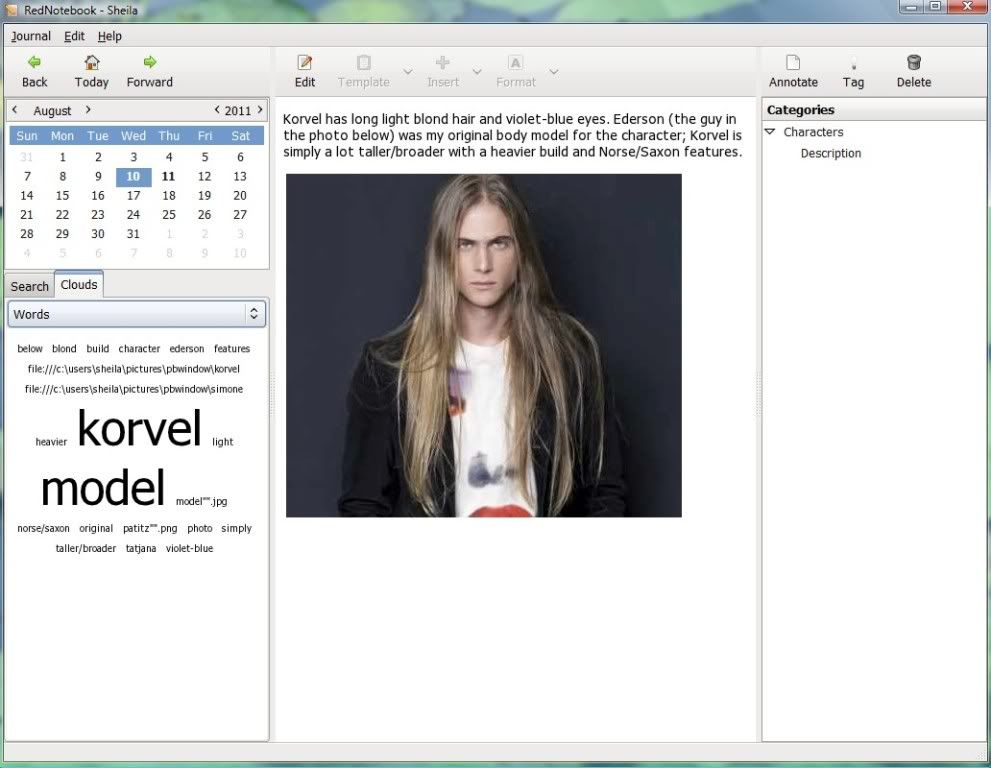
There aren't a huge amount of options; just enough for a working writer or someone who wants to organize their info. On the downside you can't print direct from RedNotebook, but you can easily export to .pdf, text file, html, etc., which is the next best thing. I really like that you can export a range of as much data as you want, anywhere from one day to all the days stored in the program.
Another feature I thought was truly neat was a statistics option, which pops up in a little window to analyze your data. Here's what it looks like:

It not only tells you how many words, lines and letters you've typed on a selected day, it keeps running totals for your entire wordcount, distinct words, the days you've edited, the days between your first and last entry, the average number of words you're writing and what percentage has been edited. If you use RedNotebook for writing or as a mirror depository for your daily work, the statistics make it almost the perfect virtual notebook for monitoring your progress on a project (extremely handy for something like NaNoWriMo.)
This would also be an excellent program to keep as a drafting area and/or a mirror archive for blog content, daily/weekly/monthly to-do lists, reminders and schedules. Another option would be to use it as a daily ledger to track your expenses, especially as at the end of each month you could export your data to a .pdf, print it out and have a printed version to serve as your ledger.
RedNotebook is 100% free and available to download for Windows, Mac OS X and Linux, plus a bunch of other distributions (which you can read about here.) For those of you who are on the go, there's a portable version, too.
Tuesday, August 09, 2011
Books You Read When
 Sorry I'm late posting today. Last night I was baking cookies for band camp and a new recipe for shortbread decided to give me some grief. Fortunately it all worked out, and now the kids will have some homemade snacks to balance out all the store-bought stuff they usually munch on.
I don't often read when I cook (I like not burning dinner) but baking usually requires some significant wait time in between tasks, so I started Barbara O'Neal's How to Bake a Perfect Life. It's a strong, very emotional story interspersed with lots of interesting recipes, and reading it while I was baking created the perfect atmosphere. With the cookies in the oven my kitchen became a warm, cozy perfumery of vanilla and brown sugar and chocolate, and made me feel as if I were in the book, working alongside Ramona, the baker protagonist.
 It also made me realize how often I choose a book to suit what I'm doing. Barbara O'Neal is great to read while working on an extended cooking project, as is Peter Mayle, Poppy Brite or Anthony Bourdain. When I'm sewing I take a break with a quilt book or an art magazine, but I also read historical romance by Mary Balogh or Liz Carlyle, I suppose because sewing and needlework are my strongest personal connection with the past. When I'm cleaning house, for example, I always take a break with an urban fantasy, a strong contemporary or paranormal romance, most often by Patricia Briggs, Larissa Ione or Marjorie Liu. I think while I'm vanquishing dirt, dust and dog hair I feel more in tune with someone doing the same with evil demons (not to be read while cooking however; as I learned the last time Stephanie Tyler made me burn dinner.)
My moods sometimes dictate what I take off the TBR pile to read, too. If I'm happy and things are going well I like to read nonfiction or a how-to because I'm open and more inclined to learn something new. Whenever I get the blues, however, only poetry appeals to me; probably because it's always been my reading security blanket (for comfort, e.e. cummings, Keats or Rilke are most frequently my go-to guys.) I read most any type of fiction to relax at night after a long day at the keyboard, but when I'm particularly frustrated or I've had a bad day I always gravitate toward dark fiction with attitude, like one of Rob Thurman's Cal Leandros novels.
Do you choose what you read based on what you're doing? Do you have any perfect reads for certain situations or moods? Let us know in comments.
Monday, August 08, 2011
Found Ten
Ten Things I've Found in Old Books

1. Love Letter: back in 1978 a new wife gave a handyman book to her husband after they bought their first home, and wrote a funny, beautiful note to him on the inside of the front cover. Thirty years later I bought the same book from a UBS for my guy, and didn't discover the letter until I got home.
2. Seed Packet: This fell out of a newer landscaping book I bought at a flea market. It was never opened so the seeds are still inside. I should plant them somewhere.
 3. Old Photo: in 1917 a lady named Eloise Barto visited the Lackawanna Botanical Gardens in New York and had her picture taken by some flowers. How do I know this? Someone took a photo of her and wrote her name, the date and the location on the back of it, and ninety years later I found the photo tucked into a collection of Spenser's poetry. Btw, Eloise's eyes and expression were what first inspired my character Jessa in Shadowlight.
4. Book Spine: The actual spine cover of a nineteenth century edition of Byron's complete works, found inside the same book (I think the bookseller probably tucked it inside so it wouldn't be lost.)
5. Bookplates: Many of the older books I buy come with bookplates, as that was the custom in the old days, but this one was particularly charming, as it features a Pegasus flying through a starry night sky and the names Henry & Roberta inscribed on it. Found in a 1956 edition of Helen Ashton's The Half-Crown House. One of these days I have to use those names in a story.
6. Hair Pick Directions: Someone used as a bookmark the cardboard insert for a hairpick, which has illustrations on how to use it. I found it in a used copy of Kahlil Gibran's collected works.
7. Silk Ribbon: This cream-colored, completely unmarked ribbon had darkened at the bottom from where it protruded from the old King James Bible where it was left and that I bought about fifty years later from a church rummage sale.
8. A-B Honor Roll Award: A red ribbon from a nearby elementary school left in a romance novel. I always feel bad about having this one, as the mom probably meant to keep it, but there were no clues as to who the book belonged to before I bought it from a UBS.
9. Multi-colored paper ribbon: This looks like a remnant from some gift-wrapping ribbon. I found it literally wound around a section of a pocket thesaurus.
10. Button Bag: a small plastic zip-lock bag with two buttons in it; the kind that is sold attached to a nice blouse as spares. Found tucked in the center of a newer hardcover I bought from a library sale.
1. Love Letter: back in 1978 a new wife gave a handyman book to her husband after they bought their first home, and wrote a funny, beautiful note to him on the inside of the front cover. Thirty years later I bought the same book from a UBS for my guy, and didn't discover the letter until I got home.
2. Seed Packet: This fell out of a newer landscaping book I bought at a flea market. It was never opened so the seeds are still inside. I should plant them somewhere.
3. Old Photo: in 1917 a lady named Eloise Barto visited the Lackawanna Botanical Gardens in New York and had her picture taken by some flowers. How do I know this? Someone took a photo of her and wrote her name, the date and the location on the back of it, and ninety years later I found the photo tucked into a collection of Spenser's poetry. Btw, Eloise's eyes and expression were what first inspired my character Jessa in Shadowlight.
4. Book Spine: The actual spine cover of a nineteenth century edition of Byron's complete works, found inside the same book (I think the bookseller probably tucked it inside so it wouldn't be lost.)
5. Bookplates: Many of the older books I buy come with bookplates, as that was the custom in the old days, but this one was particularly charming, as it features a Pegasus flying through a starry night sky and the names Henry & Roberta inscribed on it. Found in a 1956 edition of Helen Ashton's The Half-Crown House. One of these days I have to use those names in a story.
6. Hair Pick Directions: Someone used as a bookmark the cardboard insert for a hairpick, which has illustrations on how to use it. I found it in a used copy of Kahlil Gibran's collected works.
7. Silk Ribbon: This cream-colored, completely unmarked ribbon had darkened at the bottom from where it protruded from the old King James Bible where it was left and that I bought about fifty years later from a church rummage sale.
8. A-B Honor Roll Award: A red ribbon from a nearby elementary school left in a romance novel. I always feel bad about having this one, as the mom probably meant to keep it, but there were no clues as to who the book belonged to before I bought it from a UBS.
9. Multi-colored paper ribbon: This looks like a remnant from some gift-wrapping ribbon. I found it literally wound around a section of a pocket thesaurus.
10. Button Bag: a small plastic zip-lock bag with two buttons in it; the kind that is sold attached to a nice blouse as spares. Found tucked in the center of a newer hardcover I bought from a library sale.
Sunday, August 07, 2011
Green Journal
 While I admit that I am addicted to art magazines, I never feel guilty buying an issue of Greencraft magazine. All the art projects in it are made from recycled materials -- things like old sweaters, cardboard, junk mail, even dryer sheets -- and the content is never boring or predictable.
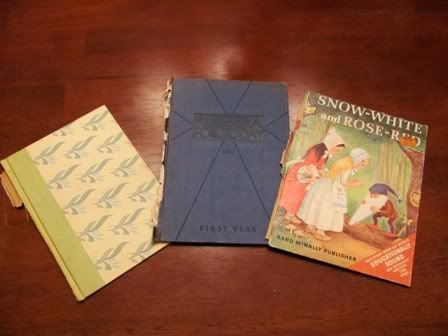
In the Autumn 2011 issue there are a bunch of great ideas (including a way for me to finally recycle all these old beautiful calendars I can't bear to throw away) but the one idea I found most interesting was a notepad made from a hardcover book board, old end papers from other books, and a ribbon. It was so beautifully simple I immediately saw how I could adapt it into a green journal, using book boards for covers and filling it with pages made from the ton of stuff I have in my scrap paper bin.
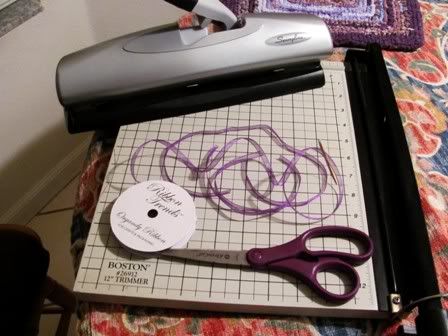
I assembled the tools I needed, and started with some book boards that were left over from another project, and picked two that were the same size. Once I trimmed the ragged edges on the binding side, I punched two holes at the top of each board (I don't have a 2-hole punch, so I tucked the boards in the end of my 3-hole punch, punched one hole in them, and then flipped them over and punched another hole on the opposite side. Worked great.
 For the pages I raided my scrap paper bin, and used a chapter from an old manuscript, watercolor paintings that didn't work out, some odds and ends I'd trimmed from other projects, etc. I mixed them up and trimmed them slightly smaller than the book board covers, but I didn't worry about making them all equal in size because I think that makes the journal pages more interesting. I then stacked them so that all the white or unused sides were facing up, and them punched holes in them the same way I did the covers.
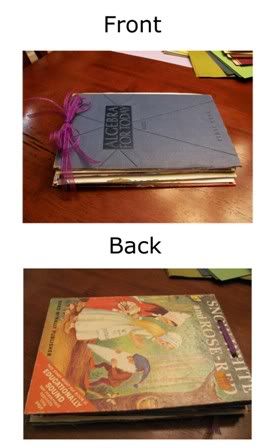
Putting the journal together was simple; I put the pages inside the covers, threaded some narrow organdy ribbon through the holes and tied them all together with a bow. I left it loose so I could turn the pages, but the next time I made one I'll probably use binder rings or some elastic ribbon or cord to have more give in the binding.
By stacking all the white/unused sides in the same direction I gave myself space to write or paint something on the right side of the journal. I plan to put photos or pictures on the left/used sides. I'm not going to alter the book board covers, though, because I think they're charming just the way they are.
 If you don't have any book boards to recycle you can harvest them from any old used books available at flea markets, thrift stores or rummage sales. Some mixed media art suppliers sell them, too. If you're not into making journals, you can adapt this idea to make a green photo album or scrapbook. You don't have to use the same materials for the pages as I did, either; old maps, leftovers from scrapbooking projects, pages from magazines, pamphlets, greeting cards, photographs, envelopes, souvenirs, fabric or anything that appeals to you. This might also be a great project for kids to teach them how to recycle some of their old artwork, school papers, doodles and so on.
Thursday, August 04, 2011
Elsewhere
I have to unplug for a couple of days to get some revisions finished and prepare for some bad weather on the way. So that your trip here was not entirely wasted, here are some links to some cool stuff elsewhere:
Old agent/New author Nathan Bransford has come up with a brilliant solution to every writing problem that has ever existed. Well, except that one when something keeps you from writing.
Author Karen Mahoney is very kindly hosting a giveaway on her blog for two copies of my novel After Midnight. Stop in, leave a comment to let her know what you're reading at the moment, and you'll have a chance to win one. She's also opened the giveaway to everyone on the planet, so anyone can join in.
Author Bill Peschel speculates on why we writers play so nice these days in his article Where Have All the Good Literary Feuds Gone? I know, but I'm not telling.
Author Kris Reisz runs a regular feature on his LJ called Cabinet of Curiosities, and the latest entry about the Codex Gigas, a 165lb. illuminated manuscript from the thirteenth century, is beyond neat.
Weather permitting, I will be back this weekend. See you then.
Old agent/New author Nathan Bransford has come up with a brilliant solution to every writing problem that has ever existed. Well, except that one when something keeps you from writing.
Author Karen Mahoney is very kindly hosting a giveaway on her blog for two copies of my novel After Midnight. Stop in, leave a comment to let her know what you're reading at the moment, and you'll have a chance to win one. She's also opened the giveaway to everyone on the planet, so anyone can join in.
Author Bill Peschel speculates on why we writers play so nice these days in his article Where Have All the Good Literary Feuds Gone? I know, but I'm not telling.
Author Kris Reisz runs a regular feature on his LJ called Cabinet of Curiosities, and the latest entry about the Codex Gigas, a 165lb. illuminated manuscript from the thirteenth century, is beyond neat.
Weather permitting, I will be back this weekend. See you then.
Wednesday, August 03, 2011
Point
What do our writing instruments think of us? Watch and see the point (warning for those of you at work, this video is narrated.)
Point from Victoria Harding on Vimeo.
Tuesday, August 02, 2011
Might Haves
I saw this graffiti today while walking the streets of an old city:

Since it's a quotation from a writer this made me very happy. I also let it percolate in my head all afternoon, and eventually distilled it to this: It's never too late to write what you might have been writing.
It's easy to get discouraged and give up on a story that you think you can't write, or you're convinced you can't sell, or for whatever reason just scares the bejesus out of you. The vision is there, the story is waiting, and suddenly your spine turns into pudding.
I think most of the stories we don't write turn into vague regrets, but a few become ghosts that follow us and haunt us. I try to write mine into short stories whenever I can, just to exorcise the little demons, but there are a couple that won't work as anything but novel-length works. With my schedule I already have to be very selective about what I write; I can't afford to waste my energy on a project that worries me more than it excites me (and even as I write that, I feel like I'm making excuses. If I really wanted to, I could make the time.)
I'd say of all the might-have-written novels in my head, there are four that someday I would like to get over my fear and get them down on the page. Even if the only person who ever reads them is me. I don't know if I'm ready to say I'm planning to write them; maybe they need to haunt me a bit more.
How do you handle your might-have-written stories? Let us know in comments.
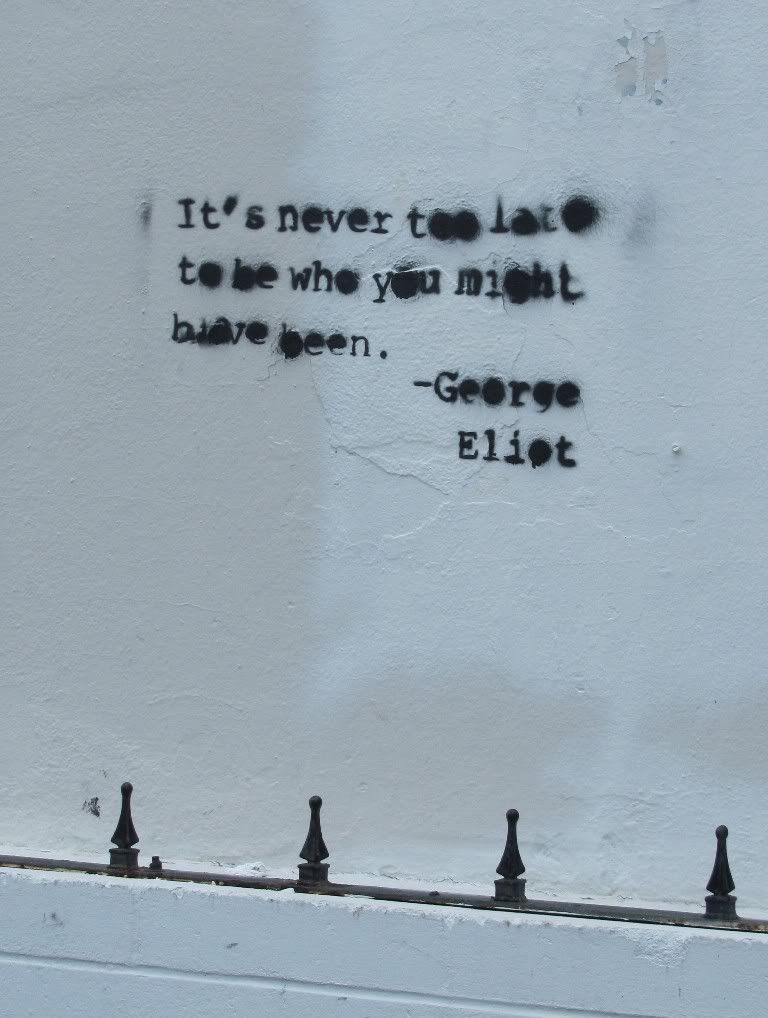
Since it's a quotation from a writer this made me very happy. I also let it percolate in my head all afternoon, and eventually distilled it to this: It's never too late to write what you might have been writing.
It's easy to get discouraged and give up on a story that you think you can't write, or you're convinced you can't sell, or for whatever reason just scares the bejesus out of you. The vision is there, the story is waiting, and suddenly your spine turns into pudding.
I think most of the stories we don't write turn into vague regrets, but a few become ghosts that follow us and haunt us. I try to write mine into short stories whenever I can, just to exorcise the little demons, but there are a couple that won't work as anything but novel-length works. With my schedule I already have to be very selective about what I write; I can't afford to waste my energy on a project that worries me more than it excites me (and even as I write that, I feel like I'm making excuses. If I really wanted to, I could make the time.)
I'd say of all the might-have-written novels in my head, there are four that someday I would like to get over my fear and get them down on the page. Even if the only person who ever reads them is me. I don't know if I'm ready to say I'm planning to write them; maybe they need to haunt me a bit more.
How do you handle your might-have-written stories? Let us know in comments.
Monday, August 01, 2011
Virtual Design Ten
Ten Things to Help Design Settings
3Dream is a room-space design generator that allows you to custom design and arrange a given space. Requires download of plug-in.
Although I was a big fan of Degraeve's Color Palette Generator, it doesn't seem to be functional anymore (at least for my browser/computer.) Hunting around for an alternative, I found another generator here at CSS Drive that offers light, medium and dark as well as full palettes for URL images or those you upload.
The Color Scheme Designer helps you figure out a variety of color schemes, from monochromatic to analogic and more.
Design-a-Room.net is very basic, but of all the generators I found it was the easiest to use and didn't require me to jump through any hoops at all. Good for laying out a rough floor plan.
Armstrong.com has an impressive online design-a-room generator that shows you how different types of floors look like in a variety of room styles and colors.
FloorPlanner.com (registration for free account required to use) gives you the ability to draw up your own floor plans online.
Mydeco's design generators give you a lot of predesigned options to create rooms and mood boards (idea collages.)
Sherwin Williams has a pretty amazing online color visualizer that allows you to upload your photo of a room and virtually repaint it with their products.
Small Blue Printer allows you to build your own floor plans online, view them in 3D, walk through the structure and print out the plans. To help give you ideas, there are four pre-loaded sample plans you can work with, too.
Totally Custom Wallpaper has an online wall covering generator that allows you to create your own wallpaper, mural or canvas using templates, stock images or your own photos.
3Dream is a room-space design generator that allows you to custom design and arrange a given space. Requires download of plug-in.
Although I was a big fan of Degraeve's Color Palette Generator, it doesn't seem to be functional anymore (at least for my browser/computer.) Hunting around for an alternative, I found another generator here at CSS Drive that offers light, medium and dark as well as full palettes for URL images or those you upload.
The Color Scheme Designer helps you figure out a variety of color schemes, from monochromatic to analogic and more.
Design-a-Room.net is very basic, but of all the generators I found it was the easiest to use and didn't require me to jump through any hoops at all. Good for laying out a rough floor plan.
Armstrong.com has an impressive online design-a-room generator that shows you how different types of floors look like in a variety of room styles and colors.
FloorPlanner.com (registration for free account required to use) gives you the ability to draw up your own floor plans online.
Mydeco's design generators give you a lot of predesigned options to create rooms and mood boards (idea collages.)
Sherwin Williams has a pretty amazing online color visualizer that allows you to upload your photo of a room and virtually repaint it with their products.
Small Blue Printer allows you to build your own floor plans online, view them in 3D, walk through the structure and print out the plans. To help give you ideas, there are four pre-loaded sample plans you can work with, too.
Totally Custom Wallpaper has an online wall covering generator that allows you to create your own wallpaper, mural or canvas using templates, stock images or your own photos.
Sunday, July 31, 2011
Journal Evolution
I've been keeping handwritten journals since 1974, and every now and then I like to take out one from an earlier year and compare it to what I'm writing now. Here are the two I was looking at tonight: July 2011 on the left, and July 2008 on the right.

Obviously I was a much neater journal writer back in 2008, but since completing Keri Smith's Wreck This Journal last year I think I've loosened up quite a bit. All my journals used to be absolutely flat and perfect, now they're filled with all sorts of things I never put in my older journals (fabrics, souvenirs, cards, clippings and what have you.) I also recovered the 2011 journal with paper printed to look like rain on a window because while I loved the pages the cover was beyond ugly.
Some things don't change, however. In July 2008 I started an entry by complaining about laundry, and did the exact same thing in 2011. Laundry seems to be my personal demon no matter what year it is.

My personal journals are filled with art. I added a lot more watercolor paintings in my journals in years past; now I tend to put in more of my photography. I still leave some pages blank, which is not me being mysterious -- I just don't backtrack through my journals, and sometimes skip one by accident.

Art populates all my journals, especially when I'm sad or going through a tough time. Here in 2011 I pasted in some fabric scraps from a crazy quilt project on the day I lost my uncle (and that passage is deliberately blurred for privacy); in 2008 I actually ironed one of my paint rags and pasted that in along with some trimmings from my watercolors after a stressful day dealing with the downside of Publishing.

Of the several hundred journals I've filled I've given away only a few to friends, but those were journals I wrote especially for them. I've also destroyed a pile that I felt didn't need to survive me, and I think that's important. If you don't want it published or passed around after you're gone, you should absolutely destroy it now, because no matter what your wishes are, they will probably be disregarded once you've gone on to the next place. If there are only certain passages you want to remove, I advise tearing out and trashing those pages.
After thirty-seven years of journaling I can't imagine not having one. With everything being electronic these days I'm afraid the handwritten journal will soon go the way of the handwritten letter, so I'm more determined than ever to keep up with mine. I don't think mine are especially interesting to anyone but me or possibly my family members, but it's good writing practice and it helps to clear my head and get me prepped to focus on the work.
Do you guys keep handwritten journals? What do you put in yours that you consider unusual? Let us know in comments.
Obviously I was a much neater journal writer back in 2008, but since completing Keri Smith's Wreck This Journal last year I think I've loosened up quite a bit. All my journals used to be absolutely flat and perfect, now they're filled with all sorts of things I never put in my older journals (fabrics, souvenirs, cards, clippings and what have you.) I also recovered the 2011 journal with paper printed to look like rain on a window because while I loved the pages the cover was beyond ugly.
Some things don't change, however. In July 2008 I started an entry by complaining about laundry, and did the exact same thing in 2011. Laundry seems to be my personal demon no matter what year it is.
My personal journals are filled with art. I added a lot more watercolor paintings in my journals in years past; now I tend to put in more of my photography. I still leave some pages blank, which is not me being mysterious -- I just don't backtrack through my journals, and sometimes skip one by accident.
Art populates all my journals, especially when I'm sad or going through a tough time. Here in 2011 I pasted in some fabric scraps from a crazy quilt project on the day I lost my uncle (and that passage is deliberately blurred for privacy); in 2008 I actually ironed one of my paint rags and pasted that in along with some trimmings from my watercolors after a stressful day dealing with the downside of Publishing.
Of the several hundred journals I've filled I've given away only a few to friends, but those were journals I wrote especially for them. I've also destroyed a pile that I felt didn't need to survive me, and I think that's important. If you don't want it published or passed around after you're gone, you should absolutely destroy it now, because no matter what your wishes are, they will probably be disregarded once you've gone on to the next place. If there are only certain passages you want to remove, I advise tearing out and trashing those pages.
After thirty-seven years of journaling I can't imagine not having one. With everything being electronic these days I'm afraid the handwritten journal will soon go the way of the handwritten letter, so I'm more determined than ever to keep up with mine. I don't think mine are especially interesting to anyone but me or possibly my family members, but it's good writing practice and it helps to clear my head and get me prepped to focus on the work.
Do you guys keep handwritten journals? What do you put in yours that you consider unusual? Let us know in comments.
Saturday, July 30, 2011
NaNoWriMo

I put a reminder on my virtual calendar to decide now whether or not I want to join in National Novel Writing Month 2011, which is only three months away. I've got a book being released in November and another due in December, plus all the usual holiday prep to deal with, so unless some miracle or disaster clears my schedule, I'm probably just going to be in the cheering section this year.
Are you guys planning to participate this year? Got any special plans? Let us know in comments.
Friday, July 29, 2011
A Tale of Two Roses
 Hang around me long enough and I will tell you a story about my roses. It's inevitable; I'm a rose addict. I began growing them because I like to have fresh flowers in the house, and roses remind me of what happened on the day I fell in love with my guy. That's why they're my favorite flower -- and why our daughter's middle name is Rose.
Most people don't realize just how long roses have been cultivated. The Chinese were probably the first to add them to their flower beds about five thousand years ago, and they've been bedevilling gardeners ever since. The ancient Romans used them in perfumes and medicines, and showered rose petals on their armies as they paraded through the streets. Many cultures consider the rose a sacred symbol, and have used them to represent everything from love to war.
I read a couple of books last week that reminded me of two of the roses I grow, which prompted me to cut a bloom from each of them while I wrote this post. The image up top there are the two roses just after I cut them and put them in water. You might think at first glance that the showpiece of my garden is my lady rose on the right. She produces white flowers with just the faintest tinge of pink, and they are always perfect, from bud to bloom. Lady's roses have the classic rose scent, and she also has perfect leaves and a nice shape. She responds well to pruning and produces steadily right on schedule, from late spring to early fall. They all look just like this one:

Then there is my cranky old rose bush, who is responsible for the dark pink bloom on the left. Cranky and I have a colorful history. She's pretended to die on me multiple times only to come back to life; I should really call her Zombie Rose. She also blooms whenever she feels like it; one year she gave me roses for three weeks in the middle of winter (that was right after the summer she got the black pox and spread it to every other bush in the garden.) I never know what to expect from her; one day she gives me a dozen blooms that all open at the same time; the next she turns into a brown stick and plays dead.
 For an heirloom rose Cranky is old, ugly and she refuses to be cultivated, pruned or otherwise tamed. Her blooms don't smell like roses at all; they're a bit like baby powder plus cotton candy plus something else. They also look more like carnations than roses, and their crinkly petals will never win any beauty contests. Cranky spits on the word showpiece. I'm pretty sure she hates me, too, and I have the thorn scars to prove it.
I'd have kicked Cranky out of the garden years ago, except for the fact that (when she wants) she produces incredible, complex roses that seem to change color from year to year and last for more than a week after cutting. That and the fragrance of her blooms is like a drug (after one sniff you keep wanting to smell it, which is what gave me the idea for the Darkyn's l'attrait ability.)
I appreciate my lady rose, too, but for all her excellent qualities and endless perfection, she's really not much use to me. I can't cut any of her blooms because they fall apart immediately. Here are the two roses again, 12 hours after I cut them:

Now onto the books I read. Book #1 was by a writer who shall remain nameless (it's no one who visits here or knows me.) This writer is quite attractive, very popular, has won industry awards and is well spoken of by people who think all that stuff is important. These are also the reasons I've never read this writer, but a family member asked me if the writer's books were any good, so I thought I'd better actually read one and test the waters before I offered an opinion. While I was wading through the cloned characters, the knockoff worldbuilding, the pinhead plot, the endless housekeeping dialogue and sex scenes that read like Pilates instructions, I also realized how perfect this writer was. Technically speaking, I couldn't find a single thing wrong with the writing. The novel contained zero grammar mistakes, typos or broken genre rules. The writing also had no voice, no passion, nothing to distinguish it from a hundred others just like it. Reading it was like what I imagine eating library paste tastes like.
I read Book #2 a day after recovering from Book #1, and I was convinced I would hate it, too (#1 really left me in a hateful mood, which is probably why I went to another book I didn't want to read, to get all the suffering over with at once.) #2 was a Christmas gift from a friend across the pond; a literary novel set in a time period I don't especially care for. The main character was, God help me, a writer. There is no character that makes me cringe more that a fiction protagonist who is a writer. The title was waaaaay too long. The characters were poorly named. It wasn't even structured like a novel. But it was a gift from someone I care about, so I had to read it. Started out slow, but by the middle of the story I was on the edge of my seat, reading as fast as I could to find out what was going to happen next. The terribly-named characters stole my heart. So did the story, which wasn't like anything I'd ever read. It was brilliant stuff. I will remember this book forever (and once I get more copies, I'll tell you more and have a giveaway for it.)
When you're writing for publication, you will be pressured to deliver perfection. You'll be handed a lot of rules about what you should or shouldn't write. You'll have agents, editors and even writer friends give you advice on what you have to write to win awards, be more marketable, and appeal to the readers of other, better-selling writers. I don't think there's anything wrong with trying to improve the work, or to train yourself to turn in the cleanest manuscript that you can, but don't be bullied into sacrificing who you are as a storyteller so that you look better. Don't surrender what is unique about you just to be more acceptable. Pretty might look really good, but as my poor lady rose proves, it has no substance, no surprises, and it never lasts.
Thursday, July 28, 2011
Cover Déjà vu
I've seen the preliminary cover art for Nightborn, which is pretty spectacular, and as soon as I get the green light from my editor I'll be showing it off to you guys. There was something about it that was driving me a little bonkers, though -- one of the background elements, a fountain, looked really familiar. As in a serious déjà vu , I'd-photographed-it-myself moment. But where?
I started going through my old photo files and pulling everything I'd labeled with fountain:

Wasn't this behemoth.

Or this one, which I dubbed Le Crane Upchucks.

This Honey, Call the Plumber fountain wasn't it, either.

I never realized I had such a fetish for fountains.

Kind of weird fountains, too.

Possibly radioactive fountains.

Have you ever noticed how many fountains are built around the concept of the regurgitating critter?

Or critters who are relieving themselves in, um, other ways?

Anyway. After going through several dozen more image files, I started becoming annoyed with myself. Everything is not a message from the universe, and my memory is certainly not the steel trap it used to be when I was younger. I told myself I was just imagining things.
Only I couldn't leave it alone, so I looked at the artwork again, this time with a magnifying glass. I then saw two tiny details that escaped me on first glance: something behind the fountain that hadn't been altogether photoshopped out, and something in the middle of it. And then I knew exactly what it was, and where it was, and nearly fell on the floor.
Why I didn't recognize it immediately is anyone's guess, but I think it's one of those knee-jerk, "No, it couldn't be that" assumptions we make when we have a déjà vu moment. I've actually seen the fountain from my cover art in person a couple dozen times. It happens to be one of my favorite spots in the world. The last time I visited it, I didn't just photograph the fountain, I sat next to it for about an hour and wrote about it in my research journal, which ended up becoming part of a novel I wrote six books back.
Here's the last photograph I took of it in 2008:

I know it's probably just a coincidence, and it's silly to get happy about such things, but I'm still taking it as a good omen.
I started going through my old photo files and pulling everything I'd labeled with fountain:
Wasn't this behemoth.
Or this one, which I dubbed Le Crane Upchucks.
This Honey, Call the Plumber fountain wasn't it, either.
I never realized I had such a fetish for fountains.
Kind of weird fountains, too.
Possibly radioactive fountains.
Have you ever noticed how many fountains are built around the concept of the regurgitating critter?
Or critters who are relieving themselves in, um, other ways?
Anyway. After going through several dozen more image files, I started becoming annoyed with myself. Everything is not a message from the universe, and my memory is certainly not the steel trap it used to be when I was younger. I told myself I was just imagining things.
Only I couldn't leave it alone, so I looked at the artwork again, this time with a magnifying glass. I then saw two tiny details that escaped me on first glance: something behind the fountain that hadn't been altogether photoshopped out, and something in the middle of it. And then I knew exactly what it was, and where it was, and nearly fell on the floor.
Why I didn't recognize it immediately is anyone's guess, but I think it's one of those knee-jerk, "No, it couldn't be that" assumptions we make when we have a déjà vu moment. I've actually seen the fountain from my cover art in person a couple dozen times. It happens to be one of my favorite spots in the world. The last time I visited it, I didn't just photograph the fountain, I sat next to it for about an hour and wrote about it in my research journal, which ended up becoming part of a novel I wrote six books back.
Here's the last photograph I took of it in 2008:
I know it's probably just a coincidence, and it's silly to get happy about such things, but I'm still taking it as a good omen.
Wednesday, July 27, 2011
Widget Quest
Now that I've tried reinventing the bookmark, my second creative challenge is to come up with three widgets to use with promo for my upcoming Lords of the Darkyn trilogy. The immediate problems: I'm not a widget lover; I think 99% of all widgets are a waste of time and materials. I want something unique and different that is my idea, which rules out all the mass-produced advertising-type junk (thank heavens.) And I want to make it myself, which limits the range of possibilities to what I can reasonably produce without making a complete hash of it.
I've been keeping my eye out for inspiration and hoping the universe would conk me on the head with something fabulous. Which it did last night when I made a stop at World Market for some international treats. I always check their bargain bins for interesting sale items, where this time I found a set of three notes made into scrolls:


It was a real eureka moment. Scrolls are what books were before there were books, and as it happens Nightborn, the first novel in the new Darkyn trilogy, features a scroll as an important part of the story. Perfect idea for a widget! I even knew what I could do with different materials to make it low-cost, give it my own personal spin, and end up with something that has a good chance of not landing in the trash bin.
 Next problem: I've never actually made a scroll, so I needed to do some research. I promptly went over to BAM to hunt for some how-to guidance, and in the process found Alisa Golden's Making Handmade Books. This is practically an encyclopedia of book making, and features a wide variety of beautiful and unusual bindings and forms. Ms. Golden offers fully illustrated, step-by-step instructions paired with beautiful finished examples of the different styles, so you can see what the end result should look like. Btw, if you're an art journalist, book maker or someone who for whatever reason fashions and binds your own books, this should absolutely be in your library.
Lucky for me it also included how to make a scroll book, the instructions for which I can adapt to use for my widget project. Reading through it also gave me a great idea on how I can secure the scroll in an interesting way and still assure that every component of the widget can actually be used for practical purposes. I love art, but I love not wasting or throwing away things even more. Now I just have to experiment with the design and put together some prototypes to test out the vision and see if I can make it work in reality.
I've been keeping my eye out for inspiration and hoping the universe would conk me on the head with something fabulous. Which it did last night when I made a stop at World Market for some international treats. I always check their bargain bins for interesting sale items, where this time I found a set of three notes made into scrolls:
It was a real eureka moment. Scrolls are what books were before there were books, and as it happens Nightborn, the first novel in the new Darkyn trilogy, features a scroll as an important part of the story. Perfect idea for a widget! I even knew what I could do with different materials to make it low-cost, give it my own personal spin, and end up with something that has a good chance of not landing in the trash bin.
Next problem: I've never actually made a scroll, so I needed to do some research. I promptly went over to BAM to hunt for some how-to guidance, and in the process found Alisa Golden's Making Handmade Books. This is practically an encyclopedia of book making, and features a wide variety of beautiful and unusual bindings and forms. Ms. Golden offers fully illustrated, step-by-step instructions paired with beautiful finished examples of the different styles, so you can see what the end result should look like. Btw, if you're an art journalist, book maker or someone who for whatever reason fashions and binds your own books, this should absolutely be in your library.Lucky for me it also included how to make a scroll book, the instructions for which I can adapt to use for my widget project. Reading through it also gave me a great idea on how I can secure the scroll in an interesting way and still assure that every component of the widget can actually be used for practical purposes. I love art, but I love not wasting or throwing away things even more. Now I just have to experiment with the design and put together some prototypes to test out the vision and see if I can make it work in reality.
Tuesday, July 26, 2011
Test Your Vocab
Ever wonder what size English vocabulary you have? Here's a test you can take online to give you an estimate.
I took the test and gave honest responses (it's honor system based, so you can lie and say you know the tough words and probably make yourself look better.) I thought I'd absolutely bomb, especially when I hit the final column, but my results surprised me:

Test link nicked from Gerard over at The Presurfer.
I took the test and gave honest responses (it's honor system based, so you can lie and say you know the tough words and probably make yourself look better.) I thought I'd absolutely bomb, especially when I hit the final column, but my results surprised me:
Test link nicked from Gerard over at The Presurfer.
Monday, July 25, 2011
Freeware Ten
Ten Things You Can Have for Free
Freeware caution: always scan free downloads of anything for bugs and other threats before dumping the programs into your hard drive.
Book Tracker is "an organizer program for the book collector or manager of a small library. Book Tracker was designed to be simple to use, yet feature rich. Many of the features can be implemented with a single click or hot key and most of the information is presented on the main screen. Book Tracker Collector's Edition is a freeware program designed to be used by anyone needing to organize their books including avid readers, book collectors, law librarians, small school librarians, corporation librarians and more" (OS: Not specified but it looks like Windows)
Fusion "allows merging several images of the same scene in one. You can merge photos taken with the same exposure or images taken with different exposures. When blending together images taken with different exposure, the program creates an image with high dynamic range of brightness (HDR). Subsequent tone mapping to low range (LDR) uses nonlinear algorithms and allows preserving maximum details of the original images" (OS: Windows XP/Vista/7)
ManicTime is "a time tracking software which automatically collects data on your computer usage. It records active and away time, as well as which applications you used and for how long you used them. The data ManicTime collects is stored in a local database on your computer. Once data is collected you can use our simple click and drag feature to accurately tag how you spent your time. Time tagging allows you to see how you spent your time based on your own time tags and gives you accurate information on how efficient you really are" (OS: Windows XP/2003/Vista/7)
NoteFly is "a very small, colorful note taking application. Features: very small application (Less than 200kb setup) if .net framework 2.0/Mono is installed; several skins for notes to select; make sticky notes on top or roll them up to save screen space; a lot of settings to customize NoteFly to your needs; fully xml based (does not need windows registry, except for running on logon) (OS: Win 2000/XP/Vista/7 + Microsoft .NET Framework 2.0.)
NoteLiner "helps you structure and track your work; it provides a place to record meeting and conversation notes, manage todos, and store key project information that might otherwise be scattered about. It is a simple tool that will not slow you down, but will give you a means to stay on top of what you need to do and remember" (OS: Windows XP/2003/Vista/2008/7)
Piggydb is "an open source Web notebook application that provides you with a platform to build your knowledge personally or collaboratively" (OS: Windows/Mac OS X/etc with Java)
Qumana is "an easy-to-use desktop blog editor, enabling you to write, edit and post to one or more blogs. You can use Qumana even when you are offline. Save your blog posts to your hard drive and upload whenever you like. Great for bloggers on the move. Qumana features include easy text formatting and image insertion, simple Technorati tagging, and advertising insertion with Q Ads" (OS: Mac OS X)
Skim is a speedy pdf reader that Mac lovers say is better than Preview. It comes with a few powerful built-in editing tools such as adding an arrow/circle, or striking out unwanted text. With Skim, you can quickly sort through and edit your PDFs in a pinch (OS: Mac OS X)
Speak-a-Message "replaces written text with your voice: Just record and send. Speak-A-Message provides a rich communication experience that enables you to create and email your own audio messages and to listen to audio messages in your inbox. Speak-A-Message is free for private use. Speak-A-Message can also be used to add audio comments to text documents or to add your voice comments to presentations" (OS: Windows Vista/7)
VueMinder Lite is a "calendar and reminder program for Windows. It supports multiple calendars displayed simultaneously in layers. These can be viewed and printed by day, week, or month. They can also be visually distinguished using unlimited combinations of fonts, background colors, and gradient styles. It also integrates a semitransparent calendar into your Windows desktop, so you´ll always be able to see your upcoming events" (OS: Windows 2000/XP/Vista/7)
Freeware caution: always scan free downloads of anything for bugs and other threats before dumping the programs into your hard drive.
Book Tracker is "an organizer program for the book collector or manager of a small library. Book Tracker was designed to be simple to use, yet feature rich. Many of the features can be implemented with a single click or hot key and most of the information is presented on the main screen. Book Tracker Collector's Edition is a freeware program designed to be used by anyone needing to organize their books including avid readers, book collectors, law librarians, small school librarians, corporation librarians and more" (OS: Not specified but it looks like Windows)
Fusion "allows merging several images of the same scene in one. You can merge photos taken with the same exposure or images taken with different exposures. When blending together images taken with different exposure, the program creates an image with high dynamic range of brightness (HDR). Subsequent tone mapping to low range (LDR) uses nonlinear algorithms and allows preserving maximum details of the original images" (OS: Windows XP/Vista/7)
ManicTime is "a time tracking software which automatically collects data on your computer usage. It records active and away time, as well as which applications you used and for how long you used them. The data ManicTime collects is stored in a local database on your computer. Once data is collected you can use our simple click and drag feature to accurately tag how you spent your time. Time tagging allows you to see how you spent your time based on your own time tags and gives you accurate information on how efficient you really are" (OS: Windows XP/2003/Vista/7)
NoteFly is "a very small, colorful note taking application. Features: very small application (Less than 200kb setup) if .net framework 2.0/Mono is installed; several skins for notes to select; make sticky notes on top or roll them up to save screen space; a lot of settings to customize NoteFly to your needs; fully xml based (does not need windows registry, except for running on logon) (OS: Win 2000/XP/Vista/7 + Microsoft .NET Framework 2.0.)
NoteLiner "helps you structure and track your work; it provides a place to record meeting and conversation notes, manage todos, and store key project information that might otherwise be scattered about. It is a simple tool that will not slow you down, but will give you a means to stay on top of what you need to do and remember" (OS: Windows XP/2003/Vista/2008/7)
Piggydb is "an open source Web notebook application that provides you with a platform to build your knowledge personally or collaboratively" (OS: Windows/Mac OS X/etc with Java)
Qumana is "an easy-to-use desktop blog editor, enabling you to write, edit and post to one or more blogs. You can use Qumana even when you are offline. Save your blog posts to your hard drive and upload whenever you like. Great for bloggers on the move. Qumana features include easy text formatting and image insertion, simple Technorati tagging, and advertising insertion with Q Ads" (OS: Mac OS X)
Skim is a speedy pdf reader that Mac lovers say is better than Preview. It comes with a few powerful built-in editing tools such as adding an arrow/circle, or striking out unwanted text. With Skim, you can quickly sort through and edit your PDFs in a pinch (OS: Mac OS X)
Speak-a-Message "replaces written text with your voice: Just record and send. Speak-A-Message provides a rich communication experience that enables you to create and email your own audio messages and to listen to audio messages in your inbox. Speak-A-Message is free for private use. Speak-A-Message can also be used to add audio comments to text documents or to add your voice comments to presentations" (OS: Windows Vista/7)
VueMinder Lite is a "calendar and reminder program for Windows. It supports multiple calendars displayed simultaneously in layers. These can be viewed and printed by day, week, or month. They can also be visually distinguished using unlimited combinations of fonts, background colors, and gradient styles. It also integrates a semitransparent calendar into your Windows desktop, so you´ll always be able to see your upcoming events" (OS: Windows 2000/XP/Vista/7)
Sunday, July 24, 2011
Fake Agent E-mail Scam
I just read about this today over at YAHighway, and since this is a horrific scam I thought I'd post the info as well as my comment here, too.
From Publishers Lunch:
Writers House has learned that a series of fake emails claiming to be from WH agent Jodi Reamer have been circulating to self-published authors this week. "These emails, which contain a number of false statements, have not in fact come from Jodi Reamer and should thus be disregarded." One easy "tell": they advise that any e-mail from a non-Writers House address "expressing interest in representation is counterfeit."
I've been a client of Writers House for twelve years. When I queried WH back in 1998, I had a personal rec from a Big Name Author and a two-book contract offer from a major publisher in hand. My agent (Robin Rue) did not sign me instantly; she asked to see the full manuscripts plus other samples of my work, and then she called me to talk about my career goals. Then she had to think about it. The whole thing took about three weeks.
While some agencies or agents do move faster, and occasionally a promising writer will end up having agents fighting over them, when it comes to signing with a prestigious agency it generally does require some time.
From Publishers Lunch:
Writers House has learned that a series of fake emails claiming to be from WH agent Jodi Reamer have been circulating to self-published authors this week. "These emails, which contain a number of false statements, have not in fact come from Jodi Reamer and should thus be disregarded." One easy "tell": they advise that any e-mail from a non-Writers House address "expressing interest in representation is counterfeit."
I've been a client of Writers House for twelve years. When I queried WH back in 1998, I had a personal rec from a Big Name Author and a two-book contract offer from a major publisher in hand. My agent (Robin Rue) did not sign me instantly; she asked to see the full manuscripts plus other samples of my work, and then she called me to talk about my career goals. Then she had to think about it. The whole thing took about three weeks.
While some agencies or agents do move faster, and occasionally a promising writer will end up having agents fighting over them, when it comes to signing with a prestigious agency it generally does require some time.
Subscribe to:
Posts (Atom)