"Can't find a pulse again?" I asked her (my BP regularly runs very low, and I have a heart murmur, so I routinely scare the daylights out of people using stethoscopes.)
"Actually it's a little on the high side. For you, anyway." She pumped up the sleeve again. "Any reason you might be feeling some stress?"
I thought for a moment. "My new novel is being released today, and everyone is already saying great things about it, something that in Publishing never goes unpunished. Last night one of my editors asked me to synopsize two hundred years of a character's backstory from a book I'm not actually writing until 2012. I have to electronically correct a set of proofs for another book before my mother visits next week, but I don't think that editor is going to send them until Friday afternoon. And right before I came here, my agent e-mailed to tell me the editor I've worked with longer than any other in my career is quitting the business, possibly before she finishes editing my current novel, and I have to decide on a new editor. So now I have to pick who I want to work with on the bestselling books of my career until 2013 in the next twenty minutes before I call the agent back."
"Uh-huh." The nurse stopped taking my blood pressure. "When does Mama arrive, and how much house cleaning have you done?"
"Next Wednesday. We just renovated one of the bathrooms." I hung my head. "The rest of the house looks like the North Pole after an Elf Kegger."
"Poor thing." She patted my shoulder. "I'll have the doc write a scrip for some more chocolate-covered Valium."
So as I've already admitted to the cosmos, change is good. For 2011 I fully intend to be a good sport and willingly embrace it. However, it would be helpful -- and a little less stressful -- if all the changes the universe is going to throw at me didn't have to happen in the first week.
If you stay in the business long enough, you will probably have to change editors. Just like any other biz pro, editors are routinely promoted, laid off, or shuffled to another imprint or division. Older editors eventually retire; younger editors often get pink-slipped or jump ship to take a better job at another house. Occasionally some leave Publishing behind entirely; one of my editors quit the biz to go to law school.
Losing an editor can be extremely stressful for a writer, especially if you've worked together for a long time. After a few years you both know each other well and have settled into a workable routine. Even if you didn't particularly like your old editor, s/he is the devil you know; the replacement is the one you don't.
If you're given the opportunity to choose your next editor, and you haven't been collecting info about other editors at your publisher (most of us veterans do that in anticipation of editor changes), you should (discreetly) check out the candidates first versus blindly choosing one or relying on an agent or senior editor's recommendation (remember, they don't have to work with the new editor, you do.) You can go info-gathering on the internet (editors talk a bit about their professional experience in interviews, and they also sometimes list other publishers they've worked for in bios), contact other authors who have worked with them, and ask your agent what s/he knows about them.
Everyone has different expectations and desires, so you have to tailor your investigation to suit your needs. I always look at experience first (as in, where have they worked, how long have they been in the biz, and how many houses have they worked for. Also if possible I like to know how often they've changed jobs; I prefer to work with editors who don't jump ship a lot.), I also consider what's on the editor's plate: which authors are they editing, which genres are they handling and how many titles they're putting out a year. The more info I gather, the better guess I can make as to whether or not we'll be a good match.
When you have to change editors, your new editor is generally aware of how stressful the situation is for you, and will try to fill the
Some writers say you should always meet an editor in person before you agree to work with them, but I don't agree. At times it can even be counterproductive. The last editor I met in person back in 2003 was so young she had barely gotten through puberty -- she sounded a lot older on the phone -- and was so "on" for the conference we were at that I couldn't get a genuine handle on who she was as a person (something that later resulted in a major clash during production that I might have avoided if I hadn't met her and assumed she was -- as she behaved at the conference -- all sunshine and happiness.)
One more thing about asking around the writing community: a writer who doesn't know you is probably only going to say good things about their editor. 99% of the time this is because the writer doesn't know you well enough to depend on your discretion to keep the truth confidential. 1% of the time it's because the writer thinks their editor sent you to find out what they're saying about them. It really depends on how neurotic and paranoid the writer is.
Tomorrow I should hear whether or not if I can be moved to the editor I want to work with; tonight I'm going to think about a few alternatives if I can't. While I put together a 2012 novel notebook for the notes from the 200 year character backstory synopsis. And clean the guest bedroom -- twice. And see how chocolate-covered valium taste crushed and sprinkled on top of a big honking banana split . . .



 Last year
 The first project of 2011 my guy and I had planned is to renovate one of our bathrooms, and that morning we went to local home improvement store to pick up some things we needed. On the way to the check-out we passed a magazine rack with all the usual how-to gardening, painting and other home stuff, when I spotted the Dec/Jan issue of Fine Cooking. Generally I don't see many cooking mags in home improvement stores, so that struck me as odd. So did the gorgeous towering dessert featured on the cover, which was one I'd never tried to make (and mentioned that here on the blog.) The message couldn't have been plainer if they'd printed it on the cover: #2 -- Don't be afraid to try things you think you can't do.

 Sorry I'm late posting; due to some connection problems we're currently on dial-up only, and will likely remain that way until my guy figures it out, or the cable company sends someone to check out our equipment (at this point, looks like Saturday.)
 Toward the end of December I always catch myself thinking about what sort of year I've had. There are landmarks like my blog and my work backups that chronicle my writing journey, which is ever an interesting one. Often I count the number of personal art and writing journals I fill up in twelve months to measure how often I needed to retreat and work things out in private; I used twenty-three for 2010 (about average; a bad year can result in forty or more.)
 I admit, I'm a calendar junkie. Every year I go out and buy a year's supply (I wait until after January 1st so I can get them at a discount) for the entire family. They are not as vigilant as I am about keeping them updated -- the slackers -- but it satisfies my ever-constant need for organization. If you're going to the brick and mortars, BAM and B&N always seem to have a nice selection, and Borders usually offers theirs with excellent discounts after January 1st.
 The whole thing took about thirty minutes, and the resulting calendar came out great,
 The simple but wonderful


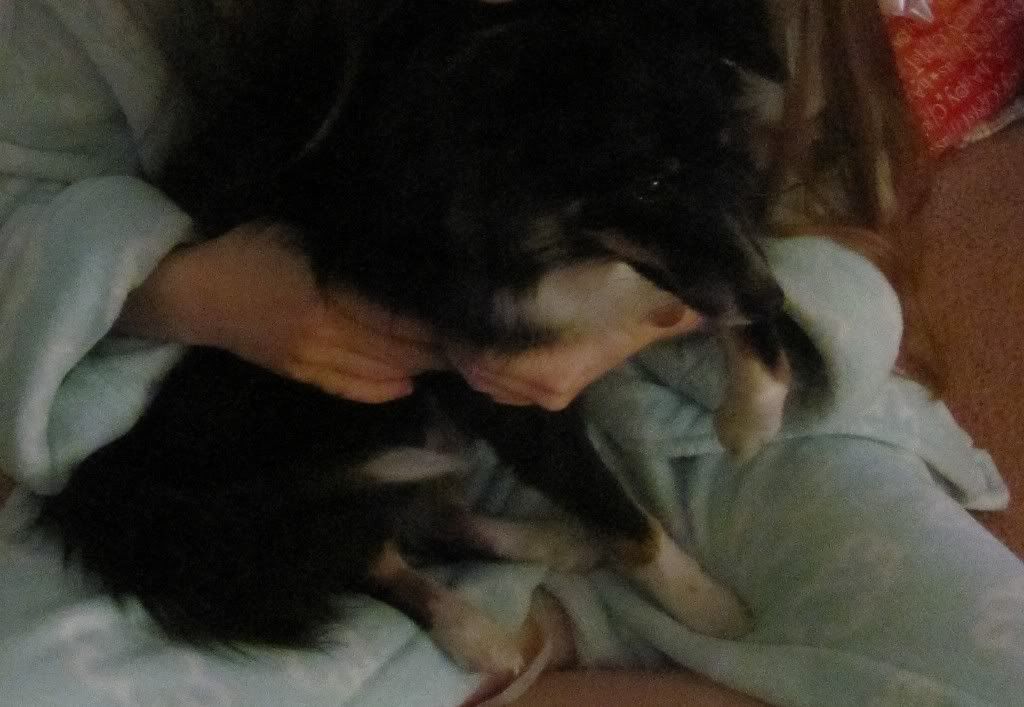 I hope everyone is keeping warm and enjoying their holidays. Our college kid made it home Christmas Eve night, which was all my guy and I wanted from Santa. The next day was quiet but relaxing, with the weather keeping us all inside to hang out with the kids, play with the dogs and take naps on the couch. We expect to do the same today, so it's been pretty much the perfect Christmas at Casa PBW.
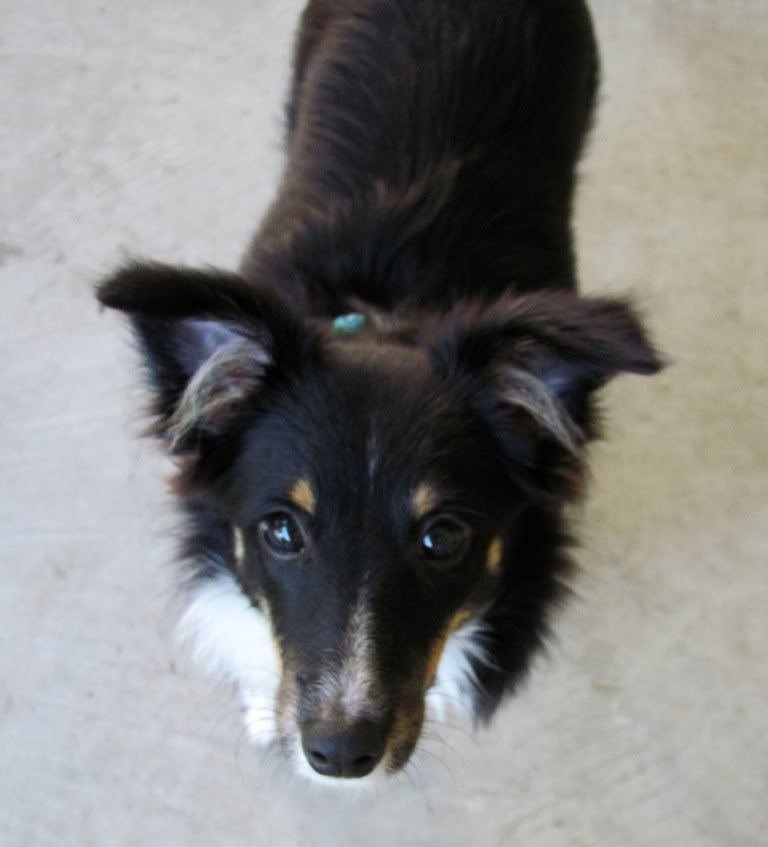
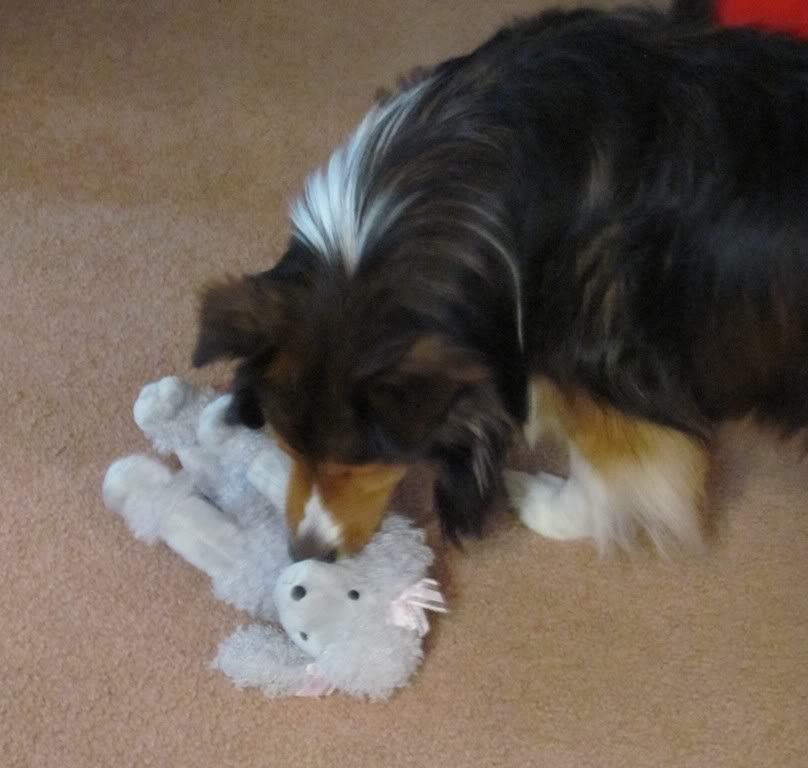 We finally found something our fearless and feisty new pup is afraid of: wearing jingle bells. Because I'm becoming that classic old lady who dresses her pets, I got a little velvet collar with tiny bells to put around the puppy's neck (Cole got a more manly John Deere neck scarf.) Skye skittered around, tail between her legs, until finally she crawled onto my daughter's lap and refused to budge. So now I have a very nice velvet and bells ornament for the tree.
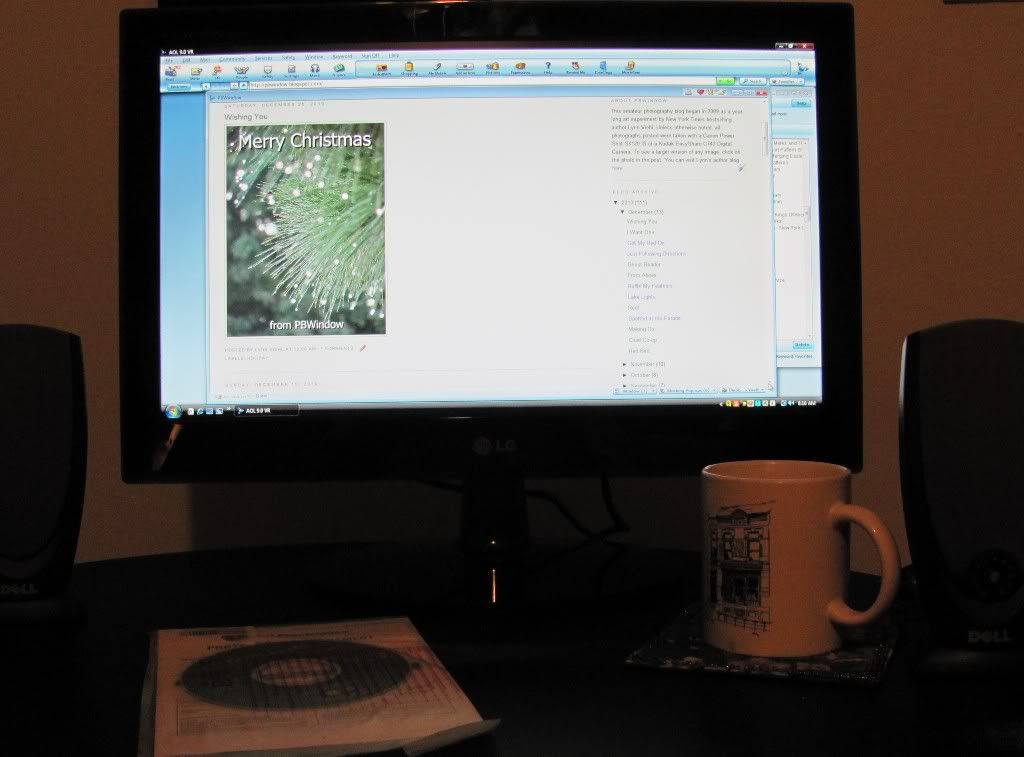 What I didn't expect to find in my stocking was a shiny new 20" monitor for my work computer, which will allow me to see everything on the screen without scrolling back and forth (and replaces the monitor I've been using for the last six years, which was six inches smaller.) This will also be invaluable now that I have to do all my copy-edits electronically, as I can see the page and the editor's comments at the same time without reducing the size of the page. My guy also gave me a beautiful new steel filing cabinet, which sounds dull but for me is the same as getting a diamond bracelet is for other women.

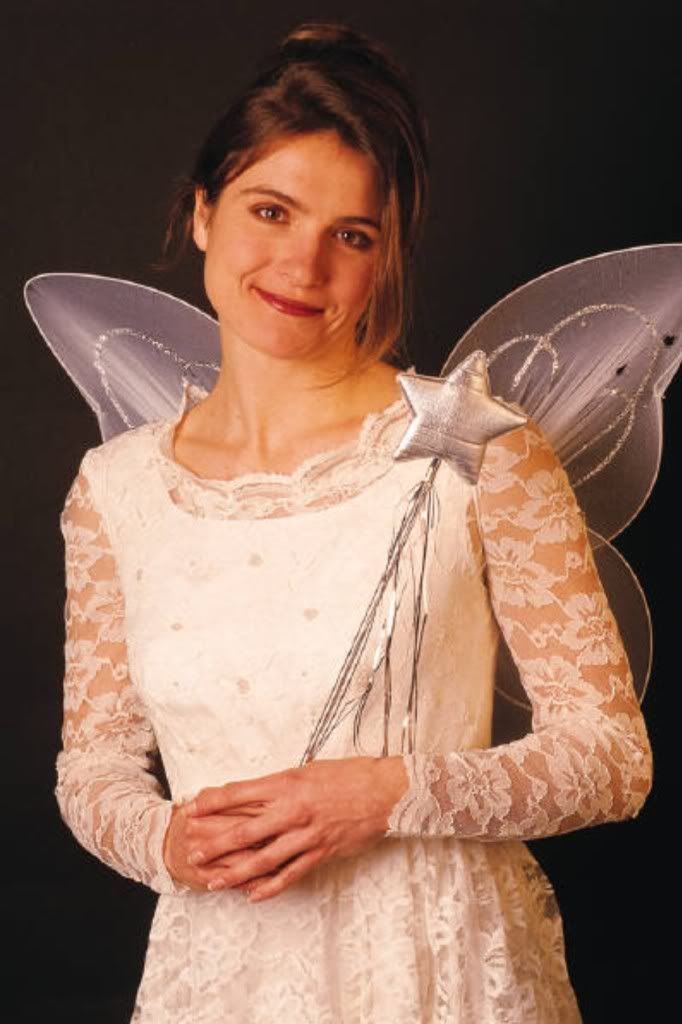 The Publishing Fairy and I had a long talk last night, during which I presented her with my wish list.

 Yesterday I made candy for the first time: honeycomb toffee brittle. My mother makes candy (her fudge is to die for), and so do all the other women in my family; I've never tried. This is because I am occasionally clumsy in the kitchen, and in the past the thought of handling substances that are liquid and not far from the melting temperature of tin has always discouraged me. Besides, I can buy candy any time.
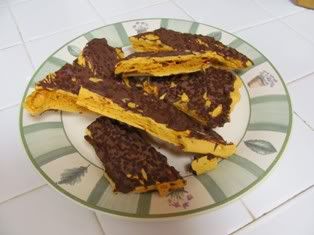 A half-hour later, when the candy was cool enough, I broke it into pieces and passed it around. My daughter didn't care much for it; her best friend thought it was amazing. As for me, well, it melted in my mouth, and was so rich and carmel-chocolatey that it made me shiver. It also stuck to my teeth, and had a trace of baking soda taste to it, and from the dense texture I think I stirred it too much that last time. I also know I've never enjoyed a piece of candy so much in my life.
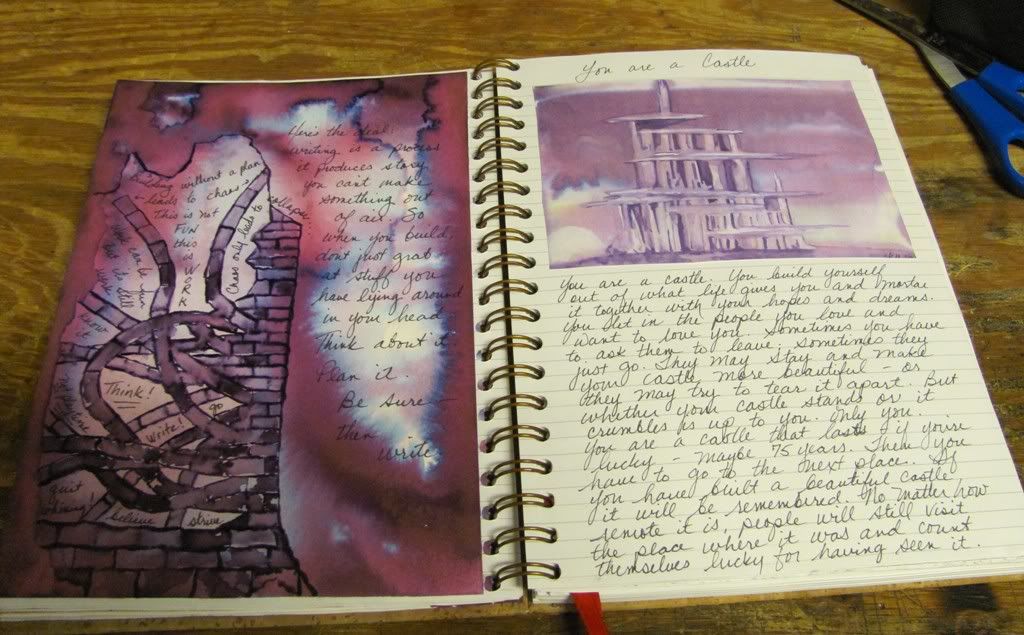 To give you some perspective, here is a typical entry in one of my own journals. I write about my family, friends, books, music, art, world events, my job, and all the ordinary (and probably boring to anyone else) things that go to make up a life. After getting into art journaling a few years back, I also
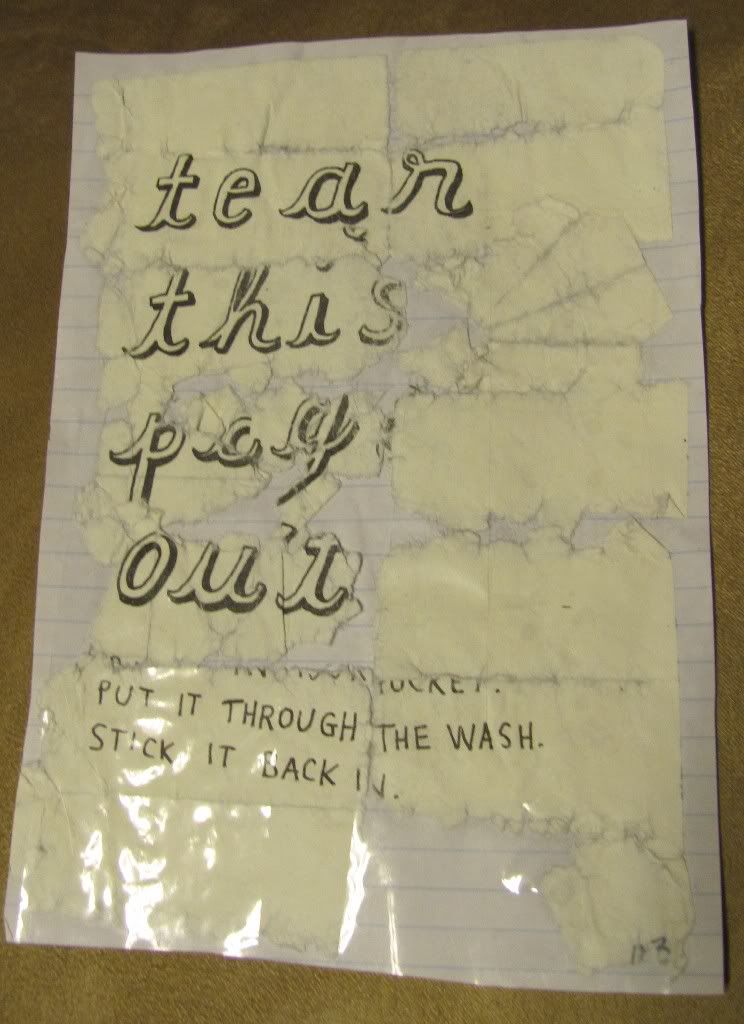
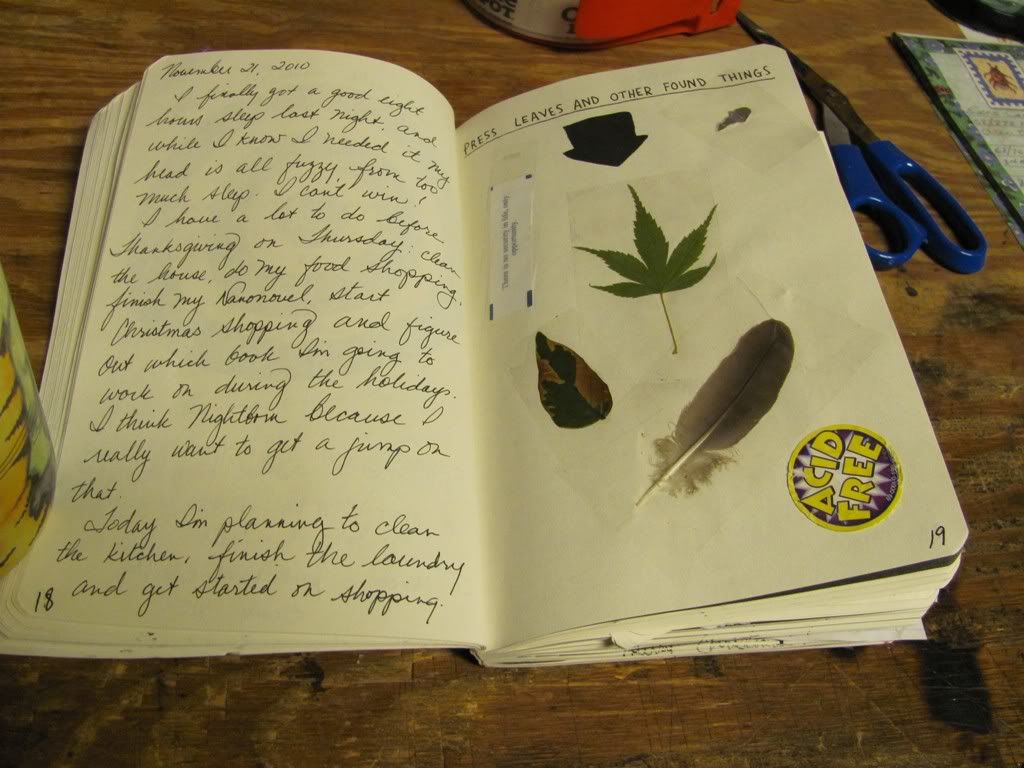 Every other page in Wreck This Journal listed instructions of what to do on that page or to the page, i.e. "drip something here (ink, paint, tea) close the book to make a print" and "tear this page out, put it in your pocket, put it through the wash, stick it back in." I dutifully followed the instructions, going so far as to spend a half hour reconstructing the page my washing machine turned into mush.
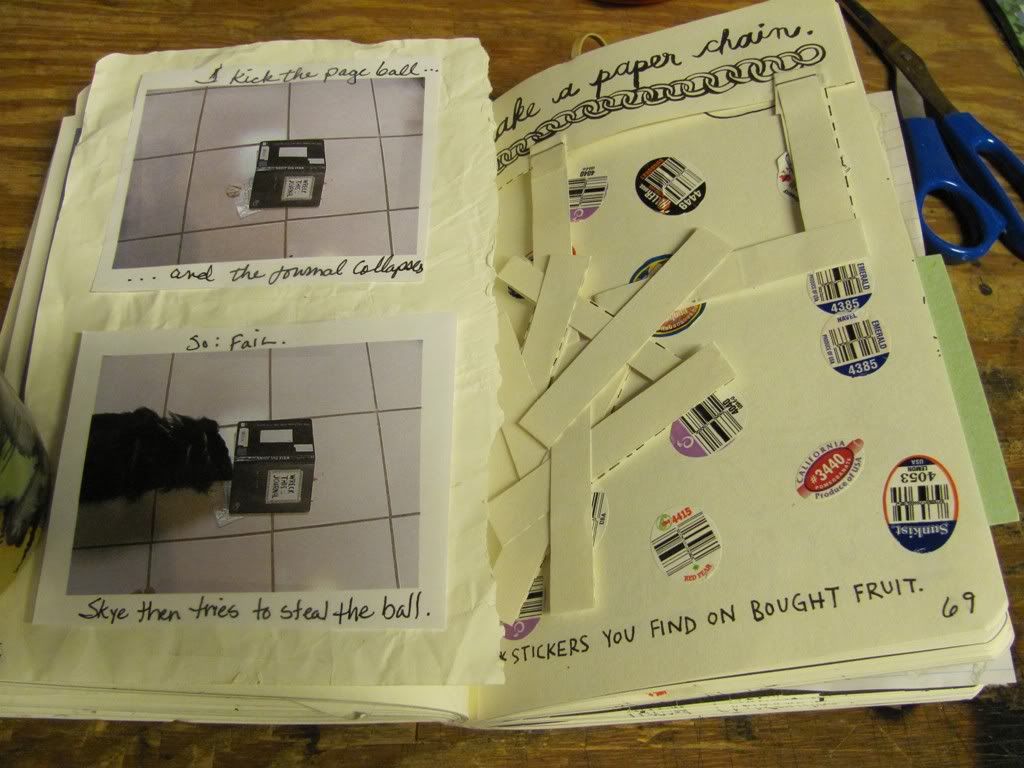
 I did things I've never done with journals, though, lots of them. I sewed a page, picked up the journal with my feet, played golf with a page, slept with the journal under my pillow (now there's something I didn't do even when I was a teenager) and covered two pages with office supplies. I also added bird feathers I found in the yard (safely and sanitarily encased & sealed under clear packing tape) and made a drawing using my own hair.
 Toward the end of finishing the journal my aversions made a light bulb go off. I've always believed that I write my private journals for myself, but maybe subconsciously I want them to be read by someone else someday. After thirty-six years of keeping a daily journal, you'd think I'd have realized that, but honestly I hadn't.
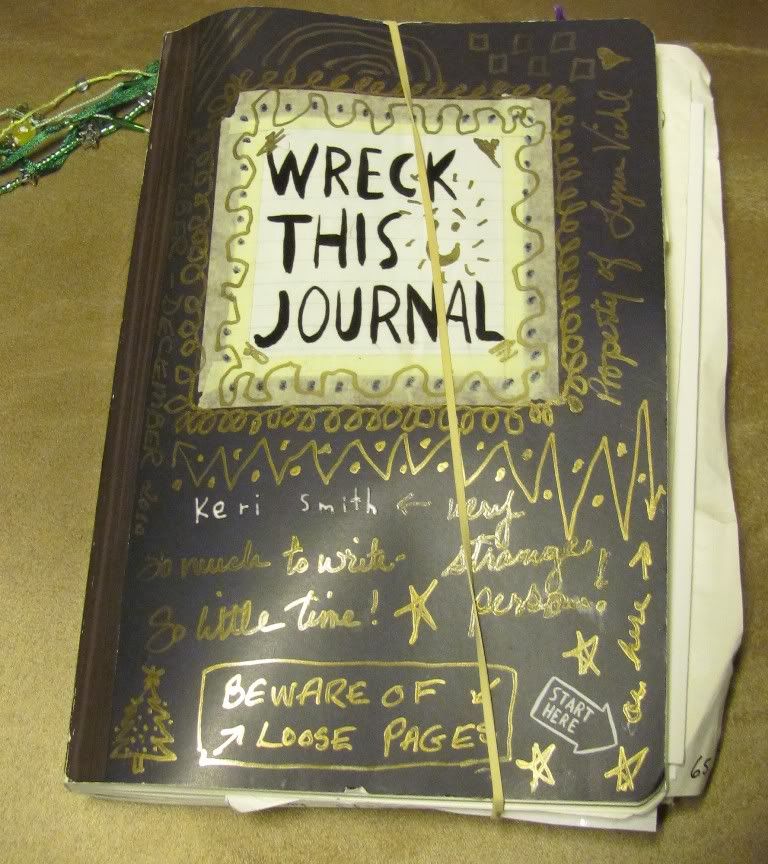 Guided journals often prompt us to vent our worries and explore our imaginations, but Keri Smith invites us to rethink our attitudes toward the journal itself. Through her zany instructions she reminds us that a journal can be more than a thought depository or a sketch book; it can become a golf ball, a pull-toy, a bulls-eye, and just about anything else we want to play with.
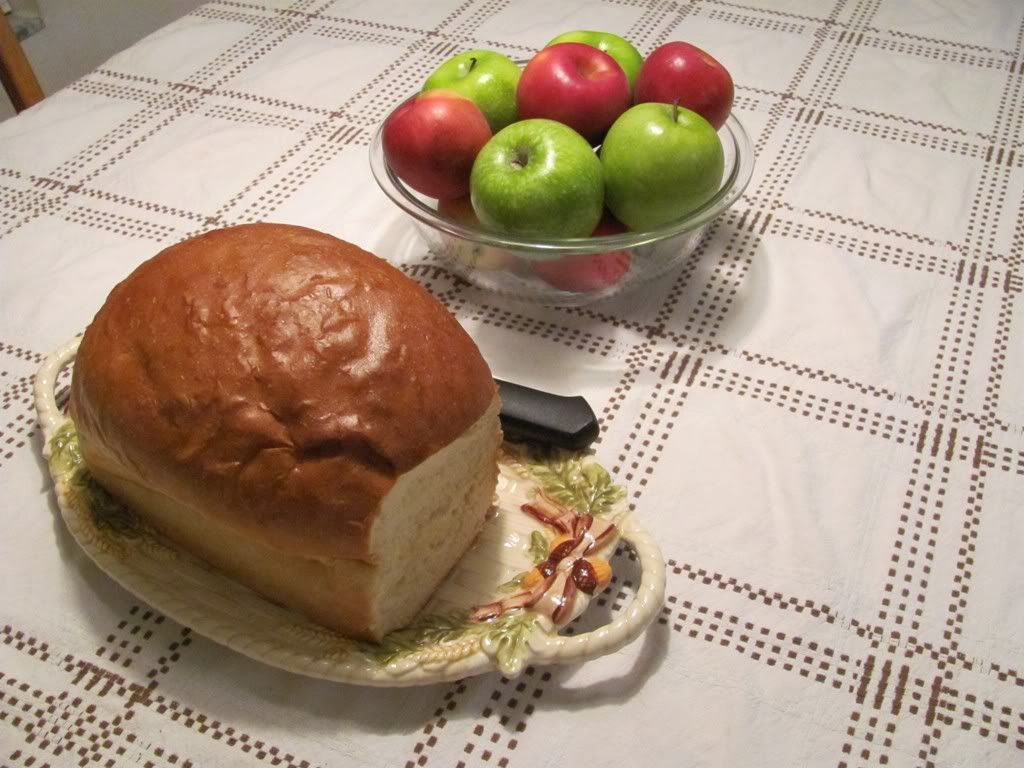 This may look like a loaf of bread, but it's not. It's a gift. A delicious, homemade, still-warm-from-the-oven gift. Someone couldn't wait to taste it and nipped an end piece the minute it touched a flat surface in the kitchen. Okay, it was me, but I live with another crust lover. If I don't nick one for myself my guy will eat both.