Saturday, June 08, 2013

Closer

Photography has taught me a lot about writing. Through the camera's lens I see the world and use its functions try to capture my vision of it as a permanent record. But not everything I see properly translates that perspective. For example, this picture:


This is a leaf on one of my rose bushes, covered with early morning dew. At first glance it's okay but really nothing special. Yet when I focused the camera a bit closer, more details came out, such as the structure of the leaf, at points magnified by the dew drops. The colors also seemed more intense, and new things became apparent that I didn't notice when I snapped the first pic. I couldn't see the very tiny drops of dew surrounding the larger ones until I zoomed in and snapped this:


Getting closer gave me a better perspective and allowed me to bring out more of what was special about this otherwise ordinary sight. The delight of that made me decide to go in even closer (via Photoshop) and isolate the universe contained in just one dew drop:


Not much of a universe, is it? That's because I went in too close and blocked out everything else and ended up with a kind of fuzzy circle that is even less interesting than the first photo. Worse, if that's all I showed you, you probably wouldn't know what it was.

Everthing you write should present mental snapshots to your reader. If you keep your distance and don't focus, all they get is a very general (and typically blasé) idea of your vision (which is the first photo). On the flip side, if you focus too much and zoom in too close, the reader has no context and probably won't recognize anything (as in the third photo). So story that emulates the middle photo, where you see the obvious and some of that which is not so obvious, is the ideal balance.

Friday, June 07, 2013

Unwoven Light

I've seen a lot of art installations over the years, but this one will stay with me for a while (includes narration and background music, for those of you at work):

Soo Sunny Park: Unwoven Light from Walley Films on Vimeo.

Thursday, June 06, 2013

Andrea & Interesting Sub Op

We're currently under a tropical storm watch here, and while we're always prepared for bad weather, the conditions may knock out our power and internet and keep me unplugged for a bit. For any of you who might also be in the path, you can find out more about Tropical Storm Andrea at the National Hurricane Center website here.

Also, a heads-up on an interesting sub op -- while I was checking something at Ralan.com this new antho listing caught my eye:

Ticonderoga Publications has an open call for their new romance steampunk-themed anthology: "This anthology, with the working title Kisses by Clockwork, will combine the fun and irreverence of steampunk fiction with an element of romance. There might be stories of airships, gaslight romance, retro-futurism, post-apocalyptic steam-powered cities, analytical engines or neo-Victorian ladies and gentlemen. The relationship/s in the stories should have an emphasis on romance rather than erotica, but well-placed steamy scenes necessary for the plot are of course, acceptable." Length: 2-7K; publisher notes "Longer stories may be accepted, although payment is capped at 7,500." Payment: "2 copies of anthology and Aus 2.5 cents/word (GST inc., maximum payment $187.50) on publication." No reprints, electronic submissions only, see guidelines for more details. Deadline: October 15th, 2013.

Wednesday, June 05, 2013

Backyard Surprises

Our neighborhood sandhill cranes paid me a visit yesterday morning:


My dogs would like nothing better than to chase them around the yard, so I'll have to remember to check for them before we step outside.


Over the years the cranes have grown slightly less skittish of humans, so I was able to get a bit closer without alarming them. I'd love to get some more close-up shots like this one:


This morning we had another surprise show up in the pasture bordering the back of our property:


At first I thought a stray dog had gotten into the field, but on closer inspection it turned out to be a new addition to the herd:


You know the really old saying about making calf's eyes at someone? This is what it actually looks like:

Tuesday, June 04, 2013

Over at Disenchanted & Co.


I'm making some changes to the Disenchanted & Co. series blog; stop by today if you get a chance to see what's new and what to expect in the months ahead.

Monday, June 03, 2013

Book Giving Ten

Ten Things You Can Do with Unwanted Print Books

Donate Them: Every public library I've ever visited accepts donations of any type of book; most sell donated books to library patrons and/or to the public during regularly scheduled book sales. The funds raised by these sales go to benefit the library, so it's a good cause. Many libraries also accept donations of used magazines, for those of you who don't like to throw them away.

Give Them to Patients: Contact your local hospital to see if they have a patient library and/or accept donations of books for patient use. Many veteran hospitals also maintain a library of donated books for our wounded and recovering soldiers.

Make Them into Art: Librarian Lindsay White has a very cool page on Pinterest here with plenty of ideas on how you can turn old books into new artworks.

Pass Them Along to Students: Budget cuts are depriving our public schools of many things, including much-needed reference books and fiction appropriate for kids, so check with your local public schools to see if they accept donations. Also, if your kids have outgrown their preschool books, call a daycare center and see if they can use them.

Release Them into the Wild: BookCrossing.com defines itself as "the World's Library. It's a smart social networking site. It's a celebration of literature and a place where books get new life. BookCrossing is the act of giving a book a unique identity so, as the book is passed from reader to reader, it can be tracked and thus connecting its readers. There are currently 1,882,717 BookCrossers and 9,734,339 books travelling throughout 132 countries. Our community is changing the world and touching lives one book at a time." To use this site, you register, print out and attach a tracking label for your title, and then leave the book in a public place. You can then track your title as others pick it up and pass it along (assuming everyone who does registers with the site and updates the book's travels, naturally.)

Sell Them: Sites like Cash4Books will buy some of your unwanted books and even provide you with a free shipping label to send them along. Note that they will not buy everything (you usually need to punch in the ISBN and see if they're buying the title), and for most books they offer only small/token amounts -- but something is better than nothing.

Swap Them for Something You Want: Book trading sites like Paperbackswap.com allow you to swap your unwanted books with other readers. I think this is an especially neat service because your book goes to someone who really wants it and you get something you want to read in return, which is the best kind of book win/win.

Turn Them into Bookends: Transform your unwanted titles into a pair of interesting bookends -- Design Sponge has all the DIY instructions for this project here.

Use Them for Interesting Craft Projects: Here's a slideshow of 21 craft projects made from old books; I really liked the birdhouse and table runner (I bet you could make a neat party table covering from book pages, too.)

Work Them into Clocks: With an hour, a drill and less than $10.00 in supplies you can turn an old book into a wall clock; Design Dazzle shows you how here.

Do you have any ideas on or links to interesting ways to recycle old print books? Let us know in comments.

Sunday, June 02, 2013

Comments Catchup Day


See you in comments.

Saturday, June 01, 2013

Secret Rooms

Imagine discovering your home contained a secret room that you never knew existed -- that just happened to Reddit user mYNDIG, who posted photos of it here. Other Reddit users speculate the space was used as a radio room or even to hide people during WWII (and to me the one little doll shoe strongly suggests the latter.)

I love reading about stories like this, probably because the secret room is one of my favorite elements in fiction. It first scared the daylights out of me when I read Poe's The Cask of Amontillado, and again when I discovered what Miss Emily was hiding in one of her rooms in Faulkner's A Rose for Emily. Rob Thurman's latest Cal Leandros novel, Slashback, has a scary secret room in the backstory, and Robin Cook used an ancient secret room (as well as a unique way of hiding it) as the hub of the entire plot of Sphinx. There can be more than one secret room in a story, too; I have three of them in my novel Night Lost, and Stephen King famously packed an entire hotel to the rafters with them in The Shining.

The secret room to me has always worked best as a subtle metaphor as well as a physical setting. The triumvirate of secret rooms in Night Lost are not simply places; they embody the changes that occur during the dual journey of the protagonists as they progress from being lost and alone to finding each other in three acts (thus three rooms.) The secret room can also work as a metaphor for the true self, a double life, the chains of the past or the doorway to a new future -- it's all in how you use it.

If you'd like to play with the secret room as a story element, here are some writing exercises to try:

Create a secret room in one of your character's homes that hides something important (good or bad) to your character. First describe the room as a setting, and then write a short scene in which your character discovers it.

Write a flash fiction story in which a secret room is a main character -- either as a protagonist or an antagonist.

Describe a secret room that embodies this saying: One man's trash is another man's treasure.

Tell the story of the discovery of a secret room from the room's POV.

Now it's your turn: What's your favorite secret room story? Let us know in comments.

Friday, May 31, 2013

Elsewhere with Her Ladyship

Stop by Disenchanted & Co. today, tell me the title of the last novel you've read, and you could win this giveaway:

Thursday, May 30, 2013

By the Chapter

Chapter by Chapter (aka CbC) is a freeware program designed by Sébastien Berthet for "novel writers who use Microsoft Word intensively. It allows managing and organizing chapters within a book far easier than in Word just because it deals with one doc file per chapter rather than one big file containing the whole book. When the book is finished (or whenever the writer wants), CbC generates that big file. CbC was developed because the Master Document feature of Word was too complex and very buggy (it corrupts documents). So, the idea was to mimic this feature from out of Word with another application running independently and driving Word."

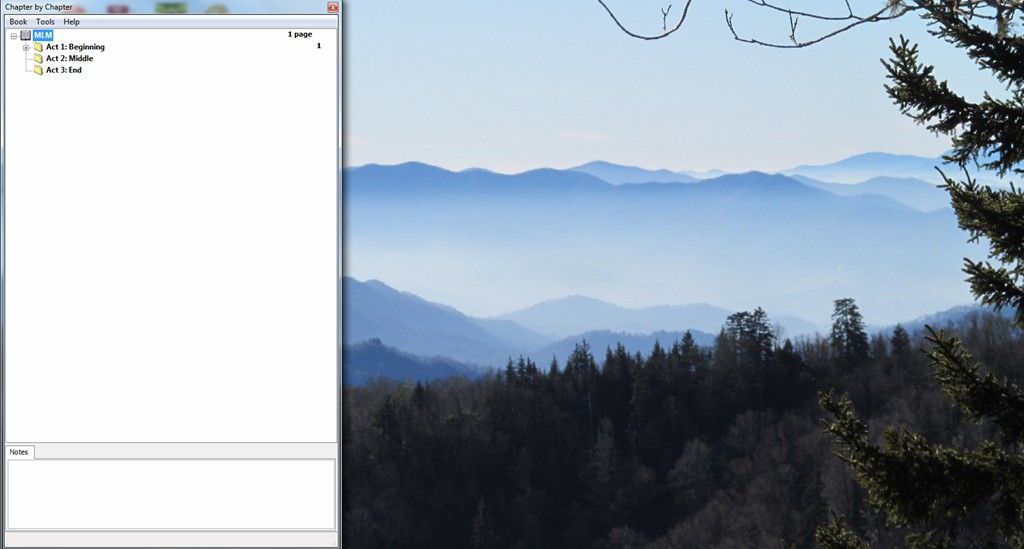
I usually work on a novel as a single document on Word and keep all my chapter/scene/etc. notes separate and hand-written in my novel notebook, so this approach of doing both at the same time on the same screen definitely appealed to me. I downloaded the program and installed it today (very quick and no problems there.) When you open CbC you'll first get this little side screen on your desktop:


(Click here to see larger version)

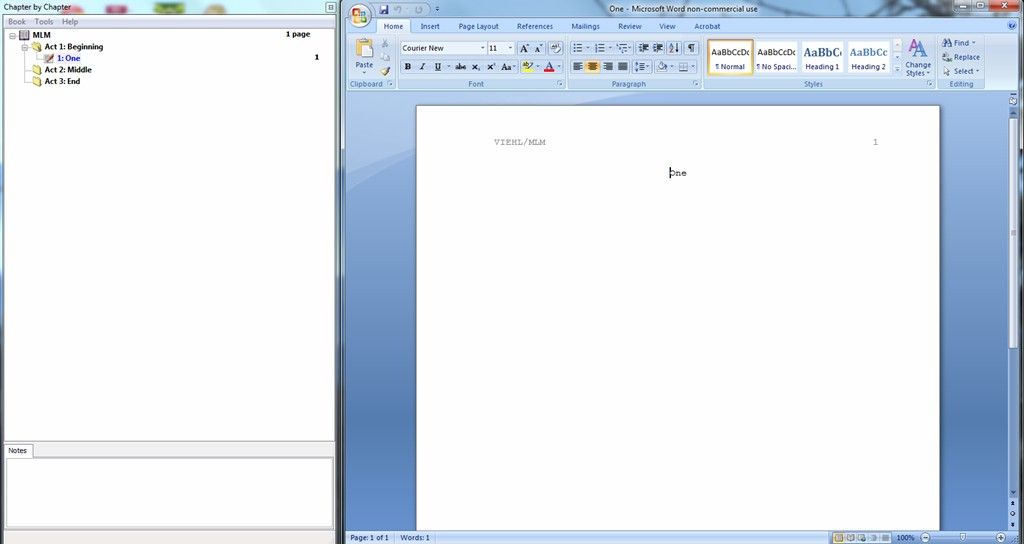
When you open a new book you're prompted for a title, byline, and which file format (doc, rtf, docx etc.) that you want to use. Once you've input that, you can begin adding chapters by right-clicking on the appropriate act, which automatically opens up a new Word file and companion screen:


(Click here to see larger version)

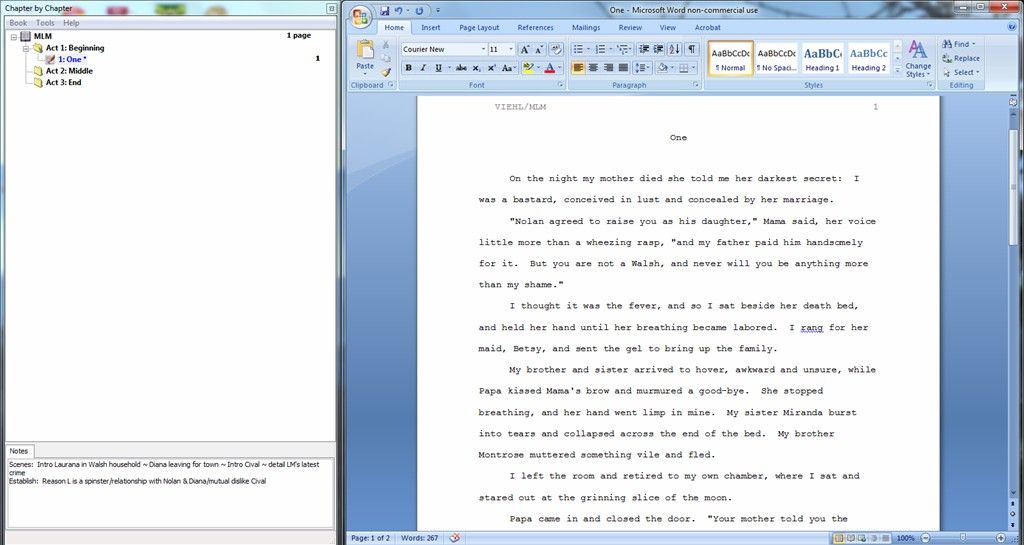
I like the convenience of being able to make notes while I'm writing a chapter, which the program allows in a small box at the bottom of the side screen:


(Click here to see larger version)

When you save your files, the document is segregated to the CbC program file, but you can dupe it elsewhere easily with a different Save As file name. This is as far as I've gotten with using the CbC program, but I'm going to give it a genuine test drive by writing an entire story using only the program for what I usually do in Word and with my hand-written notes. If it proves to be as helpful as I think it will, I'll report back on what happens and how I think you can use it for your Word story projects.

Wednesday, May 29, 2013

Elsewhere with the Parasol Protectorate

Stop by Disenchanted & Co. today, tell me what urban fantasy novel I should be reading, and you could win this giveaway:

Tuesday, May 28, 2013

Because Sometimes You Need a Prompt

Sorry I'm late posting again today. My life got temporarily derailed, but I'm now back on track, all's well etc.

A few nights back I was doing one of my random searches for online writing inspiration when I found this article by Jenny Yang on ten resources to help break writer's block. Most of them I've already seen, linked to or keep bookmarked, except for one: Plinky. Here's how the site defines itself:

Plinky makes it easy for you to create inspired content. Every day we provide a prompt (i.e. a question or challenge) and you answer. We make it simple to add rich media and share your answers on Facebook, Twitter and blogs.

They don't support Blogger, so I can't comment on how simple it is to share Plinky content on blogs, but those of you who are hooked up to Facebook and Twitter are evidently covered. I looked through the prompt archive, and here's a sampling of what they've posted as challenges for the last three days:

Prompted May 28, 2013: Tell us about the most surprising helping hand you’ve ever received.

Prompted May 27, 2013: Write down the first sight, sound, smell, and sensation you experienced on waking up today. Pick the one you’re most drawn to, and write. (For a bigger challenge, pick the one you’re least drawn to.)

Prompted May 26, 2013: Tell us about something you would attempt if you were guaranteed not to fail (and tell us why you haven’t tried it yet).

These seem like interesting topics for blogging, writing practice and/or personal journaling, and if you wanted to apply them to your fiction you might have a character answer them for you. You can also learn a lot about people by reading the answers that have been posted online by others. Speaking of that, if you don't want to share your thoughts online with others, you can visit the site to pick up the prompt of the day and simply keep your answer to yourself, so in that sense Plinky can work for anyone.

Monday, May 27, 2013

Sub Ops Ten

Ten Things About Submission Opportunities

Barking Rain Press is looking for subs, and publishes "complete novels or novellas of at least 20,000 words to sell through the BRP website and other partner sites in print and eBook formats. We will also consider the following: Short story collections (anthologies) with a strong central theme, written by a single author; Reprints of previously published works that are out-of-print, so long as the author owns BOTH the worldwide electronic rights and print rights. While we are open to a variety of literary genres, we are NOT open to submissions containing the following subject matter. These submissions will be automatically rejected: Poetry; A single short story, a single piece of short fiction,or a single work of flash fiction; Children’s books; Erotica; NC-17 / X-Rated / Pornographic fiction; Self-published works that are currently available for sale anywhere. If the work(s) are no longer for sale, and you own worldwide print and electronic rights, they may be submitted for consideration. Keep in mind that if a work can be found for sale or free download through a search engine search, the submission will be rejected outright. Make sure that the work is completely unavailable BEFORE you submit it." Payment: "Barking Rain Press pays authors 50% of net sales for both print and electronic sales (minus PayPal fees). Royalty payments are sent monthly. We pay only through PayPal, so authors must have a PayPal account." Submission periods: "January 1-31; May 1-31; and September 1-30." Query on reprints, electronic submissions only, see guidelines for more details.

Betwixt magazine "publishes speculative fiction of all sorts—fantasy, science fiction, horror, slipstream, weird fiction, npunk, you name it. We particularly like stories that smash genre boundaries to smithereens, but we also love fresh takes on established genres and in-depth explorations of ultraspecific niches. Experiments in form and style are welcomed enthusiastically—but a straightforward narrative with tight, crisp language is just as beautiful. When it comes down to it, we want stories that will amaze us, astound us, provoke our thoughts, and boggle our minds." Length: "Stories of 4,000 to 7,000 words are ideal, but we will consider a range from 1,000 to 30,000 words." Payment: "We pay $0.02 per word up to $150, payable upon receipt of completed contract and author questionnaire." No reprints, electronic submissions only, see guidelines for more details.

Class Act Books is looking for subs, and "is currently accepting fiction and non-fiction manuscripts in all genres. Only COMPLETE manuscripts that portray a story with a beginning, middle and end will be accepted." Length: "The submission word count for ebook publication ONLY is 5,000-150,000 words. Word count for books intended to include POD Print publication is 20,000-125,000 words." Payment: "e-book=30% net; print=7.5% net." Reprints okay, electronic submissions only, see guidelines for more details.

Dark Continents Publishing has an open call for their upcoming The Sea antho: "HP Lovecraft once wrote, 'The sea can bind us to her many moods, whispering to us by the subtle token of a shadow or a gleam upon the waves, and hinting in these ways of her mournfulness or rejoicing. Always she is remembering old things, and these memories, though we may not grasp them, are imparted to us, so that we share her gaiety or remorse.' The oceans of this world can swallow us, and sink us into the watery depths where monsters lurk and mermaids frolic. Or we can voyage far and discover new worlds. Selkies sing beneath the moonlight. The Flying Dutchman sails forever damned. Many-tentacled monstrosities drown unwary swimmers. Sunken treasures rest in wrecks shrouded in kelp and guarded by sea serpents. Be your tales wonder- or terror-filled, Dark Continents Publishing invites you to submit your previously unpublished short fiction" Length: "between 3,000 to 9,000 words that falls within the fantasy, horror, weird and science fiction genres." Payment: "a flat rate of $20 per story." No reprints, electronic submissions only, see guidelines for more details. Deadline: [Note from PBW: I'm not really sure what it is; the publisher guidelines say "Closing date for submissions is June 21, 2013" but Ralan.com has the reading period listed as "1 June to 31 July 2013" -- so if you want to get a confirm on the open/close of the reading period, you might e-mail the publisher.]

The Dreadful Cafe has an open call for query letters for Membrane, their first antho: "We are now soliciting query letters for Membrane, our first anthology. All genres are eligible, but preference is given to stories that cross more than one and which reflect the flavor and theme described above." [Note from PBW: this flavor and theme thing is described as "Unreal. Imaginative. Intense. An escape from the safe. These stories will propel the reader—by wormhole or peephole—through the fantastic, the criminal, and the insane. Sometimes strange, always original, the stories we publish are of the highest production standards, from thrilling premise all the way to professional editing."] Length: "Manuscripts must be between 2,000 and 30,000 words and not previously published by anyone but the author. Self-published works are accepted and encouraged!" Payment: "Upon acceptance of your completed manuscript, Dreadful Cafe pays for non-exclusive, unlimited, 5-year publishing rights on the following schedule: Short Stories (2,000-7,000 words) — $125; Novelettes (7,001-15,000 words) — $250; Novellas (15,001-30,000 words) — $500/Negotiable." Query on reprints, electronic submission query first only, see guidelines for more details. Deadline: October 1st, 2013 or when filled.

Fable Press is looking for sub ops: "seek all flavors of speculative fiction. This could be a thriller with a supernatural flair or a paranormal romance novel. A dark horror story or high fantasy. Utopian/dystopian. Alternate reality/history. Space Opera or steam punk – steam punk space opera? Why not! Speculative fiction covers a wide range of genre fiction and we love it all! Currently, we're only considering Young Adult (YA) and Adult fiction. We aren't publishing Children or Youth fiction at this time." Length: "All novel-length (60,000+ words) submissions are welcome, as well as any serialized novella proposals." Payment: "30% and 40% of the net sale." Reprints okay, electronic submissions only, see guidelines for more details.

New Zealand digital-first publisher Paper Road Press wants to see subs "with a strong New Zealand or Pacific voice or work by New Zealand writers" and "specialises in science fiction and fantasy, but we are happy to consider detective and historical manuscripts. If these contain a dash of science fiction or fantasy themes or concepts, all the better. Please query first for other genres." Length: "We are currently seeking fiction of 20,000-50,000 words for our Novellas list, and 10,000-20,000 words for our Shortcuts list." Payment: "min. 35% royalty" Query on reprints, electronic submissions only, see guidelines for more details.

Postscripts to Darkness has an open call for their fifth antho of dark fiction and illustrations: "We print volumes twice yearly, and while we include work from writers and artists all over the world, we give ample space to local creators, emerging or established. While we are open to a variety of approaches and styles, we are interested in original work that pushes and plays with(in) the boundaries of the fantastic, the marvelous, the uncanny, and the horrific. While we are open to a variety of approaches and styles, we are interested in original work that pushes and plays with(in) the boundaries of the fantastic, the marvelous, the uncanny, and the horrific. We are not interested in formulaic re-treads of genre conventions, but in work that revises and interrogates the relationship between genre writing and literary experimentation. We welcome challenging, edgy fiction that embraces not only elements of classic horror, but also dark fantasy, urban fantasy, slipstream, (new) weird fiction, and surrealism. While we are open to English-language fiction by writers of all nationalities, we also strive to support Canadian writers and artists, and maintain at least 50% Canadian content in any given issue. Bearing this in mind, please include with your submission information about your citizenship and/or current country of residence." Length: "We are looking for works of short fiction (up to 3500 words)." Payment: "We offer fiction contributors $25 CAN per story (payable through PayPal), regardless of length. We will also provide a complimentary electronic version of the book to each contributor. Contributors have the option of purchasing hard copies at a low contributor’s rate (30% off.)" No reprints, electronic submissions only, see guidelines for more details. Deadline: June 30th, 2013.

World Weaver Press has an open call for their upcoming Specter Spectacular II: 13 Deathly Tales antho: "The shift from Specter Spectacular I’s “ghostly tales” to Specter Spectacular II’s “deathly tales” is a slight one, but rather than repeat of the first anthology, we hope to expand on the content and story tropes while still holding onto the eerie and enthralling feeling associated with the classic ghost story. While the final anthology will include some ghost stories, we also hope to feature rifts between worlds, specters and jack-o’-lanters, ghosts that are not ghosts, psychopomps (characters who conduct spirits or souls to the other world, such as Charon, Valkyries, the Grim Reaper, etc.), psychic mediums, and tales of crossing over … and back … and perhaps over and back again. We’re quite intrigued by the possibilities (gothic, mythological, modern, humorous, etc.) and are looking forward to seeing what authors bring to the table. We recommend a familiarity with Specter Spectacular: 13 Ghostly Tales. As we did in the first volume, we will seek a mix of scary, eerie, beautiful, and funny stories to round out the reading experience. The first volume made Tangent’s 2012 recommended reading list and was named a Night Owl Review Top Pick; we hope to see the same quality of fiction or higher in volume II." Length: "Under 10,000 words." Payment: "$10 + paperback copy of the anthology." Reprints okay but editor notes their "Preference for stories which have not been anthologized previously." Electronic submissions only, see guidelines for more details; open submission period: May 1 – June 15, 2013.

For the final listing I want to mention something that recently came up: a couple of freelancers alerted me to an overseas Asian publisher with an open call that offers $.25/word for children's magazine articles. I don't know this publisher, and since their web site is not in English I can't do any research on them. For those reasons I'm not going to list the publisher by name, link to them, or try to comment on why they would offer so much money via an open call; I'll simply pass along a warning about publishers in other countries that I've always followed: if the money sounds too good to be true, it probably is.

Sunday, May 26, 2013

Comments Catchup Day


See you in comments.

Saturday, May 25, 2013

Winners

You all offered some terrific journal prompts for the Be My Guide giveaway, and I hope you'll take the next step and use your suggestion (or any of the other entries you found intriguing) as inspiration to start a journal or add to one you've already been writing.

We got the magic hat to work its wonders, and the winners of the giveaway are:

SandyL, who offered From a tarot deck, I pull out a card and then use the imagery and symbolism on the card to write a scene or a character.

Liv, who suggested Write the life story of a lightbulb?

Winners, when you have a chance please send your full name and ship-to address to LynnViehl@aol.com so I can get your packages out to you. My thanks to everyone for joining in.

Friday, May 24, 2013

Cities of Light

This video uses time-lapse photography to show some of the architectural wonders of the Chinese cities of Guangzhou, Shanghai and Shenzhen (contains background music, too, for those of you at work):

Guangzhou'2012/CHINA from zweizwei |motion timelapse| on Vimeo.

(Video link nicked from Gerard at The Presurfer)

Thursday, May 23, 2013

Another Guide

I found How to Publish Your Own E-Book by Nik Rawlinson, published by Magbook, on the tabloid shelf at my local market's checkout line, which was probably why it caught my eye. That and waiting to pay for my groceries is always a little boring, so I picked it up, flipped through it and decided to fork out a rather pricey $14.99 to take it home for further study.

The author is a UK journalist, btw, and brings that sort of no-nonsense tone to the book, which for me made it an easy read. He devotes the first twenty pages of the magazine to convincing the reader why digital self-publishing is the best option, and they're quite effective. There are a few slams against traditional publishing but it's nothing you haven't already heard. Chapter Two addresses writing your book, but only very lightly and not at all in practical terms; this is only section that I found to be basically useless. That said, this is really a book to teach you how to self-publish, not how to write.

Chapter Three is where Mr. Rawlinson earns his cover price by detailing how to create and format your e-book using Sigil, Scrivener, InDesign, QuarkXPress, and iBooks Author. He also looks at working with Kindle Format 8 and how to test Kindle and ePub documents to see how they're going to look. I haven't used any of these programs, so I can't comment on the quality of the info, but there are plenty of screenshots and instructions, and they appear to be what someone would need to get through the basic process involved with each. My only reservation is how long this info will be useful, especially as the e-publishing world continues to evolve. According to the author it has been updated to reflect changes in these programs and services through December 2012, so unless there are radical/unexpected changes ahead in the near future it might be a good reference resource for another year or two.

Chapters Four and Five, Selling Your E-book and After Publication, return to the lighter/theoretical format of earlier chapters, although they contain some solid advice. Since I'm not personally interested in going the indie publishing route, the fact that I found two resources, Sigil and E-Junkie.com., still made it worth the cover price.

I wouldn't call this a complete guide, or a must-have manual for anyone considering digital self-publication, but it contains enough info to get you started down the indie path. I couldn't find it for sale at any US online booksellers but it is available through Amazon's UK site here in Kindle format. Combine this guide with your own research and online legwork, go cautiously, and you just may be able to self-publish your own e-book, too.

Wednesday, May 22, 2013

Direct e-Sales

Sorry I'm so late posting today (long story), but I do want to pass on some info for those of you who want to self-publish but are not in love with the idea of signing on with Amazon, Apple etc. and handing over a chunk of your profits. Alternative services are coming onto the market now, like E-Junkie.com , which for a monthly flat fee will sell digital downloads of your books. You're paid directly and instantaneously for each purchase via services like Paypal, and you're not required to adhere to preset (and often obnoxious) formatting requirements. Do be sure to read carefully all the terms of service and the amount required per month to keep your title(s) in stock before you sign up.

While a direct sales service isn't for everyone (new-to-the-biz writers might want to first establish themselves via the online booksellers), if you have built a strong following and have a dedicated readership, this could be the way to sell via links from your website or blog and keep 100% of your profits. Authors who have a specialty title might profit more from selling direct as well; you won't get lost in the current deluge on the big bookseller sites.

With the direct sales approach you'd definitely have to be more aggressive with promotions and getting the word out, as you won't have the exposure you'd get on the big bookseller sites, so keep that in mind as well.

Tuesday, May 21, 2013

Be My Guide

Guided journals, or blank books that include specific prompts or instructions on what to write in them, can provide an interesting journaling challenge and plenty of no-sweat writing practice. They're great for youngsters but I think adults can get a lot out of them, too. If you ever feel blocked, unable to focus or otherwise cut off from the work, a guide journal can be like jumper cables for your creativity. You still have to think and write, but it's nice to have your direction mapped out in advance for you.

On a recent trip to BAM I picked up two newly-published guided journals: Michael Nobbs's Drawing Your Life and The Pocket Scavenger by Keri Smith. Michael, who is the founder of SustainablyCreative.com, has tackled guided journal via impromptu art by putting together a book of drawing challenges.

I struggle most with sketching, and when I spotted Michael's jourrnal I thought it would be geared more toward experienced/confident artists. But while flipping through it I discovered Michael has disabled since the late nineties and learned to draw himself as a way to come to terms with his health challenges. That comes through in the journal, as he puts it: I hope this book will encourage you to draw YOUR LIFE and perhaps show you a way you can enjoy each day just a little bit more. To me the fact that he not only wrote but also illustrated the book convinced me to invest; I like authors who practice what they preach.

I tried out the journal in the fearless sense -- with a pen -- and freehand drew a bunch of different keys I'd been working with on some BookLoop and art projects earlier that morning:


I've already enjoyed working through one of Keri Smith's guided journals, so I had to grab a copy of her latest, The Pocket Scavenger. This journal is a guided treasure hunt through your life where you hunt for ordinary and even mundane objects like postage stamps, buttons, part of a book, a used envelope, something that was given to you -- all of which you add to the journal along with the location, time, date, and a story/notes section where you write a bit about the process of finding the object.

Now to some of you this might sound a little tedious, but wait, there's more to do: once you've found the required treasure, you then flip to a random page in the journal, turn it upside down, and follow the instructions written in the bottom page border to alter the object you found. For example: I found some old postage stamps in my desk. I noted the details of the hunt on that page, then did the flip and got these instructions from the border: add some music. That I interpreted as making the background of my postage stamp page out of some old sheet music from my paper recycling bin. Which then turned the postage stamps into a neat mini-collage:


Both of these guided journals allow anyone, no matter what level of artistic skill they might have, to creatively explore their immediate environment, document their life in an interesting way and journal outside the box. If you've never tried to keep a journal, either one of these could make a great first experience.

As always you don't have to take my word for it. In comments to this post, give us a journaling prompt you think would be interesting to do (or if you can't think of one, just toss your name in the hat) by midnight EST on Friday, May 24th, 2013. I'll draw two names at random from everyone who participates and send the winners an unsigned new copy of either The Pocket Scavenger by Keri Smith or Drawing Your Life by Michael Nobbs (to keep it fun, the winner won't know which until my package arrives.) This giveaway is open to everyone on the planet, even if you've won something at PBW in the past.

Monday, May 20, 2013

Freely Ten

Ten Things You Can Have for Free

Freeware Caution: always scan free downloads of anything for bugs and other threats before dumping the programs into your hard drive.

Clip Trap is a handy little utility that "watches the clipboard and keeps track of copied text in its window" (OS: Windows 98/ME/2000/XP/2003/Vista/7)

Efficient PIM is a "full-featured personal information manager (PIM) software program that can help you organize and plan your business and private life. With EfficientPIM you can keep track of contacts, appointments, tasks, to-do lists, birthdays, and much more. The program also gives you space for keeping notes, diaries, and even passwords. In order to be successful you need to be organized and efficient. With EfficientPIM all of the things you need to manage are located in one, easy-to-use interface" (OS: Windows 8/7/XP/Vista [32-bit or 64-bit])

Efficient Sticky Notes "allows various background colors, with optional gradient effect, to be set for the desktop notes. You can also customize the font of each note and set it to be semi-transparent so it will not fully cover up your desktop background or icons. To fully protect your privacy, the software encrypts the login password with the irreversible SHA algorithm and also encrypts data files. Besides, it offers various special features such as managing sticky notes by group, setting note importance, tracking the creation time and last modification time of desktop notes, adding attachments to notes, Recycle Bin, etc." (OS: Win 98/ME/NT/2K/XP/2K3/Vista/7)

Focus Writer is a "simple, distraction-free writing environment. It utilizes a hide-away interface that you access by moving your mouse to the edges of the screen, allowing the program to have a familiar look and feel to it while still getting out of the way so that you can immerse yourself in your work" (OS: Linux, Windows, and Mac OS X)

Listen N Write "can be used to play and transcribe ordinary audio and video recordings (WAV, MP3, OGG, WMA, AVI, MPG, WMV, OGV, FLV, VOB, TS, etc). Listen N Write has special features simplifying the transcription work as you can control via keys (while using its integrated word processor) and insert time markers (bookmarks). Moreover, the audio stream is automatically rewound a few seconds when pressing the Pause key. Listen N Write can be considered the standard program for any transcription because of its simplicity of use and small size" (OS: Windows 2000/XP/Vista/2008/7)

ManicTime is a "time tracking software which automatically collects data on your computer usage. It records active and away time, as well as which applications you used and for how long you used them. The data ManicTime collects is stored in a local database on your computer. Once data is collected you can use our simple click and drag feature to accurately tag how you spent your time. Time tagging allows you to see how you spent your time based on your own time tags and gives you accurate information on how efficient you really are. Because there is so much data available about your computer usage, you are able to tag spent time for days in the past. Based on this data you are able to generate various statistics. You can easily find out how much time you spend behind a computer or how much time you spend browsing the web" (OS: Windows XP/2003/Vista/7; Requires: Microsoft .NET Framework 3.5.)

Mendeley is a "free reference manager and academic social network that can help you organize your research, collaborate with others online, and discover the latest research. Features: Automatically generate bibliographies; Collaborate easily with other researchers online; Easily import papers from other research software; Find relevant papers based on what you’re reading; Access your papers from anywhere online; Read papers on the go, with our new iPhone app" (OS: Windows XP/Vista/7)

Sigil is a "multi-platform EPUB ebook editor with the following features: Online Sigil User's Guide, and Wiki documentation; Free and open source software under GPLv3; Full UTF-16 support; Full EPUB 2 spec support; Multiple Views: Book View, Code View and Preview View; WYSIWYG editing in Book View; Complete control over directly editing EPUB syntax in Code View; Table of Contents generator with multi-level heading support; Metadata editor with full support for all possible metadata entries (more than 200) with full descriptions for each; User interface translated into many languages; Spell checking with default and user configurable dictionaries; Full Regular Expression (PCRE) support for Find & Replace; Supports import of EPUB and HTML files, images, and style sheets; Documents can be validated for EPUB compliance with the integrated FlightCrew EPUB validator; Embedded HTML Tidy: all imported files have their formatting corrected, and your editing can be optionally cleaned" (OS: Windows, Linux and Mac)

StylePix is a "convenient, easy-to-use image editor that has all the features of raster graphics editor and adhered to lightweight design and effective UI. In addition, it has a built-in image viewer and batch processor" (OS: Windows XP/Vista/7/8)

TheSage is a "free software application that, through a multi-tool interface, integrates a complete dictionary and a multifaceted thesaurus of the English language together into a unique language reference system" (OS: Windows XP, Vista, 7 [32bit and 64bit])