Showing posts with label story power. Show all posts

Sunday, August 05, 2012

Berg Vision

After dinner tonight we went down by the water to take a walk and get some fresh air. I managed to take this shot of a seaplane taking off, but I fumbled with the buttons trying to zoom in and get more details, and by the time I had the camera ready the plane was gone.

No one else on the dock seemed to be watching the plane; the half-dozen people there with us were hanging over the railing looking at something in the water. They were all smiling, too, which I thought was a little strange. My kid joined them and started making those "Aw, isn't it cute?" noises; which made me think there was a duck or maybe even a puppy under the dock. Earlier we'd run into a nice guy who was carting around a wagon with three golden lab puppies that he was trying to sell, something I had to drag my kid away from before we ended up with another pet.

I got to the railing and looked over, and to my surprise, this is who everyone was cooing over:


I suppose to someone who didn't grow up by the Everglades he does look cute. To me he looks like a gator, which ranks very high on my don't-fool-with list, right up there with rattlesnakes, yellow jackets and brown recluse spiders.

I think people don't know how deceptively small a gator can look when it's in the water. Mostly you see the eyes poking up, a bit of its snout and that's all -- but that's not all there is to the gator. You might see this:


But what you're really looking at is just the tip of this:


Gators in the water aren't that much different from icebergs; what you don't see can be a lot bigger than you'd ever imagine (and I apologize for the poor quality of that last pic; not only was Mr. Popularity big, like all gators he was also really fast.) Here's something else: I was the only one who saw the gator full-length; after a couple of minutes everyone else got bored looking at his cute little head and wandered off the dock.

Sometimes when you're honing an element of story, whether it be a character or a plot or even a setting, the need for clarity often demands tight focus: here is Protagonist Guy, what he looks like, what he wants, and what his problems are. Like the gator, we see all the attractive/sympathetic/exciting bits upfront. As writers we want that; to immediately engage the reader's attention is one of the most important aspects of the work.

But once you've got them hanging over the railing, is this all they're going to see? If you haven't gone deeper with your character (or any of your other story elements), and developed them to be more than what the reader initially encounters, how are you going to sustain interest? Remember, as with the gator, all that upfront cuteness only goes so far.

Wednesday, July 13, 2011

Quantum Writing Part II

Yesterday I talked about working on several writing projects at the same time and preparations to make in order to try this. Today we'll discuss how to do the actual work without driving yourself batty.

For each of your projects you now have a one-page outline, a notebook, folder or file for the paperwork, and a dedicated space for all research and reference materials. From here you can go three ways, depending on how you like to work your writing plan:

1. Write a detailed synopsis for each project.
2. Write chapter summaries for each project.
3. Work off the one-page outline for each project.

I don't like guessing what to write, and there is no such thing as too much planning for me, so I always go with #1 and a modified version of #2 (once I have the synopsis written, I divide it into approximate chapters.) This also automatically generates my daily task list, which we'll get to after we cover the other options.

If you're not interested in writing a synopsis for the project, you can put together chapter summaries based on your one-page outline. You can get as detailed or keep it as simple as you like, but you're basically answering this question for each chapter: What happens now?

Writers who don't want to fiddle with a synopsis or chapter summaries can write based on the one-page outline, which is probably the best choice for you organic writers out there.

Once you've decided on your writing plan, you are ready to make up your session task list. This is when decide exactly what part of the story you want to work on for each project during one writing session. To start off I strongly suggest doing a list for just one session at a time; it takes a while to get used to giving yourself defined writing assignments each day, and you may want to adjust the amount of work you're planning to accomplish.

Here's a session task list with just writing goals:

Project A -- Chapter 1 Scene 2 (Simone receives a cryptic message, knocks out courier, arms herself and rides to chateau)
Project B -- Chapter 6 Scene 4 (The colonists build a temporary shelter out of fuselage, discover new monster in caverns)
Project C -- Chapter 11 Scene 1 (Doyle takes Kit to Rumsen Main, where she is questioned and drugged)

If you'd rather not write on every project, you can write one and perform other tasks on the other(s):

Project A -- Chapter 1 Scene 2 (Simone receives a cryptic message, knocks out courier, arms herself and rides to chateau)
Project B -- Edit/research Chapter 5 (Estimate amount of food and water needed by colonists to survive, possible treatment for unknown venom, weight of fuselage)
Project C -- Type ins Chapter 10 Scene 3 (correct manuscript according to editing changes and rewrites)

Organic writers who don't want to plan anything can still assign themselves goals. If you have two projects and four hours in a session, estimate how many pages you can reasonably expect to write in that period of time, divide it by two, and that's your quota for each project.

When you've decided which writing tasks you're going to tackle for that session, then you just pick which one you want to start on first. This is a decision you make based on how you work, too. If you're not feeling too confident, you might start off with the easiest project first as a warm-up. If you tend to get crabby and tired toward the end of a writing session, save the easiest for last.

Work on each task straight through without backtracking or second-guessing yourself for the length of time you've allotted for that project. If you're working three projects over three hours, work for fifty minutes straight and then take a ten minute break before you begin the second project/task. During that ten minute break, don't think about anything, Make yourself a cup of tea, walk around, stretch, or whatever works best to help clear your mind. At the end of the break move on to the next item on your task list and repeat.

This sounds so easy, but of course it's really not. If things are going really well with your Project A, you're not going to want to move on to Project B. If things with Project B suck, you'll be tempted to shove it aside and work on Project C. The key here is to resist the urge to short or overextend yourself on any one task. Unless you are writing the most brilliant prose (or the most malodorous) ever to grace the page, it's best to stick to your writing schedule.

Sometimes you will need more than a ten minute break to shift project gears, and this is when focus breaks and project cues can be helpful. I mentioned a focus break yesterday in comments; it's something I do when for whatever reason I'm not ready to write during a writing session. I leave my writing space and do a short-term chore I dislike, such as folding laundry. That helps motivate me to get back into a writing frame of mind.

Project cues are something writers do to get their heads in the right place for a project. I usually listen to a song that I associate with the project and visualize the story over again. I also use sensory cues like scented candles or flavored teas. Occasionally I'll change my clothes (I used to put on my old scrubs whenever I worked on any of the StarDoc books; just wearing them put me into more of a medical frame of mind.)

Some other tips:

While you're working on each project, keep a blank notepad nearby to make any notes for unexpected editing changes or research needs. Once you've finish with that project, add the notes to the editing section of your project file/folder/notebook.

If you hit a stumbling block on the page and you can't get past it because you need to be in a different mood, or you need to do some research, or you just need to think about it, note the problem in brackets like this [describe the hotel in Avignon] and move on.

If you feel you're stretching yourself too thin, you're probably trying to accomplish too much each day. Adjust your task list or cut your writing time back an hour or two. You can also give yourself a couple of days to work on one project only, and then when you feel more relaxed, try the quantum approach again.

Don't think about the enormity of working on more than one project at the same time. Don't question your sanity. Don't decide you can't do this. Don't think about failing. Try not to think about anything at all but the work at hand and completing all the items on your task list. When they're done then you can go sit in your worry space and beat yourself up for an hour or two.

Quantum writing may or may not work for you, and the only person who can decide that is you. I suggest that you try it for a week, and then at the end of it look at what you've accomplished by counting the total number of pages of new material you've written for all your projects. Once you've done that, read what you've written, too. This is not just about knocking out a lot of pages on a lot of different projects, it's also about getting quality work done in a timely manner.

Working on more than one project at once can also cause you to burn out faster than the one-project writer, so be good to yourself. Eat healthy, take plenty of breaks, get a good night's sleep and do whatever else you can to make sure you're keeping your creative batteries charged.

And that wraps up this workshop -- any questions?

Tuesday, July 12, 2011

Quantum Writing Part I

If you've ever played chess, you know that it's a game of simple strategy: Capture the king. You do this by eliminating the pieces guarding the king and opening up avenues to get to him, hopefully before your opponent does the same to your king. Easy. Only it's not easy because you have to plan your moves while guessing what your opponent's moves are going to be.

Okay, now imagine that writing a novel is playing a game of chess. One playing field, one set of chess pieces, and a whole lot of moves to make. It's enough to keep anyone busy. But what if you could play three games of chess at the same time?

With the right amount of planning and prep work, there is actually very little difference between working on one project and working on two or three simultaneously. It does take more time to finish multiple projects (no writer trick in the world can eliminate the actual work involved) but there are many potential benefits, from eradicating boredom and writer's block from your life to becoming a more efficient and productive writer.

If you're a one-story-at-a-time writer and would like to try this, I have a few preliminary suggestions:

Be conservative. Start off with two projects first (once you get in some practice, then you can try juggling three or more.)

Know your projects. This is not a technique you want to try with a vague idea or a glimmer of story; you want solid, strong, well-thought-out ideas that excite you on the creative level.

Have faith in yourself. If your main writing obstacle is fear, waffling, self-loathing or something along those lines, doing this is probably going to double it. The only way I know how to combat this is to give yourself permission to try this no matter how it turns out. Do it the first time just for fun.

Organize your life. Clear out your writing space, stock up on the office supplies you need, and communicate your plans to your family and loved ones. Eliminate all unnecessary distractions, and make a vow to avoid things that will lure you away from the work.

Once you're in a good place and feel ready to start, write up a working title and a one-page outline for each project (this is also the way to check and see if your idea is clear, strong, and appeals to you.) If you've never done a one-page outline, try my ten point novel template or Alicia Rasley's thirty minute novel outline technique. At this point you want to use broad strokes for outlining to avoid getting mired down in a lot of endless details (you will have time to get more into the details once you start working.)

Set up project files, fiction folders, novel notebooks, or whatever you use to keep your story paperwork organized while you're working on it. Once you have that ready, set up a drawer, box or other contained space where you can put reference materials related to the project (for each project I'm working on I dedicate a shelf in a bookcase near my writing space.) The idea is to have everything you need for the project in one place so you don't have to look around for things while you're writing.

The final prep step is to divide up your dedicated writing time between the projects, and this is where you tailor your time to suit your process. If you prefer to work on one project per day, designate days of the week (i.e. Monday - Project A, Tuesday - Project B, Wednesday - Project A, Thursday - Project B, etc.) If you're like me and you feel comfortable working on different projects during the same session, divide your writing time into hours (i.e. Monday - Project A 9-11 am, Project B 1-3pm; Tuesday - Project C 9-11 am, Project A 1-3 pm, etc.) If you've never tried this and don't know which will work for you, try a test run of each method for a week and find out which one makes you more productive.

A side note on dedicating the writing time: I know it's difficult for those of you with day jobs and/or busy home lives to find the time. If you don't have the time now to write, you'll have to pass on this. Or you might make the time, which means giving up something. Waking up an hour earlier is the simplest way to do it; if you get up before everyone else does that gives you an hour to write in peace and quiet. If you're spending an hour or two a day texting people, tell your friends you're going to take some time to write and turn off the phone. You can also sacrifice watching your favorite television shows to make time to write (if you're worried about missing something, record the shows while you're working, and hold onto the copies as a reward for yourself when you finish the manuscript.)

Tomorrow we'll talk about how to handle the work of quantum writing, how to get into the create-as-you-go zone (and stay there), and some ways to troubleshoot and self-correct common problems. Until then, any questions?

Image credit: © Tino Mager | Dreamstime.com

Saturday, June 25, 2011

Full Spectrum Story

Whenever I'm away from home I carry my camera in my purse, just in case I see something I want to shoot (in the good way.) Experience has taught me that you never know when something interesting is going to cross your path.

This unretouched shot here is one I took while I was sitting in a diner have breakfast with my guy and our kid. I looked up at a shiny glass surface, but instead of seeing my own face I saw this. Now, while there are (cough) always rainbows in my heart, generally I don't see them in mirrored objects. I was seeing it because I was sitting in just the right place at precisely the correct moment; the sun and certain properties of light did the rest (and if you want to know what I was looking at, keep reading.)

The image made me think of writing, naturally, because of course everything is about writing. Story is like the reverse of refracting light, in that the creation of it begins with a wide spectrum of elements -- characters, plot, dialogue, action, setting, time period -- which through the prism of the writer's storytelling hopefully all blend back together into a single, dazzling read.

It would be nice to play God with a novel and only have to say "Let there be light," but as any writer will tell you there's a lot more work involved in it for us. I'd say the most difficult part of making this happen for the writer is being too close to see beyond the spectrum of elements. Occupational hazard, I think; we have to be so detail-oriented when we're working that we can be blinded by the dispersion. This juggling act we do often results in an uneven execution that affects the whole story.

Fortunately we have the editing phase, when hopefully we can back off enough to see all the elements, not just what we were so zeroed in on at the time of creation.

Every book you write has its own set of challenges. With the one I just finished I was fully immersed in four of the characters: my two protagonists and two central secondary characters. This quartet had strong, distinct personalities, and the story issues they had to deal with were so interwoven even one misstep could have turned into a big ball of tangled plot yarn. An added problem was with one who decided to give me nothing but grief whenever she was on the page; at one point I was so frustrated I actually killed her to shut her up. Which of course I went back and rewrote as soon as I cooled off enough to do the daily edit.

My daily edits are what really prevented the book from being all character and no story, and also saved me from having to do a massive rewrite or a total manuscript toss-out. I knew I was focusing too much on the characters, so at the end of each day I made myself stop obsessing about them and take a hard look at the other elements in the scene. In the beginning of the book I saw that I was rushing through or skipping things that needed to be there so I could get the characters on the page and transcribe all this great dialogue in my head. By the middle of the book, I was remembering this while I was writing new material, and correcting myself in the process of getting the story down. The last half of the book went much smoother, and what I produced was much more balanced and needed far fewer rewrites.

Every writer has their own set of strengths and weaknesses, and unless you're a cookie cutter writer every story will bring these together in different ways. Your challenge is to find the correct combination of elements and focus that produces that single dazzling result.

I found this wallpaper while I was hunting for spectrum images, and I think I'm going to put it into my desktop background file for when I start my next novel. Seeing this every morning will be an excellent reminder to mind the details, but also keep my eye on the full spectrum of the story.


Spectrum Colors image via 3D Wallpapers

Wednesday, June 23, 2010

3-18-03

Sometimes I have to play writer pong between my work and internet computers, especially when someone uses the guest room, where I keep the work computer. I don't mind relocating upstairs to work on the internet computer, although it is older, not as fast and doesn't like the Dragon as much. It's that or get behind on my edits.

Tonight I forgot to bring a blank CD with me for backups, so rather than go downstairs I rummaged around in the desk to see if I'd left any up here the last time I played writer pong. That's when I unearthed an old floppy disk labeled only with a date: 3-18-03.

In the first couple years I was a pro I used to back up everything on floppies and date the labels instead of marking them with proper file names. I discovered what a dumb habit it was when I needed a backup of one of my original StarDoc manuscripts, and it took me two days of checking floppies to find it.

I didn't expect to find anything valuable when I popped the floppy in the drive; I wouldn't have been surprised if the computer couldn't read it. But there was a file (also titled with just the date) so I opened it to see what was inside.

Word started, and a forty-nine page manuscript of a story titled Possession popped onto my screen. I didn't remember it at first until I got to the notes I'd saved at the end of the manuscript. I'd written the story as a test drive of an idea I had for a dark fantasy novel about exorcism (which I then decided was cool but not particularly marketable, and put aside to work on something else.)

I don't remember why I never printed out the story or put it in the idea file, but it was neat to rediscover it. I'll have to sit down this weekend, read it over and see if maybe it's decent enough to post on Scribd (I still don't think it's marketable.) Note 9/3/10: Since Scribd.com instituted an access fee scam to charge people for downloading e-books, including those I have provided for free for the last ten years, I will not be posting this or any other document on their site. See my post about this scam here.

It also made me realize that in a couple of years I won't be able to read any of the stuff I have saved on floppies because they're no longer being made, and once I fry this computer, I'll probably have a tough time finding one with a floppy drive. So finding this story also nudged me to start seriously thinking about converting my sizeable collection of floppies over to CDs.

Have you ever found an old story you couldn't remember writing? What do you like to do with old stories once you've revisited your writing past?

Friday, April 30, 2010

Assemblage

Assemblage art is what I'd describe as 3-D collage. Basically you use found objects (usually vintage or distressed) and recombine them to make art. You can read more about it and see some very fine examples here.

I'm working on my first assemblage piece but I've been having kind of a tough time with it. I like order, neatness, organization and logic; I'm drawn to patterns and symmetry versus spontaneity and chaos. The soup cans in my pantry are arranged in alphabetical order; so are the spice jars. None of my natural inclinations are particular helpful to me for this project.

Fortunately the May/June issue of Cloth Paper Scissors magazine has a great article/mini- workshop on assemblage art by Amy Hitchcock, which helped me understand a bit more about the how-to aspects of assemblage. The why was still a problem for me, though. As in: why put all this junk together when I could be making something useful, like a quilt?

For a while I sat and looked at the assemblage ephemera kit I bought over at Etsy.com and waited for the junk to spark something. The vendor did send me some pretty interesting bits: a doll's head, shredded money, a little computer board, a vintage book page, a tiny glass light bulb, dice, springs, etc., but none of them really related to each other (other than being a collection of stuff you might find in anyone's junk drawer.)

Since sitting and staring at the pile didn't result in any ideas, I started separating the ephemera into categories: paper, glass, metal, plastic. No, I didn't alphabetize them, but I was tempted. Then I noticed that the doll's head had the same color hair as I did about fifteen years ago. She also had painted-shut eyes, as if she were asleep, and dreaming.

I could relate; twenty years ago I was all about the dreams. Me, the dreamy little housewife, changing diapers, scrubbing floors and folding laundry, all the while constantly writing in my head, or furiously typing up a few pages while the kids napped, all the while thinking about how incredible it would be to see my name on the cover of a book.

It wasn't all dreamy, though. I clearly remember my perpetual state of frustration, trying to find the time to write and pursue publication and being rejected week after week after month after year, all while juggling the kids and the house and chores and family obligations. All alone; no one to talk to about it. All those negative comments from well-meaning friends and family: you'll never get published, you should be happy with what you have, stop deluding yourself. I put up with ten straight years of that; even now I wonder, how did I manage to keep writing?

Still reminiscing, I put the little light bulb over the doll's head. If she were wet, I thought, she'd be me in the shower, shrieking as the title for StarDoc came to me. That was really the moment everything changed for me and my writing, and ultimately led to my first published novel, my first series, and my career as a professional writer. And in true lightbulb fashion, I finally got it. Assemblage art is symbolic, like a visual metaphor for whatever the artist is trying to communicate. I wasn't compiling random bits; I was supposed to take the pieces that had a personal vibe for me and put them together to tell a story.

I found a little crate I used to use for the business cards I collected at writer conferences over the years (all of which are now alphabetically filed away in a card holder) and began assembling in earnest. The background is a page; the focal point is the doll. I put the little lightbulb over her head, positioned the computer board to serve as her torso, and scattered some shredded money at the bottom. It all began to make sense to me: the burden of inspiration, the delight of dreams, the challenge of technology, the achievements, the disappointments. The single di, for the gamble that is each book. All of it playing out against the work.
I have some other elements to add so I'm not finished, and I still have to figure out how to nail or glue everything in place, but it felt good to finally get it. I even have a title for the piece: Bruised Dreamer.

When writers tell a story, we do often start with a lot of unconnected, random bits. A great character, a fiery conflict, an amazing setting. Building those elements into something cohesive and coherent is what drives us: pulling it all together, assembling it into something with meaning. Often we're not successful and it still looks like a pile of random stuff, or it doesn't convey our vision, or under scrutiny it falls apart. But when we make the right connections, all the story ephemera can be assembled into something really wonderful, something that another person can explore and understand and be entertained by; something that will add to their cache of life's delight. And isn't that why we write?

Wednesday, March 25, 2009

Spooky

I've been taking my little camera with me everywhere to keep up with the challenge of posting a new picture every day over at the photoblog. I could never do this for a living, but while working on this project I've been learning more about light and shadows, composition and perspective, and how to wait for the right moment rather than snap in haste. I've never thought of photography as just another form of storytelling, but turns out it is.*

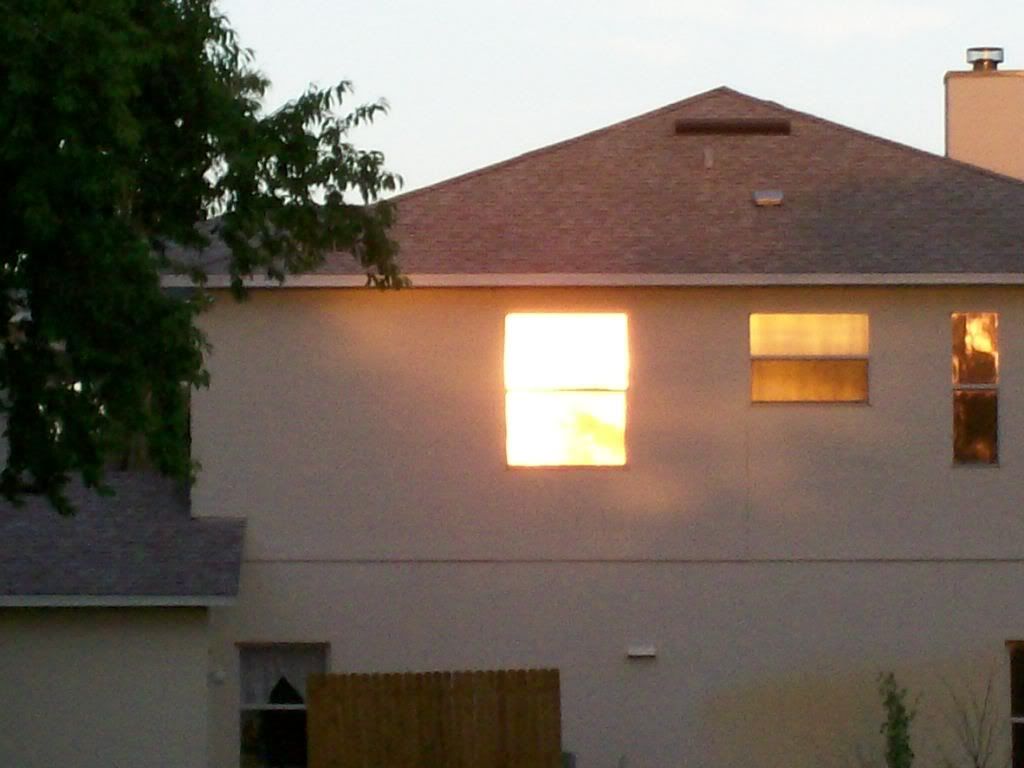
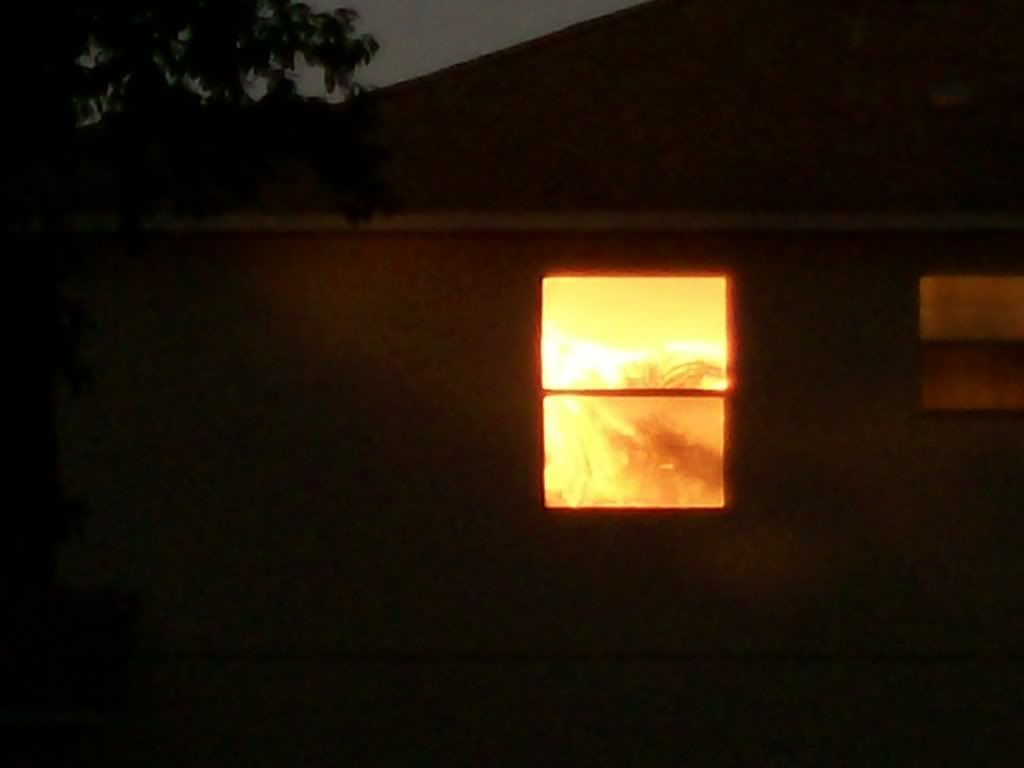
Sometimes when you're taking pictures in odd light, however, very weird things happen. Like this shot I took tonight of the side of a neighbor's house. It was getting close to sunset but still completely daylight outside, and one of the big windows was reflecting the sunset. So I took a shot of the window with the sunset at my back, and ended up with this image (click on it to see larger version):


I swear, it was not that dark out.** It was still full daylight. I'm guessing the reflected sunlight made my camera go wonky. Or for a split second midnight descended six hours early and retreated just as fast. Or the neighbors have a really good security system that messes with digital cameras. Whatever it was, it produced a very cool, spooky effect.

Sometimes when you're writing that happens, too. Words seem to come out of nowhere and arrange themselves in ways you never expected or even considered. You know what you intended to get on the page, but in the process of writing it it simply comes out another way -- weird, strange, different, whatever you want to call it. Spooky writing.

When that kind of thing happens in one of my stories, my first impulse is to dissect it and analyze it (so I can figure it out and control it, of course) but I find myself instead backing away from it every time. Those spooky moments happen for a reason, and even when I don't exactly understand why, they're powerful. They feel right, where they are, the way they are. Other than an editing pass for spelling and grammar I don't alter or cut them.

How do you guys handle those spooky moments on the page (or anywhere else, for that matter?)

*I want credit for not making the obvious flash fiction pun.

**Added: I checked my camera and sure enough, I took a shot of the window before I zoomed in and snapped the spooky one. The before shot is proof of how light it was outside.

Saturday, January 24, 2009

Story Seeds

Anything your senses offer as inspiration for story is always a good thing, but I find next to music that art, texture and other tactile material objects often sow the seeds of what grow into my stories.

Our blogpal Raine Weaver mentioned fortune cookies in her SFC post here about the need for simplification. I save all my fortunes, and sometimes use them sometimes in my altered art/philosophy journals, like this one:


Pulling out that old journal made me wonder if you could tell a story entirely in fortune cookie fortunes. I sat at the table after dinner with the four hundred or so slips I've collected over the years and started arranging them like you do magnetic poetry. I'd have to come up with original fortunes of my own, but they could work as dialogue for an oracle, I think (I'm still mulling it over.)

A few months ago I was looking through some quilt magazines and spotted a photo of this incredible piece by German artist Britta Ankenbauer*:

Scrap City, created by mixed media fiber artist Britta Ankenbauer

I don't know why but seeing this art quilt hit me like a sledgehammer. I responded to this piece on a dozen levels, including a storytelling perspective, which had me jotting down an outline of the city that I saw in the art. That grew into a country, and then a planet, and ultimately became one of the settings for my final StarDoc novel.

I've always wanted to write a piece of fiction about the elements in this photo I took a couple of years ago:


This is more abstract and definitely more personal (the real story behind the image is over on the photoblog here.) I'm not ready to write this one yet, so it's still percolating in the back of my head. When I do I suspect the story will include a minor war between gardeners and artists.

Most of the time we writers maintain a pretty healthy stock of story seeds -- if they were veggies and flowers I could supply a couple hundred farms on my own -- but I still think it's a good idea to keep yourself open to the random chance of inspiration. When you respond to something personally, you know if you can convert that energy and passion into words that it's going to shine through in the work, and better yet, no other writer will have anything like the beauty you grow.

*To see more of Britta Ankenabauer's amazing textile art, visit her web site here.

Thursday, July 12, 2007

VW#3: Turn Up the Wattage ~ Story Power

The winners of VW#1 giveaway are:

Jaye Patrick

Calenhíril

Winners, please send your full name and ship-to address to LynnViehl@aol.com, and I'll get these goodies out to you. On to the workshop:

I. The Terminal Manuscript

A submission lands on an editor's desk. The manuscript is perfectly formatted, printed, and meticulously proofed. The prose is well-written, the characters fully-fleshed out, the settings precisely detailed, and the plotwork completely logical. Even the title is a fitting choice.

If this submission were a bed, it would be all starched sheets and hospital corners.

The editor reads the first chapter or reviews the synopsis, and then composes a letter to the novel's hard-working author. She might praise the author for their competence, but she does not make an offer. Instead, she rejects the novel and moves on to the next submission.

Why does the editor do this? The author covered all the bases. The writing is at professional level. The story is seamless. All the i's are dotted and the t's are crossed, so what's the problem?

The problem is not the manuscript -- it's the story that it tells. It's bland, unoriginal, muddled or uninteresting. No matter how competently it's packaged as a submission, a story that doesn't have the power to captivate and excite the editor is not going to snag you an offer.

II. What Makes a Story Powerful?

When we read, we want to experience the following:

1. Emotional Connection: a great story affects us emotionally, and the only way it can do that is to resonate with us on some emotional level. A love story taps into how a reader feels about desire, love, and commitment between two people, just as a science fiction story invokes the reader's sense of adventure as well as their fears and hopes for the future.

2. Enchantment: like a treasure chest, a story should reveal things that dazzle the reader. If you're showing the reader nothing new, they're going to yawn through your story.

3. Entertainment: a story has to compete with the other pleasures in our lives, like sex, food, television, computers, video games and long hot bubble baths. If a story doesn't entertain us at least as much as a good flick, most readers will toss the book aside and turn on the TV.

4. Escape: everyone can use a few hours off from the burdens and stresses in life, and a great story will whisk us away from them.

Why are the readers' desires so important? A story is only as powerful as the reader's reaction to it.

Remember that these days, most dedicated readers are as sophisticated (and often as jaded) as publishing editors are. If every story out there has already been told a thousand times, readers have probably read nine hundred and ninety-nine versions of it. To push past all those mediocre memories, you need to think about how your story will be different from everything they've already read.

III. Delivering the Goods

To crank up the power of your story, keep all four aspects of reader expectation in mind as you create or polish the work:

#1 -- Make the emotional connection with the reader early on in the novel, and use tension and conflict to increase the stakes. Avoid the same-old-same-old with your plot; take the reader on a rollercoaster ride instead.

#2 -- You can't enchant someone without magic, so look at the elements of the fantastic in your story. Are they unique and unexpected, or dull and predictable? What will thrill the reader? What will bore them?

#3 -- Humor always entertains, but so do scandals, risks, thrills, irony, poetic justic and twists of fate. Any of those in your story? Think about your book being made into a movie -- as it stands, would it be a box-office smash, or tank on opening night?

#4 -- If you want to whisk me away from doing the laundry for a couple of hours, you've got to give me the vicarious thrill of being a voyeur. Show me new worlds, exciting people, and provocative situations. Don't show me more laundry.

IV. Power Generators

Powerful stories are the ones that start trends, propel their authors to publishing rockstardom, and end up occupying our keeper shelves. Ask Helen Fielding, the perpetrator of chick-lit, or Anne McCaffrey, the grand dame of science fantasy. John Grisham gave us the courtroom thriller; Stephen King has remade horror in his own image. We just lost Kathleen Woodiwiss, whom most of us consider to be the mother of the modern romance.

All of them have the same thing in common: they wrote powerful, original stories that blew away their readers.

It's tough to take risks with your fiction, though, especially when you could be writing a competent knockoff. We all want to feel safe, especially when we're first starting out, because God forbid we get our foot in the door only to blow it. But I think we have to pour as much power as we can get into our stories, because the readers are so bored that they're finding other things to do, and we're losing more of them with each passing year.

Or maybe I'm wrong, and readers will collectively run to the stores to buy up the two hundred very competently written vampire brotherhood series that will be published in the next year.

We'll see.

For a chance to win one of today's two Left Behind and Loving It goodie bags, in comments to this post ask a question or share your view on story power, or just throw your name into the hat by midnight EST on Friday, July 13, 2007. I will draw two names at random from everyone who participates and send the winners a tote filled with a signed copy of my novel StarDoc (paperback), as well as unsigned copies of The Writer's Book of Matches ~ 1,001 Prompts to Ignite Your Fiction by the staff of Boiled Peanuts, a literary journal (hardcover), Unbound by Lori Devoti, One Night with You by Gwynne Forster, Raintree: Inferno by Linda Howard (paperback), Tied to the Tracks by Rosina Lippi (trade paperback), Night Echoes by Holly Lisle, the July/August 2007 issue of Poets & Writers magazine, and some surprises. This giveaway is open to everyone on the planet, even if you've won something here at PBW in the past.

Other sources on story power:

Kim Kay's To Speak or Not to Speak ~ Creating Dazzling Dialogue Part 1 and Part 2

Lost on the Border at Twilight: Finding -- and Using -- Your Life's Essential Strangeness by Holly Lisle

Play It Again, Sam - Redundancy in Writing by Tina Morgan

Rob Parnell's I Can't Put It Down - How to Write Compelling Fiction


Other virtual workshops now in progress:

Joely Sue Burkhart's Do You Know the Secret?

Gabriele Campbell's How to Make a Battle Come Alive on the Page, Part 1

LJ Cohen's Organize your Novel with a WIKI

Rosina Lippi's Workshop Day 1: The Story Machine, Workshop Day 2: Ask Your Characters

Shiloh Walker's Heat with Heart Day 1, finding that missing emotion, Exploring that Backstory (where she briefly grills me)