Showing posts with label Pages magazine. Show all posts

Wednesday, January 14, 2015

Pages Winter 2015

Due to the usual holiday madness I was a little late picking up the Winter 2015 issue of Pages magazine, but I thought the journal-maker's instant fix would make a nice creative kickstart for the new year. I'm planning on making all my journals for 2015 -- no more being lazy and buying them from the store or Etsy! -- so I was quite interested to see what sort of inspiration they were offering.

It's an okay issue for the most part. This time nearly all the projects were fairly standard book-type journals (as opposed to past issues that explored making a journal out of a paintbrush, a fake piece of fruit, etc.), which will appeal to the traditionalists. I did like the Illuminated Tangles page project by Wendy Currier and Marcia Thornton Jones, which is a kind of fusion between Zentangle-type doodling and illuminated manuscript techniques. The steps of the project are explained very well, and the results are impressive. It's also a project basically anyone can do.

The techniques in this issue ranged from interesting to useful to scary. Making a book you don't have to sew or glue and assembling a simple pop-up were likely the best of the lot. Watercolor travel journalers will really love the piece on visual fieldnotes, while those of you who are interesting in less traditional journals will enjoy the project on deconstructed journaling. There are also some stunning journal pages showcased in the back of the issue that look as if they've traveled through time.

Because I'm a nut about old sewing notions I have a substantial amount of old buttons cards that I've never done anything with, and in this issue Mandy Russell shows you how to use them as covers for wee journals. The artist does use a Coptic stitch to bind the journals, so it's a bit more advanced in the technique department, but she has excellent directions and a couple of stitching illustrations to show you how to manage the binding. The scary project was one that involved cutting up and weaving strips from aluminum cans to make journal covers; while I appreciate the recycling aspect it definitely looked like an exercise in slicing your fingers to pieces. If you can't resist that one I advise you proceed with extreme caution and make sure your tentanus shot is current.

I did feel this issue is a bit light on new ideas, and I get the feeling Pages may be heading in another direction now. I really liked this magazine because it started out genuinely invested in real, creative book-making. In this issue I do see some signs (the results of a subscriber challenge, making your own "cozy journaling corner") that it could be evolving into another Butterfly people rag (and Lord, don't read the article about the scroll journal in this issue unless you want to cry all morning.) If the next edition is more of the same I think I might have to move on, but I'm hoping it won't be.

Wednesday, June 18, 2014

One-Sheet Journal

For Journaling Week I decided to test-drive Rachelle Panagarry's mini-zine project from the Summer issue of Pages magazine. There is no binding, gluing or any special technique involved except folding, and it's so simple I think anyone can do it.

Here's a slideshow of my first try, along with simple instructions to go with each pic.


1. To make this you'll need a sheet of letter-size paper and a pair of scissors. I used some old printer paper.

2. Fold your paper in half both ways, which divides the paper into four equal sections.

3. Fold the long ends of your paper over so that the ends are even with the center fold, and create eight rectangular sections.

4. Fold your paper by the long ends and cut the center fold up to the next intersecting fold. Stop there.

5. Open and refold your paper the other way (by the short ends) and stand it up like a tent.

6. Take the ends and push them toward the center to form a plus sign with the paper.

7. Place your plus sign down and press flat.

8. Fold over in half.

9. You've got a mini-journal.

10. The reason this project is so cool is that you can unfold your journal once it's finished and copy it (which is why Ms. Panagarry makes hers into little zines to share with friends.) Here's my first picture journal, and the two copies I made for extras:


Some project tips: for best results, match your edges exactly and crease your folds well. If you're making a journal out of something that already has content printed on it, your content should be face-down as you do steps 1-3, then face out from steps 4-8. Do one blank book first to figure out how the pages are oriented (front and back covers are the first two rectangles on the upper left side of the paper, for example. Also, half your pages are upside down to the other half.)

If you want to print something on your paper before you fold it, you might so a black and white version first to make sure you have everything arranged correctly (I didn't size a couple of my pics correctly, so this saved me some color ink.)

Wednesday, June 11, 2014

Summer Pages

The Summer 2014 issue of Pages magazine has just hit the newstands, and naturally I grabbed a copy as soon as I saw it at my local BAM. I've been waffling on a couple of journals I want to make and really needed a good shove in the right direction. Definitely got that and then some from this issue.

While this installment of Pages may not offer as much in the way of whimsical projects as some of the previous editions, I liked it probably more than all the previous issues I've read. Don't get me wrong; I love the idea of turning a paint brush into a journal-like art object, but it's not really a practical project for someone who uses all the journals she creates for actual journaling. Still, for those of you who do like the fun stuff, there's a piece on creating a niche for the little books you make, as well as a way to turn tissue boxes (as in Kleenex tissue) into journals.

As in previous issues the variety of techniques is interesting, and address every aspect of book making. This time around there are several projects that incorporate unusual/non-traditional materials, like encaustic paints, driftwood and shipping tags. The magazine's ongoing committment to featuring projects using recycled materials hasn't evaporated, either; two of the book-making projects use two kinds of old envelopes, and there's an interesting piece on an experimental project that makes art out of an old book that at one point the artist set on fire.

Two articles I found especially interesting:


Rebekah Meier has found a way to make journal covers out of quilt batting -- aka the fluffy stuff that is sandwiched between the top and bottom layers of a quilt. Batting is not made to be used as a fabric itself, but that didn't stop Ms. Meier from doing this. I'm fascinated by the project because there is a particular type of soft cotton batting I use that has a luscious feel to it, and I'd love to cover one of my journals with it.


Making a book from a single sheet of paper requires some careful planning and origami-type folding skills, but it's a simple way to make a small book. Rachelle Panagarry uses her one-sheet book making skills to produce mini-books for short stories or as little giveaway zines. This is one of those projects that virtually anyone can do without having to take a book-making class, plus it lends itself beautifully to personal customization. The editors must have really loved it, too, because they've issued a reader challenge in this issue for everyone to follow Ms. Panagarry's example and send in their own mini-zines, the best of which will be features in Pages Winter 2015 issue (and if you want to join in, the deadline is August 19th, 2014; see complete challenge rules on pages 72-73 of this issue.)

Thursday, January 02, 2014

First Reads of 2014

I thought I'd kick off my 2014 reading year with books and mags I was given or bought during the holidays. Here's what I picked:


And, what I thought:

I picked up a copy of Writer's Digest Writer's Yearbook 2014 special issue because of the market listings; I needed the info for some future sub op posts. Kevin Kaiser has a decent article with some smart strategies on self-promotion for those of you who are looking more for theory, but the rest isn't all that new or interesting. I do think the market listings make it worth the cover price, though.

The Cuckoo's Calling by J.K. Rowling (at first pretending to be a guy writer named Robert Galbraith until the publisher realized no one was buying the book and accidentally/artfully spilled the beans) is a private detective mystery. It's easy to sneer over a book that didn't sell until everyone knew who really wrote it, but I thought it was okay. Middle of the road, earnestly-written -- like a lot of popular hardcover crime fic, in fact (disclaimer: I'm not really a P.I. mystery fan, but I started with P.D. James's Dagliesh novels, so as a result I expect my reading bar is a bit higher than most.) There were a few size references for the protag that also made me envision that kindly giant character Hagrid from Harry Potter, but otherwise it seemed to be entirely Hogwart-free. I would not recommend it for youngsters due to the violence, language and certain themes -- J.K. does sprinkle the eff word about quite liberally -- but fans of Michael Connolly and his sort might find it mildly diverting.

Land of the Painted Caves by Jean M. Auel. How do I describe this reading experience, besides regret over the large chunks of three days of my life spent plowing through it that I'll never get back? I had wondered why so many of you had nothing good to say about the book when I mentioned it last year, and hindsight says I should have listened to you. It's true that I haven't really loved the series since the end of The Mammoth Hunters, but I was hanging on until we could get to the last novel, you know? I even waited an extra two years before I cracked this puppy so I'd be emotionally ready to let go.

Am now quite ready. Fasten your seatbelts, friends.

Probably the most annoying thing was all the repetition, repetition, rep -- I mean, how many times did we really have to hear the Mother's song in its entirety? I'm thinking not twenty-seven, how about you? Or what it was like to bring the horses into a strange camp and calm people's fears about them (fifty times), or show them how to pet Wolf and feel his neck fur (ninety times), or be introduced to Ayla and hear all her titles (two hundred times), or see the same fricking boring cave paintings of horse heads and elephant heads and what have you over and over (I'm not counting those. After the third cave, I just skipped over those scenes.) I think some of you mentioned that, too.

And what was with the kid and whipping her out of the carrying blanket so she could pee on the ground? Why, exactly, did I have read that four hundred times? Jean, honey, I've potty-trained a daughter. After the first perfectly-timed piddle it's just not that impressive. And that's in real life -- but in fiction? Even less.

I know how difficult it is to end a series, so I think I could have forgiven all the repeats and dragginess, but whoever was playing the part of Ayla in this book was not the Ayla I know from The Valley of Horses. That Ayla would have never stood around so much, or uttered all this housekeeping dialogue, or treated Jondalar like an unreliable babysitter instead of the love of her life, or perpetually kissed the First's butt for reasons I'm still not straight on (and don't get me started on that portion of the story. Your seatbelt will snap.) No, my Ayla would have packed up her sling and dragged Jondalar back to the Mamutoi and gone on thrilling hunts and invented more cool stuff and tamed some more critters and kept me from falling asleep. This Ayla was about as engaging as Zzzzzzquil.

No reunion with Durc, so that was a huge disappointment. I should have expected that, but I really wanted Ayla to see her kid again, one last time. I was led to believe it would happen. Remember the dream she had where her Clan son meets her Other son and they fight or something? I think that was in The Mammoth Hunters. What happened to that coming true?

Then, toward the end, in the last part . . . I won't get into specifics so I don't totally spoil the end, even though I want to, but Jondalar and Marona? After what that witch did to Ayla in Shelters? Okay, maybe my disbelief might have eventually stretched to accomodate that drop into fictional relationship hell -- Jondalar could have had a complete lobotomy at the Big Summer Meeting, right? -- but then to follow it up with Ayla and Laramar? Really? Laramar? No, really? Laramar? Laramar?

JM&J. I never like to caps-yell, but the next time you all tell me not to read a book, I swear, I AM GOING TO LISTEN TO YOU.

To end on a positive note, the Winter 2014 issue of Pages magazine has just hit the racks, and this one has another great assortment of ideas and projects for your handmade books, journals and art journaling. I was amused to see the "Pocket Star" journal (have to make one of those for my editor) but I thought Gina Lee Kim's Washi Tape Art Journal project and Shayna Butler's article on what to put in an idea book were especially inspiring. I also applaud the editors for continuing to provide fresh new projects, many of which use recycled materials, for those of us who love to make books.

So what have you read so far in 2014? Let us know in comments.

Thursday, June 13, 2013

Pages

Can you turn driftwood, two by fours, cereal bags and coasters into journals? If you get the third issue of Pages magazine you can; those are just a few of the projects included in this Summer 2013 edition. There are also two articles on how to make journals you can wear on necklaces which look like fun; I'm definitely going to try my hand at both.

Over the last couple of years the evolution of journal-making as an art form has been fascinating to follow. Mixed media artists are bringing new materials, techniques and perspectives to the craft that are entirely unexpected, and taking the journal in all sorts of new directions. Pages does a great job in sampling some of the most interesting of these as well as presenting ideas I've seen nowhere else. As with previous issues the mag offers multiple projects with detailed instructions for bookmaking, covers and binding, inside pages and the art of journaling, and as always there are plenty of ways you can repurpose and upcycle materials to keep your projects green.

One of the articles in this issue, Boiled Books by Laura Ryan, involves combining botanical material with paper in a layered packet that you boil to transfer the natural dyes in the botanicals to the paper. You may remember I did something like this (admittedly on a much smaller scale) with my tea-dyed index card journal, and the results were very pleasing.

Laura's results are stunning:


Personally I can't wait to try her technique. One note of caution on this project: many plant materials like oleander can be highly toxic, so be sure whatever botanicals you use are safe before you handle them or toss them in the boiling water (and Laura makes quite a few suggestions of non-toxic organic materials you can safely use in the article.)

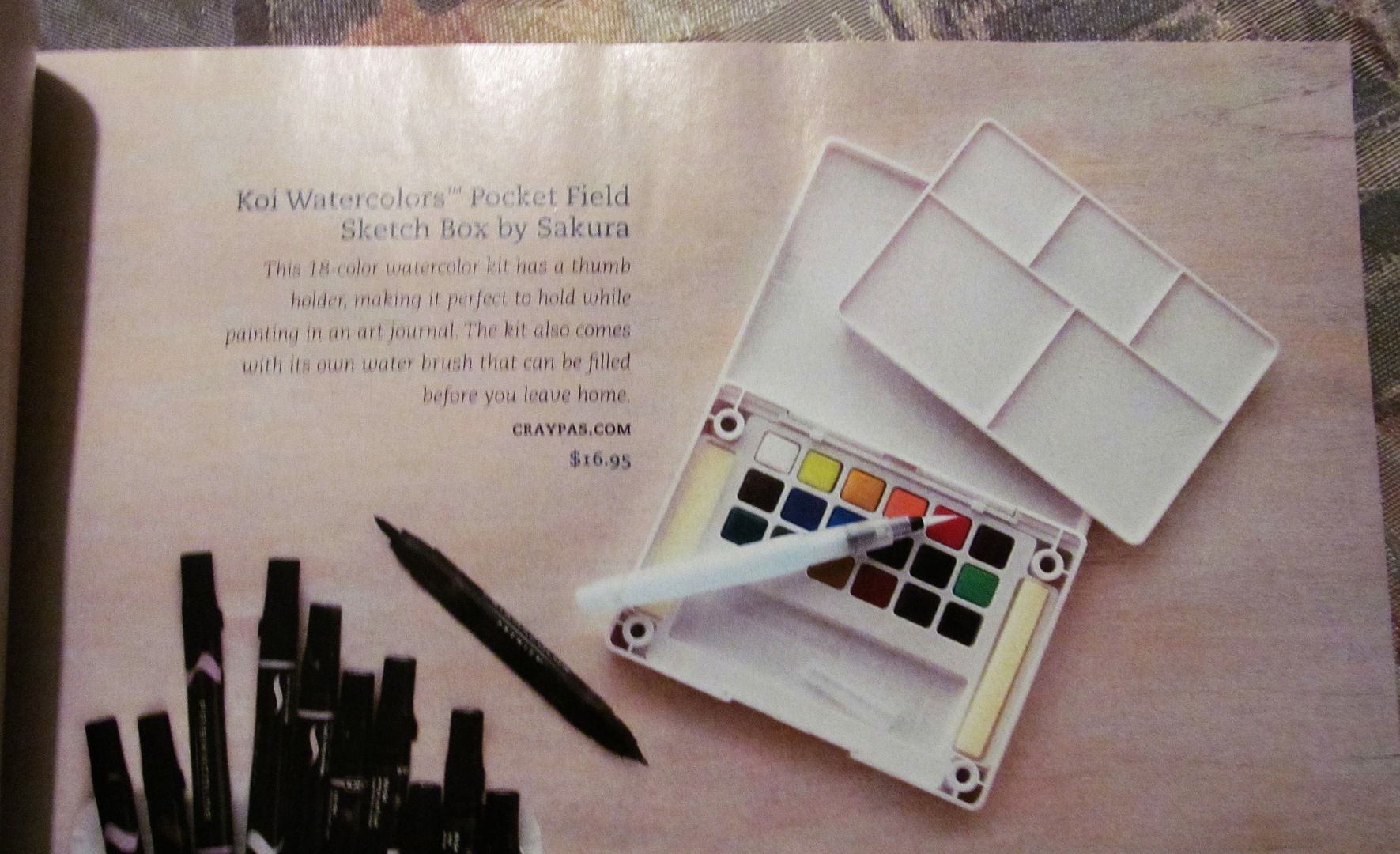
In the editors' picks section I noted one more thing I immediately wanted, this watercolor pocket field sketch box by Sakura. It's hard for me to travel with my watercolors, and this kit sounds ideal as a take-along. The brush in the kit contains a reservoir that you fill with water; if that really works and eliminates the need for a water dish that will make the kit super convenient for watercolorists who want to paint on the go.

You can usually find Pages on the magazine racks at most big chain booksellers, or order it online here in print or as a digital download here.

Sunday, July 01, 2012

More Pages

The 2012 issue of Pages, the creative guide for art journaling and bookmarking from the publishers of Cloth Paper Scissors, has just hit the newstands. I fell in love with the premiere issue last winter so there was no question I'd grab the second volume.

This one has several whimsical projects in it, from creating tiny wearable books to fusing and stitching plastic shopping bags into covers. There's also a mini-workshop on Japanese stab binding which I'm going to study, as I've gotten a little bored with coptic stitch and want to stretch my binding horizons.

If you have art journal maker friends, there's a good article on how to host a journal swap using pages rather than entire books (which could result in a neat collaborative project if you belong to an art group.) If you're a pack rat, there's an excellent project on creating a keepsake album made entirely of envelopes (this is another one I might try as I have piles of tiny ephemera stashed that I'd like to sort and keep categorized.) One artist shows you how to make wall-type paintbrushes into books by removing the bristle block and replacing it with decorated pages. I thought that one was absolutely ingenious.

I was so tempted by Katherine Pippin Pauley's project Not a Still-life, which shows how to make books out of fake plastic fruit, that I had to give that one a try right away. She used hers as recipe booklets -- each themed by the sort of fruit she used, but I decided to make mine into a poetry and photo album that paid homage to the color of my fruit.


Although it looks simple enough there were some tricky parts; cutting the fruit in half evenly requires a very sharp blade, and the accordion-folded pages have to be precisely trimmed to fit. Still, I made the book in a couple of days, and what I learned from my first attempt now has me eyeing other objects I might turn into books.

Once again the editors included a nice range of projects suitable for beginners to advanced book-makers. They're also keeping it green by emphasizing the use of recycled materials. One artist made a travel art journal out of an old sweater; another fused and stitched tiny bits of scrap fabric to create some impressive abstract covers.

I think Pages is breathing new life into a very old craft. Book-making has always been a serious, sober art, and while there's nothing wrong with that -- I have enormous respect for the traditionalists -- I think opening it up and bringing an element of play to the table makes it more accessible. Back when I took my class in book-binding we were lectured on using the proper materials and following techniques that really hadn't changed much since the seventeenth century. I've made some lovely traditional books, but I'd like to stretch my range and explore some new territory. Pages magazine is definitely taking me there.

Tuesday, November 29, 2011

Making Book

Cloth Paper Scissors has debuted a new magazine, Pages, as a creative guide for art journaling and bookmaking. The Winter 2011 issue has over sixty different handmade books and journals, and is simply stunning. I haven't seen this many good ideas in one place since reading Alisa Golden's Making Handmade Books (which they also review in this issue.)

The magazine sectioned projects and articles into Bookmaking, Book Covers, Binding, Inside Pages, Art Journaling and Regulars (editor's page, advertising, supply wish lists, etc.) I think this is smart because often with bookmaking you know what you want for one part but need some ideas for others (I have no problem with making interesting covers, for example, but I definitely need some new directions to try with my pages as foundations. I'm also not especially fond of complicated bindings, and often have the most problems with that part of bookmaking, so I always like seeing alternative binding options.)

Making your own books seems like an old-fashioned concept, but with all the attention and emphasis electronic format is getting, I think it's more important than ever to devote some quality time to writing and creating personal works that can't be uploaded or downloaded, pirated or otherwise become lost to the digital abyss. As art goes it can also be intensely private; something one does out of the deep and abiding love for the physical book.

If you've never attempted making a book, and really want to, this magazine is inspiration on tap. Some of the projects are pretty simple and require materials you probably have around the house; other are more challenging and can teach savvy bookmakers some dazzling new tricks. A few of the projects could be scaled down/simplified for kids to try, and I especially liked how many of the projects features upcycled or recycled materials.

This would also make a great holiday gift for your favorite art journaler, bookmaker or diary junkie; find a pretty tote, fill in with interesting materials and supplies and top it off with a copy of the magazine.