Always thinks He's right.
Doesn't dress well; really needs a haircut.
Gets blamed for everything that goes wrong with His work, even when it isn't His fault.
Goes for the surprise ending.
Had one huge bestseller but hasn't done much since.
His only kid got famous using His name.
People who collect money supposedly for His works keep most of it to use for their own purposes.
Spends a lot of time alone; spotted in some very strange places.
Wackos He's never met or even talked to claim to know the precise meaning behind whatever He does.
Wants peace, love and happiness, but rarely gets them.
Sunday, January 31, 2010


Saturday, January 30, 2010
I Dream of Jenny
I'm at a writer's conference, trying to dodge the drinkers, smokers, spitters and touchers -- basically, everyone -- when I'm cornered in the only working elevator by the nastiest person in Publishing I've ever encountered.
Next time, stupid, take the stairs.
SwampBreath Nastiest Person tells me I've been invited to spend the weekend at a private retreat with four other writers, all of whom are RWA legends. One is Jennifer Crusie. HogFace Nastiest Person also makes it very clear that I can't refuse the invitation or my writing career will be roadkill. This is when I realize that I'm a) asleep and b) dreaming, but I don't try to wake up.
Come on. Jennifer Crusie is in my dream; how bad could it be?
I'm magically transported to this beautiful mountain cottage that is about the size of Hearst Castle and looks like it's been decorated by Laura Ashley. Personally. The air smells of heirloom rose potpourri, Botox and platinum American Express cards. There are no kids, men, pets or dust motes, anywhere.
Okay. This is not a dream. It's a nightmare.
I don't know why but I think that Barbara Samuel is cooking something wonderful in the kitchen. Naturally I can't find the kitchen. I can also hear the four legends talking but I can't find them because they keep moving around the cottage-palace. Jennifer Crusie is laughing a lot, not in the evil I've-got-a-chainsaw-waitin'-for-ya way, but in the good way. It's reassuring. She and the others are obviously having fun. Maybe there won't be chainsaws this time.
And maybe this time I will also escape playing the Open Heart Surgery Patient Who Stays Awake Under Anesthesia, or being the live offering to the voracious lava gods of the volcano, or becoming the evening's entree tartar (feeling pretty good about the last one because Barbara Samuel is cooking, not Fannie Flagg.)
On the other hand, I am horribly uncomfortable, and I don't want to touch anything because if I touch Laura Ashley anything there will be chainsaws. There always are. So I wander around like a ghost. I can't figure out where the other writers are or what I'm supposed to do. I should try to wake up, but part of me wants to see if it's my subconscious version of a Jennifer Crusie novel, so I still don't fight it.
Besides, I'm pretty sure it's only around 3 a.m. and if I wake up now I'll never go back to sleep until five minutes before I have to get up.
Finally I discover a room filled with unused art supplies, where I enter, lock the door and begin creating. My art seems to be defacing a wall covered with velvet-flocked pastel-colored paper with these truly cheesy cartoon flowers on it. The locked door opens, and the four legends start drifting in and out of the room, watching me but not speaking to me. Jennifer Crusie talks about her best girlfriends and cute dogs, and she sounds just like her blog.
See?
Meanwhile, I'm now using a sledgehammer to knock out the cheesy flowers, and I keep on defacing the wall but I don't say anything to the four legends because as usual I can't think of a single clever thing to say. I'm painfully aware of how I'm covered in paint splatters and plaster dust, but hey, at least I'm not naked. P.S., my art project has become a 3D Swiss cheese-ish depiction of the Jado Massacre, complete with little blue bodies floating around a massive debris field in space.
You know, there's nothing wrong with admitting you need a little therapy.
About this time the television appears in the room.
No. Oh, no. If it's showing American Idol, I'm going to use the sledgehammer on myself. I swear.
(It's not showing American Idol.)
Thank you.
(You're welcome.) The TV is one of those old-school humongous big screens that looks like a portable billboard. The program being broadcast is a glowing retrospective on various modern Presidents. When they get to Clinton, whom they show as he looked in the seventies and portray as a saint, I make a rude remark.
Rude?
Yep. Something rude.
Am I smelling some Eau de Wimpout?
All right, I refer to the former President as Saint Willie of the Wandering Penis.
Touchdown!
Immediately all four writers gather around me.
Oops. Flag on the field.
While a very disappointed Jennifer Crusie sadly shakes her head, another of the legends tells me I have to leave the premises now.
Using an anatomically correct word for the former President's or any man's pee-pee violates RWA bylaw #9,895.2 paragraph D section 9: "If the member cannot use pee-pee or another word from the list of approved euphemisms for that Male Organ Of Which Nice Girls Must Never Speak, the member shall pretend there is no such thing as a member." Addendum: a guy member, not a member member. You know, that icky thing down there. Not you.
As I slink away feeling thoroughly squashed, I hear one of them say that they expected better of me. It's not Jennifer Crusie, though. She's talking about dogs again.
And now the chainsaws!
Instantly I wake up. It's 3:15 am, and I don't go back to sleep until five minutes before I have to wake up.
Tolja.
Nightmare analysis: Minus some elements, would make a decent horror short story. It was a bit like the David Lynch version of something that happened at my first Nat'l conference. The wall/sledgehammer thing is likely due to the permanent damage inflicted by the required reading of Poe's The Cask of Amontillado during my freshman year in high school. I thought writing that scene where Nick finds Gabriel in Night Lost would help, but no, my ninth grade English teacher really did scar me for life. Setting came from being pressured to attend a romance conference, which evidently left an unpleasant aftertaste in my psyche. Kind of like Clinton's administration. I wonder what Barbara was cooking. It smelled amazing.
To prevent a repeat, I probably should stop reading business e-mail, Barbara Samuel's books and Jennifer Crusie's blog right before I go to bed.
Next time, stupid, take the stairs.
Come on. Jennifer Crusie is in my dream; how bad could it be?
I'm magically transported to this beautiful mountain cottage that is about the size of Hearst Castle and looks like it's been decorated by Laura Ashley. Personally. The air smells of heirloom rose potpourri, Botox and platinum American Express cards. There are no kids, men, pets or dust motes, anywhere.
Okay. This is not a dream. It's a nightmare.
I don't know why but I think that Barbara Samuel is cooking something wonderful in the kitchen. Naturally I can't find the kitchen. I can also hear the four legends talking but I can't find them because they keep moving around the cottage-palace. Jennifer Crusie is laughing a lot, not in the evil I've-got-a-chainsaw-waitin'-for-ya way, but in the good way. It's reassuring. She and the others are obviously having fun. Maybe there won't be chainsaws this time.
And maybe this time I will also escape playing the Open Heart Surgery Patient Who Stays Awake Under Anesthesia, or being the live offering to the voracious lava gods of the volcano, or becoming the evening's entree tartar (feeling pretty good about the last one because Barbara Samuel is cooking, not Fannie Flagg.)
On the other hand, I am horribly uncomfortable, and I don't want to touch anything because if I touch Laura Ashley anything there will be chainsaws. There always are. So I wander around like a ghost. I can't figure out where the other writers are or what I'm supposed to do. I should try to wake up, but part of me wants to see if it's my subconscious version of a Jennifer Crusie novel, so I still don't fight it.
Besides, I'm pretty sure it's only around 3 a.m. and if I wake up now I'll never go back to sleep until five minutes before I have to get up.
Finally I discover a room filled with unused art supplies, where I enter, lock the door and begin creating. My art seems to be defacing a wall covered with velvet-flocked pastel-colored paper with these truly cheesy cartoon flowers on it. The locked door opens, and the four legends start drifting in and out of the room, watching me but not speaking to me. Jennifer Crusie talks about her best girlfriends and cute dogs, and she sounds just like her blog.
See?
Meanwhile, I'm now using a sledgehammer to knock out the cheesy flowers, and I keep on defacing the wall but I don't say anything to the four legends because as usual I can't think of a single clever thing to say. I'm painfully aware of how I'm covered in paint splatters and plaster dust, but hey, at least I'm not naked. P.S., my art project has become a 3D Swiss cheese-ish depiction of the Jado Massacre, complete with little blue bodies floating around a massive debris field in space.
You know, there's nothing wrong with admitting you need a little therapy.
About this time the television appears in the room.
No. Oh, no. If it's showing American Idol, I'm going to use the sledgehammer on myself. I swear.
(It's not showing American Idol.)
Thank you.
(You're welcome.) The TV is one of those old-school humongous big screens that looks like a portable billboard. The program being broadcast is a glowing retrospective on various modern Presidents. When they get to Clinton, whom they show as he looked in the seventies and portray as a saint, I make a rude remark.
Rude?
Yep. Something rude.
Am I smelling some Eau de Wimpout?
All right, I refer to the former President as Saint Willie of the Wandering Penis.
Touchdown!
Immediately all four writers gather around me.
Oops. Flag on the field.
While a very disappointed Jennifer Crusie sadly shakes her head, another of the legends tells me I have to leave the premises now.
Using an anatomically correct word for the former President's or any man's pee-pee violates RWA bylaw #9,895.2 paragraph D section 9: "If the member cannot use pee-pee or another word from the list of approved euphemisms for that Male Organ Of Which Nice Girls Must Never Speak, the member shall pretend there is no such thing as a member." Addendum: a guy member, not a member member. You know, that icky thing down there. Not you.
As I slink away feeling thoroughly squashed, I hear one of them say that they expected better of me. It's not Jennifer Crusie, though. She's talking about dogs again.
And now the chainsaws!
Instantly I wake up. It's 3:15 am, and I don't go back to sleep until five minutes before I have to wake up.
Tolja.
Nightmare analysis: Minus some elements, would make a decent horror short story. It was a bit like the David Lynch version of something that happened at my first Nat'l conference. The wall/sledgehammer thing is likely due to the permanent damage inflicted by the required reading of Poe's The Cask of Amontillado during my freshman year in high school. I thought writing that scene where Nick finds Gabriel in Night Lost would help, but no, my ninth grade English teacher really did scar me for life. Setting came from being pressured to attend a romance conference, which evidently left an unpleasant aftertaste in my psyche. Kind of like Clinton's administration. I wonder what Barbara was cooking. It smelled amazing.
To prevent a repeat, I probably should stop reading business e-mail, Barbara Samuel's books and Jennifer Crusie's blog right before I go to bed.
Friday, January 29, 2010
J.D.
 You were rude, arrogant, eccentric, reclusive -- and that's just what the people who liked you say. I admired you, not for that damn book, which annoyed the hell out of me, but instead for the way you ferociously battled to protect the work as well as the rights of the author. I bet you went out still swinging, too.
To reflect on your legacy, well, let's put it this way: my middle teen has a copy of that damn book sitting on his desk at this very moment. He's writing a paper about it, and he and I have already had several semi-heated debates over it. I expect we'll have many more.
Whatever people say about you, your writing and the way you lived, J.D., you didn't just talk it, you walked it. Rest in peace.
Thursday, January 28, 2010
Fun with Droste
 The Droste Effect is named for a Dutch cocoa maker that employed a recursive image (an image which contains an image of itself that contains an image of itself that contains an image of itself, etc.) on its tin.
Escher had a lot of fun with the Droste Effect, too, which can be explained mathematically. If you loop a droste effect image, you can create a little piece of infinity, ala Rooney Design's Christmas Zoom Movie.
In fiction, we have a similar term -- mise en abyme* which is the practice of telling a story within a story. Usually this takes form as a character within the story telling a story, as Stephen King is quite fond of over-doing to the point of where I want to slap some duct tape over the mouth of every old guy who walks into one of his scenes. But for the sake of this post (and because the Dragon is not fond of French) I'll refer to the story-within-a-story device as droste.
If you look at them sideways, prologues and epilogues can be viewed as droste, as they're usually about what happened before and after the central story. Flashbacks, or prologue that is scattered throughout the story, is a form of droste, and so are those revelatory dream sequences. But the most common use of droste is usually delivered through dialogue as a character delivers backstory, a revelation, or something else that until that point has not been explained or made obvious:
Heather collapsed into the chair in front of the mirror, laughing until tears rolled down her satiny cheeks. "M-M-Morning Cloud?"
One of Nathan’s now-winged ebony brows rose. "It’s the special name I gave you when we were children playing together in the secret flower-covered meadow on the reservation where your father owned the general store and cheated my relatives for every dime he could get and beat you regularly but I still loved you and swore one day we’d be married which is why I’m defending you against the murder charges you were framed for."
Heather covered her face with her slim hands as her shoulders shook. When she could speak again, she said, "Hand me a beer, Running Bear."
"Bird. Running Bird."
"Whatever." She caught the can he tossed to her and drained it in five swallows. "I can’t keep doing this, pal."
Nathan’s other brow rose. "Oh, like I’m having the time of my life?" He stared at the pizza. "We haven’t eaten since Gena made us stop at the diner back in Nevada, and you threw your food at me --"
"That was to get you back for kidnapping me from the school for the retarded children where I was a much-beloved teacher and forcing me into your pickup truck and driving me out of the state before I could be arrested for the murder of my ex-husband who was never able to consummate our marriage due to an unspecified health problem and consequently treated me like dirt," she reminded him.
Aside from my little romance parody here (the rest of which you can read in my freebie Sink or Swim), these standard deliveries are all perfectly acceptable, and there's no reason why you shouldn't use them. But I think it can be fun to play with other forms of droste storytelling, and find new ways to incorporate these stories within the story without resorting to the tried and true.
Hand-written Artifacts: letters, journals, memos, reports, and all the other paper ephemera of life contain a lot of information, often in a neat package. Jane Austen was quite fond of having her characters write plaintive letters to each other to explain things, and in our generation we're seeing novelists do the same with voice mails, e-mails and texts. How about graffiti, shopping lists, or half-finished crossword puzzles? Anything written is game as droste.
Lyrical Fragments: Foreshadowing quotes from songs and poetry can be found in every other book on the shelf, but there is more to music and verse than Bob Dylan and Robert Frost. Consider the droste possibilities in opera, rap, chants, prayer, folk songs, marching cadences and meditations. And speaking of poetry, I'd love to see backstory delivered in original limericks, or haiku, or villanelles.
Everything in Print: we've all seen the droste newspaper headline or short article, but why not draw on other sources of news? Severe weather warnings or other community alerts that run across the bottom of the TV like ticker tape can be very dramatic, so can lab test results, a performance report, a page from a police blotter or a middle school student's typed science project outline (I used that one in Dreamveil, btw.)
When you weave a story within your story, you are in essence interrupting the reader, so the main point is to make it worth it. One of the most original and effective forms of droste storytelling I've seen in recent years were in Stephenie Meyer's New Moon, specifically pages 85 - 92 (hardcover edition). The pages list a single word -- the current month -- but are otherwise blank. They're not even numbered. This is because the protagonist, who narrates the book, is in such a terrible depression that she falls silent, and these pages are the only thing to tell us of her misery and that these months are passing -- without her or the author having to utter a single word.
Look around you and see if you can spot some unusual form of droste in your corner of the world. For a couple of weeks last fall I drove past one property whose owner kept in the front yard a hand-painted plywood sign with brief heartfelt messages for a woman we'll call Sandra, always punctuated with a blue heart, and positioned so they could be read from the road (obviously so she would read them whenever she drove past.) The messages were loving and G-rated, and could have just been a romantic gesture from a really cool guy, but it was the little blue heart that told me things were not so rosy.
I looked for and read the signs every time I drove past, and I still wonder if they disappeared because he gave up or they got back together. Maybe this fall he'll finish the story for me with a blue stork-shaped sign that reads It's a Boy!
*The French phrase was derived from a practice in heraldry of putting the image of a small shield on a larger one.
Wednesday, January 27, 2010
Letters to Dead Writers

Letters to Dead People, an online blogging project by Celine Song, is exactly what the title says: letters written to the deceased. They're short and sweet, like telegrams to the hereafter, and seem to range from wry to angry to painfully wistful. Every one I've read so far is addressed to a famous person, like the one above to Edgar (and yeah, I'm kind of partial to the wording.)
I can't recall ever writing a letter to a dead writer. For one thing, I like receiving replies to my letters. I have sent letters to a few ailing writers, mostly recently Kage Baker, to pass along encouragement, thoughts and prayers, that sort of thing. When you're in the hospital it's nice to know people care and are thinking of you; I speak from much experience.
If I had to write letters to the writers who have left this world, the ones whose work means a great deal to me, I'd likely pen something long, rambling, filled with awkward gushy fan stuff, earnest thanks, and end with a promise to carry on and pay it forward. But I think I can distill one down to a short version:
Dear Oscar Wilde,
Beautiful, brilliant man and writer, you've always nudged me to laugh at myself. Thank you. I wish the wall paper had gone instead.
PBW
Now it's your turn: Which writer in the hereafter would you write to, and what would you put in your letter? Let us know in comments.
Tuesday, January 26, 2010
Coining by Association
Jeroen Kessels' Word Generator creates artificial random words in your choice of seven languages. The helpful thing about this particular generator is that it produces words that look and even sound real (at least in English, Spanish and French; I'm assuming it does the same in the other available languages.)
It also gives you sixty words at once, which gives provides a nice selection to choose from versus the one-word generators out there. While I was playing with it, I started making a list of the artificial words that caught my eye:
ritabian
versompe
lortler
amesar
cablere
throtild
feury
verislor
thagic
inkmande
When your a kid and you don't know the definition of a word or phrase, often you'll make up one in your head. Until I reached high school I thought a socialist was just someone who was very old, fussy-friendly and went to church a lot. There was even some logic to that assumption: the monthly meeting my grandma went to was called a social, and at them she would hang with her friends and make calendars out of felt and sequins and beads to sell at rummage sales. Therfore a socialist had to be one of those crafty-type old people.
Fortunately I never called my rabidly independent. group-hating Grandma a socialist; she probably would have throttled me.
There are any number of techniques writers can use to coin words, but I like returning to that childlike mindset and building words out of bits and pieces of other words that have real or personal meaning through word association. It means letting go of logic and knowledge and instead running with your imagination, and once you get the hang of it can become a kind of game.
Let's look at that list again, and this time I'll also add what goes through my head as I'm looking at the word:
ritabian: rit = writ; something written; abian = Sabian = cymbal (this is what I get for hanging with musicians when I was younger) = symbol (soundalike word.) Ritabian could be something written that is also something symbolic, maybe a type of pictograph made of words.
versompe: vers = something elegant, i.e. Versace, Versailles, ver à soie (silkworm); sompe = sump, a reservoir inside the bottom of a machine. I don't think there is such a thing as an elegant sump, but the image that forms in my head in some kind of boudoir oubliette; an elegant trap.
lortler: It looks a lot like chortle (chuckle + snort = chortle) but the beginning L softens the word, so maybe a chortler who whispers.
amesar:: ame = amiable, friend; I definitely hear "Tsar" in the end of this word, which is to me a dual symbol of power and corruption, so a kind of benevolent tyrant who isn't too clean or too awful.
cablere: two sound-alike words popped into my head: caballaro and cabala; the -lere makes me think of an organization. A secret cowboy society, or someone who runs one.
throtild: throt = throttle; -ild = gild; a beautiful but tight adornment worn on the neck to downsize it, like a throat corset.
feury: this looks like a blend of fey + fury. Angry faeries.
verislor: veris = Latin ver = truth; lor = lore. Legends based on something that really happened, or that expose the truth of some event.
thagic: thermal + magic. Phoenix-type magic, fire-based that burns or backlashes on the practitioner in some fashion. Magic of last resort; magic of the masochist. Sorrowful magic.
inkmande: ink = ink; mande = mandatory = directive. Although it would probably make more sense to define this one as homework or something one is made to write, I'm thinking it's a kind of writing instrument. Not a pen, but something that functions like a pen that is also plain but beautiful to look at.
If you have trouble coining words, coming up with titles or otherwise using words as building blocks, this kind of game can help stretch your boundaries and teach you to see words not as someone else defines them, but as what they mean to you. Getting in touch with that part of yourself who is still a kid and wants to define the world on your terms is never a bad thing, either. It's the kind of exercise every imagination needs on a regular basis.
Monday, January 25, 2010
Story Divorce Ten
Ten Things that Indicate You and Your Story Should Part Ways
Backstory Shortages: A description of all your characters' backstories can fit comfortably on a Post-It note, and you're okay with that.
Character Massacre: By page fifty you find yourself killing off the entire cast, and you're not writing a zombie novel.
Crit Partner Pass: You refuse to show any pages of your story to your crit partner, unless you really hate him/her, in which case you dump all the pages on them.
Flame Fodder: when your spouse needs some kindling in order to start a fire on a cold night, you hand him the first three chapters you just polished.
Involvement Deficit: While editing your story, you fall asleep. Serious: While writing your story, you fall asleep. Terminal: While you're writing your story, your spouse interrupts to nervously ask where you put your living will.
Lifter Turnoff: While you're talking about it at your monthly chapter luncheon, the writer who perpetually eavesdrops on your conversations and writes stories that are always remarkably similar to your own abruptly changes tables.
Pitch Confession: Before you tell your editor about the story, you first apologize for the premise, the setting, the characters, the main conflict and the writing.
Slipshod Synopsis: The first draft of your synopsis for the story reads something like this: Joe meets Janet. They talk. Stuff happens. Janet needs to pick up some OJ from the market. So do I. And remind Tom about fixing the sink. Pay electric bill. Call Susan about the car pool. Did Jill finish her Algebra homework??? Um, then more stuff happens. The end.
Title Apathy: You've titled your story "This Stupid @#$!* Thing" and you're not in a real hurry to change it.
Unhappily Ever After: By the time you finish your story, all the characters in it are dead, or zombies. Or dead zombies.
Sunday, January 24, 2010
Seriously Neat
I am off writing again, but so that your stop here was not wasted, some neat links to check out:
 True humor in advertisement is a rare thing; brilliant storytelling is almost always non-existent. Find an ad that has both and a run time of only 1:28, and well, you have Nolan's Cheddar* (animal lovers will likely be furious about halfway through, but keep watching, it's not what you assume. You folks at work, try to watch it at home or when you can listen to the background music.)
SF writers often have to employ transport pods of some variety or another (usually for evacuation purposes when a big ship is about to blow) but it's often hard to imagine how many necessities of life you'd be able to fit in such a small space. But now Belgian architectural firm dmvA has built blob VB3*, a mobile living unit that contains storage, sleeping area, bathroom, kitchen and more in a big egg-shaped construct with a surprisingly futuristic-looking interior.
Online radio that boldly goes where no science show has gone before: The Naked Scientists, a very popular group of Cambridge University doctors and researchers who are using podcasts, live lectures and other internet resources to make science fun, interesting and overall less terrifying for the general public. You get smarter just listening to it (and I thought this might be a great resource for you homeschooling moms, too.)
For those of you who are fans of Randy Ingermanson's snowflake method of writing a novel, StoryHack.com designed a complimentary outlining freeware, Text Tree. This is "an outline based writer’s tool . . . designed make structured, understandable documents easily and quickly. Text Tree has been found useful for story writing, FAQ creation, novel planning, manual writing, software support, biographies, and lesson planning. What really sets Text Tree apart from other outliners is its export abilities. In other outliners, you make a outline of everything, then you have to cut and paste or go node by node to get your information out. Text Tree allows you to quickly export all or part of the information in your outline. For example, if you are organizing information to be displayed on the web, Text Tree can generate an html file with a table of contents to your information" (OS: Windows XP or higher, Java installed)
And last but not least, I have read the funniest galley-related blog post of all time. No lie; it was written by author Robin Becker, and features the arrival of the galley for her May '10 debut novel Brains: A Zombie Memoir.
*These two links were shamelessly filched from The Presurfer.
True humor in advertisement is a rare thing; brilliant storytelling is almost always non-existent. Find an ad that has both and a run time of only 1:28, and well, you have Nolan's Cheddar* (animal lovers will likely be furious about halfway through, but keep watching, it's not what you assume. You folks at work, try to watch it at home or when you can listen to the background music.)SF writers often have to employ transport pods of some variety or another (usually for evacuation purposes when a big ship is about to blow) but it's often hard to imagine how many necessities of life you'd be able to fit in such a small space. But now Belgian architectural firm dmvA has built blob VB3*, a mobile living unit that contains storage, sleeping area, bathroom, kitchen and more in a big egg-shaped construct with a surprisingly futuristic-looking interior.
Online radio that boldly goes where no science show has gone before: The Naked Scientists, a very popular group of Cambridge University doctors and researchers who are using podcasts, live lectures and other internet resources to make science fun, interesting and overall less terrifying for the general public. You get smarter just listening to it (and I thought this might be a great resource for you homeschooling moms, too.)
For those of you who are fans of Randy Ingermanson's snowflake method of writing a novel, StoryHack.com designed a complimentary outlining freeware, Text Tree. This is "an outline based writer’s tool . . . designed make structured, understandable documents easily and quickly. Text Tree has been found useful for story writing, FAQ creation, novel planning, manual writing, software support, biographies, and lesson planning. What really sets Text Tree apart from other outliners is its export abilities. In other outliners, you make a outline of everything, then you have to cut and paste or go node by node to get your information out. Text Tree allows you to quickly export all or part of the information in your outline. For example, if you are organizing information to be displayed on the web, Text Tree can generate an html file with a table of contents to your information" (OS: Windows XP or higher, Java installed)
And last but not least, I have read the funniest galley-related blog post of all time. No lie; it was written by author Robin Becker, and features the arrival of the galley for her May '10 debut novel Brains: A Zombie Memoir.
*These two links were shamelessly filched from The Presurfer.
Saturday, January 23, 2010
In the Trades
 The February issue of The Writer was a bit of a wash this month. Several articles in the issue focused on self-publishing, but I didn't feel they presented the reality and downsides as well as they might have. It's nice to hear about the handful of authors who make it big via self-publication, but hard stats on how many don't make it, how few writers earn back their investment, and exactly how time-consuming and aggravating the self-pub process can be would have provided more balance.
On the plus side, there are the six pages in the back with 47 concise agent listings with the latest contact info, query specs and so forth. It was a last-minute redemption, but it saved the issue for me.
 Poets & Writers magazine was also a downer this month, as their Jan/Feb inspiration-themed issue was not at all genre-friendly. Granted, they're celebrating their 40th anniversary, and they're firmly entrenched in the lit pit, but I think genre deserved at least a nod (and of course, I'm prejudiced, but there you go.) I think the pages devoted to congratulating winners of grants and awards should be eliminated entirely. Vanity year book pages were cute in high school; in a writer's magazine they're a waste of good space.
What saved this issue from the trashcan was one article about writer's block by Dennis Cass, How to Get Unstuck (checking P&W's site to see if they have a free copy of it online. And they don't, rats.) Dennis explains the psychology of writer's block from a cognitive perspective, and the exact mechanism of thought that may cause so many writers suffer from it. I'm not a fan of writer psychology, because a lot of it seems to me like dressed-up excuses for Lazyass Syndrome. That said, this is the first time the problem has been defined in such a way that I finally understand and see it as a legit process. I'll also never look at a pair of pliers the same way again.
Regarding the shrinkage of the trades in general, I know most print magazines now are a lot thinner because they're not getting as many advertisers. This is good and bad; I can live without the ads but there are several magazines I don't want to see disappear, and The Writer and P&W are two of them. At the same time, I think both magazines could up the practical quality of their content. So:
P&W: It's all well and good to wax-on wax-off about how wonderful and frightful and life-changing the literary experience is, but enough already. If we want more, we'll just go hang with the laptop coffee shop brigade. FYI on your list of the 50 most inspiring living authors, there are plenty of genre authors who have also shaken up the industry, started trends, created readers where there were none before and inspired innumerable other writers. Off the top of my head: Sue Grafton. John Grisham. Thomas Harris. Linda Howard. Stephenie Meyer. And for that matter, you put Susanna Clarke on your list, but not J.K. Rowling? Not that I mean to be rude, but really, what planet are you guys living on? This eye-to-ceiling whistling you do while you pretend genre isn't in the room is unworthy of you.
The Writer: You've been better than most of the writer trades, so don't blow it now and turn into another Writer's Digest. Please, we beg you. One is already one too many. As working writers we want facts, market info, tools that actually work and a practical GPS for the career. The nuts and bolts stuff is the reason why most writers buy or subscribe to the trades, and now more than ever we need that kind of content. Writers are poor, and we can't afford magazines that don't work for us. So quit with the advertiser-slanted stuff and work for us.
Not that I think anyone is going to listen to me, but just in case Kevin Larimer or Jeff Reich are Googling their names today, there are my two pennies.
Friday, January 22, 2010
Wordling Poetry
I've discovered a cool new trick to do with Wordle, my favorite online word cloud generator, that can help with titles, coined words and other phrases you might need for a story.
On Wordle's Create Page, paste in the text box a poem that you like and/or that somehow relates to your story and click go. In the cloud screen, set up the layout to be horizontal with rounder edges, and choose a non-fancy font option like the one I have below (Scheherazade.)
Here's what e.e. cummings's poem Somewhere I have never traveled looks like once I Wordle it (click on any word cloud to see larger version):

From the resulting word cloud, I can see the words of the poem aligned differently, and begin to pick out some eye-catching phrases, such as always roses (great title for a sweet romance, especially if roses are a key symbol in the story), small beyond (maybe there's something to the left of the great beyond), and voiceclose (how close is he? Voiceclose.)
If I don't see any phrases that I like in the resulting wordle, I can reshuffle all the words by clicking on layout and choosing the re-layout with the current settings option.
Here's another Wordled Poem, this time Shakespeare's Sonnet XXIX:

From this one pops phrases like outcast love (nothing like a leper for a boyfriend, eh?) trouble hymns (the sort you sing when the world isn't being especially kind), and hopegate (there's a new synonym for heart.)
One more, this time using Lines on the Mermaid Tavern by John Keats:

Lots of cool word phrases in this one: deadsign (you mystery writers should be able to take that one to the bank), fineglory (perfect description for baby blond hair), mermaid gone (that sounds like a fantasy speed of some kind -- she was out of there so fast she was mermaid gone), underneath souls (what is underneath the soul, anyway?), smack Paradise (instant image of an addict flophouse), winebold (he wasn't beercrazy, he was winebold.)
I didn't use poems that were especially lengthy or overly wordy to generate these clouds; the Shakespearean sonnet is only 14 lines. If you're not a fan of poetry, of course you can also use prose, letters, word lists or anything else you prefer (any imagery-rich text will probably give you a neat wordle to work with.)
On Wordle's Create Page, paste in the text box a poem that you like and/or that somehow relates to your story and click go. In the cloud screen, set up the layout to be horizontal with rounder edges, and choose a non-fancy font option like the one I have below (Scheherazade.)
Here's what e.e. cummings's poem Somewhere I have never traveled looks like once I Wordle it (click on any word cloud to see larger version):
From the resulting word cloud, I can see the words of the poem aligned differently, and begin to pick out some eye-catching phrases, such as always roses (great title for a sweet romance, especially if roses are a key symbol in the story), small beyond (maybe there's something to the left of the great beyond), and voiceclose (how close is he? Voiceclose.)
If I don't see any phrases that I like in the resulting wordle, I can reshuffle all the words by clicking on layout and choosing the re-layout with the current settings option.
Here's another Wordled Poem, this time Shakespeare's Sonnet XXIX:
From this one pops phrases like outcast love (nothing like a leper for a boyfriend, eh?) trouble hymns (the sort you sing when the world isn't being especially kind), and hopegate (there's a new synonym for heart.)
One more, this time using Lines on the Mermaid Tavern by John Keats:
Lots of cool word phrases in this one: deadsign (you mystery writers should be able to take that one to the bank), fineglory (perfect description for baby blond hair), mermaid gone (that sounds like a fantasy speed of some kind -- she was out of there so fast she was mermaid gone), underneath souls (what is underneath the soul, anyway?), smack Paradise (instant image of an addict flophouse), winebold (he wasn't beercrazy, he was winebold.)
I didn't use poems that were especially lengthy or overly wordy to generate these clouds; the Shakespearean sonnet is only 14 lines. If you're not a fan of poetry, of course you can also use prose, letters, word lists or anything else you prefer (any imagery-rich text will probably give you a neat wordle to work with.)
Thursday, January 21, 2010
Got Cover
Here's the cover art for the final StarDoc novel, Dream Called Time, book ten (to see a large version, click on the image.)
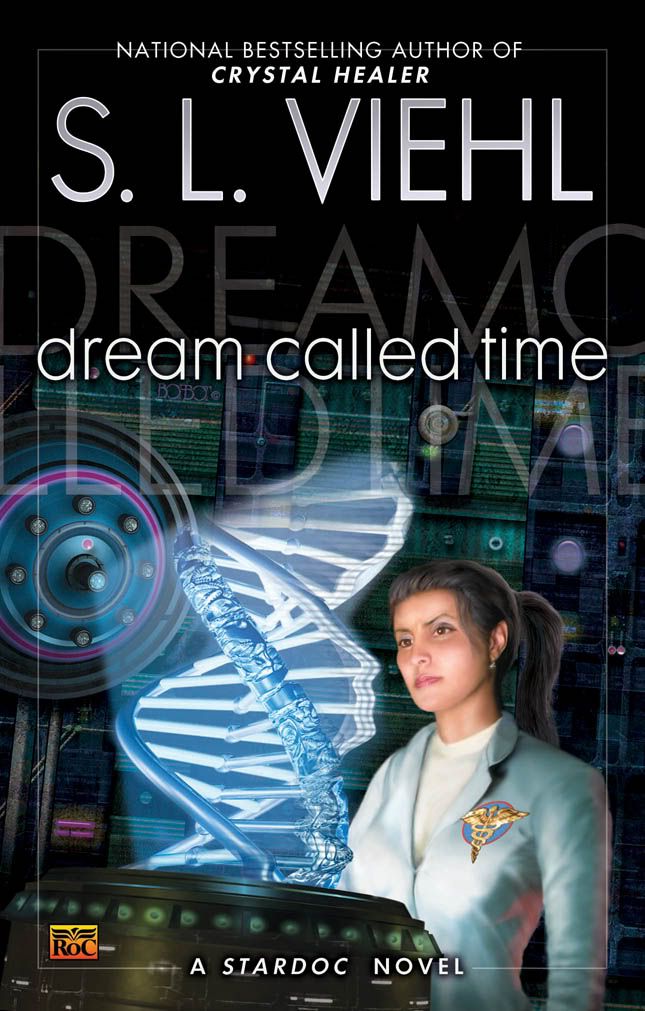
Made it to the last book of the series without a single unsightly cover in the bunch, too:

My only regret is that the publisher decided to change the cover design toward the end of the series to "update" it, as the last three covers don't mesh well with the first seven. But I also realize cover art styles and tastes change over the years and cohesion is not a top priority. Hardly anyone gets to write a SF series that spans a decade, either, so I think I'll just be happy and grateful that Cherijo was never depicted headless, semi-naked or dressed in hot pink DayGlo Spandex.
Made it to the last book of the series without a single unsightly cover in the bunch, too:
My only regret is that the publisher decided to change the cover design toward the end of the series to "update" it, as the last three covers don't mesh well with the first seven. But I also realize cover art styles and tastes change over the years and cohesion is not a top priority. Hardly anyone gets to write a SF series that spans a decade, either, so I think I'll just be happy and grateful that Cherijo was never depicted headless, semi-naked or dressed in hot pink DayGlo Spandex.
Wednesday, January 20, 2010
Blog Blocked
If writer's block wasn't bad enough, I'm seeing a lot of excuse posts out there in NetPubland that could all be titled "Why I'm Not Blogging." Makes me think a good portion of the online writing community has developed a raging case of blog block.
It's understandable. Anyone who is now trying to keep up with the demands of the social media promo trend has got to be exhausted; I honestly don't know how you all do it. If I had to spend that much time twitting and facebooking and scribbling I wouldn't even want to look at PBW, much less keep it updated.
There's also a kind of blog plateau one tends to hit after a few years where you feel as if you've said everything you have to say about yourself and your favorite topics, and you're starting to repeat the same things over and over. No one is the Energizer Bunny; everyone's batteries run low at some point or another.
I don't think anyone should keep a blog going for no good reason. If your blog has become a chore, you might have more fun twitting or facebooking or whatever. But if you're still passionate about blogging, and are just having a tough time putting together your posts, there are other things you can do besides phoning it in.
The first step around any kind of block is to see it for what it is: an obstacle that is in your way, and that should be treated accordingly. You can't go forward until you find a way around it, over it or through it, so stop making excuses for the block and why it's there, and start using your creativity.
Some suggestions on how to head in a new direction with your blog:
Listing: If the words just aren't there, make up some lists of interesting things: books you make other people read, movies that made you cry, songs you loved in high school. I love to make lists of free things that anyone can access online because everyone likes free stuff.
Other Interests: If your blog has been focused relentlessly on Publishing, take a look at something outside the industry that also interests you. If you have a hobby that is unrelated to writing, discuss it (I spent a year basically playing with my digital camera and posting the results each day, and that experiment inspired countless posts here on PBW in 2009.)
Self-Challenge: Set a writing challenge for yourself, ala NaNoWriMo, and blog about the experience, especially any new ways you find to solve problems with the WIP.
Switch Gears: if all you've been posting about is centered around you (your life, your writing, your family, your TBR, etc.) write a post about someone else. Pick someone you've never before written about on your blog and tell a story about them (I never wrote about my guy's mom until I put together this post about her Italian sausage sauce.) Write about one of your personal heroes, or someone who had tremendous influence over you in some part of your life. Discuss the most aggravating person you've ever encountered, or the kindest, or the strangest.
Themed Posts: Put together a pile of links to other places with a common theme. One week when I wasn't feeling especially creative I had a lot of fun looking around for links to art made of Post-It Notes, books, pens and words.
Visuals: Post an image or images that you find inspiring, interesting, unbelievable, bizarre or in some other way brings out a strong emotional response, and talk about why it does.
There are also plenty of sites out there that offer writing prompts, sparks and other jumpstarts for your blogging. Among them:
Creativity Portal has a one-button imagination prompt generator that asks questions you can turn into blog posts.
The Write Prompts offers a schedule of blog prompts for every day of the week: Journal Mondays, Image Tuesdays, Poetry Wednesdays, One Word Thursdays, Movie Fridays, Continue One Saturdays and Quote Sundays.
Writer's Block Archive over on LiveJournal offers thoughtful questions to blog about as well as archived answers from LJ'ers, too.
The Northern Nevada Writing Project's Writing Fix site has a pretty decent writing prompt generator that could give you some ideas for your blog as well.
And finally, maybe you just need to do a little creative doodling. Zentangles aren't about writing, they're just about that thing most of us do when we're thinking and have a pen in hand -- doodling. It may not seem important to doodle, but I've found it can give your mind a little breather when you're feeling blog blocked. All you need are paper and something to draw with (pencil, pen, marker, whatever.) If you're not familiar with the technique, you can find a step-by-step tutorial here.
Tuesday, January 19, 2010
Winners
It looks like a lot of you are finding some great reads out there to jumpstart 2010 -- thanks for the many recommendations you made for The Secret of Everything giveaway.
Tonight we put the magic hat to work, and the winners are:
Nicole
Sherry
Melissa, whose comment began with The Host by Stephenie Meyer. I liked it a lot better than Twilight because it was written more for adults and it was very character based.
Birgitte Necessary
Keita Haruka, who started 2010 with my free e-book Ravelin
Winners, when you have a chance please send your full name and ship-to address to LynnViehl@aol.com so I can get these books out to you, and my thanks to everyone for joining in.
Monday, January 18, 2010
Worldly Ten
Ten Things About Worldbuilding
Freeware caution: always scan free downloads of anything for bugs and other threats before dumping the programs into your hard drive.
Want to see a worldbuilder at work? Stop by Are you a God?, Nils Jeppe's art, writing and worldbuilding blog.
AutoREALM is "a Free GNU mapping software (a "cartographer") that can design maps of castles, cities, dungeons and more. AutoREALM is generally used by Role-playing Game practicants who enjoy doing their own maps. But it could fits the needs of other people. If you are a Role-Playing gamer or else, you are cordially invited to join the AutoREALM community: fellows gathered around a free hobbyist map tool. Originally made by Andrew Gryc (say "grits"), AutoREALM is now Open Source, creating a unique opportunity for the RPG world to mix graphics and computer programming" (OS: unspecified; also I couldn't access the download link pages on the official freeware site but I found a download link over on sourceforge.net here.)
If you need an interactive app to generate and view random fractal planets and terrain with oceans, mountains, icecaps and rivers, check out the Fractal Planet and Terrain Generator (OS: unspecified)
If you're interested in building a language, you might try the tools and advice available in Zompist.com's The Language Construction Kit.
One of my more recent finds among online sources about worldbuilding, The Mythopoet's Manual ~ Writing Multi-Cultural Fictional Settings by Loren J. Miller, is simply fabulous.
Terragen Classic is "a scenery generator, created with the goal of generating photorealistic landscape images and animations. Terragen is free for personal, noncommercial use, with only a few limitations. Terragen Classic is capable of near-photorealistic results for professional landscape visualisation, special effects, art and recreation. Terragen Classic has been used in a variety of commercial applications including film, television and music videos, games and multimedia, books, magazines and print advertisements (OS: Windows, Mac)
Planet Engine is "a 3D real-time planet renderer. It allows you to fly over the surface of planets and also to see them from space. You can explore real planets - like Mars and Earth - or use imaginary data" (OS: Windows)
One of the best matter-of-fact articles on worldbuilding that I've read in a while: The Power of Worldbuilding by Steven Savage.
To get some planetary ideas without having to plow through tons of generated stats, take the Random Planet Generator for a spin.
Patricia C. Wrede's Worldbuilder Questions are hosted on a fan site and contain all of her old FIDONET postings. The questions are like writing prompts for creating and fleshing out your fantasy worlds; they cover just about everything a worldbuilder could possibly want to think about and then some.
Friday, January 15, 2010
Off to Stomp

Create a sticky note online for your blog at Wigflip.com's sticky note generator, Superstickies (link swiped from Gerard over at The Generator Blog.)
Thursday, January 14, 2010
The Secret of Everything . . .
. . . wouldn't be much of a secret if I told you, now, would it? No. Then it would be the Expose of Everything. The Tell-All of the Total. The Up front, In Your Face Entirety of the Enchilada. So I must tread carefully here.
A secret is a tantalizing thing, especially as almost everyone has at least one. But when along with it you invoke the sacred summa summarum, you take it to another level. Who doesn't want to know the secret of life, the secret of success, the secret of why the clothes drier eats only one sock instead of two? All you have to do is whisper the word secret and watch people's eyes light up.
 It's no mystery that I'm always searching for a great read, and my latest find is author Barbara O'Neal's new release, The Secret of Everything. This was my first read of 2010, and I went in with no expectations (frankly I was too tired when I started it to want more than something to keep me from rewriting chapter five in my head for the hundredth time.)
Although the story sounded interesting -- after a wretched tragedy, a wounded woman returns to her forgotten childhood home to find herself and maybe a little peace, only to recover memories of a mysterious past and a far older tragedy -- I didn't really feel like reading women's fiction. Lately I have no patience for all that touchy-feely pseudoliterary stuff; I'd rather read nonfiction. Or even man fiction. Give me a good political thriller with shallow but testosterone-oozing characters and some blithely evil technogenius who figures out how to blow up Congress with toner cartridges. And then let me watch it go boom. That's the kind of mood I'm in.
But I needed to read something better, in the same way an exhausted person needs some serious sack time, and Barbara's lovely, lyrical writing wooed me out of my rotten mood. To my surprise, it wasn't touchy-feely or pseudoanything at all. Then, on page 12, the story had me. And held me. And kept me. Page 12, have mercy. As a writer/reader I don't have time to waste. Nor do I want to get in touch with my inner weepy female. I mean, I'm working here. I don't play hard to get, I am hard to get.
But damn if she didn't get me. She lured me in with luscious descriptions and effortless but intricately layered characterizations, the haunting storyline and in particular this truly amazing big strapping incredibly sexy guy named Vince who makes every scene he has in the book a shivery delight to read (no offense to the heroine, who was terrific, but Mother of God, Vince is so real on the page you can almost feel his body heat radiating off it.)
Then she started with the recipes at the end of every chapter. Remember, I'm the daughter of a chef. I love food, and I love to read about food, especially now that I'm stuck on this cardio-healthy bark-and-twigs diet. Barbara's recipes were magic -- real food, great ingredients, beyond tempting. No squirrel food! As for my inner weepy female, I admit, there were a few times my eyes started to sting while I imagined the food from the story (and I am making Vita's orange cinnamon rolls from the story, the hell with my diet.)
Finally, there are the dogs in the story, and I don't want to say too much about them because they're something you should discover along with the story. It's just that I'm a dog lover, but I love real dogs, not the silly over-idealized anthropomorphic caricatures you encounter so often in novels. Well, Barbara writes them real.
This novel was the best possible kick-off for my reading year. It's the first time I've read anything by this author, but I think three minutes after I finished The Secret of Everything I was in the car on my way to BAM to get whatever else they had of Barbara's on the shelves (scored The Lost Recipe for Happiness) because I must have more. You see, however many secrets Barbara knows, the way to write a beautifully absorbing, honestly shining gem of a story is definitely one of them.
As always, you don't have to take my word for it. In comments to this post, name your first amazing read of 2010 (or if you haven't read anything that great yet, just toss your name in the hat) by midnight EST on Monday, January 18, 2010. I'll draw five names at random from everyone who participates, and send the winners an unsigned trade paperback copy of The Secret of Everything by Barbara O'Neal. This giveaway is open to everyone on the planet, even if you've won something here at PBW in the past.
A secret is a tantalizing thing, especially as almost everyone has at least one. But when along with it you invoke the sacred summa summarum, you take it to another level. Who doesn't want to know the secret of life, the secret of success, the secret of why the clothes drier eats only one sock instead of two? All you have to do is whisper the word secret and watch people's eyes light up.
It's no mystery that I'm always searching for a great read, and my latest find is author Barbara O'Neal's new release, The Secret of Everything. This was my first read of 2010, and I went in with no expectations (frankly I was too tired when I started it to want more than something to keep me from rewriting chapter five in my head for the hundredth time.)Although the story sounded interesting -- after a wretched tragedy, a wounded woman returns to her forgotten childhood home to find herself and maybe a little peace, only to recover memories of a mysterious past and a far older tragedy -- I didn't really feel like reading women's fiction. Lately I have no patience for all that touchy-feely pseudoliterary stuff; I'd rather read nonfiction. Or even man fiction. Give me a good political thriller with shallow but testosterone-oozing characters and some blithely evil technogenius who figures out how to blow up Congress with toner cartridges. And then let me watch it go boom. That's the kind of mood I'm in.
But I needed to read something better, in the same way an exhausted person needs some serious sack time, and Barbara's lovely, lyrical writing wooed me out of my rotten mood. To my surprise, it wasn't touchy-feely or pseudoanything at all. Then, on page 12, the story had me. And held me. And kept me. Page 12, have mercy. As a writer/reader I don't have time to waste. Nor do I want to get in touch with my inner weepy female. I mean, I'm working here. I don't play hard to get, I am hard to get.
But damn if she didn't get me. She lured me in with luscious descriptions and effortless but intricately layered characterizations, the haunting storyline and in particular this truly amazing big strapping incredibly sexy guy named Vince who makes every scene he has in the book a shivery delight to read (no offense to the heroine, who was terrific, but Mother of God, Vince is so real on the page you can almost feel his body heat radiating off it.)
Then she started with the recipes at the end of every chapter. Remember, I'm the daughter of a chef. I love food, and I love to read about food, especially now that I'm stuck on this cardio-healthy bark-and-twigs diet. Barbara's recipes were magic -- real food, great ingredients, beyond tempting. No squirrel food! As for my inner weepy female, I admit, there were a few times my eyes started to sting while I imagined the food from the story (and I am making Vita's orange cinnamon rolls from the story, the hell with my diet.)
Finally, there are the dogs in the story, and I don't want to say too much about them because they're something you should discover along with the story. It's just that I'm a dog lover, but I love real dogs, not the silly over-idealized anthropomorphic caricatures you encounter so often in novels. Well, Barbara writes them real.
This novel was the best possible kick-off for my reading year. It's the first time I've read anything by this author, but I think three minutes after I finished The Secret of Everything I was in the car on my way to BAM to get whatever else they had of Barbara's on the shelves (scored The Lost Recipe for Happiness) because I must have more. You see, however many secrets Barbara knows, the way to write a beautifully absorbing, honestly shining gem of a story is definitely one of them.
As always, you don't have to take my word for it. In comments to this post, name your first amazing read of 2010 (or if you haven't read anything that great yet, just toss your name in the hat) by midnight EST on Monday, January 18, 2010. I'll draw five names at random from everyone who participates, and send the winners an unsigned trade paperback copy of The Secret of Everything by Barbara O'Neal. This giveaway is open to everyone on the planet, even if you've won something here at PBW in the past.
Wednesday, January 13, 2010
Blog to Print II
To continue my post from yesterday, I had no problem creating and downloading the .pdf book version of Paperback Writer 2009 blog posts from Blog2Print. I then opened the file in Adobe Acrobat, and it looks very nice. The four-page per screen .pdf preview the site shows you before you buy is not replicated in the final product, it downloads in a normal document format. Here are some screenshots (click on any image to see a larger version):
Front Cover:

Sample Page with Image:

Sample Page with Multiple Images:

Back Cover (reduced in size):
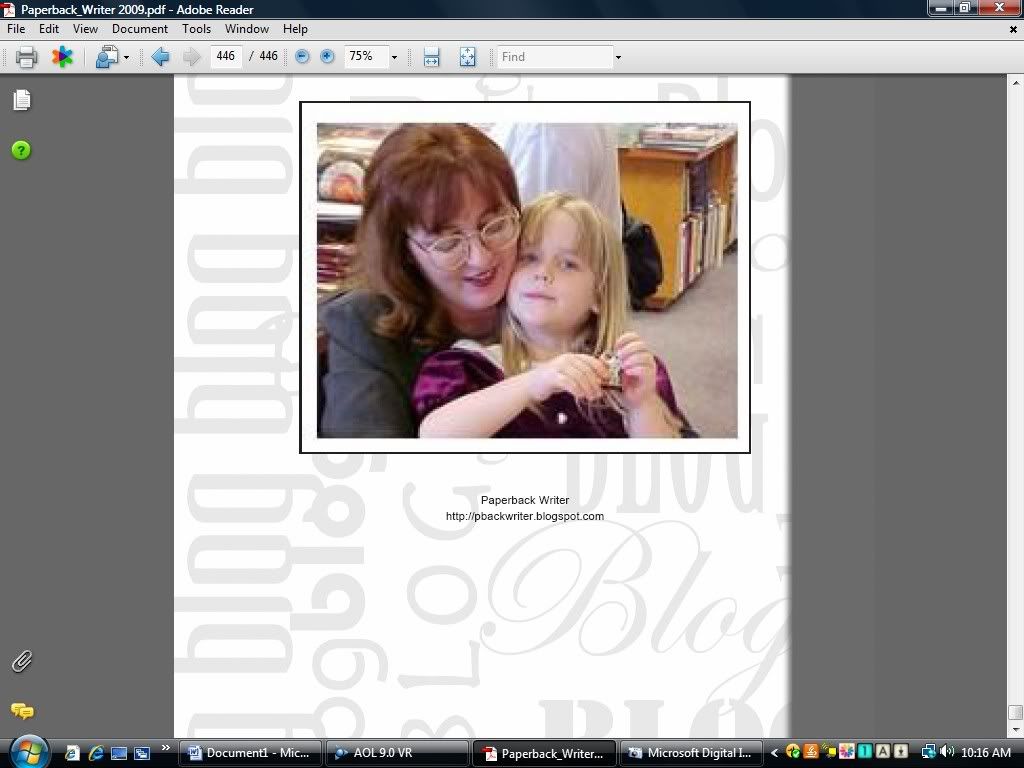
The main problem with using Blog2Print to create a .pdf of your weblog is that it doesn't import the links embedded in any of your posts. That may not be a problem for most bloggers, but I post on average 15 to 30 links a week here at PBW. Adobe Acrobat has a link tool that would allow me to manually reinsert the links, but they'll have to be done one at a time, and that's going to take a while.(and I tested a couple of other things in Adobe to see if I could comprehensively edit the final product, and had no problem at all.)
Also, if you notice the poor quality of the image I used on the back cover compared to the better quality of the image on the front cover, that is all about resolution. I deliberately uploaded a medium res image (front cover pic = 743 X 880) and a low res image (back cover pic = 212 X 165) to see how they'd turn out. Low res is definitely not the way to go.
The only other flaw I've noticed so far is that some of my images on the blog run into the blog headers in the e-book version, which is probably bad coding on my part with the weblog posts.
I still think the print pub prices are too high, and the fact that it doesn't import links is a pain, but if you've got a large weblog and you've never created a personal archive of it, creating a .pdf of it with Blog2Print would be a reasonably-priced service (especially if you don't own Adobe Acrobat.)
If you'd like to see more of the final product, I've uploaded the .pdf file created by Blog2Print for anyone to read online or download for free here.
Front Cover:
Sample Page with Image:
Sample Page with Multiple Images:
Back Cover (reduced in size):
The main problem with using Blog2Print to create a .pdf of your weblog is that it doesn't import the links embedded in any of your posts. That may not be a problem for most bloggers, but I post on average 15 to 30 links a week here at PBW. Adobe Acrobat has a link tool that would allow me to manually reinsert the links, but they'll have to be done one at a time, and that's going to take a while.(and I tested a couple of other things in Adobe to see if I could comprehensively edit the final product, and had no problem at all.)
Also, if you notice the poor quality of the image I used on the back cover compared to the better quality of the image on the front cover, that is all about resolution. I deliberately uploaded a medium res image (front cover pic = 743 X 880) and a low res image (back cover pic = 212 X 165) to see how they'd turn out. Low res is definitely not the way to go.
The only other flaw I've noticed so far is that some of my images on the blog run into the blog headers in the e-book version, which is probably bad coding on my part with the weblog posts.
I still think the print pub prices are too high, and the fact that it doesn't import links is a pain, but if you've got a large weblog and you've never created a personal archive of it, creating a .pdf of it with Blog2Print would be a reasonably-priced service (especially if you don't own Adobe Acrobat.)
If you'd like to see more of the final product, I've uploaded the .pdf file created by Blog2Print for anyone to read online or download for free here.
Tuesday, January 12, 2010
Blog to Print I
Blogger has been running internal ads for Blog2Print, a self-pub service to which you can upload your weblog content and have it published in book form (softcover, hardcover or .pdf)
The front page features a price of $14.95 for a 20-page softcover "blog book", $24.95 for a hardcover and $7.95 for a .pdf version, the first two of which seemed a bit pricey to me. But I did want to see how the upload feature performed, so I had the site create a book from 1 year of PBW posts, 2009-2010. Which it did in about three minutes.
Once you upload your blog URL, the range of dates you want to publish, and any cover images you want to add, the site creates a virtual book for you to page through, which I thought was pretty cool, especially because I did it without registering with the site or anything. Here are some screenshots (click on any image to see larger version):
Front Cover

Interior Pages with Blog Posts

Back Cover

The price for a softcover version of 1 year of PBW blog posts (438 pages) would be $162.65 -- far too pricey for me. But I'd be fine with paying $7.95 for Blog2Print to make a downloadable .pdf of my archives, which right now I just have stored in HTML on discs (mainly because it would cost me a lot more than $7.95 in labor to convert my discs to .pdf). To save your virtual book (as well as edit it and so forth) you do have to register with the site, but all they ask for is e-mail, ID/password and your zip code.
I thought this would be great for writers who want to self-pub a book form of their blogs, but it's a vanity thing only -- you can't resell the book you create. Here's the resale no-no paragraph from the site's Terms and Conditions of Sale:
"Books purchased from SharedBook are for personal use only and are not intended for resale or commercial use. SharedBook reserves the right to audit orders, to cancel any sale based on its sole discretion, and to limit quantities purchased, as well as any other legal remedy allowed by law.
With respect to certain goods, such as cookbooks purchased from SharedBook through BigOven, these cookbooks may be subject to resale, for fundraising purposes. SharedBook shall still reserve the right to audit orders, to cancel any sale based on its sole discretion, and to limit quantities purchased, as well as any other legal remedy allowed by law."
Fair enough. To thoroughly test this service, I'm going to make a Blog2Print book of last year's posts today, buy a .pdf version and post it online as a freebie so we can see how it really works. More tomorrow on how it turns out.
The front page features a price of $14.95 for a 20-page softcover "blog book", $24.95 for a hardcover and $7.95 for a .pdf version, the first two of which seemed a bit pricey to me. But I did want to see how the upload feature performed, so I had the site create a book from 1 year of PBW posts, 2009-2010. Which it did in about three minutes.
Once you upload your blog URL, the range of dates you want to publish, and any cover images you want to add, the site creates a virtual book for you to page through, which I thought was pretty cool, especially because I did it without registering with the site or anything. Here are some screenshots (click on any image to see larger version):
Front Cover
Interior Pages with Blog Posts
Back Cover
The price for a softcover version of 1 year of PBW blog posts (438 pages) would be $162.65 -- far too pricey for me. But I'd be fine with paying $7.95 for Blog2Print to make a downloadable .pdf of my archives, which right now I just have stored in HTML on discs (mainly because it would cost me a lot more than $7.95 in labor to convert my discs to .pdf). To save your virtual book (as well as edit it and so forth) you do have to register with the site, but all they ask for is e-mail, ID/password and your zip code.
I thought this would be great for writers who want to self-pub a book form of their blogs, but it's a vanity thing only -- you can't resell the book you create. Here's the resale no-no paragraph from the site's Terms and Conditions of Sale:
"Books purchased from SharedBook are for personal use only and are not intended for resale or commercial use. SharedBook reserves the right to audit orders, to cancel any sale based on its sole discretion, and to limit quantities purchased, as well as any other legal remedy allowed by law.
With respect to certain goods, such as cookbooks purchased from SharedBook through BigOven, these cookbooks may be subject to resale, for fundraising purposes. SharedBook shall still reserve the right to audit orders, to cancel any sale based on its sole discretion, and to limit quantities purchased, as well as any other legal remedy allowed by law."
Fair enough. To thoroughly test this service, I'm going to make a Blog2Print book of last year's posts today, buy a .pdf version and post it online as a freebie so we can see how it really works. More tomorrow on how it turns out.
Monday, January 11, 2010
EcoTen
Ten Ways to Go Green
Freeware caution: always scan free downloads of anything for bugs and other threats before dumping the programs into your hard drive.
Need more data storage for your netbook or mobile device? Roshi over at HowtoGoMobile.com tells you how to get a free 500GB virtual hard drive with active sharing and downloading options here.
Read Bruce Britt's post, The New Stone Age, which talks about the pros and cons of using a new paper made from stone to save trees.
eDoc Organizer (Basic Edition) is "a document management software that enables you to import your receipts, recipes, bills and other paper documents via your scanner and file them in digital format on your computer. If you have Microsoft Office 2003 or 2007 installed, you can also import any existing Word, Excel, PowerPoint, XPS, or PDF Documents from your computer and include them in the archive. The documents can be organized with custom color tags and personal comments to help you filter the list and find specific documents with the simple keyword search feature. The free basic version can be used with up to 250 documents, if you need more than that, an upgrade to the paid version is required" (OS: Windows XP, Windows Vista, or Windows 7; see additional system requirements here)
Nokia's Green Explorer site "works with its partners to provide sustainable tips and advice on how to live green and travel clean. Share your experiences and ideas here and help make a world of difference."
GreenPrint "makes it easy to print only the pages you want saving you around $100 a year on paper and ink, as well as helping to save millions of trees" (OS: Windows XP/Vista/7)
Paperless Printer is "a universal document exchange utility that can be used as a Virtual Printer to publish virtually any document in Adobe Portable Document Format (PDF), Hypertext Markup Language (HTML), Microsoft Word Format (DOC), Microsoft Excel Format (XLS), JPEG or BMP, preserving the exact look and content of the original document, complete with fonts and graphics. You can distribute your PDF and HTML documents by E-Mail or store them on the World Wide Web, on intranet, a file system, or a CD. Other users can view your work on Microsoft® Windows, Mac® OS, LINUX, and UNIX® platforms. Paperless Printer also works as a preview tool. Users can print from almost any Windows® application to this printer and visualize the output on JPEG or BMP, without actually having to print on paper. Paperless Printer is a 100% software product. It has no hardware parts. Paperless Printer appears like a normal printer on a Windows PC. You can actually see the Paperless Printer object in the Printers folder [Start -> Settings -> Printers]. Using an application's Print command you can print anything to this printer. Instead of printing on paper, Paperless Printer creates content in PDF, HTML, DOC, Excel, JPEG or BMP files" (OS: Windows 95, 98, Millennium Edition, NT 4.0, 2000 or XP)
Did you know that each ton of paper made from recycled fibers saves 17 trees, 4100 kilowatts of energy, 7000 gallons of water and 60 pounds of air pollutants? I found out this, plus more Tips for the Environmentally Friendly Office, over at Pendaflex.com, manufacturer of EarthWise® 100% recycled office products.
Also from Nokia's Green Explorer Web site, a sub op note: "Are you a seasoned eco warrior or just a traveler with a conscience and a knack for writing? Have you got green travel and lifestyle inspiration to share? We're currently hunting for creative talents to contribute articles to the blog. A strong line in offbeat locations, thought-provoking stories, and eye-catching headlines is a must, tempered with concern for the environment and a critical eye for greenwashing. If you think you've got what it takes, send us an email with a sample of your writing and we'll be in touch!"
Text Block Writer is "a virtual index card program for writers. It can be used to organize research papers, articles, fiction, non-fiction, books and whatever related to writing. It is intended for people like me who use paper index cards to write all the notes and pieces of an essay, and then arrange the pieces and then use that to type them into the computer. With this program, you can type in the notes and arrange them on the computer, and then export them to an rtf document (that can be opened in word, open office, or just about any other word processor)" (OS: Windows)
Our blogpal LJ Cohen created TiddlyWikiWrite (TWW) to organize writing projects with an electronic relational filecard system that runs in any browser window on your local computer. She also has a link to an LB&LI workshop she gave a couple years ago that is definitely worth checking out.
Sunday, January 10, 2010
Making Promotion Fun
Now and then I visit Adverblog to see the latest in online interactive marketing. I thought Give It a Ponder, the new LG campaign to educate consumers on thinking before they text, was smart, funny and interesting even to someone like me who doesn't text at all. It was genius to have James Lipton do the videos (that guy always tickles me.)
 We still don't have a lot of advergames in Publishing, and I think that's an area of online marketing that needs some serious exploration. Author Douglas Clegg's Isis difference game was great fun as well as a brilliant promo idea. I became addicted to it and played it a couple dozen times and never got tired of it, plus the illustrations made me wonder about the sotry. I think I read somewhere (and forgive me if I'm wrong here, Doug) that half a million people have already played it (Added: via Scribd*, Doug tells me to date 2.3 million people actually played the Isis game. That seriously raises the bar for all author promo games.)
 I just downloaded Orchid Games's Christmas giveaway, HeartWild Solitaire, features seven short romance stories incorporated into the game as prizes for winning. The graphics are nice, the background muzak isn't completely annoying, and there's an online top scoreboard you can post your score (not that I think I'm ever going to show up on it; the top score was like 3K higher than mine.) It works on Windows Vista, in case anyone is wondering.
 While it's not free, the one game I'm really looking forward to is Tiger Eye: Curse of the Riddle Box, an interactive computer game based on Marjorie M. Liu's novel Tiger Eye (the very first video game to be based on a romance, I believe.) I think the preorder price is great, and if the game interests players in Marjorie's books, it definitely doubles as an advergame.
I wanted to see if I could create my own promo game for free, so I went around to a couple of sites and played with some online game creation generators. The easiest one for me was Fyrebug.com, although the first game I made doesn't work perfectly -- I messed it up, or the game template was flawed to begin with -- but this will give you a general idea of what you can do on your own (warning for people at work, if you start any of the following games they play music):
Added: I moved the games I made over to the stories blog here because they were messing up the front page of PBW. Have no idea why; maybe it was the coding.
Of the three I made myself I liked the WordSearch best because it didn't have a run-down timer, I could customize it with words from my novels, and while it wasn't too simple it wasn't impossible to solve. The slider puzzle was a bit too simple; it only took me 43 seconds to solve it. Of course I made the quilt so I know every inch of what it looks like; someone who wasn't familiar with it might find it a bit more challenging.
If you consider putting together a promo game for your blog or web site, my advice would be to keep it simple, use images versus words or titles (the smaller and more detailed the image, the harder it is to see) and don't make it impossible to solve. If you keep a running high score page or widget I can guarantee you people like me will be back to play again and try to improve our score. Somewhere near the game you should post an excerpt from your latest or upcoming release, a link to an online bookseller site where it can be purchased, and links to other online games by authors.
*Note 9/3/10: Since Scribd.com instituted an access fee scam to charge people for downloading e-books, including those I have provided for free for the last ten years, I no longer reccomend using their service. See my post about this scam here.
We still don't have a lot of advergames in Publishing, and I think that's an area of online marketing that needs some serious exploration. Author Douglas Clegg's Isis difference game was great fun as well as a brilliant promo idea. I became addicted to it and played it a couple dozen times and never got tired of it, plus the illustrations made me wonder about the sotry. I think I read somewhere (and forgive me if I'm wrong here, Doug) that half a million people have already played it (Added: via Scribd*, Doug tells me to date 2.3 million people actually played the Isis game. That seriously raises the bar for all author promo games.)I just downloaded Orchid Games's Christmas giveaway, HeartWild Solitaire, features seven short romance stories incorporated into the game as prizes for winning. The graphics are nice, the background muzak isn't completely annoying, and there's an online top scoreboard you can post your score (not that I think I'm ever going to show up on it; the top score was like 3K higher than mine.) It works on Windows Vista, in case anyone is wondering.While it's not free, the one game I'm really looking forward to is Tiger Eye: Curse of the Riddle Box, an interactive computer game based on Marjorie M. Liu's novel Tiger Eye (the very first video game to be based on a romance, I believe.) I think the preorder price is great, and if the game interests players in Marjorie's books, it definitely doubles as an advergame. I wanted to see if I could create my own promo game for free, so I went around to a couple of sites and played with some online game creation generators. The easiest one for me was Fyrebug.com, although the first game I made doesn't work perfectly -- I messed it up, or the game template was flawed to begin with -- but this will give you a general idea of what you can do on your own (warning for people at work, if you start any of the following games they play music):
Added: I moved the games I made over to the stories blog here because they were messing up the front page of PBW. Have no idea why; maybe it was the coding.
Of the three I made myself I liked the WordSearch best because it didn't have a run-down timer, I could customize it with words from my novels, and while it wasn't too simple it wasn't impossible to solve. The slider puzzle was a bit too simple; it only took me 43 seconds to solve it. Of course I made the quilt so I know every inch of what it looks like; someone who wasn't familiar with it might find it a bit more challenging.
If you consider putting together a promo game for your blog or web site, my advice would be to keep it simple, use images versus words or titles (the smaller and more detailed the image, the harder it is to see) and don't make it impossible to solve. If you keep a running high score page or widget I can guarantee you people like me will be back to play again and try to improve our score. Somewhere near the game you should post an excerpt from your latest or upcoming release, a link to an online bookseller site where it can be purchased, and links to other online games by authors.
*Note 9/3/10: Since Scribd.com instituted an access fee scam to charge people for downloading e-books, including those I have provided for free for the last ten years, I no longer reccomend using their service. See my post about this scam here.
Subscribe to:
Posts (Atom)
