Every Wednesday from now until November 1st I'll be posting some ideas, resources and other info that may be of help to those of you planning to join in NaNoWriMo 2010.
For me, one of the personal pleasures of writing novels is putting together my novel notebook. No one sees this writing tool but me, so I can do exactly what I want with it (and I do.) It also allows me to stay organized when I'm working on a book, which is an important part of my process. I don't want to have to rustle around looking for notes when I can't remember the protagonist's middle name, or in which chapter the antagonist unleashes what chaos, or when I promised my agent I'd send her the proposal. I don't have a secretary, and I have story to write.
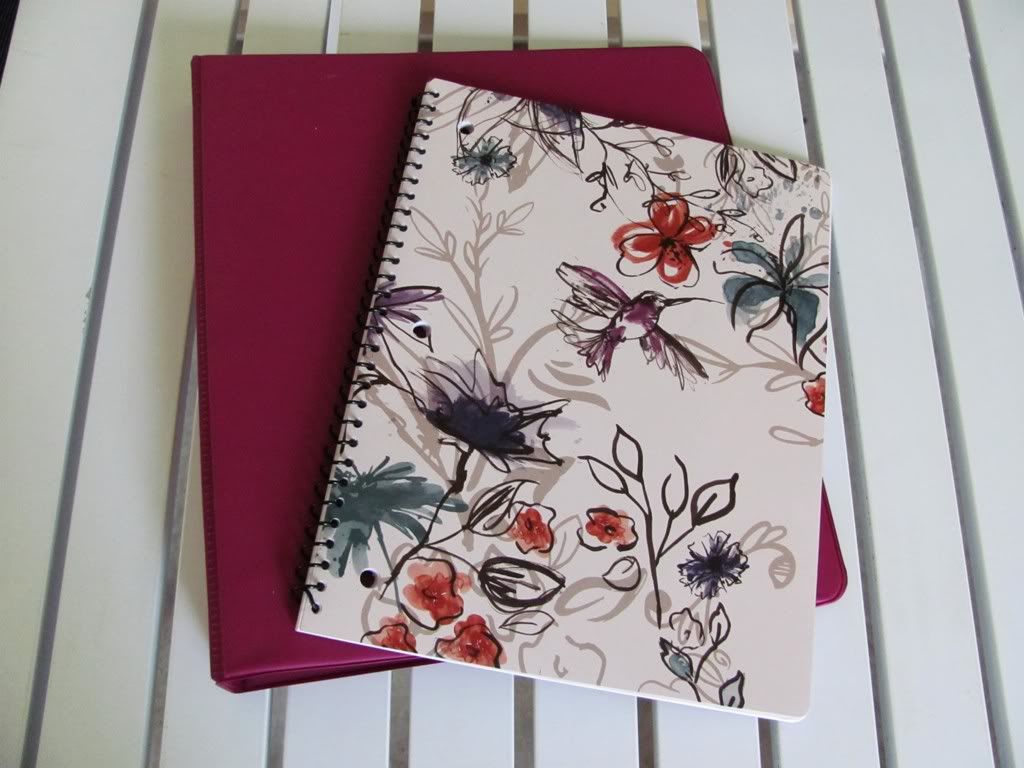 For me a novel notebook is basically the depository of all the notes, outlines, character bios, setting info, research, plotting and other ideas that I use for writing a book. Here's the one I've started putting together for my NaNo novel. It's not mandatory that you put one together in advance, or even make one at all, but I think having a place for all your story-related ephemera keeps you organized and saves time (especially when while writing you go fuzzy on some detail and need to refer back to your original outline, character notes, research, scribbles, etc.)
I've always made notebooks for my novels, but I started out just keeping a neatly-typed synopsis, chapter summaries and character worksheets together in a binder. Over time I gradually began adding other things, like sketches, photos, cover art mockups, journal entries relating to the book, music CDs and other inspirational bits. Now my notebooks are as much creative diaries and story archives as they are work schematics and fiction blue prints.
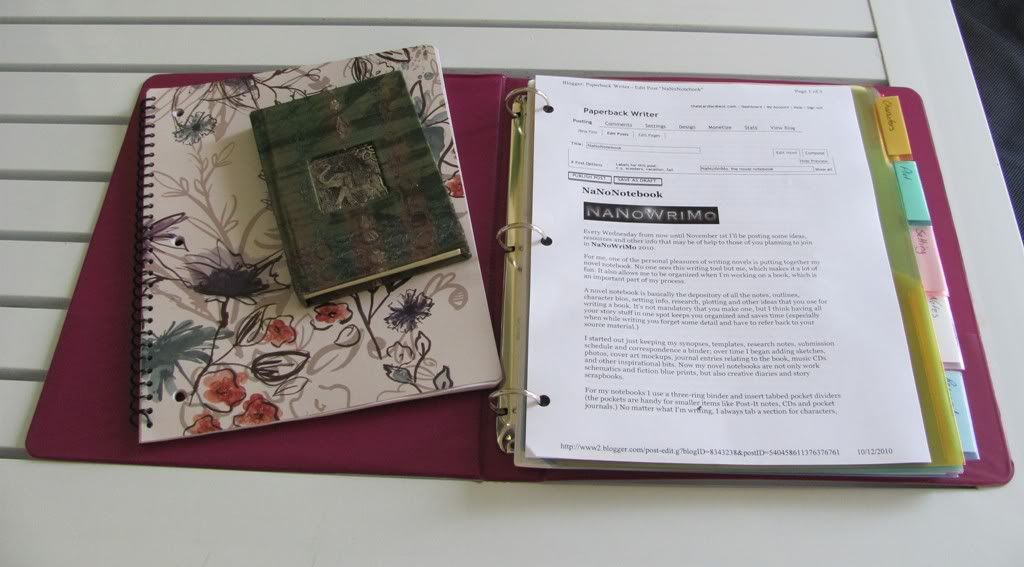 The spiral notebook I use (which fits in the binder, btw) is where I jot down all my notes related to the story. I also have a pocket-size blank book that I carry in my purse most of the time. In the binder I also insert tabbed pocket dividers (the pockets are handy for smaller items like Post-It notes, CDs and pocket journals.)
No matter what I'm writing, I always tab a section for characters, plot, setting, notes, research materials and submission info. Another strategy that helps me is to create a small theme icon for every novel (this can be anything from a word to a symbol) which I use to mark all the related paperwork in the upper right hand corner -- also very helpful later when I'm sorting out things I need to put in the office file.
Other sections I use are more business-related (pitching, promotion, styling, lists of editors to pitch for my agent and so on) but one I find very useful while writing is a section on visuals (photographed or sketched depictions of characters, objects, settings; floorplans, topographical maps, etc.) I also keep backups of my daily work on CD in my notebook because I'm just paranoid that way.
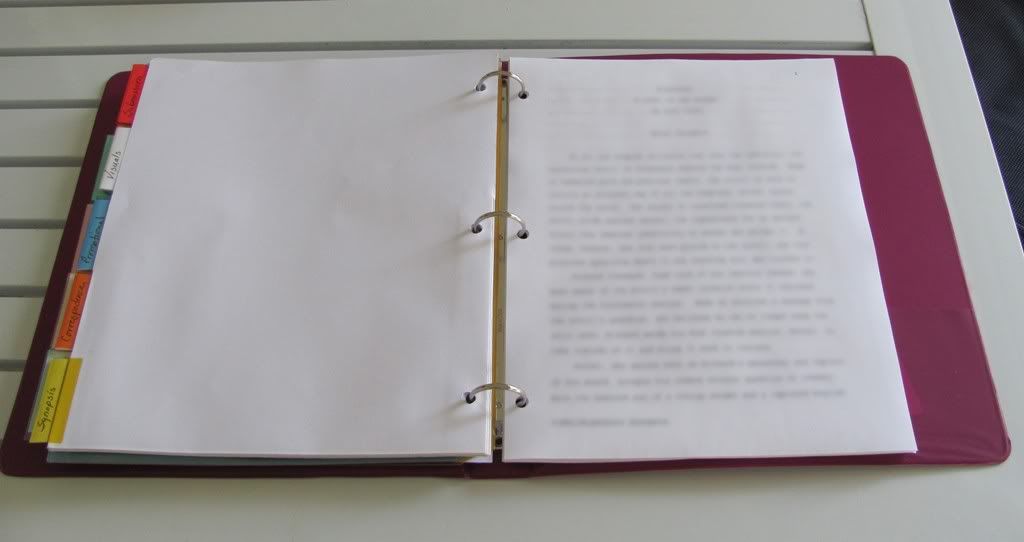 The last section in my notebook is always reserved for my synopsis. I do this because A) I always write the synopsis before I write the novel, B) it's the one document I refer to most frequently when writing, and C) I like to make any necessary corrections to it as I write the book versus rewriting it after the story is finished. Having it in the back of my notebook makes it easy to flip to immediately.
As I mentioned, it's not necessary to create a novel notebook in order to write your NaNoWriMo story, and you certainly don't need to organize everything the way I do for a book. If it's simple to use, you'll be more likely to use it. Also, don't feel forced to put your story stuff in a binder; you can use file folders, a blank book, a legal pad, a bigger spiral notebook (I like the ones that are divided into five or six sections for students), a software program or even an electronic gadget of some sort. Remember, this writing tool is for you, not anyone else, so make it what you want it to be, and have some fun with it.
Related links (Freeware caution: always scan free downloads of anything for bugs and other threats before dumping the programs into your hard drive):
PBW's Novel Notebook: This is a free .pdf e-book with templates and examples of some of the things I do with my novel notebooks (and feel free to change it around to suit your process and/or discard what you don't need.)
To organize her creative writing projects, our blogpal LJ Cohen worked with Tiddlywiki (TW), a "javascript based open source personal wiki that lives as a single html page, on a local hard drive, a thumbdrive, or on a server" to create TiddlyWikiWrite (TWW). Per Lisa: "It is an electronic relational filecard system that runs in any browser window on your local computer." She's also generously shared it online for free use and distribution.
The free version of AM-Notebook is "a multi-featured personal information manager that provides an easy and reliable way to save notes, formula supported spreadsheets, diagrams/flowcharts, to do lists, tasks and contacts within a light weight tray icon tool" (OS: Windows 7 (32/64 bit), Vista, XP, 2000)
The Printable Notebook allows you to "organize and print your personal data in the same manner a paper notebook does. You can print (and cut) selected pages so that they fit into your paper notebook. The program allows you to create multiple notebooks with custom fields for each. It includes several sample print templates, that will fit a standard notebook size. The templates are XML based and can be edited by experienced users to accommodate other formats. Printable Notebook supports website links and email fields, different tab layouts, search across notebooks and more" (OS: Windows 98/ME/2000/XP)
Scribe is "a free cross-platform note-taking program designed especially with historians in mind. Think of it as the next step in the evolution of traditional 3x5 note cards. Scribe allows you to manage your research notes, quotes, thoughts, contacts, published and archival sources, digital images, outlines, timelines, and glossary entries. You can create, organize, index, search, link, and cross-reference your note and source cards. You can assemble, print, and export bibliographies, copy formatted references to clipboard, and import sources from online catalogs. You can store entire articles, add extended comments on each card in a separate field, and find and highlight a particular word within a note or article. Scribe's uses range from an undergraduate history research seminar to a major archival research project" (OS: Windows, Mac OS X)
Pindersoft offers a thirty day free trial of their Writers Project Organizer, which is "manuscript orientated software for writers and not a magic magic program to get you published. What Writers Project Organizer will do is organize your ideas, thoughts, submissions, plots, storylines and contacts within the publishing industry" (OS: Windows + Microsoft's .Net Framework 3.5, looks like it's good to run on Vista)




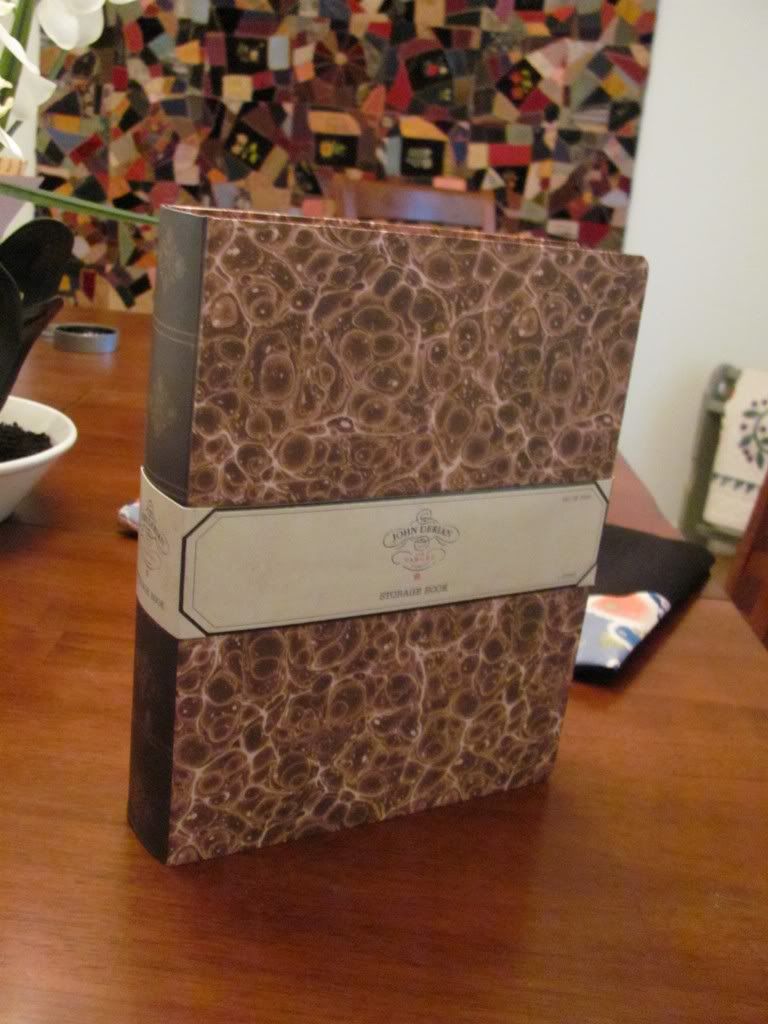 My daughter is planning to have a Halloween party this year, so I hit Target this week to start getting ideas for decorations (her theme is internet avatars, which is kind of a challenge.) I saw a big book on the end cap of the stationery/party goods aisle, and good citizen that I am, I picked it up to take it back to the book section. That's when I discovered it wasn't a book at all but
 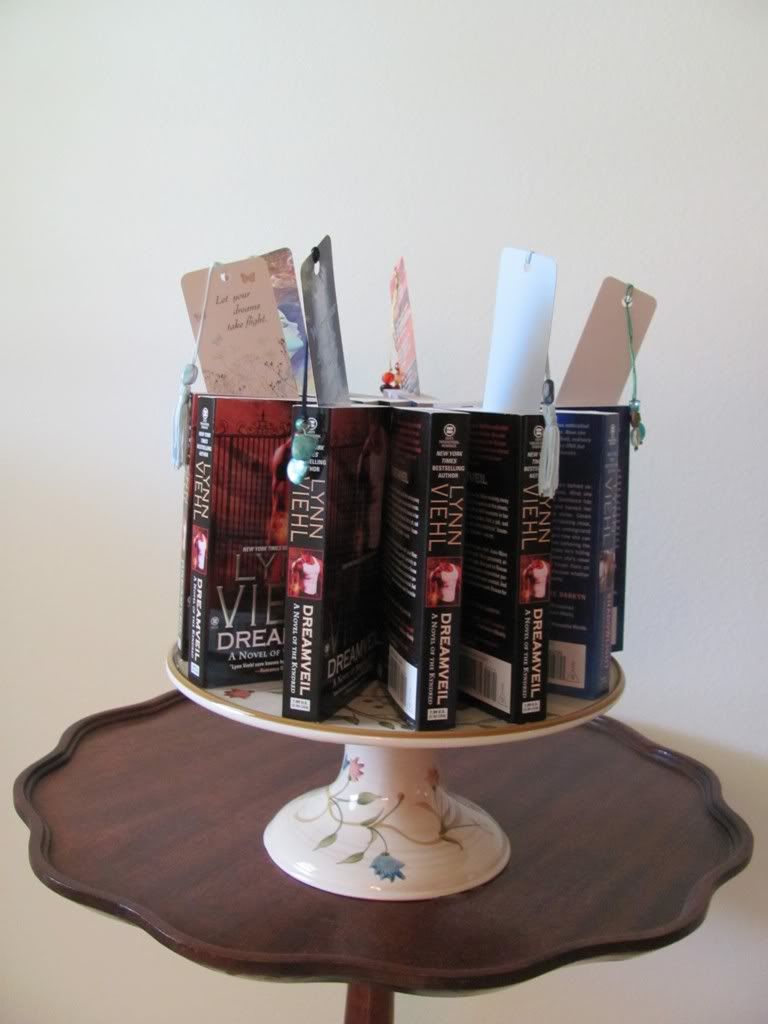 The holidays always mean lots of gatherings and parties at our house, and when friends and family visit I usually put out a stack of my books on a table to sign for anyone who wants them (saves me trips upstairs to the book room, too.) I've never found a pretty way to display them other than in a neat stack or a basket, or just in a row on one of the book cases. Then I was washing my cake stand last night and recalled the
 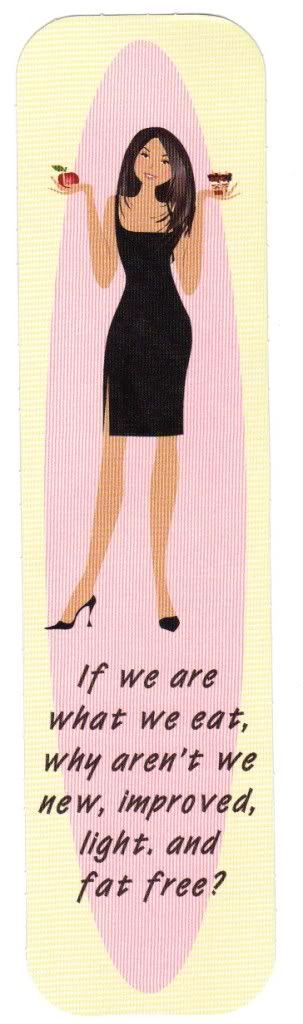 Mom is always sending me little bits in her letters, and this Current bookmark made me laugh out loud. If we are what we eat, squirrels should be following me around with lust in their hearts. But it also gave me a neat idea on how to hand out recipes for the holidays -- instead of using index cards, why not print them out on cardstock as bookmarks?
  When I heard about our blogpal
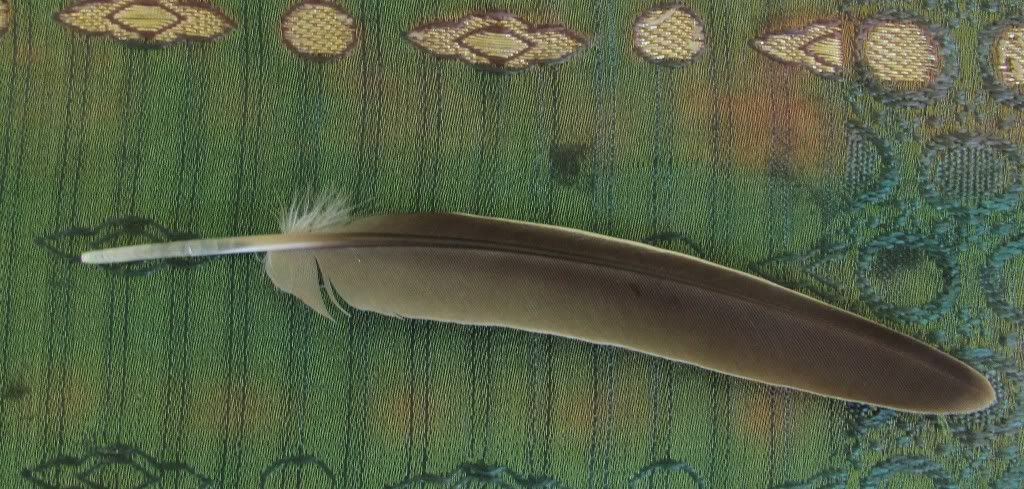
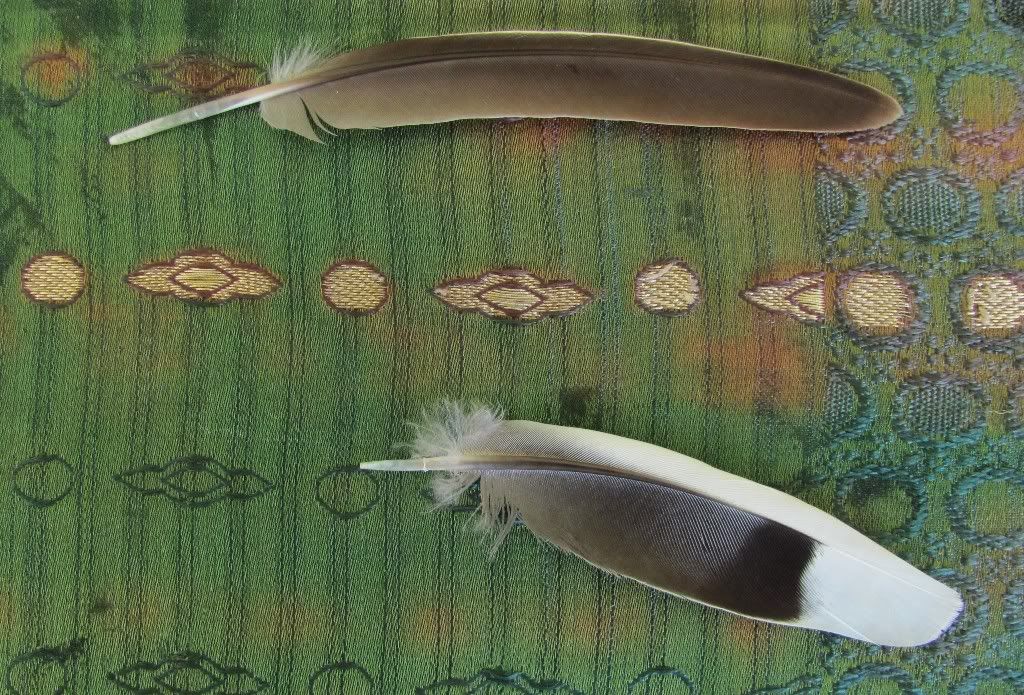
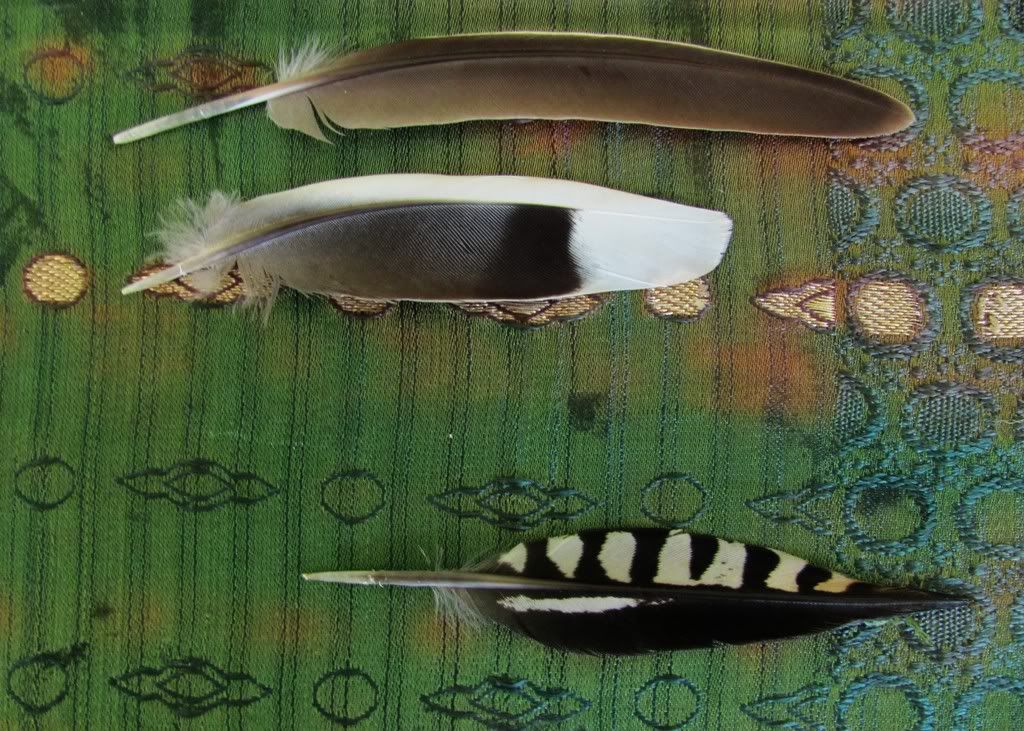
 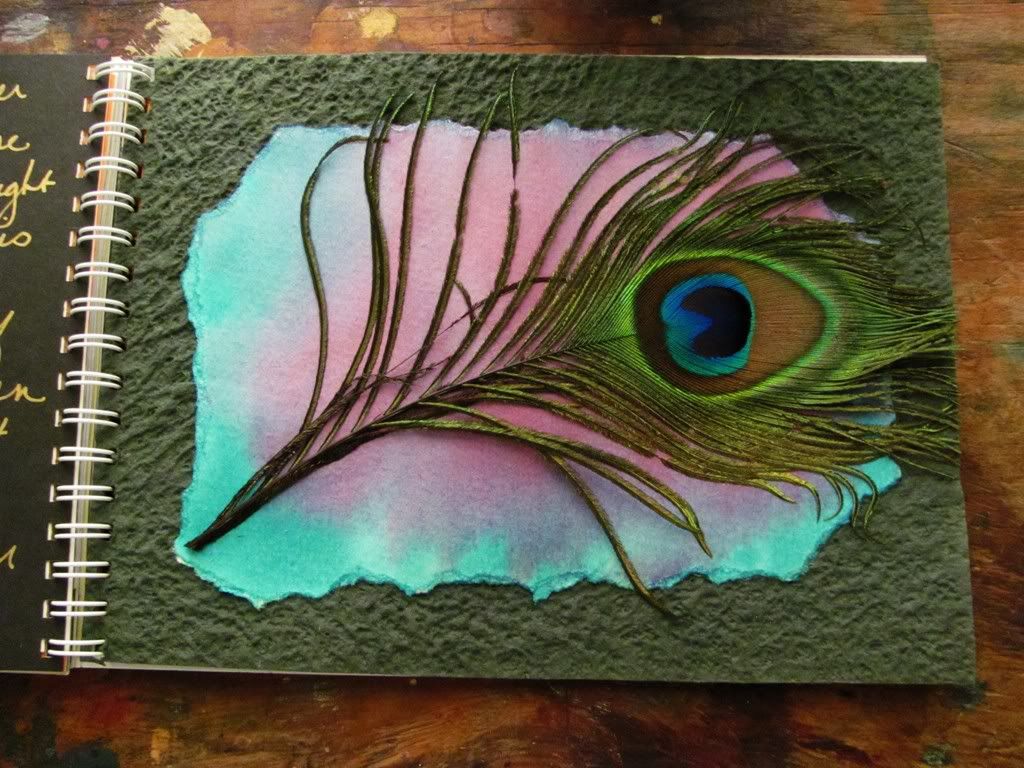 This collage page from one of my journals uses art as a personal metaphor, one I put together for the beauty I find in writing. My computer is nowhere near as gorgeous as a peacock feather, but the feather represents both how I see and what I try to do with my writing instruments. Behind the feather is a torn fragment of a watercolor I painted that I wasn't happy with, to symbolize my vision of the story (and my eternal conflict trying to realize it.) The rough dark page is the world beyond my story; the audience I can't see, the void I want to fill.
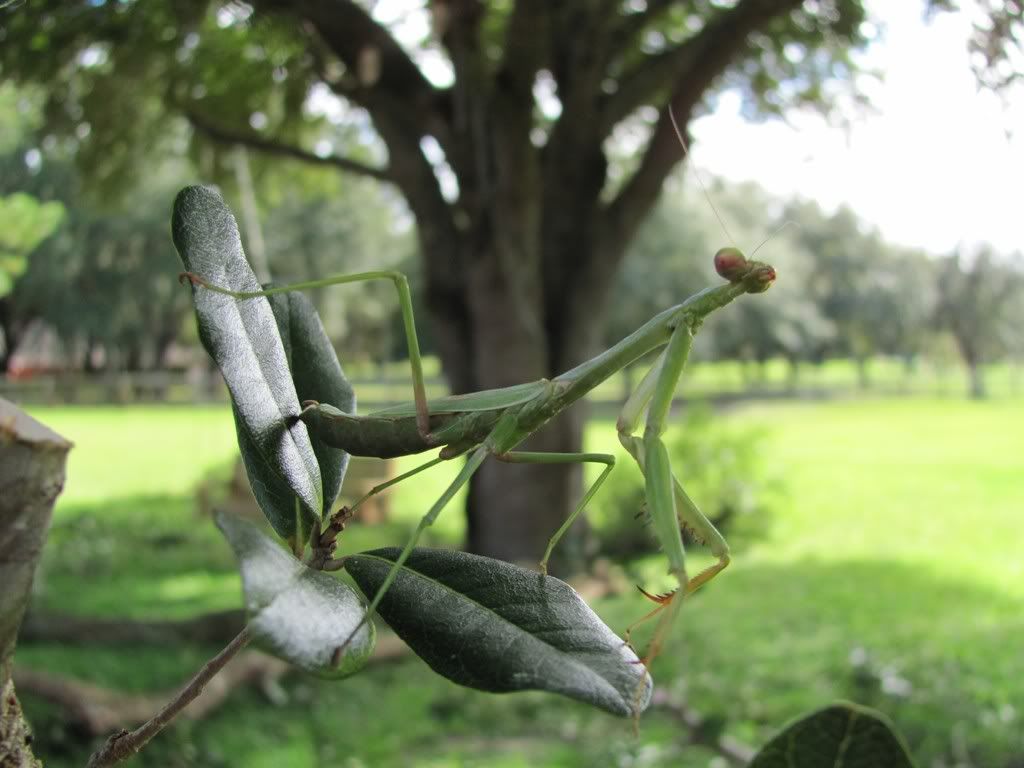 Sometimes metaphors are intensely personal, and without shared experiences, can be inexplicable. For example, while trimming trees last weekend we accidentally made this preying mantis temporarily homeless. We moved the mantis out of harm's way to a smaller tree, and now every time I mention a mantis to my guy, he'll remember everything that happened when we saved this one. If I use the mantis as a metaphor while talking to my mom, she'll just think I'm talking about a bug.
 When you're a series writer, the two words you never want to see are The End. Although like any novelist you finish every series book you write, by the time you type the last paragraph of one story you're already thinking ahead and planning the next. Until you reach the finale, the last book in the series, and you know there won't be anymore. Then you spend a lot of time second-guessing yourself (Maybe I could do a Next Generation series?) or sulking (it's not fair. I never got the chance to write Book X, Y or Z.)
 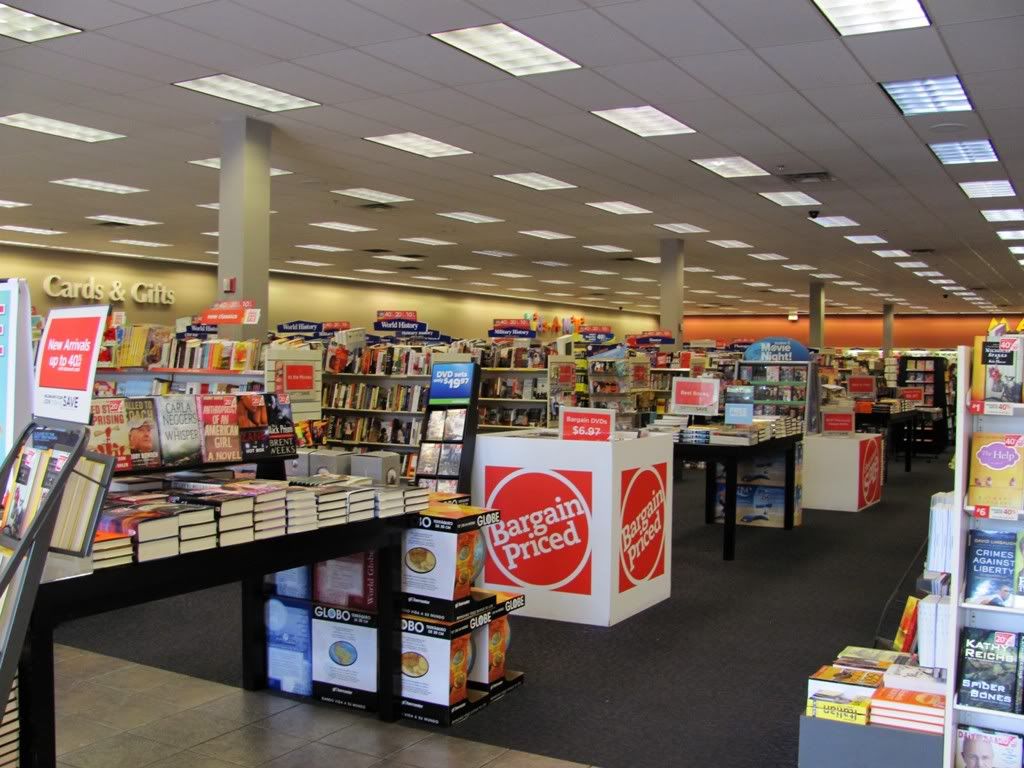 Yesterday I went to BAM, my favorite readerhood, and took some considerable me-time to amble through the aisles and soak up all the good vibes. It's like being in a library, a church and a candy shop at the same time; I tiptoe and meditate and drool a little. On this trip I probably spent as much time watching people shop as I did browsing; force of habit from my bookseller days.
 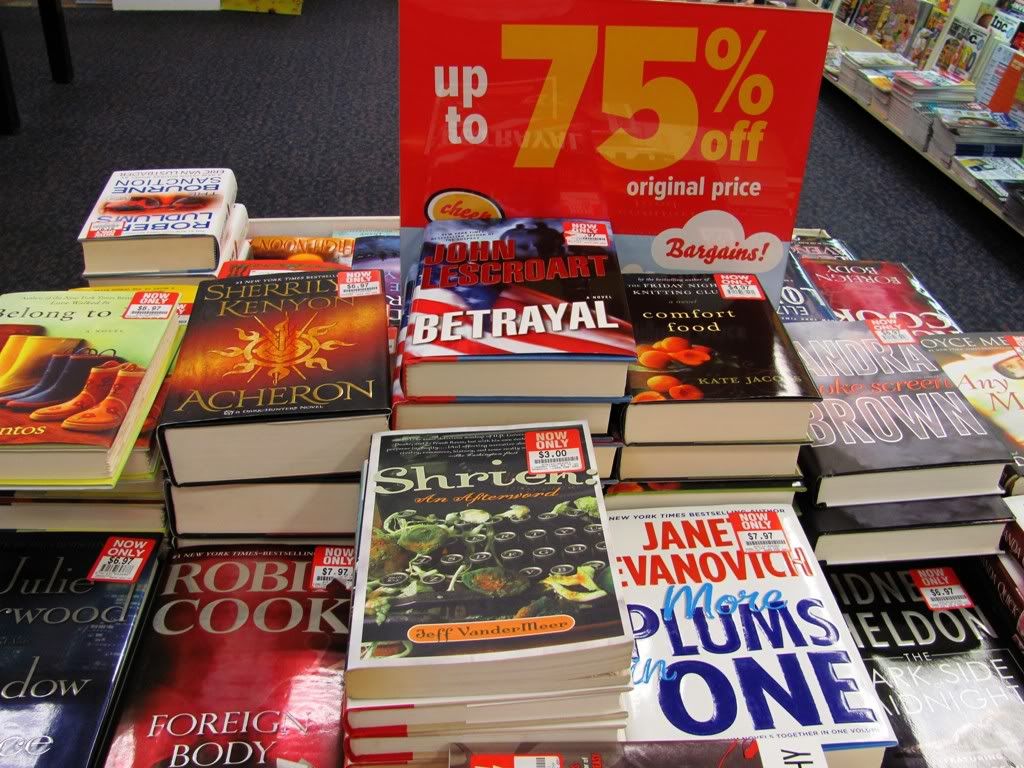 You don't really notice the people who actually want to be in the bookstore because they're usually on the move, prowling the shelves and circling the remainder tables while they look for hidden treasures and quick bargains (the 75% off remainder bins like this one get shuffled through regularly.) Unlike the gotta-get-outta-here customers, they make a grand tour, starting at the front co-op realm of bestsellers and working their way back through every aisle. When they reach the spot with their favorite form of fiction, they will stand for as long as thirty minutes in one spot while examining spines, studying covers and reading back copy before shuffling down to the next chunk of the author surname alphabet.
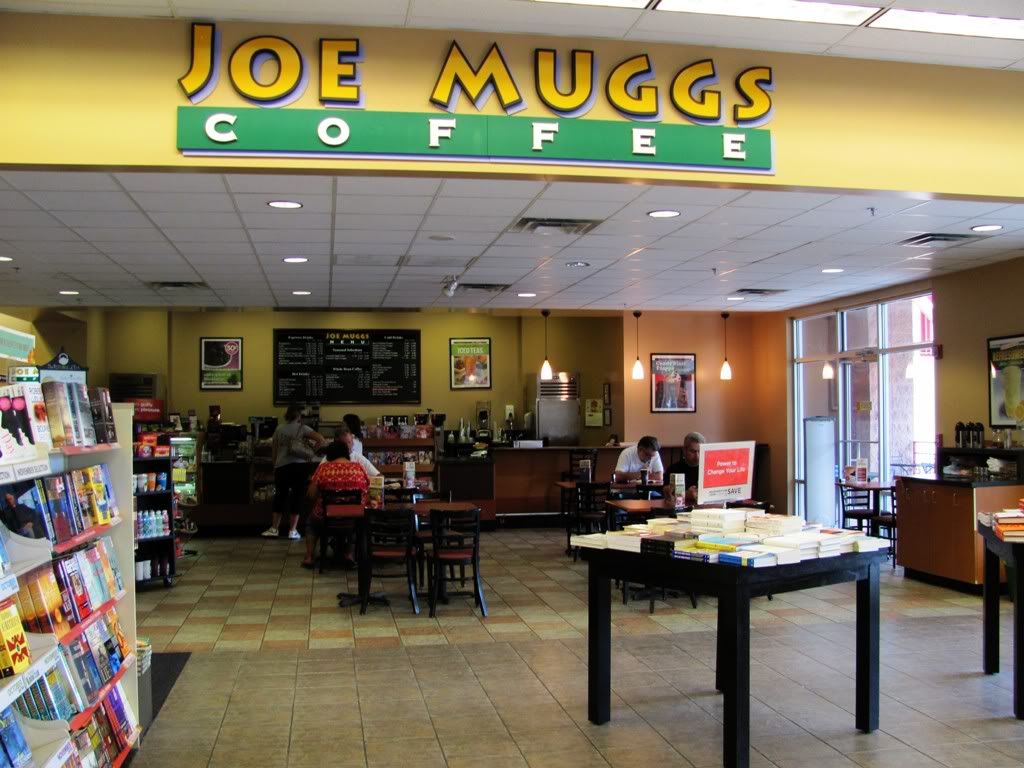 Any writers in the store are usually in the cafe letting their foamy lattes go flat while they scowl at their netbooks and laptops and scribble down notes in untidy spiral bound notebooks. Most of them are there to be seen, not to write, and I tend to think of them as performance writers. If you want to really mess with them, walk behind them, pause, and glance over their shoulder at whatever they're typing. Then raise your eyebrows, smile, and move on fast (or you may end up spending the next two hours listening to a rambling description of some over-complicated Starship Troopers/Naomi Novik knockoff complete with orcs and dragons.)
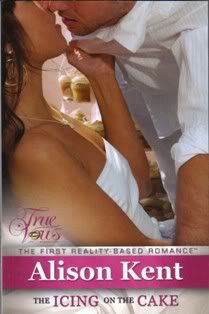
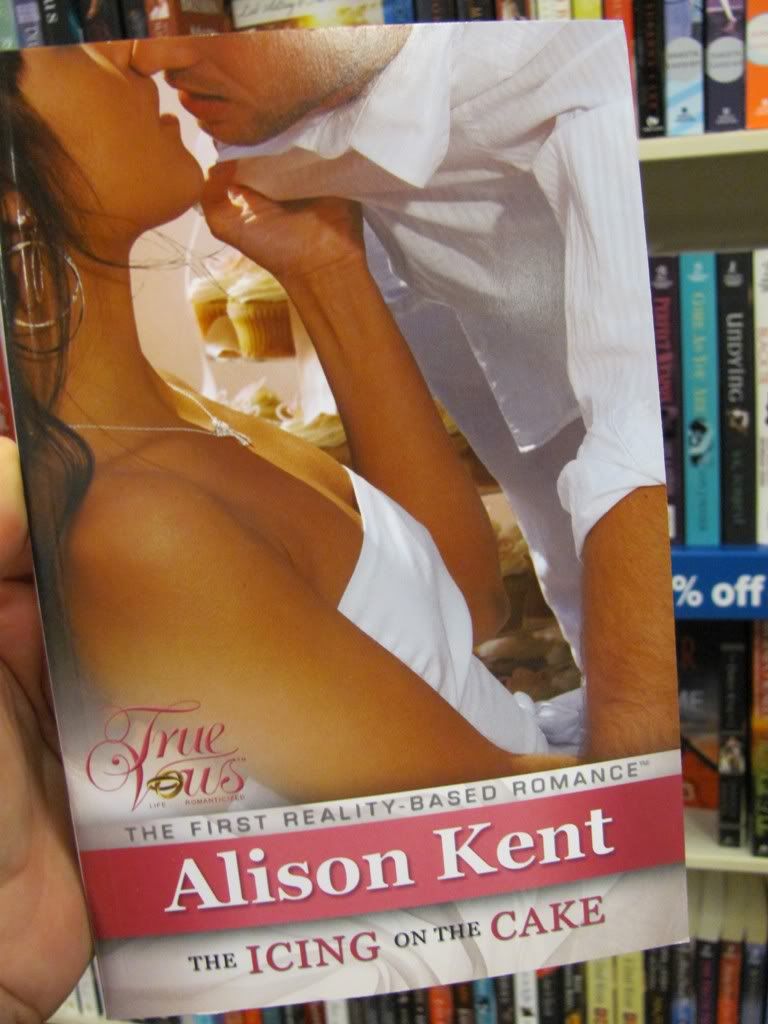 I'm loyal to my local BAM for a couple of reasons: they almost always have the latest releases I want (today I went to see if they had Alison Kent's Icing on the Cake, her first reality-based romance, and sure enough, it was on the shelf.) I found another novel I wanted to read but that I didn't think was supposed to be out yet, thought I had the wrong date in my head, and took it up front. As soon as the bookseller running the register scanned it, she apologized and said that it shouldn't have been shelved, she couldn't sell it to me, but offered to hold it for me until October 1st. Lay-down date enforced! Right in front of my eyes! I felt like kissing her, but settled for a smile and an "okay."
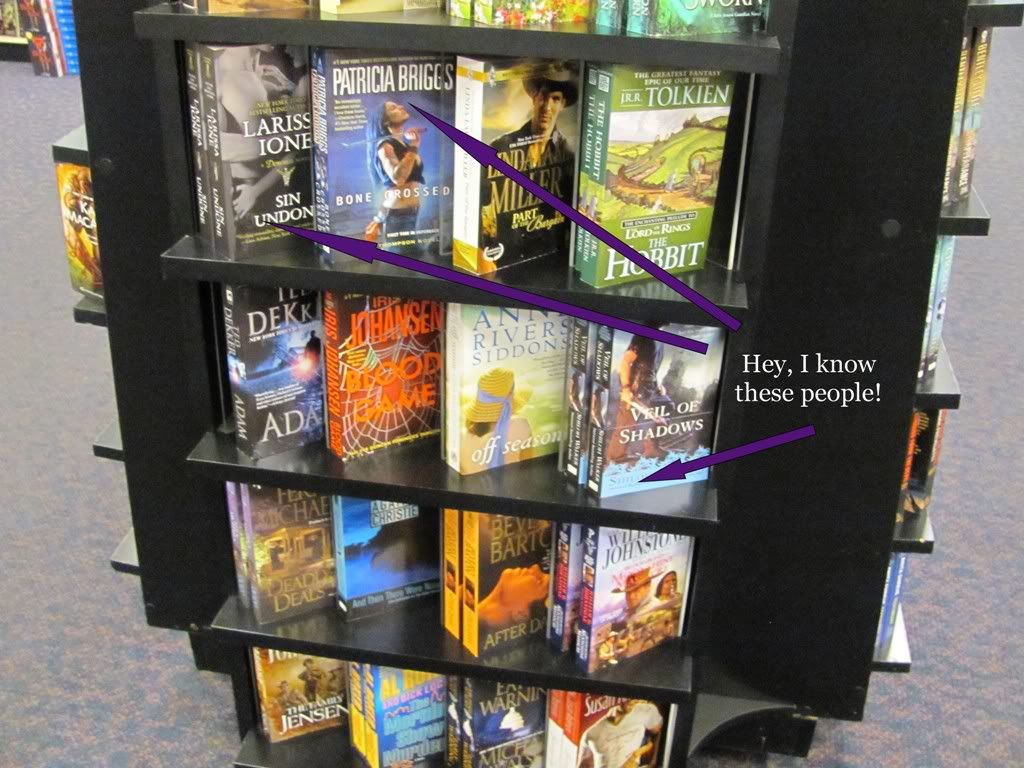 I've had some cool experiences at this BAM, too. During one visit I got into a discussion on Harlequin novels with a lifelong reader who knew who Margaret Rome was and had the same set of handblown lavender subscription bonus wineglasses I'd collected back in the eighties. Blew my mind. My favorite thing to do still is hand-sell to a talkative browser, or walk up to a confused-looking shopper and ask them what they're looking for, and then find that book. Sometimes all I have to go on is what they think the title was (inevitably wrong) and they're always a little stunned when I find it for them.
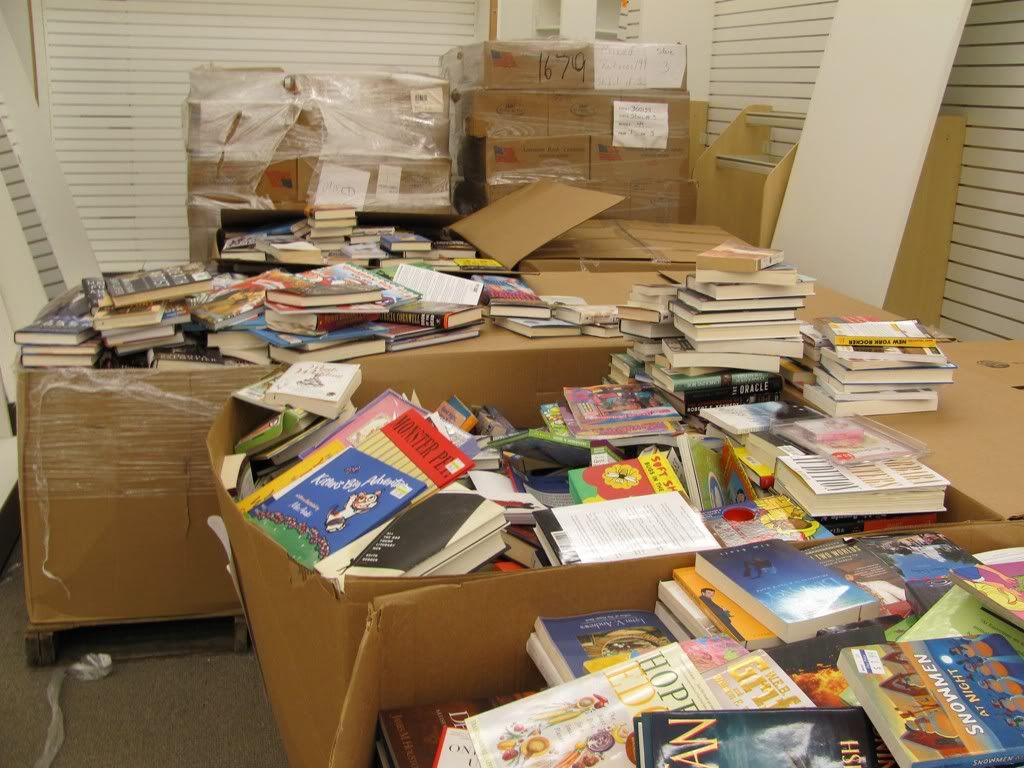 There's only one bookstore in my area that I've been steering clear of, and it's one of these giant warehouse clearance monstrosity that sets up temporary shop to get rid of overstock remainders. The first and only time I went to the one near me I saw this mess. The weekend sale they had going let you buy any book under the roof for two bucks, and there were big art books and scholarly tomes that retailed for $50.00 + or more new. They had empty shelves all around the store, but instead of shelving the books the help left them piled in the shipping boxes. Any that had fallen on the floor were just left there to get stepped on and soiled by indifferent feet. It killed me to see books being treated this way.
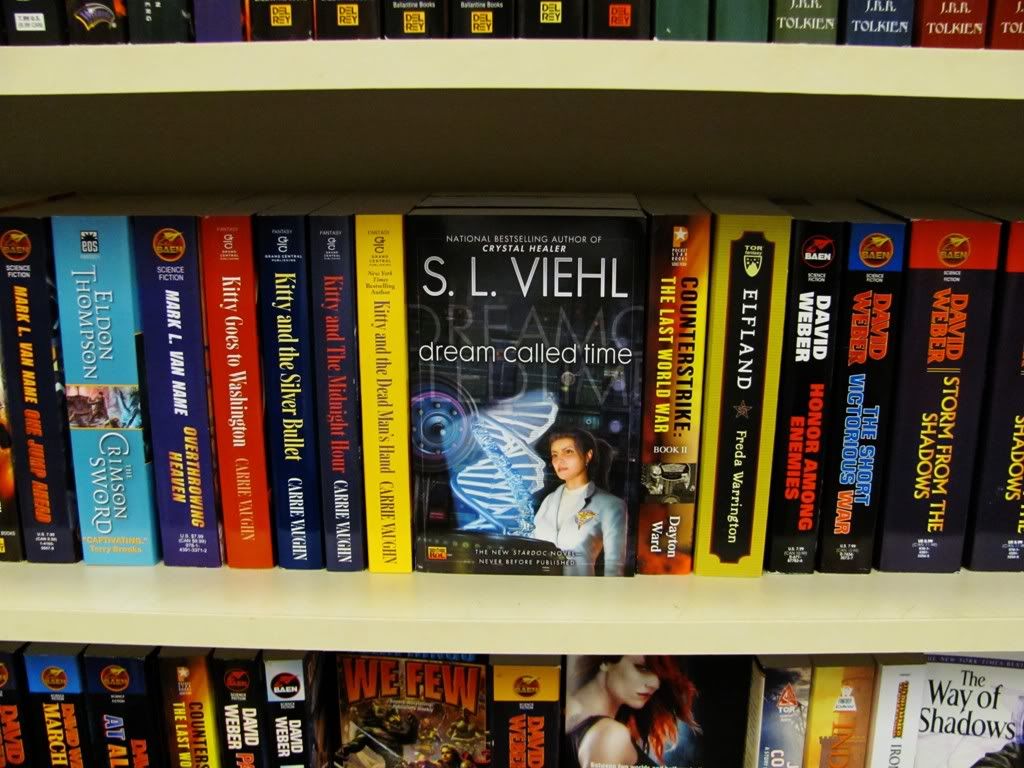 One bookstore memory that has stayed with me for years was crossing paths with a lovely older romance author in a Chicago Borders. She was wearing a gorgeous suit, but I recognized her at once because she's one of those rare authors who actually looks exactly like her bio pic. I thought she might be there for a signing or an event, but while I watched from a safe distance she picked up a couple of books to buy and then faced out her novels. Some of her books were on one of the lowest shelves, and she was wearing a skirt so it should have been awkward, but no, she did this graceful genuflection that spoke of years of practice. I didn't bother her, but seeing her there by herself, just quietly performing one of the more mundane of authorial tasks, made my heart melt (perhaps because I was there for the same reason.)
 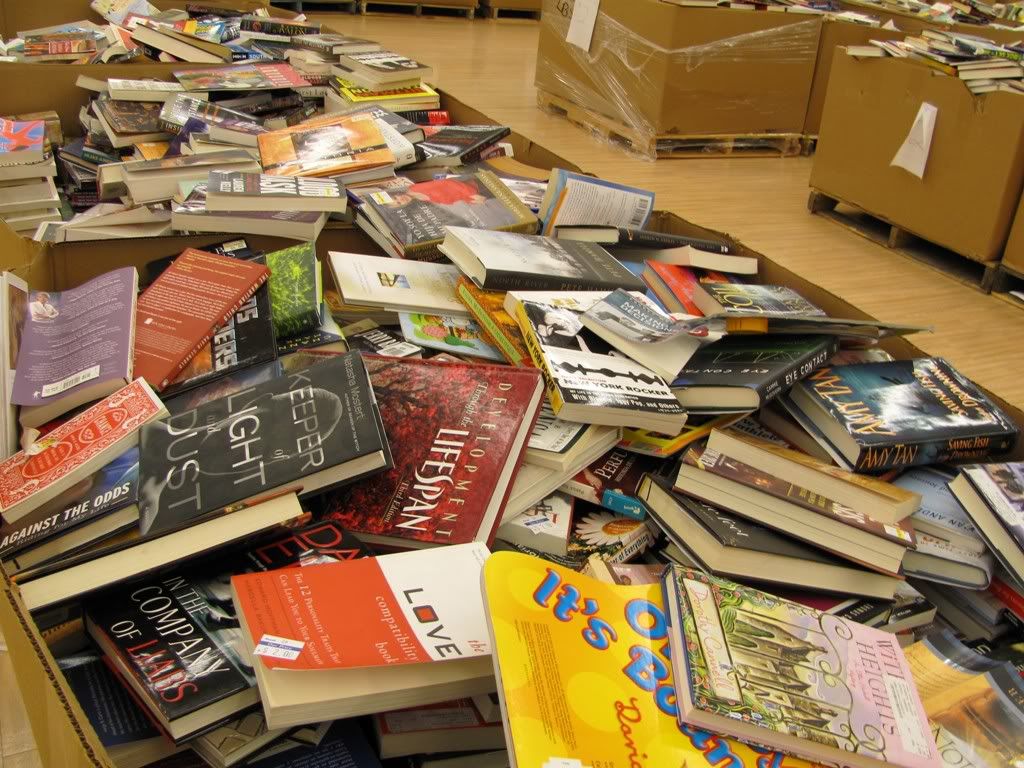 Online shopping is convenient, and will probably shut down a lot more of the brick-and-mortar stores, but it's largely sterile and disconnected. E-readers, while even more convenient, also eliminate the fun of those bargain book hunts and hidden treasure novels quests. Getting out there and visiting your favorite readerhood takes time, but there is nothing to equal the experience. I love my BAM, and shop mostly there, but this fall I'm going to make a point to visit all of the other bookstores in my area to spread the love around. I really don't want to see stores end up becoming remainder maulers who just toss books into huge cardboard bins and leave them to be picked over by the price vultures. Books merit better treatment than dollar store items.
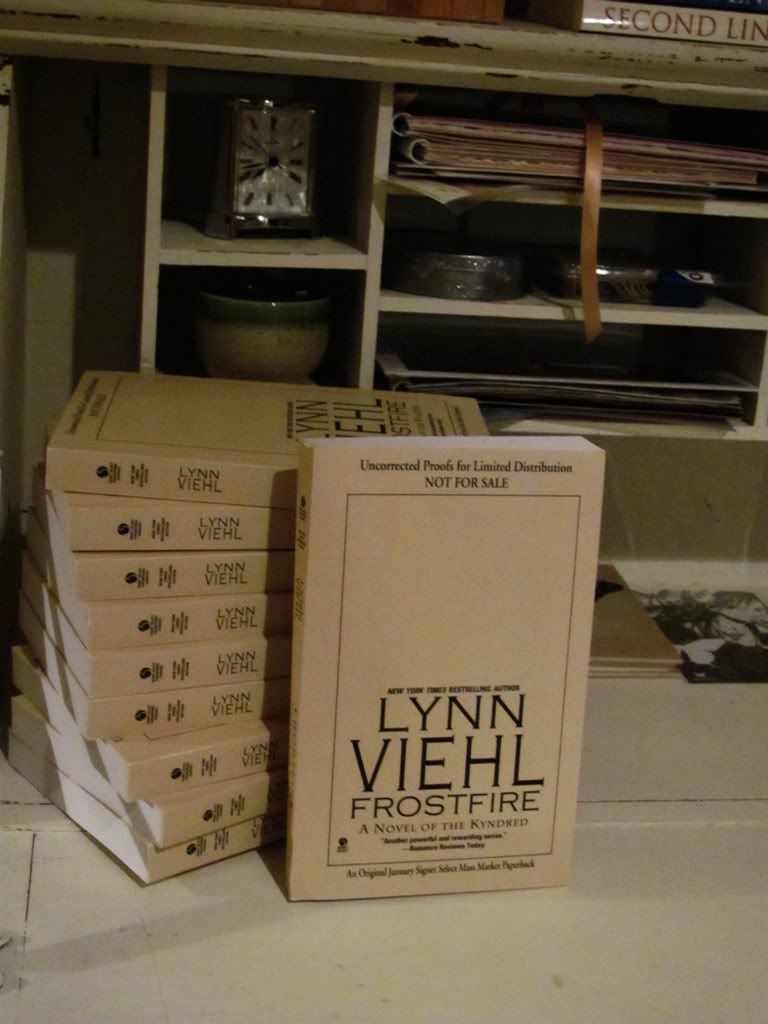 My publisher kindly sent me some ARCs for my next book, and I think a great way to kick off my online fall festivities is to give some away here. So what are you guys planning to do this fall that is something fun or just for you? Let us know in comments (or if you're still looking for your oasis, just toss your name in the hat) by midnight EST on Friday, September 24, 2010. I'll draw ten names at random from everyone who participates, and send the winners a signed ARC of