Today we're going to talk about outlining stories. All strictly artistic, spontaneous, organic and/or pantser writers should now leave the blog, lest I poison your well, ruin your process or otherwise mess with your mojo.
It's not that bad. Outlining can be a blast, if you stop with the dread and go for the fun of it. I did that last month with my outline for my NaNoWriMo 2017 novel. I had the general idea of what I wanted to write, so basically I just channeled the protagonist and let her tell me the bare bones of the story in her voice. Since I think Emma is hilarious, it was something I really enjoyed -- and that is the key.
If you don't like writing traditional outlines, why try writing them at all? Instead, why not write what happens in your story like a bullet list:
Soviet missile sub commander defects -- with invisible sub.
CIA drops analyst on US sub.
Subs meet; get cranky.
Analyst and defector become periscope pals.
Second Soviet sub arrives.
Torpedoes fly.
The cook is a saboteur!
Sam Neill character dies.
Soviets think defecting sub sank.
They defect happily ever after.
Okay, it's a bit tongue-in-cheek, but that is a bullet list-style outline of The Hunt for Red October. I covered all the major plot points in ten lines (and just fifty words) off the top of my head. Took me five minutes because it was fun.
For those of you who are muttering that you're not into list outlining, okay. Why not invent your own method? I did that back in 2015 with story cards, and in 2012 with SCARAB outlining, and in 2008 with my speedy ten point plot outline. So now it's your turn. What can you think up that would make the task easier, faster, or more interesting?
Don't limit yourself to what you can do on the computer, either. You can use index cards, sticky notes, a small notepad, a story journal, a composition book, a cork board collage -- anything that helps you organize your thoughts can also work for outlining a story.
Finally, back in 2015 I reposted my master list of novel outlining links, and most of the links still work, so if you don't want to follow my method, try someone else's. See what feels like fun for you, and you might never again dread outlining.
Showing posts with label outlining. Show all posts
Showing posts with label outlining. Show all posts
Wednesday, October 04, 2017


Monday, October 19, 2015
Outline 14
Someone (you know who you are) asked me to repost a list of links I put together back in 2012 to help with outlining a NaNoWriMo novel. Here you go:
Planning, Scheming, and Plotting by Stephannie Beman -- Stephannie talks about her method of sketching out a nice, brief checklist to loosely organize her stories in advance of the writing.
Keith Cronin abstains from Roman numerals in his hybrid pantser-plotter approach to outlining, The Big O.
 For those who prefer to write the classic synopsis as an outline -- there are one or two of you like that, yes? -- Charlotte Dillon has a fabulous page of info and links here.
If you'd like to organize your outline online, I recommend trying Hiveword, Mike Fleming's free online novel writing organizer, which I demo'd and reviewed here.
If you hate the idea of outlining at all, you may get some comfort (and ideas) from Crawford Kilian's post Writing Without an Outline.
Advice from a master: Effectively Outlining Your Plot by Lee Masterson
Alicia Rasley's classic article Outline Your Novel in Thirty Minutes asks all the right questions; you provide the answers.
For a very brief outline, test drive my one-page ten point novel concept outline template (the first page is the blank template; the second is filled in as an example.)
If you like Randy Ingermanson's Snowflake Method of outlining, you'll probably also love TextTree, a freeware written as a companion program for it.
TiddlyWiki is a free service that provides a reusable non-linear personal web notebook (LJ Cohen did a terrific virtual workshop a few years back on how to use TiddlyWiki to organize your novel.)
Try virtual whiteboarding with the free online service Trello, which I demo'd and reviewed here.
Juliette Wade's Sequence Outlining offers an event-driven method of outlining.
Writing.com has a Blank Novel Outline worksheet here.
And finally, a post I wrote that after five years remains the #1 most popular on PBW, my Novel Outlining 101.
Planning, Scheming, and Plotting by Stephannie Beman -- Stephannie talks about her method of sketching out a nice, brief checklist to loosely organize her stories in advance of the writing.
Keith Cronin abstains from Roman numerals in his hybrid pantser-plotter approach to outlining, The Big O.
For those who prefer to write the classic synopsis as an outline -- there are one or two of you like that, yes? -- Charlotte Dillon has a fabulous page of info and links here.If you'd like to organize your outline online, I recommend trying Hiveword, Mike Fleming's free online novel writing organizer, which I demo'd and reviewed here.
If you hate the idea of outlining at all, you may get some comfort (and ideas) from Crawford Kilian's post Writing Without an Outline.
Advice from a master: Effectively Outlining Your Plot by Lee Masterson
Alicia Rasley's classic article Outline Your Novel in Thirty Minutes asks all the right questions; you provide the answers.
For a very brief outline, test drive my one-page ten point novel concept outline template (the first page is the blank template; the second is filled in as an example.)
If you like Randy Ingermanson's Snowflake Method of outlining, you'll probably also love TextTree, a freeware written as a companion program for it.
TiddlyWiki is a free service that provides a reusable non-linear personal web notebook (LJ Cohen did a terrific virtual workshop a few years back on how to use TiddlyWiki to organize your novel.)
Try virtual whiteboarding with the free online service Trello, which I demo'd and reviewed here.
Juliette Wade's Sequence Outlining offers an event-driven method of outlining.
Writing.com has a Blank Novel Outline worksheet here.
And finally, a post I wrote that after five years remains the #1 most popular on PBW, my Novel Outlining 101.
Wednesday, October 24, 2012
NaNoWriMo Countdown
 We've got eight days until the kickoff of NaNoWriMo 2012, and this last week before the craziness begins is a terrific opportunity to organize in advance what you'll need to write your novel in November.
I'll be putting up a series of posts this week with things to hopefully help you do that, but before we dive into all the details and logistics let's take a moment to talk about the why. As in, why do this, this crazy thing, this impossible task of writing a novel in thirty days?
You might not know it, but you have more than a novel inside you. Actually, you have an entire library in your head. Its shelves are packed with your ideas and your dreams and your experiences and your longings. Your imagination is like a librarian who keeps acquiring all this stuff; she works tirelessly and endlessly to sort through it and catalogue it and have it ready for use. Your use, because you are this library's only patron.
Writing is about opening the doors to that library and bringing the stories shelved in it out into our world. At first it's going to be just for you and the page, but even that sharing is not an easy thing to do. Writing is not simply putting words on paper in coherent order; it's an act of creation. It takes courage to make that attempt, to make what resides only in your head into something real. So it's okay to be a little scared, and doubtful, and worried. Trust me, the rest of us are right there with you. On November 1st me and many of your writer pals and thousands of others all over the planet will be opening up the doors to our idea libraries and bringing out our stories. If you do this, you'll be writing along with the world.
So there are my thoughts on the why. In the meantime, if you haven't yet settled on what sort of story you want to write, now would also be an advantageous moment to make that decision. If you have a lot of ideas and aren't sure how to pick the best from them, I talked about my method in this post.
Making up a title for your book now can be fun, too. Input keywords about your story concept into Wordle and let it recombine them; often the clouds it produces include some interesting pairings. You can also search Bartleby.com's verse database with your story keywords to look for title ideas from poems. This title doesn't have to be anything you chisel in stone, either. If you can't think of anything that works even temporarily call it your NaNo 2012 Novel, or Scrambled Eggs, or whatever comes to mind (I once wrote a novel with a working title of Carnival Geek because those were the two words that inspired the whole idea.)
If you're planning to join in NaNoWriMo 2012, in comments let us know what you'll be writing, where you'll be posting about your progress, or anything else you'd like to share.
Thursday, October 11, 2012
NaNoWriMo 2012: Choosing Your Story
Preparing for National Novel Writing Month begins with a decision on what sort of story you'd like to write in November. Many of you have already made this decision, but for those of you who are still mulling it over, it's better to pick now than panic on November 1st.You can go with the first idea you think up that captures your imagination, or select something you've been saving for just such an opportunity. Neither way is wrong; go with what speaks to you as a writer. But if you have a lot of ideas and no clear choice, you need to sort them out in a logical fashion until you figure out which one makes the best choice for your November novel.
One way of choosing what you're going to write is like I did on Monday -- make a list of ideas that appeal to you the most. You can note them by genre, character, premise, time period or even a working title; use the words that best define the idea in your mind. If you keep a story idea file, raid it for the best of what you've collected to make up your list. You can use as many or as few ideas as you want, but I'd give yourself at least five options so you have a group to work with for comparison purposes.
Once your list is complete, take a day or two to think about all the ideas you've noted. This gives you a chance to obsess about them -- something most writers love to do -- and also allows the ideas to percolate a bit. During this time you may discover your thoughts will keep returning to one or two of the ideas on your list; these are probably the most attractive to you. They not necessarily the best choice for NaNoWriMo, however, so don't make a decision yet. You may also want to run your ideas past a writer friend or critique partner to get some feedback on which seems most viable.
Once you've thought through your ideas, take your list and read it again. Compare the ideas to each other and focus on the ones that don't especially stand out or seem a little lackluster. Start the process of elimination by crossing off the idea with the least amount of appeal to you (this does not mean it's a bad idea or that you should trash it. It's a story that for whatever reason you're not ready to tell.)
Repeat this process a couple more times. For NaNoWriMo you want to write a story that is exciting to you, that (obviously) does not require months of research in advance, and that you can easily envision from start to finish (if you're a pantser, you're looking for an idea that has enough appeal to keep you working at it for thirty days. Since I don't know how you do that, you'll have to be the judge.) As you think about these things, cross off the ideas that don't fit the bill as well as the others. Keep at it, comparing what remains to each other until you whittle the list down to the final two best possibilities.
At this point I usually invite the universe to collaborate with me and flip a coin to make the final choice between the two. You can try this, or you can run the ideas by that writer friend or critique partner and ask their opinion on which is the best, or you can simply choose the one you find most attractive. Before you leap into fleshing out the story you've selected, take the others you've eliminated and put them in your story idea file (and if you don't have that, start one.) These other ideas might work better for you sometime in the future, and they're excellent backup in the event the choice you've made doesn't work out from the start.
You can make this story decision at any point before November 1st, but my advice is to nail it down by October 15th. That will give you couple of weeks to obsess a little more, let it percolate again and begin whatever preparations you like to do before starting to write.
Do you have a tried-and-true method of sorting through your story ideas to select the one you want to write? Let us know in comments.
Monday, August 13, 2012
Outlining Ten
Ten Things About Outlining Your Fiction
I haven't yet tested Using MS Word to Auto-Outline and Keep Track of Revelations by Martina Boone, but it sounds like it should work.
Keith Cronin abstains from Roman numerals in his hybrid pantser-plotter approach to outlining, The Big O.
Glen Ford's Book Proposals ~ Writing an Outline for a Nonfiction Book from the Book Itself and How to Reverse-Outline Your First Draft by Mark Nichol both tell you how to write up an outline after you've written the book.
If you want to know how Janet Evanovich outlines (aka the easy way), take a look at her storyboard method and how she plotted one of her novels here.
Janice Hardy discusses putting together your own outlining method in Are You In or Out? Crafting Outlines That Work for You.
The Outlining Dilemma - Plotting vs. Pantsing by Beth Hill discusses the pros and cons with both approaches, and has some useful tips on outlining that work for both.
Sarah A. Hoyt's Hunting the Wild Subplot is more about the process of refining an outline than subplots per se, but still worth the read.
Alicia Tasley's classic article Outline Your Novel in Thirty Minutes asks all the right questions; you provide the answers.
DIY MFA's Untraditional Outline Techniques article includes a link to a one-page worksheet to help with outlining the primary elements of your story.
Juliette Wade's Sequence Outlining offers an event-driven method of outlining.
All of the above links were found via the fabulous writing-specific search engine at Writer's Knowledge Base. And if you'd like to see what I've written on outlining here at PBW, click here.
Thursday, April 19, 2012
Virtual Storyboard
If you like working with whiteboards and/or index cards for your stories, you might want to check out Trello. According to their About page, Trello is "a collaboration tool that organizes your projects into boards. In one glance, Trello tells you what's being worked on, who's working on what, and where something is in a process."
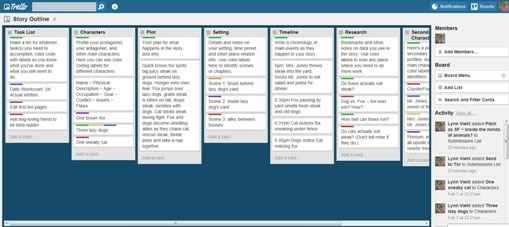
To test drive the service I set up this example story board, which you can see in more detail here. Using Trello is pretty straightforward; you just have to fiddle with it a bit to get the hang of how to edit and arrange your cards. I'd be most likely to organize a story project outline as shown and keep a running list of what tasks I need to accomplish, but you can use your cards for whatever you like.
Two of the features I liked most are the simple color-coded tags you can apply to any card, and the search feature -- you can sort through everything by any keyword, which makes finding pertinent data and editing the cards a snap.
For those of you who collaborate with another writer Trello would probably be extremely useful. You could set up an account for the two of you, organize your schedule, plot out your next project, work out who needs to do what and update each other on your progress. The right activity sidebar shows all activity on the board in chronological order, so you can always look there to see what's been added, deleted or changed recently. You can also set the board to be private so that no one sees it but you and your writing partner.
Thanks to our blogpal author Charlene Teglia for originally blogging about Trello.
Tuesday, March 27, 2012
Next Stop Irony
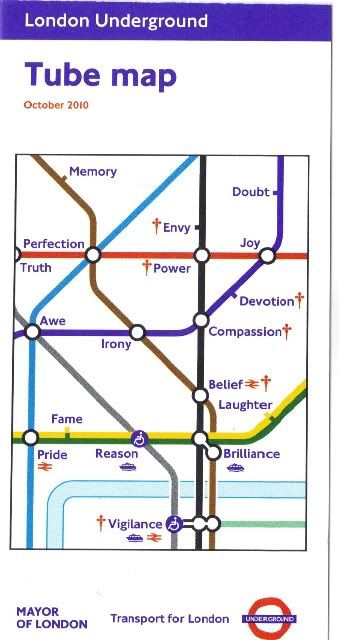 I love the cover of this map for the London Underground (click to see larger version), which was obviously designed by someone with a wry sense of humor. Wouldn't the journey be so much simpler if we could pick up a map that shows us in advance all of life's endless interchanges?
In the real world we can only wish, but in story worlds we plotters map out in advance what happens to our characters. We usually do this by writing outlines, synopses, chapter summaries, storyboards, index cards, filling in templates and what have you (I've gone so far as to outline a story like a wiring diagram.) I've never thought of mapping out a story like an actual map, probably because cartography is a beautiful, complex art that is completely beyond me. If you think of story like a simple line map for an underground or subway system, however, it seems far less intimidating.
The transit lines would be characters, I think, and the interchanges (stops along the way) would have to mark different points or elements in the story. To make it a useful tool, I'd want to map it out chronologically, starting the lines at chapter one and ending at the final chapter. One could draw/superimpose them on an actual real world map (assuming that would somehow be helpful), but to keep things from getting too complicated I'm going to start with a plain white background.
Here's my first try using three characters and the settings where they intersect in Nightborn:
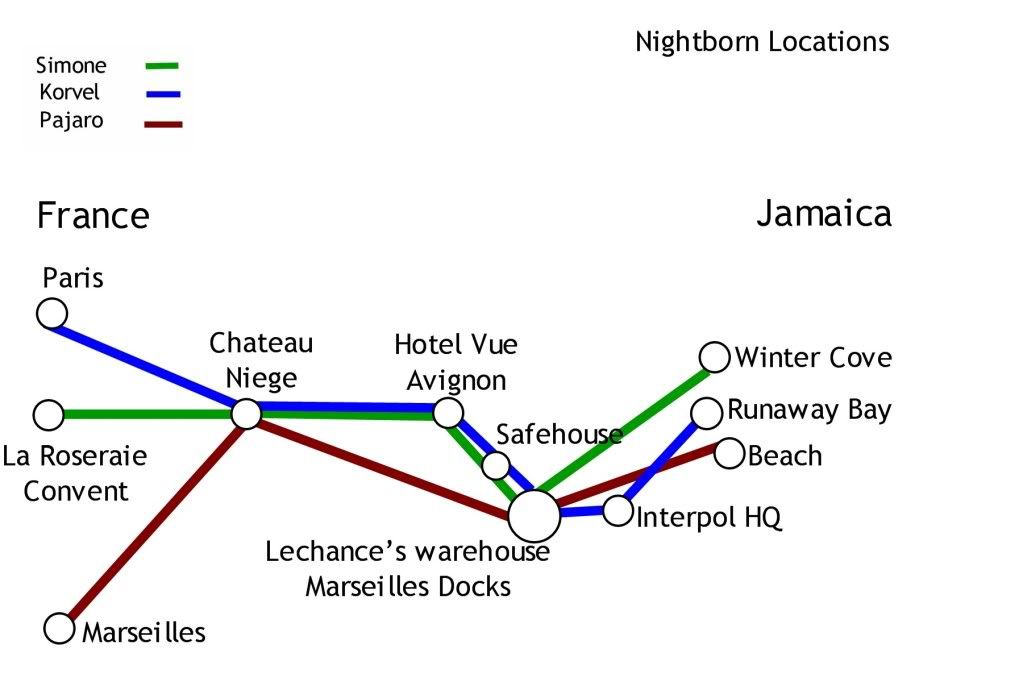
This could be a lot of fun to do with story elements other than locations or settings, too. A map with transit lines of all the novel characters and what makes them intersect or split away from each other would be fun to put together. Or imagine exploring the progression of a relationship between two characters this way while using the interchanges as events, emotional shifts, the effects of other characters on the relationship, etc.
I don't think you have to use a photo shop program for this; you can draw it in colored markers/pencils on paper, or use a whiteboard with those dry-erase markers (which would probably be easier to revise.) If you're really creative you could probably do something similar with ribbons, push pins and a big cork board, too.
I'm going to keep tinkering with this and see what I can put together. In the meantime, what do you guys think? Would this be something that would work as an outlining tool for you, or is it too weird to be practical?
Monday, January 23, 2012
Outline Ten
Ten Things to Help Outline Your Novel
Freeware caution: always scan free downloads of anything for bugs and other threats before dumping the programs into your hard drive.
The Lite version of Action Outline "consists of an Explorer-like interface where you can store and arrange all your information in a tree outline form. Arrange items using your keyboard or mouse, cut and paste branches, place checks or tags next to listed items, search information, print data, export to the external file, or link to web or local files" (OS: Windows 2000, 2003, 2008, XP, Vista and Windows 7.)
Essential PIM is a "personal information manager that allows you to keep all your information in electronic form. All your appointments, tasks, notes, contacts, password entries and email messages are stored in a graphical user interface and easily accessible form. Automatically import your data from pretty much any PIM software that just isn't working for you. Synchronize with popular online services such as Google Calendar and Contacts, Yahoo Contacts, SyncML and CalDAV servers and more, always keeping your data up-to-date and accessible anywhere, anytime" (OS: Windows XP, Vista, 7)
The Guide "evolved from the need to have an application that could organize information and ideas in a hierarchical, tree-like structure. Tree-based structures are frequently employed to manage information through a "divide-and-conquer" approach, wherein each level of the tree represents a further level of specialization of the parent-level topic — the best example of this being a book. The Guide is an application that allows you create documents ("guides") which inherently have a tree (which you can modify as you please) and text associated with each node of the tree. The text itself is of the rich-text variety, and the editor allows you to modify the style and formatting of the text (fonts, bold, italics etc). For the initiated, the Guide is a two-pane extrinsic outliner. This concept is similar to mindmapping in some ways" (OS: Designer notes: "The Guide is available as an installable package for Microsoft Windows 2000 and upwards (XP, 2003, 2008, Vista). The binaries are also available as a zip file that requires no installation and supports portable use. The Guide is a 32-bit native C++ Win32 application (that uses MFC). It will work on 64-bit platforms also.")
MemPad "is a plain text outliner and note taking program with a structured index. All pages are stored in a single file. User interface available in 15 languages. The program offers standard editing functions including cut, copy, paste, undo, date/time insert, drag&drop, and supports Web links as well as network and local file or folder links (full path not required) and internal page links. Environmental variables can be used in file links to run programs, for example" (OS: Win95 / Win98 / WinME / WinNT / Win2K / WinXP / Vista / Win7)
Mind Raider is a "personal notebook and outliner. It aims to connect the tradition of outline editors with emerging technologies. MindRaider mission is to help you in organization of your knowledge and associated web, local and realworld resources in a way that enables quick navigation, concise representation and inferencing" (OS: Windows, Linux and Mac)
The Note & Do free plugin for MS Office applications (Excel, Outlook, Powerpoint and Word) allows you to: "Drag and drop text from the documents to instantly create notes or tasks; Drag task or note text directly into your document; Categorize notes and tasks with color; Auto arrange the notes; Remove all notes at once; Pin a note to all applications or just the ones you choose; Create application-specific tasks; Complete and re-enable tasks (OS:Windows 7 (x86, x64), Windows Server 2008, Windows Vista (x86, x64), Windows 2003, Windows XP. .NET Framework 2.0 must be installed.)
NotesLogExp "can store, retrieve, catalog, manage, search, sort and export notes, documents, links, etc. The program can save and automatically fill forms as well as usernames and passwords (with auto login). The program includes a search tool, the database is password protected, and includes export to HTML" (OS: Windows 98, Vista, 7)
Text Tree was built on Randy Ingermanson's Snowflake outlining method, and "is designed make structured, understandable documents easily and quickly. Text Tree has been found useful for story writing, FAQ creation, novel planning, manual writing, software support, biographies, and lesson planning. What really sets Text Tree apart from other outliners is its export abilities. In other outliners, you make a outline of everything, then you have to cut and paste or go node by node to get your information out. Text Tree allows you to quickly export all or part of the information in your outline" (OS: Windows XP with Java installed)
Tkoutline is "a single pane, cross-platform outline editor written in Tcl/Tk. With this editor, information can be structured hierarchically in an outline and outlines can be hyperlinked together to create a web of outlines" (OS: Win95 / Win98 / WinME / WinNT / Win2K / WinXP)
TreeLine is "a structured information storage program. Some would call TreeLine an Outliner, others would call it a PIM. Basically, it just stores almost any kind of information. A tree structure makes it easy to keep things organized. And each node in the tree can contain several fields, forming a mini-database. The output format for each node can be defined, and the output can be shown on the screen, printed, or exported to html (OS: Windows XP, Vista, 7, Linux)
Friday, August 12, 2011
Character Keywords
 While I was out last week taking care of school shopping, my kid diverted me into Claire's so she could get a new keychain. I wandered around marveling at all the stuff I am now too old to wear when I found a selection of antique-look necklaces sporting decorative skeleton keys. I saw one I really liked, grabbed it on impulse and went to hurry the kid along so we could move on to the shoe store.
It wasn't until I got home and took out the necklace again that I saw there were words welded to some of the keys on the necklace; mine had keys that read Peace, Hope and Dream. As those are definitely three of my favorite words, it was a neat surprise (and after checking Claire's web site, I found this listing for it. They call it the Inspiration Keys necklace; excellent name.)
Discovering these -- pardon the pun -- keywords on my necklace also made me think of another way to work on one character I've been tinkering on for my next novel. I know almost too much about him, and I've been getting mired down in all the details and backstory, so I've been wanting to distill all this info and somehow summarize it to get a better handle on who he is. Taking a cue from my new necklace, I thought about how I would describe him using just three words; words that are keys to who he is.
The first would be chimerical because of the complicated aspects of his character, the manner in which he's evolved as a person, and (depending on how you look at him) his life has been a chimera of dreams and nightmares. Resolute is also a central aspect to his character, as his determination is both unwavering and defining, and drives him so much in the story. The final keyword for him would be valorous. He is the embodiment of this word, not just in how he conducts himself, but in that he constantly inspires the same in others.
All right, now it's your turn. What three keywords would you use to describe a character from one of your stories (or, if you're a reader, from a book you love?) Let us know in comments.
Tuesday, June 07, 2011
Novel Series Outlining
My newest editor gave me an interesting task last week that I thought I'd share. First, the backstory: In January the editor I'd worked with for the last seven years decided to quit the business. When something like this happens, most writers quietly have a cow (and I admit, for a day or two I had a small calf) but it can also be a good thing. Shortly after the bomb dropped I recognized the sterling opportunity peeking out from under the rubble, and moved quickly to request reassignment to an editor I've wanted to work with for some time -- and got it.
The only pickle still floating in the party punch was what the new editor inherited along with me: the new Darkyn trilogy. Since my new editor hadn't worked on the original series, she doesn't have first-hand knowledge of all the characters, plot lines and world-building in those books. And while I always try to include enough history in every book to keep new-to-me readers from getting lost, an editor needs to know a lot more. When she asked me to write up an overview of the characters and stories from the original series, I jumped right on it.
Outlining an entire series after you've written it might sound easy, but for me it meant condensing over 1700 pages of notes, plots, synopses, character outlines, research etc. into a reference document that someone with no knowledge of my novels could understand and use. Basically I put aside all my notes, wrote up what I would say if we were talking about my books in person, and then edited that first draft down to the simplest details.
A series outline can include, but is not limited to:
A series premise -- the tag or hook line for the entire series.
Titles in reading order
World-building outline -- this is often difficult to summarize, especially if you've built your world(s) from scratch. My advice is to map it out as briefly as you can using broad points to illustrate only the most important elements.
Plot summaries for each book -- to avoid writing full synopses, try to limit your summaries to one paragraph.
Character outlines -- major facts only. You may want to add appearance references (i.e. which book(s) does this character appear.)
There are also some genre-specific details you may want to include, such as a timeline of story and historic events, an explanation of a magic system, family or relationship trees, planetary or technological features, or any element of your invention that contributes significantly in some way to the series. Just remember to avoid getting caught up in TME (too much explanation.)
Depending on what information is needed there are a couple of ways to do a series outline, so it's also a good idea to ask for specifics as to what the editor wants to see. I did, and my editor requested just the major players and their story lines, so I focused my overviews accordingly, and distilled the series down to eleven pages, which I think is pretty decent given the mountain of information involved.
If you're considering writing a series, this is also a good way to figure out your ideas in advance. This comes in very handy when you sell the first novel and the editor asks, "Are you planning to write a sequel or a series?" Having your series outline prepared can even result in an offer for multiple books versus one.
To show you how I wrote my outline, I've uploaded some samples from it, which you can read here (warning, this includes spoilers for If Angels Burn.)
Wednesday, October 06, 2010
NaNoWriMo Wednesday

Every Wednesday from now until November 1st I'll be posting some ideas, resources and other info that may be of help to those of you planning to join in NaNoWriMo 2010.
Last week I talked to my agent about an idea I had for a new trilogy of novels. Two phone calls later, she asked me to put together a proposal and send it to her. That meant choosing titles, character casts, themes, standalone plots and subplots, interconnecting threads and a concept that would tie three stories together -- and all I had to work with was an idea. Four days, twenty-one pages and 5,454 words later, I sent my agent the trilogy proposal, which is now in the hands of an interested editor.
Don't start calling me a novel ATM. The first reason this proposal came together as fast and well as it did was because the idea I started with was pure story fuel: potent, clear, and powerful enough to keep the engines of my imagination revved. The second reason is because I did the work required to develop it from an idea into stories for three books.
When you think about what you want to write for your November novel, you're likely sorting through a lot of ideas. Some seem good, others great, but the best ones will be like finding diamonds in a gravel pit; they can dazzle and even blind you to everything else in your head. You become so excited you can't wait to start up your writing engines and hit the story road.
This period of excitement is also as it should be. Who wants to write a book based on an idea that bores you to tears? Not me.
At some point you'll realize you have some decisions to make, because ideas are not novels (if they were, I'd surely be writing my millionth by now.) Your idea needs some things, say like a title to name it, and characters to explore it, and a setting to occupy it, and suddenly your idea may begin losing some its glitter as all these undecided things start piling up around it and smothering it. You may decide not to worry about this stuff until you start writing the book, because the story details are a lot of work, and this, this is supposed to be fun.
A few of you will sit down in November and write a novel based solely on your idea, simply making it up as you go along. It will also work out for you because you are organic writers and that's your natural storytelling process. On behalf of all non-organic writers, let me say: we really hate you.
Those of you who are not organic writers but still choose to run with just an idea may get lucky and end up with diamond-quality story. More than likely, though, you will find yourselves backtracking and rewriting a lot as you try to stretch out that idea. You may become frustrated with how long it takes to work out the things that your idea didn't cover. You may even give up when your idea sputters out and leaves you stranded in the middle of Chapter Three without a clue as how to continue on.
Bottom line for non-organic writers: no matter how dazzling or fun it is, don't rely on just an idea. Take the time now to think about it, make some decisions and develop it into what you need to write a novel.
Related links:
Ten Point Novel Concept Outline Template -- this is a very simple plotting template (followed by a filled-out example) to help you painlessly outline your idea.
Outline Your Novel in Thirty Minutes by Alicia Rasley
Outlining: Clarifying & Accelerating Understanding & Organization by Dr. Robert S. Houghton (link corrected)
PBW's Novel Outlining 101
Tuesday, September 22, 2009
Generate a Pitch
During a ten list hunt I came across author Kathy Carmichael's Pitch Generator, which generates a simple novel pitch from information you fill in the blanks.
It can also help out outline a broader concept, like the core conflict of a novel series. Here's a general example (I changed some of the generated wording to encompass a series concept:)
StarDoc is a 1,000,000+ word science fiction novel series set in the far future on various alien worlds. Dr. Cherijo Grey Veil is a bioengineered cardio-thoracic surgeon who believes in doing no harm, and in fighting for freedom and equality for all life. She wants to preserve peace and life because it is essential to the survival of all species. She is prevented from attaining this goal because a malignant crystal bent on destroying all life has invaded most of the inhabited planets in the galaxy.
(Now I have to go get over the fact it took me more than a million words to tell Cherijo's story . . . )
Sunday, October 26, 2008
Speed the Outline
I've had a couple of folks who are going to be participating in NaNoWriMo ask me to put together the shortest/least time-consuming method of outlining a novel concept.
Honestly, it's just about impossible to come up with a one-size-fits-all-genres template. I know, I've tried. Every genre is different, and you need to be aware of the general expectations for stories in that genre (even if you plan to ignore them, at least know what they are.)
Every writer's process varies, too. Some, like me, usually start with a vivid character. Others have a strong plot idea. Then there are begin-with-setting writers who fall in love with a location; the go-with-way-cool technology writers, and even writers who come up with a brilliant ending and work backward from there. Nor should I leave out the writers who simply feel something nameless in the back of their head, open a blank document page and start writing.
So that's the upfront disclaimer -- this is surely not going to work for everyone. Try it out as is or rework it to suit your particular writing and/or story needs (not everyone will have three suplots, for example, you may need more or less.) Also, this is just for the writer's personal use; I don't recommend sending this to an editor or using it for anything but writing the story or maybe as notes for the writer to consult during a verbal/phone pitch.
Since most of you are familiar with my novel crash test dummies, John and Marcia, I'm going to use their story as an example to fill in this template.
Ten Point Novel Concept Outline
Who: Marcia (half-angel librarian); John (half-demon cop); Demon thief (unnamed)
What: must work together to defeat demon diamond thief, avert Armageddon
When/Where: Modern time, Metro San Francisco
Why: Thief intends to use mystic diamond to open the gates of Hell, bring the inhabitants to the mortal world and destroy mankind.
Primary plot line: John and Marcia team up to protect diamond, defeat demon thief.
Subplot #1: John and Marcia were created to battle each other but fall in love.
Subplot #2: Demon thief falls in love with Marcia, wants to kill John
Subplot #3: John's demon father and Marcia's angel mother try to separate them.
Major Twist: The thief is the demon side of John's personality (they're the same person.) Neither are aware they share the same body.
Resolution: John and Marcia each must choose to sacrifice their inhuman powers to save the world.
Once you have these ten points outlined, you have a very general overview of your story. I think these are the basic decisions you have to make before you write (as long as that doesn't throw a monkey wrench at your muse's head.)
If you'd like to print out the blank template, I've posted it, the completed example and the links listed below over on Scribd here. *Note 9/3/10: Since Scribd.com instituted an access fee scam to charge people for downloading e-books, including those I have provided for free for the last ten years, I have removed my free library from their site, and no longer use or recommend using their service. My free reads may be read online or downloaded for free from Google Docs; go to my freebies and free reads page for the links. See my post about this scam here.
Related Links:
Outline Your Novel in Thirty Minutes by Alicia Rasley
Outlining: Clarifying & Accelerating Understanding & Organization by Dr. Robert S. Houghton.
PBW's Novel Outlining 101
Honestly, it's just about impossible to come up with a one-size-fits-all-genres template. I know, I've tried. Every genre is different, and you need to be aware of the general expectations for stories in that genre (even if you plan to ignore them, at least know what they are.)
Every writer's process varies, too. Some, like me, usually start with a vivid character. Others have a strong plot idea. Then there are begin-with-setting writers who fall in love with a location; the go-with-way-cool technology writers, and even writers who come up with a brilliant ending and work backward from there. Nor should I leave out the writers who simply feel something nameless in the back of their head, open a blank document page and start writing.
So that's the upfront disclaimer -- this is surely not going to work for everyone. Try it out as is or rework it to suit your particular writing and/or story needs (not everyone will have three suplots, for example, you may need more or less.) Also, this is just for the writer's personal use; I don't recommend sending this to an editor or using it for anything but writing the story or maybe as notes for the writer to consult during a verbal/phone pitch.
Since most of you are familiar with my novel crash test dummies, John and Marcia, I'm going to use their story as an example to fill in this template.
Ten Point Novel Concept Outline
Who: Marcia (half-angel librarian); John (half-demon cop); Demon thief (unnamed)
What: must work together to defeat demon diamond thief, avert Armageddon
When/Where: Modern time, Metro San Francisco
Why: Thief intends to use mystic diamond to open the gates of Hell, bring the inhabitants to the mortal world and destroy mankind.
Primary plot line: John and Marcia team up to protect diamond, defeat demon thief.
Subplot #1: John and Marcia were created to battle each other but fall in love.
Subplot #2: Demon thief falls in love with Marcia, wants to kill John
Subplot #3: John's demon father and Marcia's angel mother try to separate them.
Major Twist: The thief is the demon side of John's personality (they're the same person.) Neither are aware they share the same body.
Resolution: John and Marcia each must choose to sacrifice their inhuman powers to save the world.
Once you have these ten points outlined, you have a very general overview of your story. I think these are the basic decisions you have to make before you write (as long as that doesn't throw a monkey wrench at your muse's head.)
Related Links:
Outline Your Novel in Thirty Minutes by Alicia Rasley
Outlining: Clarifying & Accelerating Understanding & Organization by Dr. Robert S. Houghton.
PBW's Novel Outlining 101
Sunday, September 16, 2007
Novel Outlining 101
Concept: To create a weblog post that presents a simple method of outlining a novel.
Plan: Demonstrate the method by using it to outline the post, then use the outline to write the post itself.
Prologue: Outlining Demo
Part One: Introduction to Novel Outlining, Definitions, Purpose
Part Two: Examples of Outlined Scenes, Chapters and Parts
Part Three: Common problems, Suggested Resolutions, Finale
Epilogue: Links to other posts and articles on novel outlining at PBW and elsewhere
I. Novel Outlining
A novel outline is a story plan, written in the abbreviated form of a traditional outline with headings and subheadings. We're often taught how to outline a novel in school when we learn how to write book reports. To borrow a theme from Jennifer Crusie's latest novel, the easiest way to think of it is as a story to-do list.
An outline is valuable in a couple of ways: it creates a map of your novel, so you know where you're going when you write. Depending on how detailed the outline is, it can also be the foundation or first draft of your synopsis.
An outline need not be lengthy or contain all the details of your story. It can be as simple as Peter De Vries suggested: a beginning, a muddle, and an end.
II. Outline Examples
The beginning of this post is the outline I wrote of it. It's the sort of outline I personally prefer: simple, concise, orderly, or just the facts, ma'am. Let's haul out John and Marcia and put some of their story into outline form:
Angel's Darkness by Temperance Rising -- Section Outline
I. Novel Part One
A. Chapter One: Introduce John, Marcia, demon thief and mystic diamond at Halloween party.
B. Chapter Two: John and Marcia prevent thief from retrieving diamond.
C. Chapter Three: John's investigation of theft, diamond and Marcia reveal unholy demonic plan.
D. Chapter Four: John and Marcia discover the truth about each other's half-blood, which should make them immortal enemies.
E. Chapter Five: The thief forces John and Marcia to go on the run with the diamond.
Now all of the above are just main chapter points, or the gist of what happens in each chapter. There are no details of how we meet John, Marcia and the thief, or how John and Marcia keep the diamond from the thief, or in what way they discover they were born to be immortal enemies. For that, we do a chapter outline:
Angel's Darkness by Temperance Rising -- Chapter Outline
I. Chapter One
A. Scene One: John and Marcia meet and have a quickie at the half-blood Halloween party.
B. Scene Two: A demon thief plants a soul-stealing diamond on Marcia to smuggle it out of the house.
C. Scene Three: John pursues Marcia and the diamond, and catches up with her at her house, where the demon is waiting.
D. Scene Four: John senses evil, convinces Marcia to have coffee with him, and Marcia's house explodes.
Each of the above points outlines a scene in Chapter One. We have more details now of what happens while we're being introduced to John, Marcia, demon thief and mystic diamond at Halloween party. This may be as detailed as you want to get with your outline, or you can take it to the next level, which is the scene outline:
Angel's Darkness by Temperance Rising -- Scene Outline
I. Scene One
A. John arrives at his friend Bruce's home for the annual half-blood Halloween party. There in the foyer he bumps into a beautiful human librarian named Marcia.
B. Marcia doesn't know anyone at the party but Bruce, who is busy, so John takes her to get some refreshments and chats with her over the punchbowl.
C. Marcia drinks a cup of punch which she and John don't know is spiked with half-blood aphrodisiac, and loses all of her inhibitions.
D. John takes advantage of an adult version of Seven Minutes in Heaven to protect Marcia from the punch-spiker, and ends up having sex with her in Bruce's coat closet.
Now, you can put them all together, and you have a comprehensive outline:
Angel's Darkness by Temperance Rising
I. Novel Part One
A. Chapter One: Introduce John, Marcia, demon thief and mystic diamond at Halloween party.
1. Scene One: John and Marcia meet and have a quickie at the half-blood Halloween party.
a. John arrives at his friend Bruce's home for the annual half-blood Halloween party. There in the foyer he bumps into a beautiful human librarian named Marcia.
III. Keeping It Simple and Useful
When you go to the grocery store, and you look at your shopping list, you see things like eggs, milk, bread, butter, and so forth. You don't see buy eggs because my honey likes them on Sunday or buy bread for sandwiches for the kids' lunches, my toast in the morning and grilled cheese on Thursday. You don't need that information to effectively shop, and you already know it. Plus you might change your mind and decide to use all the eggs to make potato salad, or take the bread down to the lake and feed it to the ducks.
It's the same thing with an outline. You just need a list of things that need to happen in the story. How much detail you get into is up to you, but I would keep it as simple as possible, so if you do decide to change something, you can without a major hassle.
If you're still not sure how you want to outline your novel, try outlining a novel you love by another writer. As with writing a synopsis, it's usually easier to practice on someone else's work, because the emotional attachment is different and probably not as intense.
Outlining a novel is becoming your story's architect, and drawing up plans for what will be built. Before you break ground on your project, make sure you've got the blue prints you need to make it a solid construct.
Related Links
On Novel Outlining by damongarr
Organize Your Novel by S.L. Bartlett
PBW's Plotting with Purpose virtual workshop and The Revised Novel Notebook
Writer's Digest Novel Idea Summary Sheet
Sunday, July 22, 2007
The Revised Novel Notebook
I'm in the process of updating my old novel notebook examples, forms, and worksheets. I tried to get it done before the virtual workshops, but that didn't happen. I would like to finish this project sometime before civilization falls into ruins and we devolve back into lemurs.
For those who don't know what the heck I'm talking about, I make novel notebooks for every book I write, and they've been very helpful to me when I'm in the planning and outlining stage of the game. It also gives me one place to put everything: notes, sketches, changes, plot diagrams, plans, promotional ideas, etc.
Ideally I'd like to create a novel notebook template for other writers to use that would be universal for all genres, but that's not working out. There are so many genre-specific writing issues, like charting relationship arcs in romance, creating magic systems in fantasy, inventing new tech for SF and so on. All genres share some of the same characteristics, but none of them are interchangeable.
At the moment I'm wrestling with the idea of dividing it into sections by genre or putting together different versions of the notebook for each genre. I also want to add some new ideas, like the character color wheel I've been working on and some other stuff.
In the meantime, I've put together a rough draft in .pdf form of what I've already done(click here to download)*, for those of you who are interested in having a look.
*This link no longer works, but you can find my Novel Notebookon Scribd here, and it's free for anyone to read online, download, print out and pass along. *Note 9/3/10: Since Scribd.com instituted an access fee scam to charge people for downloading e-books, including those I have provided for free for the last ten years, I have removed my free library from their site, and no longer use or recommend using their service. My free reads may be read online or downloaded for free from Google Docs; go to my freebies and free reads page for the links. See my post about this scam here.
For those who don't know what the heck I'm talking about, I make novel notebooks for every book I write, and they've been very helpful to me when I'm in the planning and outlining stage of the game. It also gives me one place to put everything: notes, sketches, changes, plot diagrams, plans, promotional ideas, etc.
Ideally I'd like to create a novel notebook template for other writers to use that would be universal for all genres, but that's not working out. There are so many genre-specific writing issues, like charting relationship arcs in romance, creating magic systems in fantasy, inventing new tech for SF and so on. All genres share some of the same characteristics, but none of them are interchangeable.
At the moment I'm wrestling with the idea of dividing it into sections by genre or putting together different versions of the notebook for each genre. I also want to add some new ideas, like the character color wheel I've been working on and some other stuff.
In the meantime, I've put together a rough draft in .pdf form of what I've already done
*This link no longer works, but you can find my Novel Notebook
Subscribe to:
Posts (Atom)
