Showing posts with label selling. Show all posts

Friday, September 04, 2009

News

One of my friends over at Scribd gave me a heads-up on a freebie that gives a broad view of how to use the site to make money: 7 Little Known Secrets for Making Money and Saving the World on SCRIBD by Jed Diamond Ph.D. Note 9/3/10: Since Scribd.com instituted an access fee scam to charge people for downloading e-books, including those I have provided for free for the last ten years, I no longer recommend using their service. See my post about this scam here.

I read it off the screen because the print option didn't work, but it's only eight pages so that didn't fry my eyes. It's a decent overview, but more geared toward nonfic writers; I don't think it's not going to set your fiction writing career on fire. It does contain a few helpful tips for those of you who are interested in self-pubbing/selling your stuff online.

I also heard from the senior editor of Artful Blogging magazine, who stopped by here and asked if they can use an edited excerpt from my Journaling Hardware post in their next issue. I said yes, of course; I love the magazine and I probably wouldn't have a photoblog if it wasn't for all the terrific articles and insight I've gleaned from every issue. This also makes me very happy, because now I have the perfect excuse to buy a bunch of copies and hand it out: Look! I'm in the Buzz section! Now put down that cell phone and read!

Finally, Guideposts sent me some trade paperback reprint copies of Going to the Chapel, my first Grace Chapel Inn novel, which they'll be selling in a two-book set along with Melody Carlson's Back Home Again. Melody and I are being featured because we were the authors of the very first two books of the series, and I imagine the two-book set is a commemorative thing (to date over a million of the Grace Chapel Inn books have sold by subscription service; I wrote six of the thirty-one books in the series.) The editors are also including with the set a neat little booklet of 30 recipes from the series books which has my strawberry popovers recipe in it. The book set will be on sale at the Guideposts web site sometime in the near future; I'll post a heads-up when it's available.

Saturday, March 14, 2009

Open or Opportunistic?

I collected ten open call sub op leads from classifieds in the back of the March/April issue of Poets & Writers magazine this month and started pulling up the web sites to get the details for a ten list. Five offered no payment information (one asked for a reading fee and is a contest, not an open call), four were obviously for-the-love or paid in copies, and one firmly states that they no longer accept unsolicited subs (so why the heck run an ad asking for book manuscripts?)

Not one of them was worth listing here, so I'm writing a letter to P&W to suggest they reclassify their classifieds. I don't think they should be running ads for open calls that are really attempts to get writers to bankroll these projects or contribute something for nothing in return.

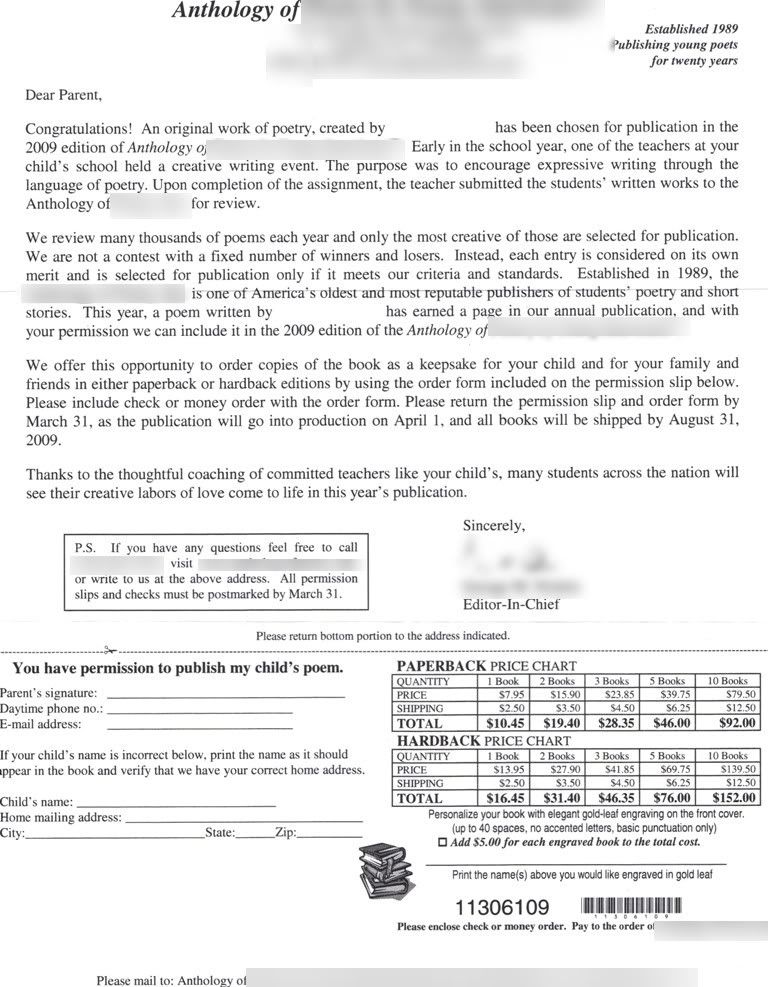
Back when I used to sell my poetry, I'd often run into open-call type ads in poetry magazines that were really fundraisers in disguise. You know the type: "Submit up to twenty poems for consideration" for something that was inevitably titled a variation on "The Best Loved Poems In America." I actually tried one out once when I was a kid, and got accepted, and even received a lovely little certificate -- along with an order form for copies of the anthology, which I would have had to pay $3 each. But no payment, no gratis copies, and no assurance that my poem would actually be published in the antho if I didn't buy a copy.*

If you're cruising the antho open call market, here are some things to watch out for:

Camouflaged Contests: these you can flag pretty easily; they always ask for an entry fee upfront, and generally the only writer who gets paid is the one judged to have "the most moving submission" or something along those lines (note: there is nothing wrong with entering a contest for publication in an antho as long as you don't have to pay to enter.)

Confusing Guidelines: if the guidelines for submission are unclear or not specific, e-mail and ask questions. If the contact person avoids giving you more details or your e-mails go unanswered, pass on it.

Kitchen Sinkers: an anthology usually has some sort of specific theme, length, form and/or genre requirement; be wary of kitchen-sink antho calls that are open to everyone and everything under the sun. Just because it touts itself as an anthology of "The Best-Loved Short Stories in America" doesn't mean it genuinely will be.

Lack of Experience: I can put up an open call for an anthology tomorrow -- it doesn't mean I know how to do one properly. Anyone headlining, editing and/or publishing an antho should have some experience with publishing them, or someone on board who does. If you submit to a first-timer, ask questions about what they plan to do.

No Publication Schedule: anyone editing and/or publishing an anthology should have a publisher or printer already on board for the project as well as an established date schedule for submissions, production and publication.

Reading Fees: if you're expected to pay just for the privilege of submitting, don't.

Thankfully there are plenty of open call anthologies out there that are legit and are run by ethical editors and publishers; the best source for these I've found so far are the market listings over at Ralan's place.

*By really creepy coincidence, today I received this poetry antho invitation in the mail -- not for me, but for my kid, whose teacher evidently sent off poems my kid and the rest of her class wrote for an assignment to this vanity pub.

Saturday, March 18, 2006

PTC #2, Part II

2. Staying Pro: I'd like to see more on how to KEEP selling, or how to organize my time (and) Once you start selling the plan is to keep selling and have a nice long career. Pointers?

Last night I talked about the popular propaganda about how to keep selling and have a nice long career. Let me emphasize again that the traditional play-it-safe-and-join-the-herd advice, which is handed out to nearly all of us when we join the pro ranks, is solid, blue-chip wisdom that you should seriously consider following. When in the herd, do as the herd does, and you'll be okay.

If you want more, you have to give up the herd, the guarantees and the tried-and-true methods, and go solo. Here are some of my ideas on how to do that, along with the amount of risk to the safety of your career:

1. Lose the herd mentality. Your writer organization's name isn't on your book, your name is. Publishing isn't a club or a bake sale or a night out with the girls. This is your job, and it's a very rare and much-desired job. At this moment there are a hundred thousand people competing with you for it, and those are just the professionals. We won't think about how many unpublished writers are wanting your spot. All the time you spent on your writer organization you can then use for doing some actual writing. Note: this doesn't mean you have to tell everyone in the herd to piss off; you can still be nice to your colleagues without blindly following in their footsteps. (low risk)

2. Be an entrepreneur, not an assembly line worker. Don't write in imitation of another author, no matter how much you admire him or her. Find out who you are as a writer, and capitalize on your individuality. Give your readers fresh, new, market-savvy novels that showcase your voice, your talent and your storytelling style. (moderate risk)

3. Break new ground. The writer who gets noticed is the writer who does something no one else is doing. Chances are best seized wisely, so before you try something daring with your writing or your career, think it through first. Be sure you're willing to accept any consequences, good or bad, that might result from it. (high risk)

4. Ditch the well-trodden road and take a different direction. Nearly every author takes the same approach to making a career in publishing: Sell the book, join the writer's group, do the promo, sell the next book, go to the con, do the promo, etc. It's like lather, rinse, repeat; I could do it in my sleep. Do you really want to sleepwalk through this gig? If you don't use your individuality, your strengths, and your creativity to navigate and enhance your career, how are you going to stand out from the rest of us and get noticed? (moderate to high risk)

5. Experiment, challenge yourself, and try new things with your work. Widen your range as a writer as often as you can. Write short stories, flash fiction, and promotional e-books. Take a writer for hire job. Write some magazine articles, or do a series of interviews with other folks in publishing on your weblog. Well-rounded writers are much more employable than single genre writers. (low risk)

5. When your career stalls, don't freeze. Don't lock yourself in a genre dungeon. If you can't sell a romantic suspense, pitch a paranormal. If you can't sell a cozy, pitch a thriller. If you can't sell a historical, pitch an alternate historical, etc. etc. Be flexible, inventive, and never give up. (low to moderate risk)

6. If after five years of trying you still can't sell that damn book of your heart, which you've rewritten three or four hundred times, for God's sake, bury it in the backyard and write something else. Better yet, burn it so you're not tempted to dig it up and rewrite it again. Make a vow never to write another one. (low risk)

7. Make the work the first priority. I know I keep harping on this, but the writing has to come first. When you're not writing, someone else is. When you're not pitching, someone else is. When you're off getting drunk in the Tiki bar at Paradise Con, someone else is at home mailing out a submission to your editor, or querying your agent. P.S. Some of them are better writers than you. (low risk)

8. Be frugal, pay off your debts and credit cards, and save your money and/or invest in yourself. Rather than financing your writing org's next big con luncheon, save your money or spend it on your writing needs. That $1000.00 you waste on airline tickets, con fees, widgets to hand out to other writers and your hotel room at the national conference could be spent on a better web site, or new computer and printer, or postage for the next year of submissions. If you've got all you need, put that money in the bank and save it for a dry spell. (moderate risk)

9. Find a healthy outlet for your negative emotions that has nothing to do with publishing, and use it as needed. Cooking, working out at a gym, gardening, going on power walks, sewing, playing raquetball, or anything like these things can help channel your frustrations so you're not tempted to get online and post something imprudent, like Ten Things I Totally Despise About My Editor, the Bitch, or worse, call her and tell her over the phone. (low risk)

10. Employ your sense of humor. Someone very wise once told me that if you can laugh at something, it has no power over you. That little saying has saved my ass as a writer more times than I can count. (moderate risk)

Related Links (including some on organizing yourself):

Chip Scalan's Organizing the Writing Life

Courage and Good Decision Makers are Successful People by S. Manikandan

Ten Things for Marketing & Planning

Find More Time by Organizing Your Writing Space by Michelle Jean Hoppe

Writers-Editors.com's The Business End of Writing