Ten Things About Submission Opportunities
The University of Pittsburgh has a call for submissions for the Drue Heinz Literature Prize: "The Drue Heinz Literature Prize recognizes and supports writers of short fiction and makes their work available to readers around the world. The award is open to writers who have published a book-length collection of fiction or at least three short stories or novellas in commercial magazines or literary journals. Manuscripts are judged anonymously by nationally known writers; past judges have included Robert Penn Warren, Joyce Carol Oates, Raymond Carver, Margaret Atwood, Russell Banks, Rick Moody and Joan Didion. The prize carries a cash award of $15,000 and publication by the University of Pittsburgh Press under its standard contract. The winner will be announced by the University Press in January." Length: 150-300 page manuscript, no entry fee, no electronic submissions, opens May 1st, 2012; deadline June 30th, 2012.
Family Circle magazine is holding their annual Fiction Contest: "Submit an original (written by entrant), fiction short story of no more than 2,500 words, typed, double-spaced and page numbered on 8-1/2x11paper. Entries must be unpublished and may not have won any prize or award. Include your name, address, daytime telephone number and e-mail address (optional) on each page and send to: Family Circle Fiction Contest, c/o Family Circle Magazine, 805 Third Avenue, 22nd Floor, New York, NY 10022. LIMIT: Up to two (2) entries per person will be accepted but each entry must be a unique short story. No group entries. Sponsor reserves the right, in its sole discretion, to reject, disqualify, modify, edit, and revise any entries, subjects, stories, or related materials that Sponsor deems to be nude, obscene, defamatory, profane, offensive, lewd, pornographic, false, misleading, deceptive, or otherwise inconsistent with its editorial standards, audience expectations, or reputational interests or that Sponsor believes may violate any applicable law or regulation or the rights of any third party. By entering this contest, entrants consent to a background check, and Sponsor reserves the right, in its sole discretion, to verify any element of any entry or related materials and to disqualify any entrant. One (1) Grand Prize winner will receive a prize package including a check for $750.00, a gift certificate to one (1) mediabistro.com course of his or her choice, up to a value of $610.00, one (1) year mediabistro.com AvantGuild membership valued at $55.00, and a one (1) year mediabistro.com How-to Video membership valued at $99.00. Total approximate retail value of grand prize package $1,514.00. One (1) Second Place winner will receive a check for $250.00, a one (1) year mediabistro.com AvantGuild membership valued at $55.00, and a one (1) year mediabistro.com How-to Video membership valued at $99.00. Total retail value (?RV?) of second place prize package $404.00. One (1) Third Place winner will receive a check for $250.00 and a one (1) year mediabistro.com AvantGuild membership valued at $55.00. Total RV of third place prize package $305.00." No entry fee, no electronic submissions, see contest page for more details. Deadline: September 7th, 2012.
Fanstory.com has ongoing, multiple fiction contests with various prizes; check out their contest page here.
The Graywolf Press Nonfiction Prize is now open for entries: "A $12,000 advance and publication by Graywolf will be awarded to the most promising and innovative literary nonfiction project by a writer not yet established in the genre. Robert Polito, Director of the Graduate Writing Program at the New School, will serve as the judge. The 2012 prize will be awarded to a manuscript in progress. We request that authors send a long sample from their manuscript, as well as a description of the work, as detailed below. We expect that we will work with the winner of the prize and provide editorial guidance toward the completion of the project. The Graywolf Press Nonfiction Prize emphasizes innovation in form, and we want to see projects that test the boundaries of literary nonfiction. We are less interested in straightforward memoirs, and we turn down a large number of them every year. Before submitting your manuscript for the prize, please look at the books previously published as winners of the prize for examples of the type of work that we are seeking. 'This prize seeks to acknowledge—and honor—the great traditions of literary nonfiction, extending from Robert Burton and Thomas Browne in the seventeenth century through Defoe and Strachey and on to James Baldwin, Joan Didion, and Jamaica Kincaid in our own time,' says Robert Polito. 'Whether grounded in observation, autobiography, or research, much of the most beautiful, daring, and original writing over the past few decades can be categorized as nonfiction. Submissions to the prize might span memoir, biography, or history.'" No entry fee, electronic submissions only, see contest page for more details. Deadline: August 31st, 2012.
The University of Iowa holds an annual short fiction contest for writers who have not yet published a book: "The manuscript must be a collection of short stories in English of at least 150 word-processed, double-spaced pages. We do not accept e-mail submissions. The manuscript may include a cover page, contents page, etc., but these are not required. The author's name can be on every page but this is not required. Stories previously published in periodicals are eligible for inclusion. There is no reading fee; please do not send cash, checks, or money orders. Reasonable care is taken, but we are not responsible for manuscripts lost in the mail or for the return of those not accompanied by a self-addressed, stamped envelope. We assume the author retains a copy of the manuscript. Award-winning manuscripts will be published by the University of Iowa Press under the Press's standard contract." No entry fee, no electronic submissions, contest opens for entries on August 1st. See contest page for more details. Deadline: September 30th, 2012.
The Gilder Lehrman Lincoln Prize "shall be awarded annually for the finest scholarly work in English on Abraham Lincoln, or the American Civil War soldier, or a subject relating to their era. The $50,000 prize was co-founded and endowed by businessmen and philanthropists Richard Gilder and Lewis Lehrman, principals of the Gilder Lehrman Institute of American History in New York and co-creators of the Gilder Lehrman Collection, one of the largest private archives of documents and artifacts in the nation. The Institute devotes itself to history education by supporting magnet schools, teacher training, curriculum development, exhibitions, and publications, as well as endowing several major history awards. Mr. Gilder and Mr. Lehrman established the Prize in 1990, together with Professor Gabor Boritt, Director Emeritus of the Civil War Institute at Gettysburg College. Since founding the Prize in 1990, Mr. Gilder and Mr. Lehrman have bestowed some $1 million on the annual winners, including special prizes. The Prize will generally go to a book but in rare instances an important article or essay might be honored. When studies competing for the Prize show similar scholarly merit, preference will be given to work on Abraham Lincoln, or the Civil War soldier, or work aimed at the literate general public. In harmony with the last preference, in rare instances the Prize may go to a work or works of fiction, poetry, the theatre, the arts, a film, scholarly article or editing project, provided they are true to history. In rare instances, the Prize may go to a historical project, such as an inspired conference or an editing project, such as an inspired conference or an editing project. In rare instances, the trustees may grant the award to a work or service related to Lincoln, or the Civil War soldier or their era, not included in the foregoing description. As many as two prizes may be awarded each year. It will be awarded for works published only during the designated year of the Prize." No entry fee, see contest page for more details, deadline November 1st, 2012.
Although today (April 30th) is the deadline for this contest, I thought it was worth posting because they accept electronic submissions, there is no entry fee, and someone out there may have something ready to enter right now: The New England Crime Bake Al Blanchard Award gives a $100 cash award, publication in Level Best Books' tenth Crime Fiction anthology, and admission to the Crime Bake Conference to the best "crime story by a New England author or with a New England setting. Story must be previously unpublished (in print or electronically), Story must not be more than 5,000 words in length, Story may include the following genres: mystery, thriller, suspense, caper, and horror. (No torture/killing of children or animals.)" Rush over to the contest page for more details because again the deadline for this one is TODAY.
Chaosium has an open call for a two-volume anthology: "Over the river and through the woods does not always lead to grandma’s house or happy endings – especially if grandma’s house is infested with zombies… or if grandma is really a Lovecraftian being in disguise. Once Upon an Apocalypse is a two volume post apocalyptic anthology laden with the undead and otherwordly mythos crossing into the realm of fairy tales, nursery rhymes and other timeless stories. For both volumes we want stories with strong narrative lines, stronger characters and a clear blending of the theme and the fairy tales. For Volume One imagine Cinderella arriving at the ball and discovering it filled with zombies. Or how different the story would be if it were Snow White and the Seven Zombies. Give us new horrors with Alice in Zombieland, and a Prince who climbs Rapunzel’s hair to get away from and find a way to defeat – you guessed it – zombies. In Volume Two we want a strong dose of Lovecraft thrown in. What happens to the townspeople in The Boy who Cried Cthulhu? Pinocchio is going to have a much harder time getting out of the Old One than the whale; a wolf would have been preferable to Little Red Riding Hood and the Byahkee and the Little Mermaid has so much more to worry about then her legs and a missing voice when she faces a Deep One. Once you choose a story to change it’s your call how far you will take it. Make the apocalypse clear and give some meaning as to why the dead are meandering through the streets and munching on the breathing or why the Elder God has paid the town a visit. Plague, prestilence, bio warfare, meteor shower, tail of a comet… be creative. Because we don’t want duplicates of themes, you will be able to follow the progress of the anthologies on our blog (http://onceuponanapocalypse.com) or facebook page (www.facebook.com/OnceUponAnApocalypse) where we’ll keep a current list of themes/tales accepted. For example, if we get a Sleeping Beauty story and it’s awesome, that will be it for the book." Length" "Stories should be 2K – 4K in length (please query for stories under or over our limit. We will consider them if they are of exceptional merit). Payment: "$.03 per word, no royalties and 3 free books and additional copies at 50% off cover." No reprints, electronic submissions only, see guidelines for more details. Reading period is open "now through July 31, 2012 – or until filled."
Shimmer e-zine is open to submissions of "Unusual and beautifully-written speculative fiction stories with full plots and strong characters. The best way to understand what we are looking for is to read an issue of the magazine. We’re most drawn to contemporary fantasy, and seek out stories with a strong emotional core. We like unusual stories with a fluid and distinctive voice, with specific and original images. Send us your odd unclassifiable stories–though we prefer traditional storytelling mechanics to experimental approaches. We’re less likely to be interested in sword and sorcery, hard SF, space opera, paranormal romance, slasher horror, and other familiar genre types, but we’ll read anything." [PBW notes: Nicely put, and they also accept subs from authors outside the U.S.] Length: Up to 5K. Editor notes: "If your story is longer than 5000 words (and yes, 5100 words is longer than 5000 words) but you believe we would love it, please send us a query briefly describing the story along with the first page of the story." Payment and Rights: "We pay 3 cent per word, minimum $10. You’ll also receive two copies of the issue in which your story appears. Additional contributor copies available at the subscription rate. We purchase First Serial rights and electronic rights. 120 days after publication, most rights revert to the author, but we retain the right to continue selling back issues of the magazine, the right to archive your story, and non-exclusive anthology rights." No reprints, electronic submissions only, see guidelines for more details.
Underwords has an open call for a FutureDaze, a YA Science Fiction Anthology, and would like to see: "...fiction and poetry that sparks the imagination, twists the heart, and makes us yearn for the possibilities of a world yet to come. At a time when every other YA book features vampires, werewolves or other fantastical creatures, Futuredaze will be an anthology for the next generation of science fiction readers. We’re looking for hard science fiction, soft science fiction, and everything in between. Think Jules Verne, Isaac Asimov, George Orwell or Ray Bradbury with a YA focus. While we adore fantasy, Futuredaze is not the right anthology for fiction or poetry based in worlds where magic or the supernatural are the driving forces. Futuredaze‘s primary mission is to inspire a love of science fiction in today’s teens and young adults—providing them with a launching pad of quality fiction that will inspire them to further explore the many branches of the genre. Give us your stories of far-flung futures, interplanetary travel, and technology just beyond our reach. Give us near futures with eerie similarities to the present. Give us robots, extra terrestrials, brave new worlds and Andromeda strains. Most of all, give us good writing. Whether you’re a pro or still looking for your first sale we want to see the widest array of fiction and poetry possible. If you’re unsure whether your piece is right for Futuredaze, please submit it and let us determine if it’s a good fit. Our only requirement is that your story or poem operates within a science fictional universe and is written for young adults. Please no explicit sex, foul language, or gratuitous violence." Length: Fiction ~ 6,000 words max; Poetry ~ "up to 5 poems at one time." Payment:" Paying $200 per story and $25 per poem for first North American anthology rights, payable upon publication. One-year after publication, all rights return to the creators." No reprints, electronic submissions only, see guidelines page for more details. Submission period opens May 1st, 2012 and lasts "until filled."
Monday, April 30, 2012


Sunday, April 29, 2012
Catch and Release
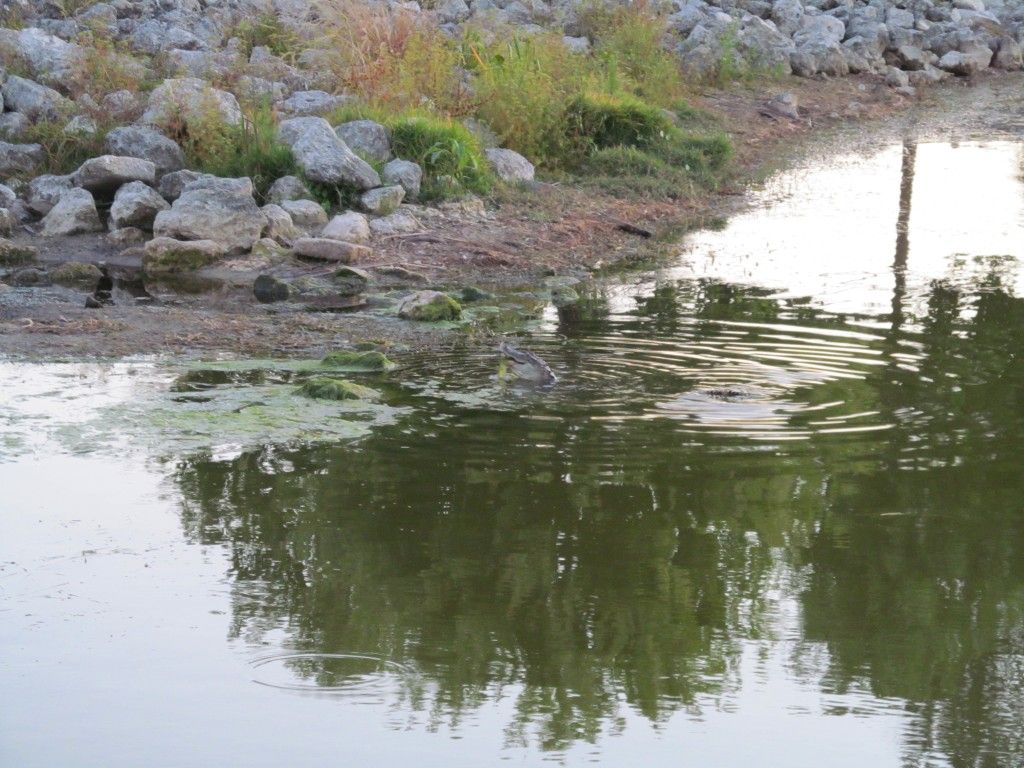
My guy and I were walking by the lake last night so I could photograph the sunset when I spotted something happening near the water's edge (click on any image to see larger version):
When I zoomed in with my camera lens, I was amazed. The head of a little four-foot gator (and yeah, for gators, that's little) had surfaced, and he had just caught a fish:
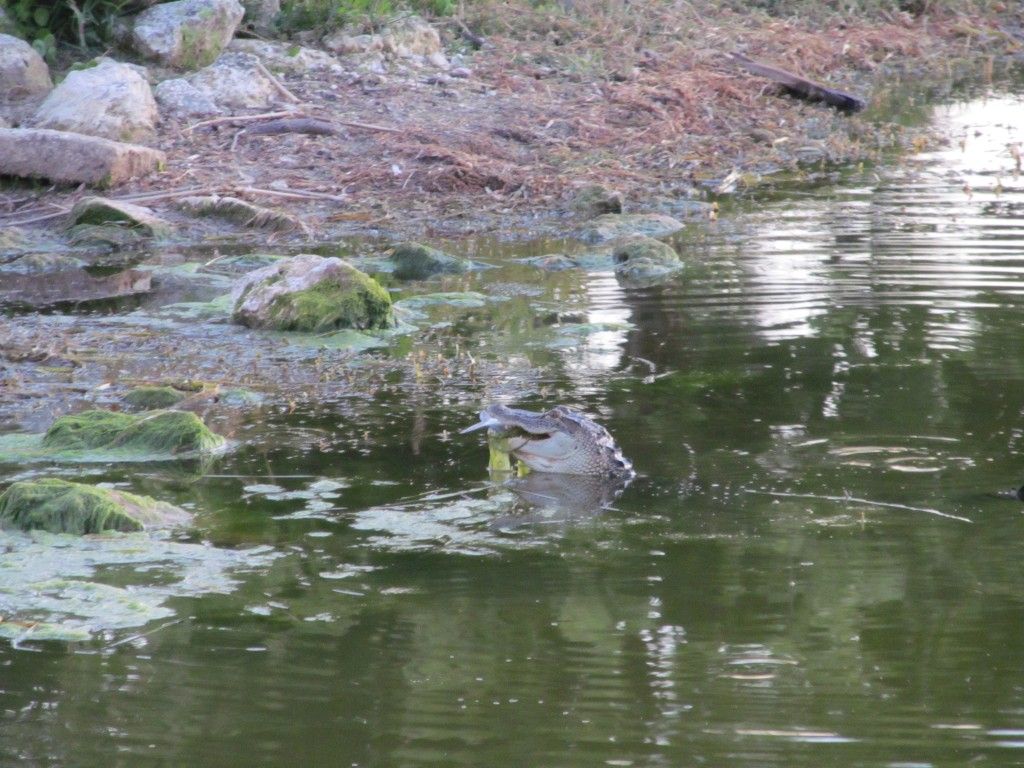
Lil Gator was all ready to enjoy some sushi. The problem was the fish, which was roughly as big as the gator's head -- too big for him to swallow whole:

At first glance I figured Lil Gator would either have to let it go, or bite off a chunk and let the rest fall back into the water. Meanwhile, interested fisher birds started to gather on the rocks, and another little gator surfaced to cruise toward the commotion.
The dilemma and the pressure didn't stop Lil Gator from trying to swallow the fish whole, but after a couple of futile attempts he began working on the problem by shaking it and turning it around and gnoshing on it:
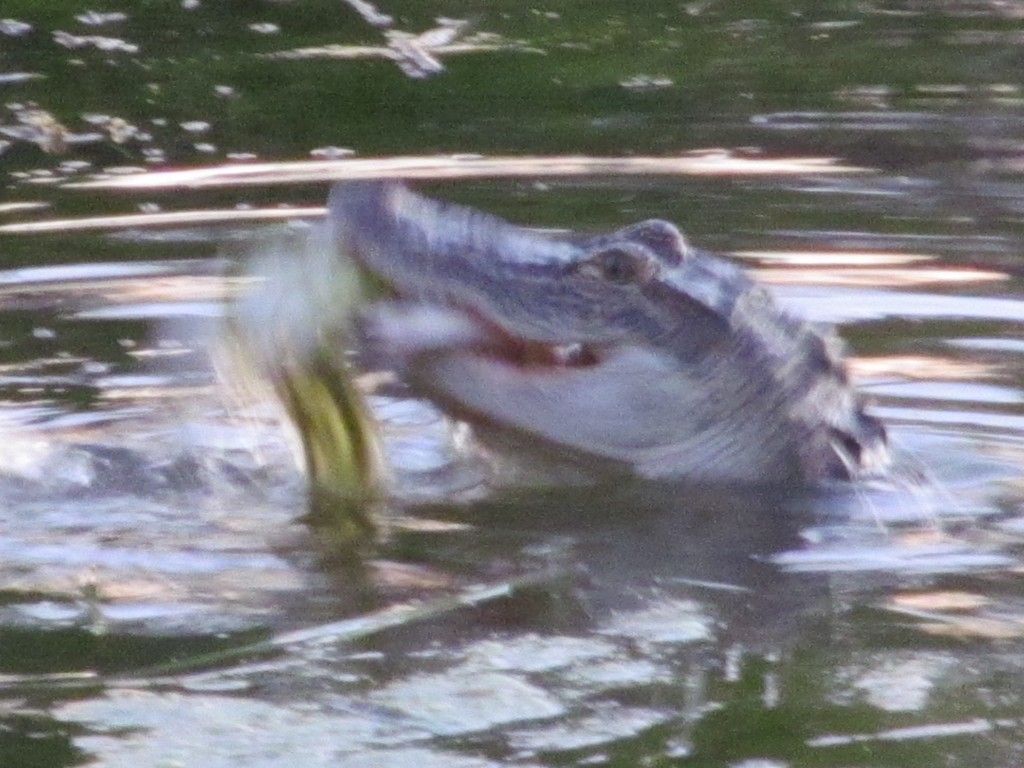

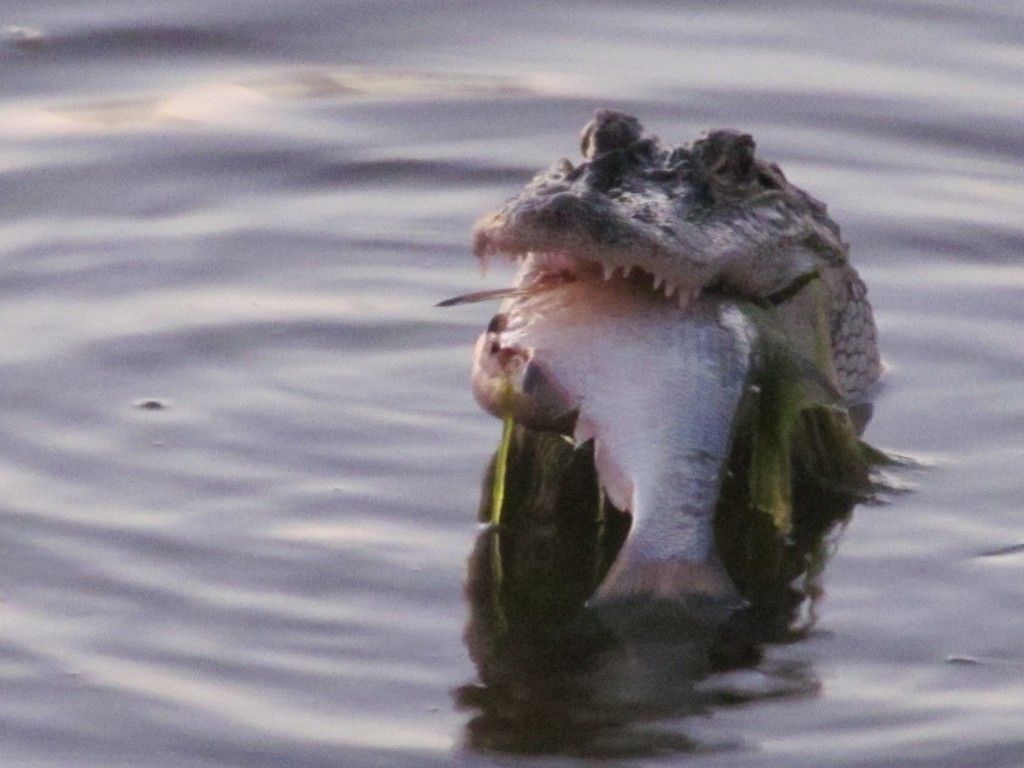
The whole process took a good ten minutes, but in the end Lil Gator's efforts worked, and he gulped down all of the fish:
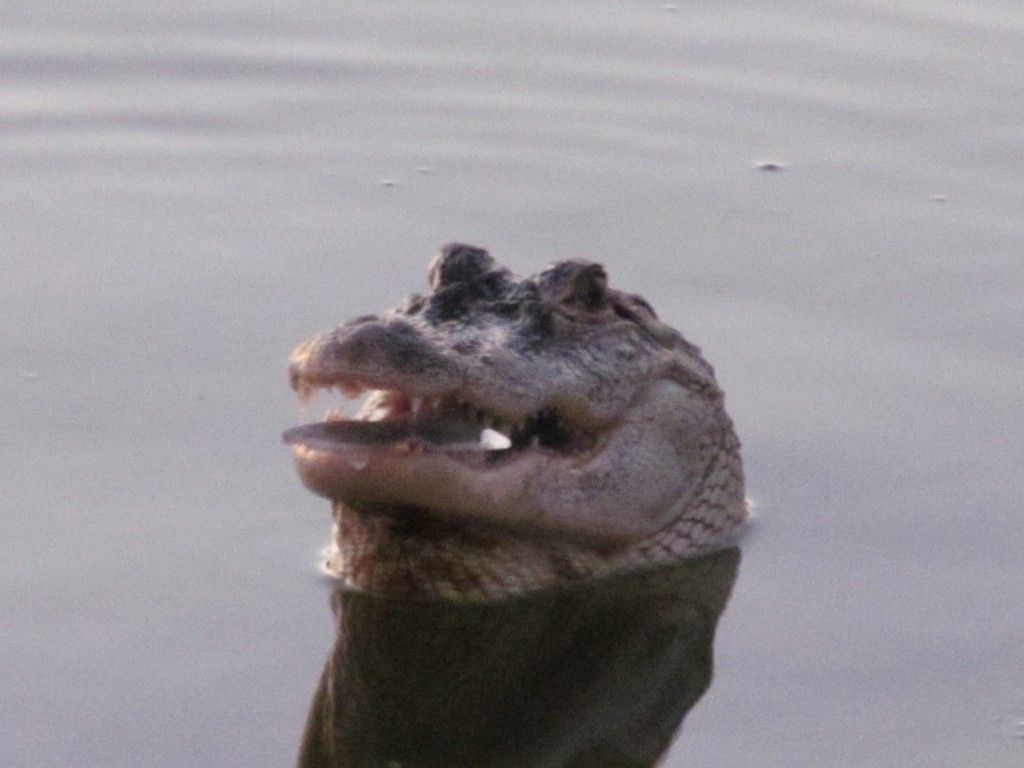
Watching Lil Gator earn his sushi feast reminded me of how it is with writing (because of course everything is about writing.) When you latch on to a story idea, it can be huge. Much bigger than your head. No matter how good it looks, you realize how tough it'll be to make it work. Getting it done is going to require a lot of effort, with no guarantees. You might lose your momentum, choke in the middle of things, or something in life might even swoop in and take it away from you.
You can let it go and hunt for something smaller and easier to swallow, or you can work your story, bit by bit. Turn it around, come at it from different sides, and break it down into manageable pieces. As for the fear that for some reason you'll lose it, that never changes. But if it's any comfort, the story waters are chock full of fish just waiting to be caught.
When I zoomed in with my camera lens, I was amazed. The head of a little four-foot gator (and yeah, for gators, that's little) had surfaced, and he had just caught a fish:
Lil Gator was all ready to enjoy some sushi. The problem was the fish, which was roughly as big as the gator's head -- too big for him to swallow whole:
At first glance I figured Lil Gator would either have to let it go, or bite off a chunk and let the rest fall back into the water. Meanwhile, interested fisher birds started to gather on the rocks, and another little gator surfaced to cruise toward the commotion.
The dilemma and the pressure didn't stop Lil Gator from trying to swallow the fish whole, but after a couple of futile attempts he began working on the problem by shaking it and turning it around and gnoshing on it:
The whole process took a good ten minutes, but in the end Lil Gator's efforts worked, and he gulped down all of the fish:
Watching Lil Gator earn his sushi feast reminded me of how it is with writing (because of course everything is about writing.) When you latch on to a story idea, it can be huge. Much bigger than your head. No matter how good it looks, you realize how tough it'll be to make it work. Getting it done is going to require a lot of effort, with no guarantees. You might lose your momentum, choke in the middle of things, or something in life might even swoop in and take it away from you.
You can let it go and hunt for something smaller and easier to swallow, or you can work your story, bit by bit. Turn it around, come at it from different sides, and break it down into manageable pieces. As for the fear that for some reason you'll lose it, that never changes. But if it's any comfort, the story waters are chock full of fish just waiting to be caught.
Saturday, April 28, 2012
The Pointe
As a kid I took ballet for quite a few years, so this fascinating video made my toes curl in happy and painful memories:
Friday, April 27, 2012
Winner
You all had some great theme suggestions for smash book pages, and I hope you'll explore more of this idea on your own, either for writing or anything else smash-worthy in your life. It's really a lot of fun (and we need more of that.)
In the meantime, we revved up the magic hat, and the winner of the Simply Smashing giveaway is:
traveler, who wrote Great photos which are unique. What an idea. Definitely one filled with family and a family tree.
When you have a chance, traveler, please send your full name and ship-to address to LynnViehl@aol.com so I can get the book and smashing stuff out to you. My thanks to everyone for joining in.
In the meantime, we revved up the magic hat, and the winner of the Simply Smashing giveaway is:
traveler, who wrote Great photos which are unique. What an idea. Definitely one filled with family and a family tree.
When you have a chance, traveler, please send your full name and ship-to address to LynnViehl@aol.com so I can get the book and smashing stuff out to you. My thanks to everyone for joining in.
Thursday, April 26, 2012
More Frivolity
Typoeffects.com has two free online image converter generators that will turn your photos and images into Wordle-like art. Here are a couple I made with some flower pics and a couple of lines from my favorite poem(click on image to see larger version):
Row-text image

Word-cloud image

The generators also allow you some interesting choices of fonts, font sizes, color schemes and (for the word-cloud) a couple ways to skew your text.
(original generator link found over among the way-cool compilation of generators at The Generator Blog)
Row-text image
Word-cloud image
The generators also allow you some interesting choices of fonts, font sizes, color schemes and (for the word-cloud) a couple ways to skew your text.
(original generator link found over among the way-cool compilation of generators at The Generator Blog)
Wednesday, April 25, 2012
Simply Smashing
Until recently I didn't know it, but I've been smashing every novel I've written since the eighties. I've also smashed my personal journals, sketchbooks, quilt diaries, poetry binders and daily planners. I've even smashed the notebook I use for what I write on PBW.
Before you start calling me a wrecking ball, I don't mean smash as into smithereens. "Smashing" is the new term for a trend in the scrapbooking industry that capitalizes on the very old practice of saving souvenirs, mementos, bits and pieces and other memory prompts in a journal or notebook. And whether you call them smash books, scrapbooks, memory journals or idea diaries, if you save any kind of junk-drawer type ephemera in book form, you're smashing.
Smashing is something most females do throughout life, I think. In Girl Scouts we used to make camp diaries and stick everything in them from pretty leaves to paper airplanes; in high school just about every girl I knew kept pressed flowers and prom programs tucked in their yearbooks. In my kids' baby albums I saved their hospital IDs, new baby cards and snipped locks from first haircuts. I have journals riddled with the kid's homemade cards, programs for all their school shows, and my guy's love notes (he always uses Post-its and leaves them in the strangest places.)
Quilters are old hands at smashing; just ask one of us to bring out a quilt diary. Along with the photos of finished projects displayed on the pages there will be swatches of fabric, experiment blocks, copies of patterns, old stencils and templates, you name it. I used to tape every needle I bent or broke in my quilt diary and then count them at the end of the year (which is also how I learned to spend a bit more money and buy better needles.)
If you're not already a smashing writer, it's simple enough to do. You need a notebook, photo album or 3-ring binder to serve as your smash book, writing instruments, paper, sticky notes, paperclips, glue stick or photo mounting adhesive (I use these little double-sided squares because they're easier than glue for me to handle.) As you collect words, ideas, images, notes and other assorted bits of inspiration and resources for your story, you put them in the book. You can be as creative or as simple as you like; there are no rules involved.
I decided to do it proper and bought K&Company's smash journal as well as a bunch of their accessories. Target and most craft stores carry a good variety, and they're not super expensive; I spent about twenty dollars for my pile of stuff. The one thing I like are the pocket pieces that I can adhere to a page and tuck things inside; that allows me to remove or add whatever I like to that particular page.
To show you some examples, here are some of the pages I put together in my smash journal for the next novel:
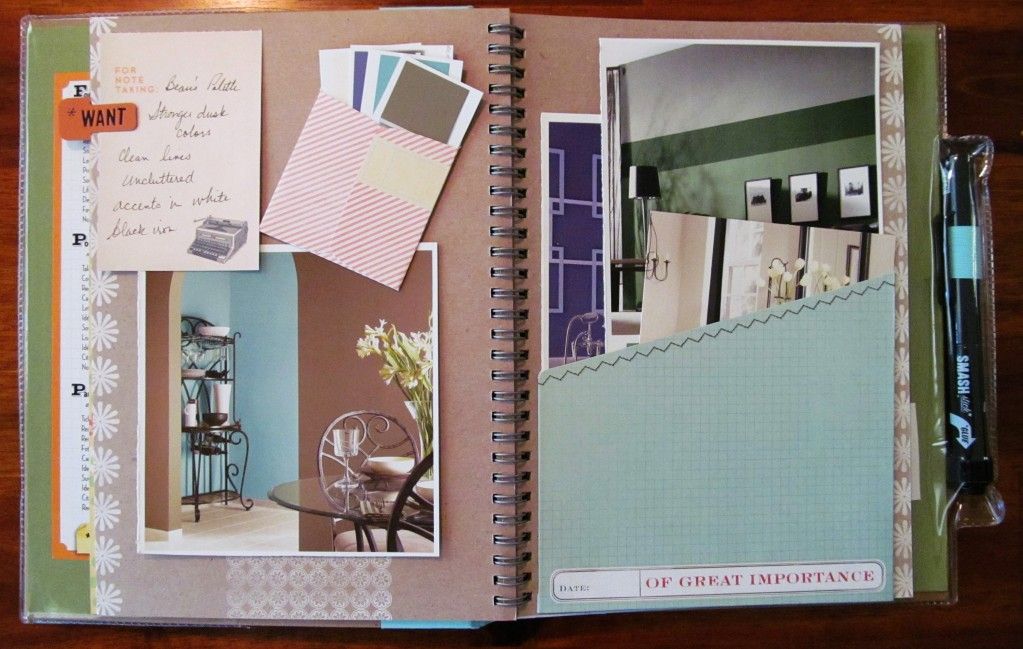
This one is for the male protagonist of my next novel, and has palette inspiration photos, paint chips and some notes for myself on particular setting details.
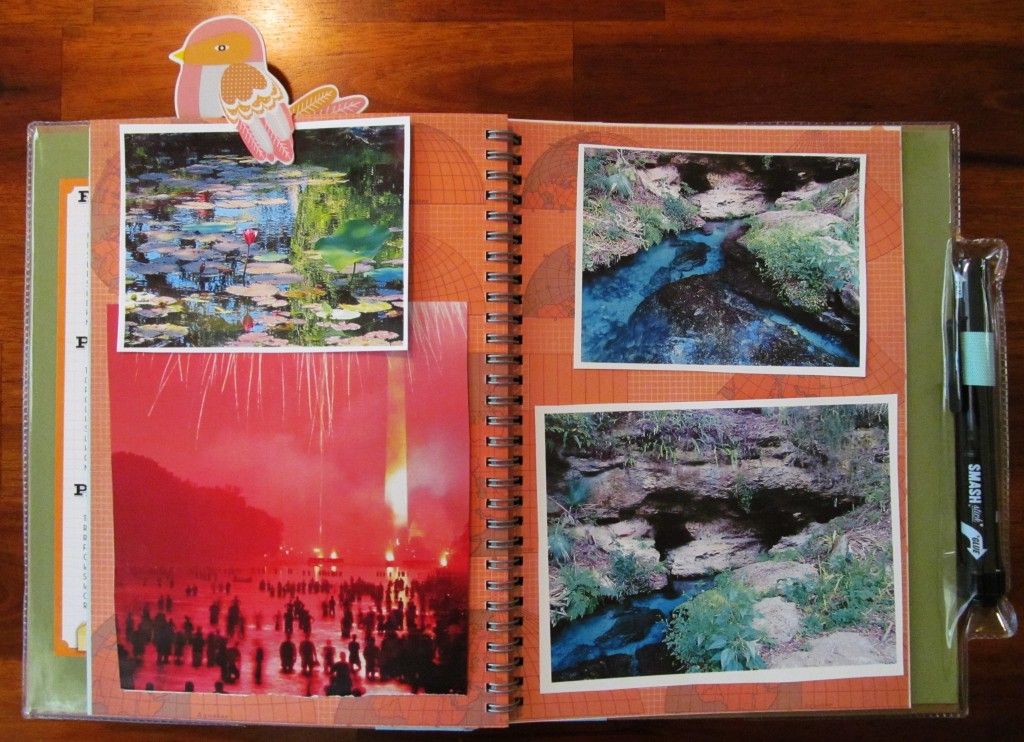
Sometimes I mount photos on the pages permanently for quick visual reference. For these two pages I collected pics I've taken in real life, but I also want to do something in one scene that transforms that setting (which is why I added the eerie red image I clipped from a calendar.)
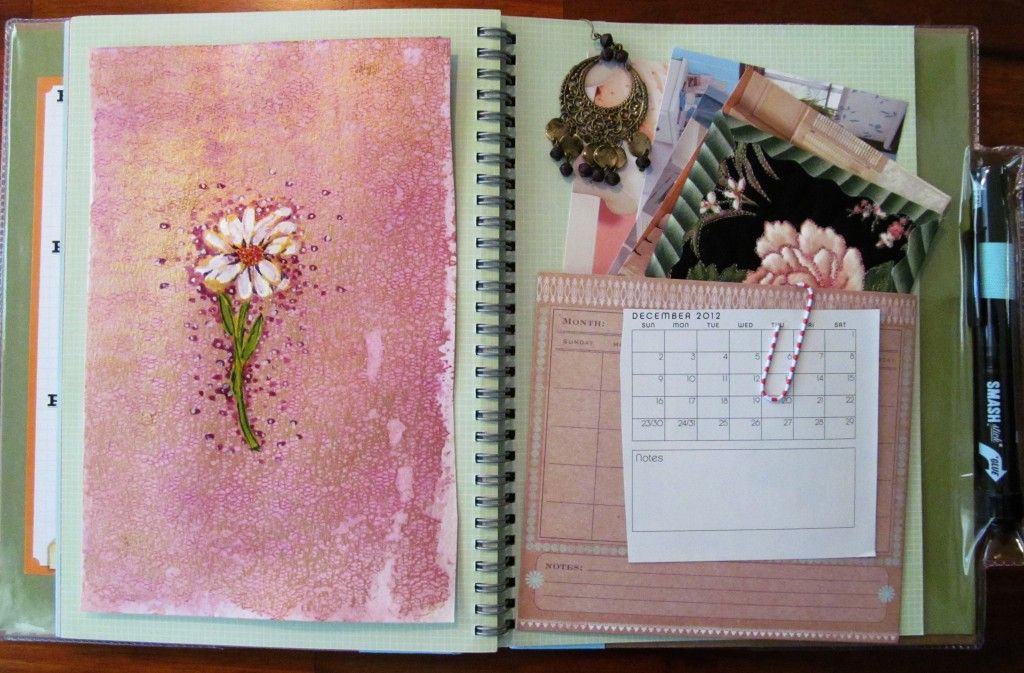
I also pages with random stuff that catches my eye. These two are for the female protagonist and are kind of a catch-all for the stuff I'm using her character, dialogue, setting, story palette, and pretty much everything else that appeals to me.
You can organize your smash book according to characters, setting, dialogue, plot, etc., but I don't ever find anything in precise story order so I don't worry about keeping it alphabetized or indexed. Although if you put together a huge smash book, you might want to use alphabetic dividers, tabs or come up with named/themed sections to keep it easy to reference.
I enjoyed discovering this new way to keep my writer junk tidy so much that I bought more of everything to give away here on the blog: K&Company's Mod-style Smash journal as well as a nice assortment of their most interesting and useful smashing stuff:
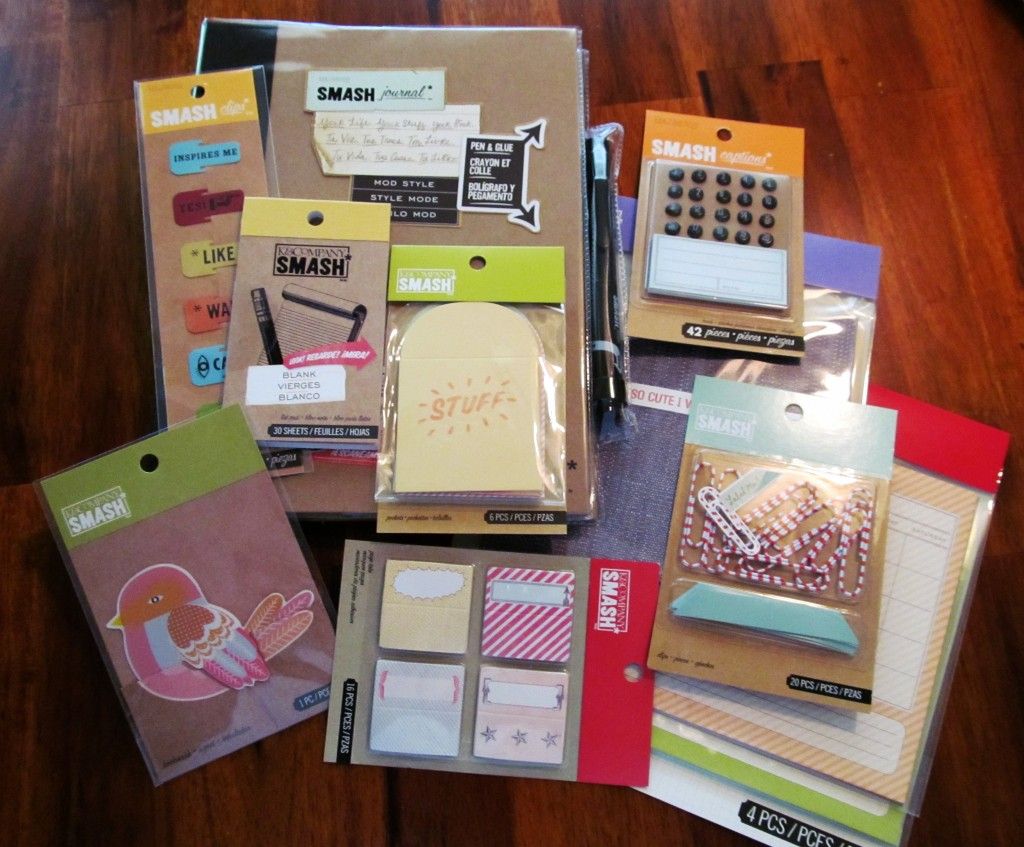
If you'd like a chance to win the whole pile, in comments to this post suggest a theme you think would be interesting (doesn't have to be about writing) for a page in a smash book by midnight EST on Thursday, April 26, 2012. I'll draw one name at random from everyone who participates and send the winner the smash journal, the accessories and a signed copy of my novel Nightborn. This giveaway is open to everyone on the planet, even if you've won something here at PBW in the past.
Before you start calling me a wrecking ball, I don't mean smash as into smithereens. "Smashing" is the new term for a trend in the scrapbooking industry that capitalizes on the very old practice of saving souvenirs, mementos, bits and pieces and other memory prompts in a journal or notebook. And whether you call them smash books, scrapbooks, memory journals or idea diaries, if you save any kind of junk-drawer type ephemera in book form, you're smashing.
Smashing is something most females do throughout life, I think. In Girl Scouts we used to make camp diaries and stick everything in them from pretty leaves to paper airplanes; in high school just about every girl I knew kept pressed flowers and prom programs tucked in their yearbooks. In my kids' baby albums I saved their hospital IDs, new baby cards and snipped locks from first haircuts. I have journals riddled with the kid's homemade cards, programs for all their school shows, and my guy's love notes (he always uses Post-its and leaves them in the strangest places.)
Quilters are old hands at smashing; just ask one of us to bring out a quilt diary. Along with the photos of finished projects displayed on the pages there will be swatches of fabric, experiment blocks, copies of patterns, old stencils and templates, you name it. I used to tape every needle I bent or broke in my quilt diary and then count them at the end of the year (which is also how I learned to spend a bit more money and buy better needles.)
If you're not already a smashing writer, it's simple enough to do. You need a notebook, photo album or 3-ring binder to serve as your smash book, writing instruments, paper, sticky notes, paperclips, glue stick or photo mounting adhesive (I use these little double-sided squares because they're easier than glue for me to handle.) As you collect words, ideas, images, notes and other assorted bits of inspiration and resources for your story, you put them in the book. You can be as creative or as simple as you like; there are no rules involved.
I decided to do it proper and bought K&Company's smash journal as well as a bunch of their accessories. Target and most craft stores carry a good variety, and they're not super expensive; I spent about twenty dollars for my pile of stuff. The one thing I like are the pocket pieces that I can adhere to a page and tuck things inside; that allows me to remove or add whatever I like to that particular page.
To show you some examples, here are some of the pages I put together in my smash journal for the next novel:
This one is for the male protagonist of my next novel, and has palette inspiration photos, paint chips and some notes for myself on particular setting details.
Sometimes I mount photos on the pages permanently for quick visual reference. For these two pages I collected pics I've taken in real life, but I also want to do something in one scene that transforms that setting (which is why I added the eerie red image I clipped from a calendar.)
I also pages with random stuff that catches my eye. These two are for the female protagonist and are kind of a catch-all for the stuff I'm using her character, dialogue, setting, story palette, and pretty much everything else that appeals to me.
You can organize your smash book according to characters, setting, dialogue, plot, etc., but I don't ever find anything in precise story order so I don't worry about keeping it alphabetized or indexed. Although if you put together a huge smash book, you might want to use alphabetic dividers, tabs or come up with named/themed sections to keep it easy to reference.
I enjoyed discovering this new way to keep my writer junk tidy so much that I bought more of everything to give away here on the blog: K&Company's Mod-style Smash journal as well as a nice assortment of their most interesting and useful smashing stuff:
If you'd like a chance to win the whole pile, in comments to this post suggest a theme you think would be interesting (doesn't have to be about writing) for a page in a smash book by midnight EST on Thursday, April 26, 2012. I'll draw one name at random from everyone who participates and send the winner the smash journal, the accessories and a signed copy of my novel Nightborn. This giveaway is open to everyone on the planet, even if you've won something here at PBW in the past.
Tuesday, April 24, 2012
Educationally Free
 Copywriter and Men with Pens blog owner James Chartrand is holding a contest for his Damn Fine Words online writing course; the winners each receive a free spot in the class. To enter, you have to write a blog article, minimum 450 words, on why writing is important to you and how better writing skills would change your business or your life, and post it on your blog, and then do some linking. No entry fee, deadline is May 1 at 7 am EST; see contest post for more details.
I'm at the halfway point of my online art class now, and I feel that I've already gotten twice my money's worth in advice and instruction, so that's working out quite well (and I will be relating more about the class once I'm finished, for those of you who were curious about it.) It's also nice to shed the authorial albatross for a couple of weeks and be a regular person.
Over the years I've been approached by various colleagues and organizations to do pay-for online writing classes, and while I've been flattered I've always declined. It's not that I think there's anything wrong with charging people to learn about writing; talented writers who share their knowledge certainly have the right to be compensated for it, and teaching for money helps them supplement their writing income which for most of them, let's face it, is probably never going to be the stuff of instant retirement.
I'm a child of public education, though, and my university was the local library; I teach for free to honor the librarians and public school teachers who guided me in this direction, and to be there for all the writers like me who could never afford to pay for classes. Aka my little personal Crusade.
My past efforts at online teaching have been both rewarding and frustrating. Early on in my career I moderated an online writer's think tank in a chat room, which made every Friday night a blast, at least until my arthritis grew worse and I couldn't type fast enough to keep up with the questions. My Left Behind & Loving It virtual writing workshops were also a lot of fun; they just got too big too fast to handle on my own. When RWA committed the ultimate irony by promoting me and my fellow writers' efforts to their membership as an alternative to their National conference, I knew it was time to let them go.
Likely the most successful teaching project I've done to date is The Novel Notebook. When I put it together five years ago I thought it might help a couple of writers organize their stuff better, but that was all. I can't tell you how many writers have since downloaded and used it, because I don't track things like that, but it's the most popular free e-book I've ever posted online. Last year during NaNoWriMo I heard that several groups were actually handing out CD and printed copies of it at their meetings, which was very neat.
I don't know yet what my next teaching project will be, but I'd like to do something along the lines of the Novel Notebook (whatever evolves, I promise I will keep it free.) Which makes me wonder: if you could get me to teach something online, what would it be, and how would you want me to teach it? Let me know in comments.
Graphic credit: © Yellowj | Dreamstime.com
Monday, April 23, 2012
Off to Avoid Doing Anything Really Stupid
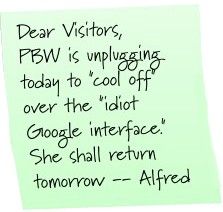
Create a sticky note online for your blog at Wigflip.com's sticky note generator, Superstickies (link originally swiped long ago from Gerard over at The Generator Blog.)
Sunday, April 22, 2012
Blog Test
The Emergency Blogger Hasn't a Clue system will now test the new Blogger posting screen for Paperback Writer. Please standby as PBW begins the test.
I hate this. What are all these stupid icons for? What happened to using words? Did everyone finally forget language and can only understand pictographs? Must we all now blog like ancient Egyptians?
Okay. I'm calm. I can do this. If I can make a new paragraph. Can I make a new paragraph? Maybe I should type in that idiot pointy-bracketed P that was the only thing that worked last night. Only I think I have to be in another screen. Where is the hieroglyph for the other screen? Let me try some of these. No, that's insert image from Google's dumb image service that I don't use. No, that's video upload. I think. Is that PacMan? Why do I have a PacMan icon?
I can't do this. Why should it be, you know, simple to use? Why is there a five-second lag now everytime I type something? The bastards are determined to make me relearn everything. This is so stupid. I can't find tags. At all. The big T with the little red x is not tags, btw; that much I figured out. Because using the image of a T for Tags would be too confusing, right? It's probably the PacMan thing. Or not. Everything is wrong, in the wrong place or has completely vanished. Maybe. The all-white screen is making me snowblind.
Image Test:

Does everyone see the birdie? 'Cause I sure don't. I can't view the blog when I hit view the blog.
Link Test:
This is my photoblog, or should be, unless Google screwed that up as well.
Google, you suck.
Thank you, this concludes the test of the Emergency Blogger Hasn't a Clue system. Had this been an actual emergency, your local writing community service would likely have sent you somewhere else until PBW stopped screaming in outrage or her head exploded, whichever came first.
I hate this. What are all these stupid icons for? What happened to using words? Did everyone finally forget language and can only understand pictographs? Must we all now blog like ancient Egyptians?
Okay. I'm calm. I can do this. If I can make a new paragraph. Can I make a new paragraph? Maybe I should type in that idiot pointy-bracketed P that was the only thing that worked last night. Only I think I have to be in another screen. Where is the hieroglyph for the other screen? Let me try some of these. No, that's insert image from Google's dumb image service that I don't use. No, that's video upload. I think. Is that PacMan? Why do I have a PacMan icon?
I can't do this. Why should it be, you know, simple to use? Why is there a five-second lag now everytime I type something? The bastards are determined to make me relearn everything. This is so stupid. I can't find tags. At all. The big T with the little red x is not tags, btw; that much I figured out. Because using the image of a T for Tags would be too confusing, right? It's probably the PacMan thing. Or not. Everything is wrong, in the wrong place or has completely vanished. Maybe. The all-white screen is making me snowblind.
Image Test:
Does everyone see the birdie? 'Cause I sure don't. I can't view the blog when I hit view the blog.
Link Test:
This is my photoblog, or should be, unless Google screwed that up as well.
Google, you suck.
Thank you, this concludes the test of the Emergency Blogger Hasn't a Clue system. Had this been an actual emergency, your local writing community service would likely have sent you somewhere else until PBW stopped screaming in outrage or her head exploded, whichever came first.
Saturday, April 21, 2012
Blogger & Backyard Drama
At some point since I last logged in Blogger has completely changed their service, drastically altering all of the screens and options I use to post to the blog, and now I haven't the slightest clue as to how to make anything work. I'll just have to fool with it until I figure it out, and hope you guys will hang in there with me until I do.
In the meantime, a photographic update on our latest backyard drama:
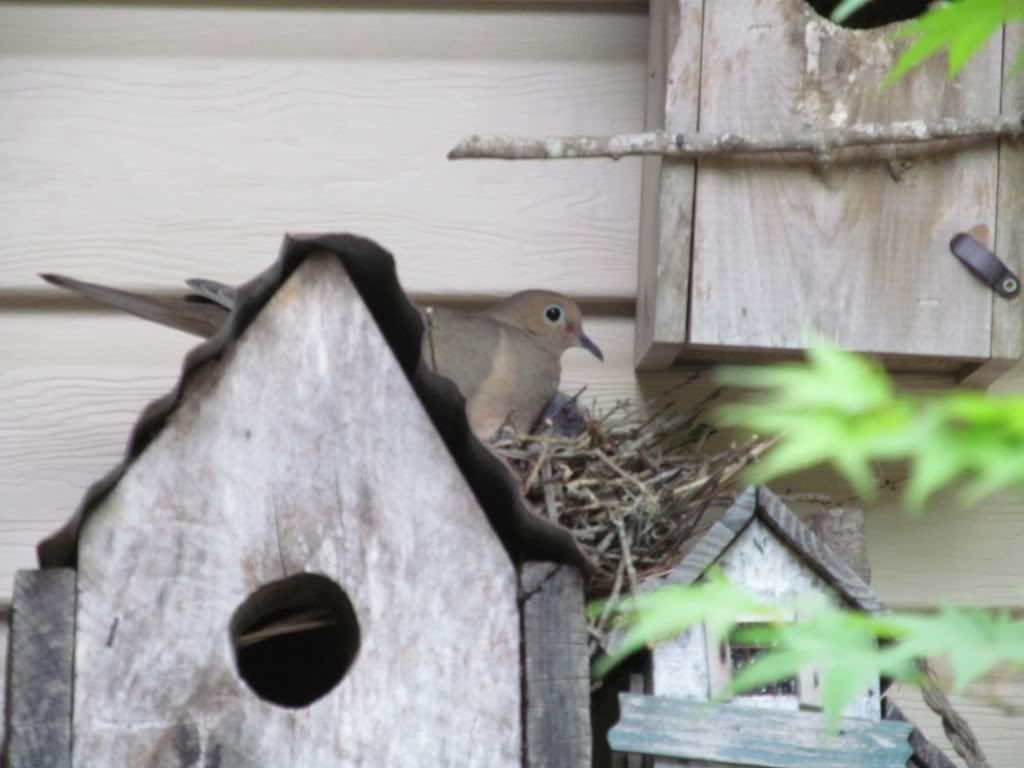
Nympho Mama has been sitting on the nest all day and night, but this morning I noticed she had shifted back a bit.
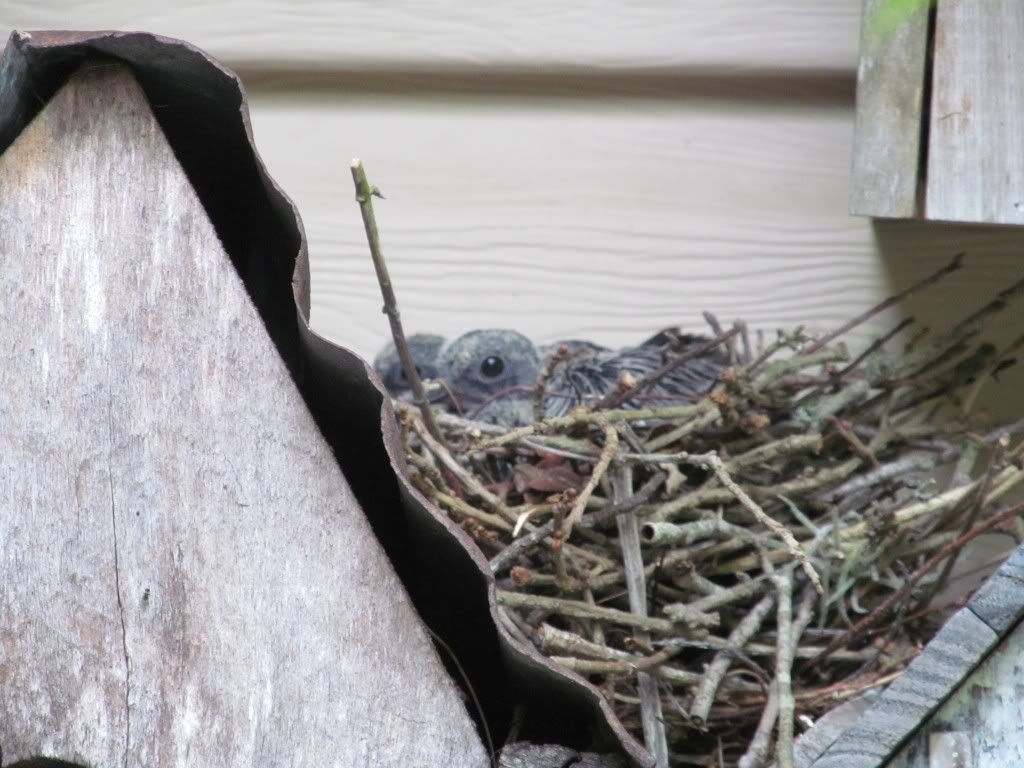
Seems her babies have hatched and are growing up fast.
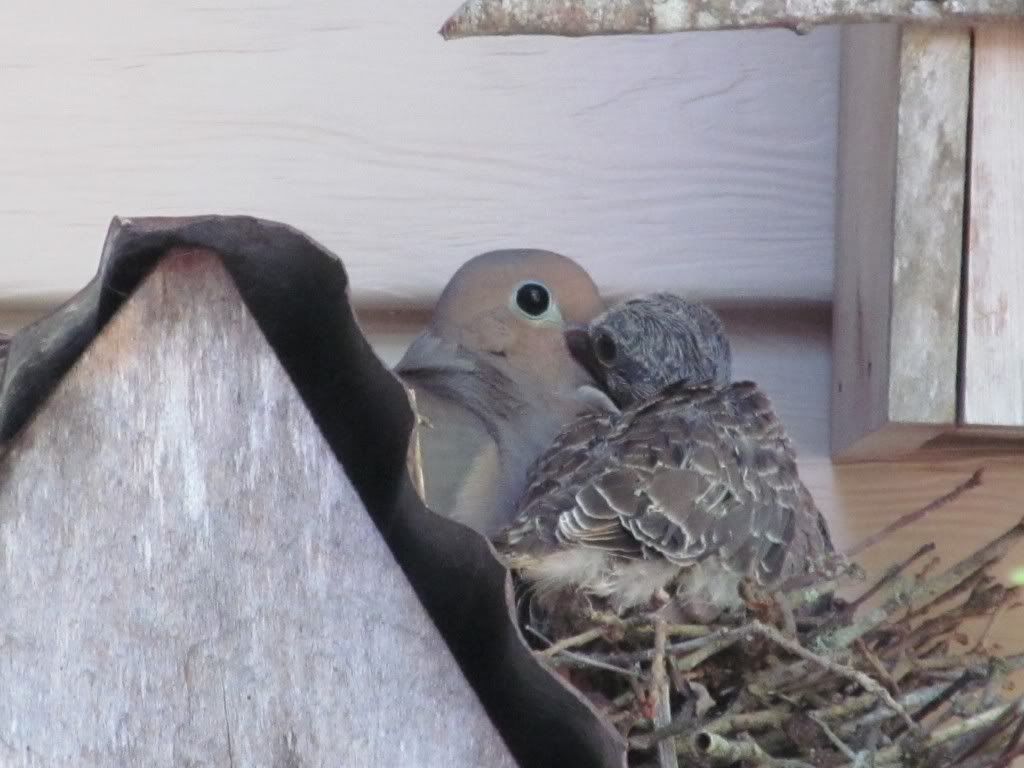
These doves really are the most devoted parents I've ever observed (and Dad still comes around at least once a day, too; I just haven't yet managed to snap both of them together with the fledglings.)
Friday, April 20, 2012
Pop Quiz
Ever since the revival of romantic paranormal fiction, reader have been hankering for great, original novels in this genre. Unfortunately this has resulted in a lot of derivative knockoffs which are neither great nor original. As a writing community service, we here at PBW have compiled a list of uh-ohs in the form of an originality test, and we recommend that anyone who is considering writing a paranormal romance novel might want to take this exam first.
The Paranormal Romance Novelist's Exam
Answer "yes" or "no" to the following questions:
1. In the first five pages, do the protagonists meet under the worst circumstances, and/or in a dark, deserted alley, and/or are attacked during their first meeting, and/or try to kill each other?
2. Is your female protagonist an oddball with no siblings, no “real” friends, deceased parents, a crap job, no money in her checking account, and who possesses a mysterious and inexplicable superpower of which she is wholly unaware until the moment when the male protagonist inadvertently does something that causes her accidentally to use it?
3. Is your male protagonist a solitary, lethal, massively muscular, insanely handsome immortal who has been seriously considering suicide because: 1) sex with normal women has become boring; 2) sex with superhuman women has become boring; 3) his onerous duties, which he has carried out for millennia without a problem, have just yesterday become unbearable; 4) despite his heroic resolve he simply can’t stand up to the vicious female deity whose smallest whims he must obey; 5) immortality, endless wealth and incomparable power seem paltry when compared to true love, which he is convinced he will never know?
4. Is your story about an immortal brotherhood of less than a dozen males battling an ancient and innumerable enemy in a centuries-old, high-casualty war that despite massive losses on both sides has somehow never once had a cease-fire declared in order to negotiate peace talks, or ended by one of the many decisive if somewhat unrealistic victories won by said brotherhood?
5. Is your story centered around a quest for that one chick who breaks the most important of your world-building rules, and as such is destined to either destroy or save the world?
5a. Is the only way the world can be saved is if your male and female protagonist have wild monkey sex before page 200?
5b. Does your male and female protagonists' inexplicable urge to have wild monkey sex result in consequences that will bring an end to the world?
5c. Unless one of the lovers kills the other one, I mean?
6. Does your novel contain a best friend/helpful sidekick character whose real job is to replace infodumps by explaining the hard parts of the story to the reader via as-you-know-Bob dialogue?
7. Does your book contain a character who is actually an angel, or was before he got booted out of heaven for being a bad boy who couldn’t follow fairly reasonable rules with which none of the other angels had a problem?
8. Is the evil overlord antagonist secretly the biological father of your female or male protagonist?
9. Is the deity ruling your brotherhood a demanding sadistic virginal bitch who takes pleasure in torturing her male underlings who, despite all her cruelties over the centuries, still smooch her feet at every turn?
10. Do the female characters in your novel spend a lot of time worrying about 1) how sexy they are; 2) how sexy they dress; 3) how long it’s been since they’ve had sex; 4) if (despite their mandatory relative inexperience) they are any good at sex; and/or 5) what sort of evil spawn they’ll give birth to if they do the nasty with the male protagonist?
11. Does your immortal male protagonist, who has been effortlessly for eons driving hordes of women out of their minds with pleasure, hold off on sex with your female protagonist because he worries that he is too “jaded” “cynical” or “heartless” for her?
12. Do any of your female characters exist solely to collapse into a puddle of wet Kleenex the moment there is any real trouble?
13. Do any of your female characters exist solely to transform into thinly-veiled rip-offs of Buffy the Vampire Slayer the moment there is any real trouble?
14. Are any of your characters half-blood hybrids who are forever torn between their human and nonhuman heritage?
15. At any point in the story will you make the vampires and the werewolves unwilling allies?
16. Does everybody who doesn’t possess a superpower, immortality or the ability to shape-shift exist solely 1) to be killed by the bad guys; 2) to keep the protagonists from having world-ending sex, or 3) to be corrupted by the antagonist, whom they will serve with unwavering devotion until just after the black moment, when a moment of completely unjustifiable remorse causes them to change their mind and sacrifice their life to protect the protagonists?
17. Do your immortal characters exude powerful scents that your mortal characters find alluring, bespelling or bewitching?
18. Does your novel contain a prologue that is very well-written but actually has little or nothing to do with the rest of the story?
19. Is a glossary of difficult-to-pronounce, wholly invented terms, that when read out loud sound a bit like Klingon as spoken by a drunken stuttering Welshman, parked in the front of the book?
20. Is this the first book in a series for which you have no practical ending or resolution in mind but that you figure will come to you eventually?
21. Did you first get the idea to write this novel after spending six months to a year in agonized fandom over a vampire television, cable or movie series?
22. Do any of your characters have names that have not been in popular use since the year 1066?
23. Do either of your protagonists have a single-word name, a four-syllable name, or a name that translates to something like “unvanquished hero” in Latin?
24. Do you see nothing wrong with having two characters from the same immortal gene pool being named "Lucien Alastair Wrathworthy" and "Bill"?
25. Does your novel contain demons, shadow demons, mindless shadow demons, little mindless shadow demons, etc.?
26. At any point in your novel, do the protagonists have no choice but to trust another character who to that point has proven to be completely untrustworthy?
27. Do you write your battle scenes by taking notes while watching Underworld movies (but fast-forwarding past the really icky parts)?
28. Do the fabulous, expensive, beautifully-furnished locations in your book exist solely so your protagonists can retreat there to have intimate chats that always lead to wild monkey sex, at least until they’re interrupted by 1) vengeance demons; 2) the rest of the brotherhood, who happen to live downstairs, heard all the noise and got worried; 3) sex-starved vengeance demons; 4) one of the antagonist’s red-shirts, who decided on his own to prove his loyalty by defying orders and killing both of his master’s enemies; 5) the female deity, who cannot permit this disastrous mating for reasons that are never adequately explained until the final pages of the last chapter?
29. Do your characters spend an inordinate amount of time discussing their feelings, their tragic pasts, the pain that no one (except the love interest) will ever understand, etc. instead of say, coming up with a practical solution to their real problem, aka a plan that a fifth grader or Scooby-Do and Shaggy could put together in less than five minutes?
30. Could one of your characters offer up a magical spell/charm/book/talisman/power that would solve all your protagonists’ problems, but they refuse to do because [insert utterly stupid reason]?
31. Do you ever use "grated" as a dialogue tag for your male protagonist more than four times?
32. Do you ever use “breathed” as a dialogue tag for your female protagonist more than four times?
33. Do you not realize how big the wounds are when you bite someone?
34. Do you think vampires can actually go on forever without feeding, even if they are in madly love with that mortal and would rather starve to death than nibble once on her neck?
35. Does anybody in your novel fight merciless enemies for most of the night, skulk back to their remote lair on foot, and wrestle a brother in a semi-homoerotic fashion before having meaningless sex with a handy/willing house wench, all of this without bleeding, sweating, bathing or taking a five-minute rest break?
36. Do either of your protagonists have tattoos that, if ever seen by real people in the real world, would cause them to 1) scream in horror and dial 911; 2) take lots of photos for the Facebook fan page they intend to create; 3) demand to know the name of the ink artist who did such amazing work; 4) ask if he/she’s a bad ass vampire slayer with a heart of gold; or 5) ask if he/she’s a bad ass vampire with a heart of gold?
37. Does anybody in your novel ever wield a sword of unimaginable power?
38. Does your immortal hero fall in love with the one mortal female in the entire world who has the only, unknown-to-her superpower that can kill him?
39. Do the shape-shifters in your story possess magic pelts of incredible colors that are never noticed by ordinary people on the street, and that never shed a single hair anywhere, even on that black velvet comforter on the female protagonist’s bed?
40. Is there absolutely no humor in your novel whatsoever? At least, in your opinion?
41. Is your massive immortal male protagonist able to withstand without blinking an eyelash consecutive, vicious attacks from armies of shadow demons, but is knocked unconscious by a single half-hearted girly punch thrown by your petite mortal female protagonist in the midst of a temper-tantrum?
42. During vampire feeding scenes, do you replace the word “blood” with euphemisms like “essence” “honey” or soften it with prefixes, i.e. “lifeblood” because they sound nicer?
43. Does your male protagonist werewolf go through hell fighting a full-moon change so as not to upset/disturb/reveal his dual nature to/consume the clueless mortal female protagonist, whom he doesn’t want to frighten away despite the fact that he goes through this every four weeks and -- unless she's a complete moron -- she is bound to find out anyway?
44. Is there a secondary female werewolf character who is 1) hopelessly in love with your male werewolf protagonist; 2) is insanely jealous of, or has killed in the past, anyone who falls in love with your male werewolf protagonist; or 3) betrays the pack, causes the death of half her friends and hands over the female protagonist to the bad guys because she’s sure that’s the only way to secure the love of your male werewolf protagonist for herself? And does no one ever get even a little suspicious of this chick before the bloodbath commences?
45. Does the female protagonist meet her long-lost or ever-absent immortal father, only to lose him to a demon attack in the same chapter?
46. Does your antagonist have nothing else to do in life but seek vengeance on your protagonist?
47. Does your vicious, overbearing, slightly psychopathic, armed-to-the-teeth male protagonist turn into an oversize, quivering, uber-emotional bunny rabbit whenever he discovers your female protagonist weeping, sitting by a window and sighing, or slumbering on his bed where she fell asleep while he was out hunting?
48. Is your story about a vampire brotherhood who truly despise all mortals (except that special one they're going to fall in love with who turns out to be only half-mortal) and yet spend all their time defending the mortal world against forces that would otherwise surely wipe them out, which logic dictates would really be okay with the brotherhood, given their human hatred?
49. Is the current leader of your werewolf pack a tough but wise Alpha, beloved by everyone, who is about to be assassinated by the antagonist, who turns out at the end of the story to have been one of his most trusted lieutenants?
50. By the end of the story does the mortal female protagonist undergo, either accidentally or voluntarily for the sake of love, a life-threatening change that has never worked on anyone else but by some extremely slim chance may bestow on her immortality, and does it work like a charm?
How to Score: if you answered "no" to all fifty questions, you passed with flying colors. If you answered "yes" to one or more of the questions, you might want to consider heading back to the drawing board and coming up with something new.
(based on The Fantasy Novelist's Exam by David J. Parker)
The Paranormal Romance Novelist's Exam
Answer "yes" or "no" to the following questions:
1. In the first five pages, do the protagonists meet under the worst circumstances, and/or in a dark, deserted alley, and/or are attacked during their first meeting, and/or try to kill each other?
2. Is your female protagonist an oddball with no siblings, no “real” friends, deceased parents, a crap job, no money in her checking account, and who possesses a mysterious and inexplicable superpower of which she is wholly unaware until the moment when the male protagonist inadvertently does something that causes her accidentally to use it?
3. Is your male protagonist a solitary, lethal, massively muscular, insanely handsome immortal who has been seriously considering suicide because: 1) sex with normal women has become boring; 2) sex with superhuman women has become boring; 3) his onerous duties, which he has carried out for millennia without a problem, have just yesterday become unbearable; 4) despite his heroic resolve he simply can’t stand up to the vicious female deity whose smallest whims he must obey; 5) immortality, endless wealth and incomparable power seem paltry when compared to true love, which he is convinced he will never know?
4. Is your story about an immortal brotherhood of less than a dozen males battling an ancient and innumerable enemy in a centuries-old, high-casualty war that despite massive losses on both sides has somehow never once had a cease-fire declared in order to negotiate peace talks, or ended by one of the many decisive if somewhat unrealistic victories won by said brotherhood?
5. Is your story centered around a quest for that one chick who breaks the most important of your world-building rules, and as such is destined to either destroy or save the world?
5a. Is the only way the world can be saved is if your male and female protagonist have wild monkey sex before page 200?
5b. Does your male and female protagonists' inexplicable urge to have wild monkey sex result in consequences that will bring an end to the world?
5c. Unless one of the lovers kills the other one, I mean?
6. Does your novel contain a best friend/helpful sidekick character whose real job is to replace infodumps by explaining the hard parts of the story to the reader via as-you-know-Bob dialogue?
7. Does your book contain a character who is actually an angel, or was before he got booted out of heaven for being a bad boy who couldn’t follow fairly reasonable rules with which none of the other angels had a problem?
8. Is the evil overlord antagonist secretly the biological father of your female or male protagonist?
9. Is the deity ruling your brotherhood a demanding sadistic virginal bitch who takes pleasure in torturing her male underlings who, despite all her cruelties over the centuries, still smooch her feet at every turn?
10. Do the female characters in your novel spend a lot of time worrying about 1) how sexy they are; 2) how sexy they dress; 3) how long it’s been since they’ve had sex; 4) if (despite their mandatory relative inexperience) they are any good at sex; and/or 5) what sort of evil spawn they’ll give birth to if they do the nasty with the male protagonist?
11. Does your immortal male protagonist, who has been effortlessly for eons driving hordes of women out of their minds with pleasure, hold off on sex with your female protagonist because he worries that he is too “jaded” “cynical” or “heartless” for her?
12. Do any of your female characters exist solely to collapse into a puddle of wet Kleenex the moment there is any real trouble?
13. Do any of your female characters exist solely to transform into thinly-veiled rip-offs of Buffy the Vampire Slayer the moment there is any real trouble?
14. Are any of your characters half-blood hybrids who are forever torn between their human and nonhuman heritage?
15. At any point in the story will you make the vampires and the werewolves unwilling allies?
16. Does everybody who doesn’t possess a superpower, immortality or the ability to shape-shift exist solely 1) to be killed by the bad guys; 2) to keep the protagonists from having world-ending sex, or 3) to be corrupted by the antagonist, whom they will serve with unwavering devotion until just after the black moment, when a moment of completely unjustifiable remorse causes them to change their mind and sacrifice their life to protect the protagonists?
17. Do your immortal characters exude powerful scents that your mortal characters find alluring, bespelling or bewitching?
18. Does your novel contain a prologue that is very well-written but actually has little or nothing to do with the rest of the story?
19. Is a glossary of difficult-to-pronounce, wholly invented terms, that when read out loud sound a bit like Klingon as spoken by a drunken stuttering Welshman, parked in the front of the book?
20. Is this the first book in a series for which you have no practical ending or resolution in mind but that you figure will come to you eventually?
21. Did you first get the idea to write this novel after spending six months to a year in agonized fandom over a vampire television, cable or movie series?
22. Do any of your characters have names that have not been in popular use since the year 1066?
23. Do either of your protagonists have a single-word name, a four-syllable name, or a name that translates to something like “unvanquished hero” in Latin?
24. Do you see nothing wrong with having two characters from the same immortal gene pool being named "Lucien Alastair Wrathworthy" and "Bill"?
25. Does your novel contain demons, shadow demons, mindless shadow demons, little mindless shadow demons, etc.?
26. At any point in your novel, do the protagonists have no choice but to trust another character who to that point has proven to be completely untrustworthy?
27. Do you write your battle scenes by taking notes while watching Underworld movies (but fast-forwarding past the really icky parts)?
28. Do the fabulous, expensive, beautifully-furnished locations in your book exist solely so your protagonists can retreat there to have intimate chats that always lead to wild monkey sex, at least until they’re interrupted by 1) vengeance demons; 2) the rest of the brotherhood, who happen to live downstairs, heard all the noise and got worried; 3) sex-starved vengeance demons; 4) one of the antagonist’s red-shirts, who decided on his own to prove his loyalty by defying orders and killing both of his master’s enemies; 5) the female deity, who cannot permit this disastrous mating for reasons that are never adequately explained until the final pages of the last chapter?
29. Do your characters spend an inordinate amount of time discussing their feelings, their tragic pasts, the pain that no one (except the love interest) will ever understand, etc. instead of say, coming up with a practical solution to their real problem, aka a plan that a fifth grader or Scooby-Do and Shaggy could put together in less than five minutes?
30. Could one of your characters offer up a magical spell/charm/book/talisman/power that would solve all your protagonists’ problems, but they refuse to do because [insert utterly stupid reason]?
31. Do you ever use "grated" as a dialogue tag for your male protagonist more than four times?
32. Do you ever use “breathed” as a dialogue tag for your female protagonist more than four times?
33. Do you not realize how big the wounds are when you bite someone?
34. Do you think vampires can actually go on forever without feeding, even if they are in madly love with that mortal and would rather starve to death than nibble once on her neck?
35. Does anybody in your novel fight merciless enemies for most of the night, skulk back to their remote lair on foot, and wrestle a brother in a semi-homoerotic fashion before having meaningless sex with a handy/willing house wench, all of this without bleeding, sweating, bathing or taking a five-minute rest break?
36. Do either of your protagonists have tattoos that, if ever seen by real people in the real world, would cause them to 1) scream in horror and dial 911; 2) take lots of photos for the Facebook fan page they intend to create; 3) demand to know the name of the ink artist who did such amazing work; 4) ask if he/she’s a bad ass vampire slayer with a heart of gold; or 5) ask if he/she’s a bad ass vampire with a heart of gold?
37. Does anybody in your novel ever wield a sword of unimaginable power?
38. Does your immortal hero fall in love with the one mortal female in the entire world who has the only, unknown-to-her superpower that can kill him?
39. Do the shape-shifters in your story possess magic pelts of incredible colors that are never noticed by ordinary people on the street, and that never shed a single hair anywhere, even on that black velvet comforter on the female protagonist’s bed?
40. Is there absolutely no humor in your novel whatsoever? At least, in your opinion?
41. Is your massive immortal male protagonist able to withstand without blinking an eyelash consecutive, vicious attacks from armies of shadow demons, but is knocked unconscious by a single half-hearted girly punch thrown by your petite mortal female protagonist in the midst of a temper-tantrum?
42. During vampire feeding scenes, do you replace the word “blood” with euphemisms like “essence” “honey” or soften it with prefixes, i.e. “lifeblood” because they sound nicer?
43. Does your male protagonist werewolf go through hell fighting a full-moon change so as not to upset/disturb/reveal his dual nature to/consume the clueless mortal female protagonist, whom he doesn’t want to frighten away despite the fact that he goes through this every four weeks and -- unless she's a complete moron -- she is bound to find out anyway?
44. Is there a secondary female werewolf character who is 1) hopelessly in love with your male werewolf protagonist; 2) is insanely jealous of, or has killed in the past, anyone who falls in love with your male werewolf protagonist; or 3) betrays the pack, causes the death of half her friends and hands over the female protagonist to the bad guys because she’s sure that’s the only way to secure the love of your male werewolf protagonist for herself? And does no one ever get even a little suspicious of this chick before the bloodbath commences?
45. Does the female protagonist meet her long-lost or ever-absent immortal father, only to lose him to a demon attack in the same chapter?
46. Does your antagonist have nothing else to do in life but seek vengeance on your protagonist?
47. Does your vicious, overbearing, slightly psychopathic, armed-to-the-teeth male protagonist turn into an oversize, quivering, uber-emotional bunny rabbit whenever he discovers your female protagonist weeping, sitting by a window and sighing, or slumbering on his bed where she fell asleep while he was out hunting?
48. Is your story about a vampire brotherhood who truly despise all mortals (except that special one they're going to fall in love with who turns out to be only half-mortal) and yet spend all their time defending the mortal world against forces that would otherwise surely wipe them out, which logic dictates would really be okay with the brotherhood, given their human hatred?
49. Is the current leader of your werewolf pack a tough but wise Alpha, beloved by everyone, who is about to be assassinated by the antagonist, who turns out at the end of the story to have been one of his most trusted lieutenants?
50. By the end of the story does the mortal female protagonist undergo, either accidentally or voluntarily for the sake of love, a life-threatening change that has never worked on anyone else but by some extremely slim chance may bestow on her immortality, and does it work like a charm?
How to Score: if you answered "no" to all fifty questions, you passed with flying colors. If you answered "yes" to one or more of the questions, you might want to consider heading back to the drawing board and coming up with something new.
(based on The Fantasy Novelist's Exam by David J. Parker)
Thursday, April 19, 2012
Virtual Storyboard
If you like working with whiteboards and/or index cards for your stories, you might want to check out Trello. According to their About page, Trello is "a collaboration tool that organizes your projects into boards. In one glance, Trello tells you what's being worked on, who's working on what, and where something is in a process."
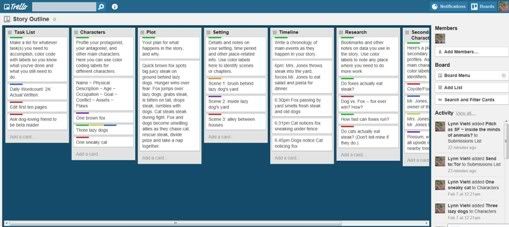
To test drive the service I set up this example story board, which you can see in more detail here. Using Trello is pretty straightforward; you just have to fiddle with it a bit to get the hang of how to edit and arrange your cards. I'd be most likely to organize a story project outline as shown and keep a running list of what tasks I need to accomplish, but you can use your cards for whatever you like.
Two of the features I liked most are the simple color-coded tags you can apply to any card, and the search feature -- you can sort through everything by any keyword, which makes finding pertinent data and editing the cards a snap.
For those of you who collaborate with another writer Trello would probably be extremely useful. You could set up an account for the two of you, organize your schedule, plot out your next project, work out who needs to do what and update each other on your progress. The right activity sidebar shows all activity on the board in chronological order, so you can always look there to see what's been added, deleted or changed recently. You can also set the board to be private so that no one sees it but you and your writing partner.
Thanks to our blogpal author Charlene Teglia for originally blogging about Trello.
To test drive the service I set up this example story board, which you can see in more detail here. Using Trello is pretty straightforward; you just have to fiddle with it a bit to get the hang of how to edit and arrange your cards. I'd be most likely to organize a story project outline as shown and keep a running list of what tasks I need to accomplish, but you can use your cards for whatever you like.
Two of the features I liked most are the simple color-coded tags you can apply to any card, and the search feature -- you can sort through everything by any keyword, which makes finding pertinent data and editing the cards a snap.
For those of you who collaborate with another writer Trello would probably be extremely useful. You could set up an account for the two of you, organize your schedule, plot out your next project, work out who needs to do what and update each other on your progress. The right activity sidebar shows all activity on the board in chronological order, so you can always look there to see what's been added, deleted or changed recently. You can also set the board to be private so that no one sees it but you and your writing partner.
Thanks to our blogpal author Charlene Teglia for originally blogging about Trello.
Wednesday, April 18, 2012
Sterling Sub Op
I have to start spending more time reading through the market archives over at Ralan.com; I'm always finding marvelous sub ops there. For example, L. Ron Hubbard's Writers of the Future Contest. This one awards sizeable cash prizes for SF or Fantasy short stories up to 17K in length. So why is this so marvelous? Let me count the ways:
1) It's not open to professional or published writers. Only those who haven't yet published can enter (publication is defined by the contest rules as follows: "The Contest is open only to those who have not professionally published a novel or short novel, or more than one novelette, or more than three short stories, in any medium. Professional publication is deemed to be payment, and at least 5,000 copies, or 5,000 hits.)
2) There's no entry fee. Zero. Zip. Zilch. Which makes it completely affordable for anyone.
3) Entrants retain all pub rights to their work, which means if you win the contest you can still sell the story elsewhere whenever you like.
4) Editors, agents, or any other non-writers are not part of the judging process; the awards are adjudicated by professional writers. Aka your peers.
5) The awards: First Prize of $1,000, a Second Prize of $750, and a Third Prize of $500, in U.S. dollars or the recipient's locally equivalent amount.
6) You can submit your story in hard copy by snail mail or electronically.
7) The contest runs four times per year, beginning on October 1, January 1, April 1 and July 1. The year will end on September 30. The four first-place prize winners are then rejudged and one is awarded the grand prize of $5000.00.
This quarter's contest opened on April 1st and runs through until June 30th, so if you want to enter but have nothing written you have time to put something together. To get more details on submission requirements, check out the contest page here.
1) It's not open to professional or published writers. Only those who haven't yet published can enter (publication is defined by the contest rules as follows: "The Contest is open only to those who have not professionally published a novel or short novel, or more than one novelette, or more than three short stories, in any medium. Professional publication is deemed to be payment, and at least 5,000 copies, or 5,000 hits.)
2) There's no entry fee. Zero. Zip. Zilch. Which makes it completely affordable for anyone.
3) Entrants retain all pub rights to their work, which means if you win the contest you can still sell the story elsewhere whenever you like.
4) Editors, agents, or any other non-writers are not part of the judging process; the awards are adjudicated by professional writers. Aka your peers.
5) The awards: First Prize of $1,000, a Second Prize of $750, and a Third Prize of $500, in U.S. dollars or the recipient's locally equivalent amount.
6) You can submit your story in hard copy by snail mail or electronically.
7) The contest runs four times per year, beginning on October 1, January 1, April 1 and July 1. The year will end on September 30. The four first-place prize winners are then rejudged and one is awarded the grand prize of $5000.00.
This quarter's contest opened on April 1st and runs through until June 30th, so if you want to enter but have nothing written you have time to put something together. To get more details on submission requirements, check out the contest page here.
Tuesday, April 17, 2012
Student Attitude
Sorry I'm late posting today; I was up late last night wrestling with a project and forgot to queue up my post for publication.
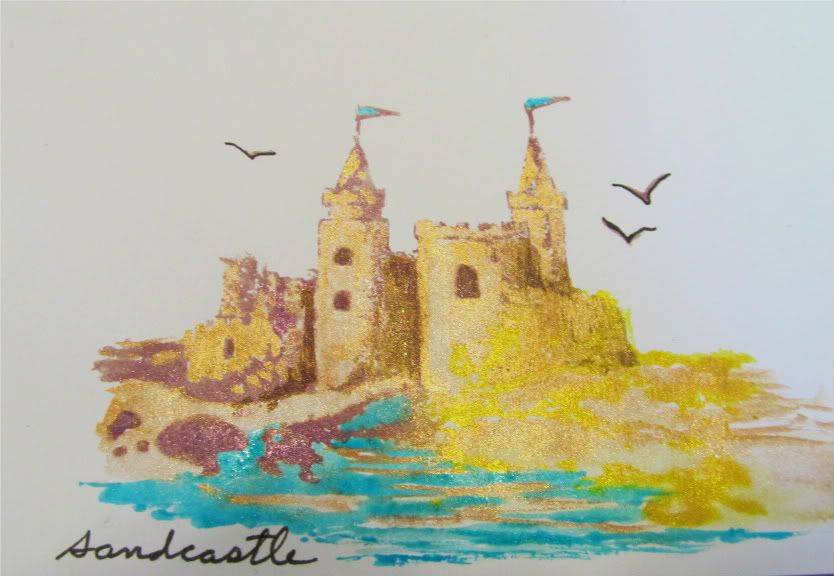 The online art class I'm taking is going well, I think. It's a bit more complicated than I expected, and some of the skills that I took for granted definitely need some rust remover. Lots of work, too, but I'm learning new things, and discovering some old truths: stencils are (still) not my friends; nothing ever turns out like it looks in your head; and if the instructions say wait until the paper is completely dry before you do something, wait until the paper is completely dry.
Being a virtual student is interesting, though. Earlier this year I took a six-week, in-real-life Bible study class with my mom, and while the art class is completely different I can't help comparing the two. When an instructor asks a question, no one ever wants to be the first to answer. There always seems to be someone who doesn't understand the simplest assignment, and someone who already knows everything and probably should be in a more advanced class. No matter what the subject or question is, everyone seems to dread being called on in case they don't have the right answer.
Then there are the personalities. Among real-life students you can always pick out certain types: the over-achiever, the oddball, the suck-up, the talker, the whiner, the fight-picker, the peacemaker. Virtual classes, on the other hand, have the internet as a buffer, and people seem to bring with them their cyber personas, which are all pretty similar.
Not being the teacher for once is also something of a challenge for me, especially when there are questions. My natural inclination to try to problem-solve and provide answers, but that's not my role in this situation, so I have to constantly remind myself to shut up. It's good for me, however, because when you do nothing but teach you tend to forget what it's like to be on the receiving end of the information. I'm seeing that an instructor can easily fall into the trap of assuming everyone knows what they're talking about, which results in leaving behind some people who didn't get it but were too shy to speak up.
I'm taking away from this experience a lot of data on what and how I want to teach in the future as well as how and what I want to pursue as a student. That may be the most valuable part of taking any course online or in real-life.
Now a couple of questions for you guys: What sort of online or real-life classes would you like to take (doesn't matter what subject)? Have you taken any classes either way that you found were particularly helpful? Let us know in comments.
The online art class I'm taking is going well, I think. It's a bit more complicated than I expected, and some of the skills that I took for granted definitely need some rust remover. Lots of work, too, but I'm learning new things, and discovering some old truths: stencils are (still) not my friends; nothing ever turns out like it looks in your head; and if the instructions say wait until the paper is completely dry before you do something, wait until the paper is completely dry.Being a virtual student is interesting, though. Earlier this year I took a six-week, in-real-life Bible study class with my mom, and while the art class is completely different I can't help comparing the two. When an instructor asks a question, no one ever wants to be the first to answer. There always seems to be someone who doesn't understand the simplest assignment, and someone who already knows everything and probably should be in a more advanced class. No matter what the subject or question is, everyone seems to dread being called on in case they don't have the right answer.
Then there are the personalities. Among real-life students you can always pick out certain types: the over-achiever, the oddball, the suck-up, the talker, the whiner, the fight-picker, the peacemaker. Virtual classes, on the other hand, have the internet as a buffer, and people seem to bring with them their cyber personas, which are all pretty similar.
Not being the teacher for once is also something of a challenge for me, especially when there are questions. My natural inclination to try to problem-solve and provide answers, but that's not my role in this situation, so I have to constantly remind myself to shut up. It's good for me, however, because when you do nothing but teach you tend to forget what it's like to be on the receiving end of the information. I'm seeing that an instructor can easily fall into the trap of assuming everyone knows what they're talking about, which results in leaving behind some people who didn't get it but were too shy to speak up.
I'm taking away from this experience a lot of data on what and how I want to teach in the future as well as how and what I want to pursue as a student. That may be the most valuable part of taking any course online or in real-life.
Now a couple of questions for you guys: What sort of online or real-life classes would you like to take (doesn't matter what subject)? Have you taken any classes either way that you found were particularly helpful? Let us know in comments.
Monday, April 16, 2012
Freebie Ten
Ten Things You Can Have for Free
Freeware caution: always scan free downloads of anything for bugs and other threats before dumping the programs into your hard drive.
AcMp3Converter is a "MP3 and WAV converter accessible for the blind or persons with low vision (20/200), tag editor, player. Different voices, large print, change background color, sound cursor heart. Supported languages: English, Polish. Uses Lame as coding engine" (OS: Windows 98/ME/2000/XP/2003/Vista/7)
The AeroClock is "a simple but at the same time beautiful desktop clock with alpha transparency. This very decorative desktop clock shows the local time at the Desktop. The basic functions: total transparency, size, setting, and the selection of the Clock-texture or the appearance are available. The Aero Clock does not have to be installed and can be executed easily from the desktop" (OS: Windows 2000/XP/2003/Vista/7 32-Bit/64-Bit)
Best CashBook is "the ideal tool to manage cash and finance. Based on [cash + deposits - cards = net cash], it treats cash, deposits, credit cards and all other finance as one to give an insight of incomings, outgoings and fund changes. It will be very simple and easy to use once you overcome learning the entry principles. Without programming skills, anyone can translate the program and distribute his own translated version even for free" (OS: Windows 98/ME/2000/XP/Vista/7)
FireAlpaca is "the image editor that can be used readily and easily" (OS: Windows XP/Vista/7; Mac OSX 10.5.8 or later)
There's a new release of GIMP, the versatile image editing and manipulation freeware which comes highly recommended by many writers, and which can be downloaded from the official site here (OS: Windows 2000/XP/2003/Vista/7, Unix, Mac OSX)
iBooks Author is a "free mac app is for those who have wanted to release an iBook but didn’t have a program to do so. This app allows you construct iBooks, by adding text, pictures, all to your specifications. You can include photo gallers, movies, and more. After you’re finished, you can submit your work to the iBookstore" (OS: Mac OS X)
Peacock Color Picker "allows you to retrieve the color of any pixel on your screen. It is the perfect color picking solution for professional graphic designers, webmasters and home users. Thanks to the revolutionary fade-out user interface you will be presented with an unobstructed view of your screen, and you can immediately start picking & mixing the color scheme of your choice" (OS:Windows 2003/XP/Vista/7/2008)
Also from Reohix, Sleep Moon Xpress is "a next-generation Automation Utility that takes computer automation to the highest level. It puts at your disposal some innovative ways to shut down or restart the system, put it into hibernation, stand-by or log off the user, run a specific file or sound an alarm without as much as touch the computer. You can clap your hands, yell, howl or make whatever sound you like to trigger the action; or you can exploit the mobile technology and use the mobile phone to do all of these things, either by appealing to Bluetooth or connecting it to a wireless network." {PBW notes: Sounds like a handy utility for handicapped users, too] (OS: Windows 2003/XP/Vista/7/2008)
viJournal Lite, the freeware version of viJournal, is "designed as an analogue of the good old-fashioned page-a-day bound diary - the kind you buy in a stationer's. You write your entries under dated headers and save them collectively by month and year" [PBW notes: This looked interesting, and although it appears that the Lite version doesn't offer as many bells and whistles as the pay-for version, I thought it might be interesting for the Mac users to check out] (OS: Mac OS X 10.5)
Twin Visions allows you to "navigate through your photos in 3D, fix flaws, apply effects, create albums and calendars, share your favorites through e-mail, prints and online sharing websites" (OS: Windows 2000/XP/Vista/7)
Freeware caution: always scan free downloads of anything for bugs and other threats before dumping the programs into your hard drive.
AcMp3Converter is a "MP3 and WAV converter accessible for the blind or persons with low vision (20/200), tag editor, player. Different voices, large print, change background color, sound cursor heart. Supported languages: English, Polish. Uses Lame as coding engine" (OS: Windows 98/ME/2000/XP/2003/Vista/7)
The AeroClock is "a simple but at the same time beautiful desktop clock with alpha transparency. This very decorative desktop clock shows the local time at the Desktop. The basic functions: total transparency, size, setting, and the selection of the Clock-texture or the appearance are available. The Aero Clock does not have to be installed and can be executed easily from the desktop" (OS: Windows 2000/XP/2003/Vista/7 32-Bit/64-Bit)
Best CashBook is "the ideal tool to manage cash and finance. Based on [cash + deposits - cards = net cash], it treats cash, deposits, credit cards and all other finance as one to give an insight of incomings, outgoings and fund changes. It will be very simple and easy to use once you overcome learning the entry principles. Without programming skills, anyone can translate the program and distribute his own translated version even for free" (OS: Windows 98/ME/2000/XP/Vista/7)
FireAlpaca is "the image editor that can be used readily and easily" (OS: Windows XP/Vista/7; Mac OSX 10.5.8 or later)
There's a new release of GIMP, the versatile image editing and manipulation freeware which comes highly recommended by many writers, and which can be downloaded from the official site here (OS: Windows 2000/XP/2003/Vista/7, Unix, Mac OSX)
iBooks Author is a "free mac app is for those who have wanted to release an iBook but didn’t have a program to do so. This app allows you construct iBooks, by adding text, pictures, all to your specifications. You can include photo gallers, movies, and more. After you’re finished, you can submit your work to the iBookstore" (OS: Mac OS X)
Peacock Color Picker "allows you to retrieve the color of any pixel on your screen. It is the perfect color picking solution for professional graphic designers, webmasters and home users. Thanks to the revolutionary fade-out user interface you will be presented with an unobstructed view of your screen, and you can immediately start picking & mixing the color scheme of your choice" (OS:Windows 2003/XP/Vista/7/2008)
Also from Reohix, Sleep Moon Xpress is "a next-generation Automation Utility that takes computer automation to the highest level. It puts at your disposal some innovative ways to shut down or restart the system, put it into hibernation, stand-by or log off the user, run a specific file or sound an alarm without as much as touch the computer. You can clap your hands, yell, howl or make whatever sound you like to trigger the action; or you can exploit the mobile technology and use the mobile phone to do all of these things, either by appealing to Bluetooth or connecting it to a wireless network." {PBW notes: Sounds like a handy utility for handicapped users, too] (OS: Windows 2003/XP/Vista/7/2008)
viJournal Lite, the freeware version of viJournal, is "designed as an analogue of the good old-fashioned page-a-day bound diary - the kind you buy in a stationer's. You write your entries under dated headers and save them collectively by month and year" [PBW notes: This looked interesting, and although it appears that the Lite version doesn't offer as many bells and whistles as the pay-for version, I thought it might be interesting for the Mac users to check out] (OS: Mac OS X 10.5)
Twin Visions allows you to "navigate through your photos in 3D, fix flaws, apply effects, create albums and calendars, share your favorites through e-mail, prints and online sharing websites" (OS: Windows 2000/XP/Vista/7)
Sunday, April 15, 2012
Whistleless
Aside from the interesting message, the remarkable thing about this video by Siri Melchior is that it was made using thousands of potato prints (if you never made them in kindergarten, they're fashioned from raw potatoes cut with shapes like rubber stamps and dipped in paint.)
Saturday, April 14, 2012
Winners
I think Magnetic Poetry needs to hire you guys as creative directors; you came up with some great ideas. For me the perfect little box of words would be about writing (but of course everything is about writing.)
We revved up the magic hat, and the winners of the MagPo's Little Boxes giveaway are:
fionaphoenix, who thinks a color theme has lots of possibilities.
Ayla, who wouldn't mind a tin of sanity
TanjaG, who'd like a high fantasy/sword & sorcery theme, or a witch craft/spell theme
clairecherven, who would like to see wisdom in 72 words or less
Winners, when you have a chance please send your full name and ship-to address to LynnViehl@aol.com so I can get your packages out to you. My thanks to everyone for joining in.
We revved up the magic hat, and the winners of the MagPo's Little Boxes giveaway are:
fionaphoenix, who thinks a color theme has lots of possibilities.
Ayla, who wouldn't mind a tin of sanity
TanjaG, who'd like a high fantasy/sword & sorcery theme, or a witch craft/spell theme
clairecherven, who would like to see wisdom in 72 words or less
Winners, when you have a chance please send your full name and ship-to address to LynnViehl@aol.com so I can get your packages out to you. My thanks to everyone for joining in.
Friday, April 13, 2012
Tiger Eye & Little Boxes of MagPo
Tonight Passionfruit Games e-mailed me a heads-up on the release of Tiger Eye ~ the Sacrifice, a computer game based on Marjorie Liu's romance novel of the same name. If you remember how much fun I had with the first game, Tiger Eye ~ the Curse of the Riddle Box, then you know how tickled I am to have the next one (I just started playing it tonight and I'm already having a blast.) If you already own the first game, want the second game or would like to find out more about them, Passionfruit Games has all the info you'll need on their web site here. Meanwhile, I'm going to play through the new game and then write up another post with more on the gaming experience.
 Helpful things often come in small packages, as I discovered when I made a trip to BAM yesterday and found Magnetic Poetry's latest delight, little boxes of words.
The palm-sized tins, which contain 72 words to play with, each have a specific theme. I picked up one of each that BAM had in stock: happiness, hope, love, peace, and (my personal favorite) whoop ass. Later that day -- when I definitely felt like whooping some ass -- I got the tins out of the bag. What I really needed an inoculation of hope, though, so that was the one I cracked open.
72 words aren't a lot to work with, but in a few minutes I put together a quick poem about something I believe in that always gives me hope (me and my guy). While it didn't transform me into Julie Andrews singing the hills are alive, and my impromptu verse won't be winning a Pulitzer, once I had arranged the poem on my board I actually felt a little better. At $5.99 per tin MagPo's little boxes are a bit pricey, but they're certainly cheaper than a therapist.
As always you don't have to take my word for it. In comments to this post, name something you'd like MagPo to use as a theme for one of their little boxes (or if you can't think of anything, just toss your name in the hat) by midnight EST tonight, April 13, 2012. I will draw four names at random from everyone who participates and send the winners one of MagPo's little boxes along with a signed copy of Nightborn, my latest release. This giveaway is open to everyone on the planet, even if you've won something at PBW in the past.
Thursday, April 12, 2012
Story Therapy
Once or twice a year your creative muse goes off on a jaunt, leaving you with a blank design wall and a blank mind, wondering where your next idea is going to come from. -- Rayna Gillman
Lately I've been working on preparations for the piece I hope to enter into an art quilt challenge. I have several techniques I want to use, including two I invented myself. I have all the materials I need. I even have little experiment pieces I'm making to test out how to put it together. But the design itself, the most important part of the piece? I couldn't figure it out. Everything I put on paper looked too busy, too complicated, too overdone.
I got to where I stopped sketching because everything I drew sucked. After twenty-odd years of designing and sewing I actually had a horrendous case of quilter's block.
I put aside the project last week, and in hopes of clearing out my head, I decided to do something different. For this I consulted my April/May 2012 issue of Quilting Arts magazine, in which I found Rayna Gillman's article, Stitch Therapy. First thought: Do these editors have me under surveillance?
I dutifully read the article, and I didn't like it. To summarize the technique it described, you're supposed to just sew a bunch of free-cut, random strips of scrap fabric together. No rulers, no templates, no pattern, no specific type of fabric, no color choosing or matching. Just cut and stitch. Like quilting could be organic. The author called it playful sewing.
You guys know me. As a writer I'm ruthlessly pre-planned and organized; as a quilter I'm even worse. Playful sewing? Please. I have my entire stash color-coded. I've cataloged my quilting magazine and book collections. I've even alphabetized my templates (okay, and cross-indexed them by size and shape.) I do not play, baby, I sew. And this is my biggest creative stonewall: I have to have everything perfect and prepared and figured out ahead of time.
Of course I know the universe wants me to color outside the lines, so I decided I probably needed some stitch therapy and went ahead with doing a project based on the article.
It's very tough to break old habits, and I won't say I had a great time putting together this piece. I kept trying to color match my scraps, cut them into uniform-sized strips and then sew them together in straight rows. I had to toss out four blocks before I finally got the hang of the no-technique technique. As I was making them I could see that the blocks were all over the place. The crooked seam lines and insane colors made my right eye twitch. But when I finally put the blocks together and had a complete piece, it surprised me with how fun it looked:

It's fresh, bright, and not like anything I've done before. It's nowhere near as good as the author's examples, and it's not going to win any awards. But it's still rather neat. Much as I hate to admit it, I'm looking forward to quilting and finishing the piece.
While I was doing the stitch therapy, I was also thinking about my challenge piece. I have been obsessing over the composition when it's the techniques that I want to showcase. To show a technique clearly and communicate the idea to as many people as possible, the ideal way to go is with an easy-to-understand example. I realized I'd been over-thinking the design. Rather than doing a hugely sophisticated piece with all the bells and whistles, I needed to step back and keep it simple.
I still don't know what my challenge piece design will be, but I have some new ideas. I also know I need to back off on the designing and think more about communicating. Stitch therapy didn't give me all the answers, but what it did was put some distance between me and my problem, and provide the chance to step outside my lines and think in a different direction. Which is where I know the answers can be found.
Right now you may be suffering from the same problem with your writing. You have all these ideas and yet you can't make them work. Everything is too complicated. One thing I've always recommended to writers who are blocked is to stop working on what's not working and do something different. It doesn't have to be a novel; write a short story. Set it in a genre you've never tried before now; if the story you're blocked on is a romance try writing a SF story, or an urban fantasy, or a YA. If you hate vampire stories, write a vampire story. The idea of story therapy is to step outside yourself and play for a short period of time. What you produce you may never be able to sell, but as with my stitch therapy project, it may get your head in the right place to go back and solve the problems with the work you do want to sell.
Lately I've been working on preparations for the piece I hope to enter into an art quilt challenge. I have several techniques I want to use, including two I invented myself. I have all the materials I need. I even have little experiment pieces I'm making to test out how to put it together. But the design itself, the most important part of the piece? I couldn't figure it out. Everything I put on paper looked too busy, too complicated, too overdone.
I got to where I stopped sketching because everything I drew sucked. After twenty-odd years of designing and sewing I actually had a horrendous case of quilter's block.
I put aside the project last week, and in hopes of clearing out my head, I decided to do something different. For this I consulted my April/May 2012 issue of Quilting Arts magazine, in which I found Rayna Gillman's article, Stitch Therapy. First thought: Do these editors have me under surveillance?
I dutifully read the article, and I didn't like it. To summarize the technique it described, you're supposed to just sew a bunch of free-cut, random strips of scrap fabric together. No rulers, no templates, no pattern, no specific type of fabric, no color choosing or matching. Just cut and stitch. Like quilting could be organic. The author called it playful sewing.
You guys know me. As a writer I'm ruthlessly pre-planned and organized; as a quilter I'm even worse. Playful sewing? Please. I have my entire stash color-coded. I've cataloged my quilting magazine and book collections. I've even alphabetized my templates (okay, and cross-indexed them by size and shape.) I do not play, baby, I sew. And this is my biggest creative stonewall: I have to have everything perfect and prepared and figured out ahead of time.
Of course I know the universe wants me to color outside the lines, so I decided I probably needed some stitch therapy and went ahead with doing a project based on the article.
It's very tough to break old habits, and I won't say I had a great time putting together this piece. I kept trying to color match my scraps, cut them into uniform-sized strips and then sew them together in straight rows. I had to toss out four blocks before I finally got the hang of the no-technique technique. As I was making them I could see that the blocks were all over the place. The crooked seam lines and insane colors made my right eye twitch. But when I finally put the blocks together and had a complete piece, it surprised me with how fun it looked:
It's fresh, bright, and not like anything I've done before. It's nowhere near as good as the author's examples, and it's not going to win any awards. But it's still rather neat. Much as I hate to admit it, I'm looking forward to quilting and finishing the piece.
While I was doing the stitch therapy, I was also thinking about my challenge piece. I have been obsessing over the composition when it's the techniques that I want to showcase. To show a technique clearly and communicate the idea to as many people as possible, the ideal way to go is with an easy-to-understand example. I realized I'd been over-thinking the design. Rather than doing a hugely sophisticated piece with all the bells and whistles, I needed to step back and keep it simple.
I still don't know what my challenge piece design will be, but I have some new ideas. I also know I need to back off on the designing and think more about communicating. Stitch therapy didn't give me all the answers, but what it did was put some distance between me and my problem, and provide the chance to step outside my lines and think in a different direction. Which is where I know the answers can be found.
Right now you may be suffering from the same problem with your writing. You have all these ideas and yet you can't make them work. Everything is too complicated. One thing I've always recommended to writers who are blocked is to stop working on what's not working and do something different. It doesn't have to be a novel; write a short story. Set it in a genre you've never tried before now; if the story you're blocked on is a romance try writing a SF story, or an urban fantasy, or a YA. If you hate vampire stories, write a vampire story. The idea of story therapy is to step outside yourself and play for a short period of time. What you produce you may never be able to sell, but as with my stitch therapy project, it may get your head in the right place to go back and solve the problems with the work you do want to sell.
Wednesday, April 11, 2012
Memed Again
The author meme: "...post 7 lines from page 77 of our latest book or current manuscript, starting after the 7th sentence."
Blame it on: Shiloh Walker.
Excerpt From Nightbred by Lynn Viehl, to be released in December 2012:
She hugged her waist with her arms and looked away. “Sometimes, when I’m too tired to drive home, I sleep up here.”
“Alone?” he couldn’t help asking.
Her eyes glittered. “No, I usually invite the entire garrison up to cuddle with me. Unless the guys want to play Strip Scrabble or Naked Twister. Then we go to the rec room down the hall.” She stalked out of the kitchen.
Blame it on: Shiloh Walker.
Excerpt From Nightbred by Lynn Viehl, to be released in December 2012:
She hugged her waist with her arms and looked away. “Sometimes, when I’m too tired to drive home, I sleep up here.”
“Alone?” he couldn’t help asking.
Her eyes glittered. “No, I usually invite the entire garrison up to cuddle with me. Unless the guys want to play Strip Scrabble or Naked Twister. Then we go to the rec room down the hall.” She stalked out of the kitchen.
Subscribe to:
Posts (Atom)