Tuesday, July 10, 2012

LEGO® Logic

Whoever invented LEGO® blocks understood that there is a little world-builder in every kid, one who needs only a simple but intriguing set of materials to create something amazing. Anyone who has ever built a LEGO® creation knows how satisfying it is to fit those pegged blocks together while figuring out the construct. The best part is the creation never has to be permanent; you can use the same blocks over and over to make new worlds.

The same is true of storytelling. Words are our building blocks, and they can be sorted and combined and recombined to form an infinite number of characters, plots and worlds. Because we all build according to our imaginations we don't need a new set of construction materials every time we start a story. You can give the same set of words or story ideas to ten writers, and you'll get back ten different creations.

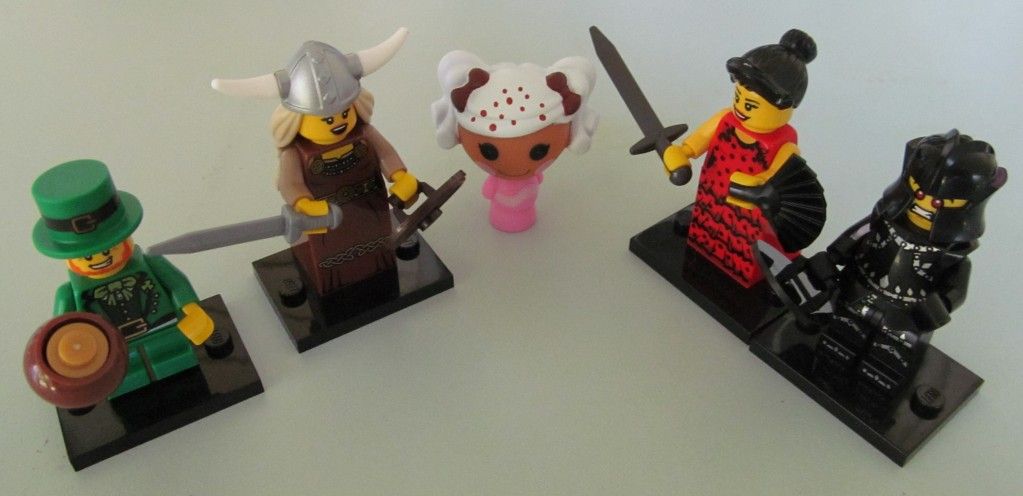
Today I'm going to apply some LEGO® logic to our characters. As with everything in the story, they are created from a series of components that when fitted together form a person. Here I've put together a little male protagonist, aka Our Hero. At first glance he seems like a happy if somewhat fashion-challenged dude. Irish, likes green, needs a shave. We'll call him Lucky, which he really won't be.

Lucky is made up of very specific parts: physical characteristics, personality, personal talents, intelligence, experience, etc. If we were to sort these character components into four major groups using the word LEGO as our inspiration, we might call them this:

Liabilities -- the flaws, limitations and other aspects of the character that in some way handicap or hinder.

Extras -- the assets, talents and other aspects of the character that in some way help or facilitate.

Goals -- any or all of the character's desires and ambitions.

Obstacles -- that which stands between the character and the goals.

Naturally characters are much more complex than this, but to create them you can use these four categories as a starting place or foundation on which you can build. Let's look at Lucky again and sort him out according to our LEGO categories:

Liabilities: he doesn't blend in too well in our world. He has problems relating to other people. He seems over-confident, probably because he relies on magic to deal with his problems.

Extras: he's cute, which makes everyone think he's harmless. When people see him they think they've found a treasure. As long as his magic hold ups, he's financially independent.

Goals: Lucky wants to hang on to his wealth, meet a nice Irish girl and settle down somewhere at the end of the rainbow.

Obstacles: Girls don't take him seriously. Everyone else thinks they're entitled to his gold and are constantly hunting for him. The magic that he's always taken for granted is about to fail him.

Lucky wouldn't be much of a protagonist without some challenges, so he needs this guy: our antagonist, Gruesome. As dark as Lucky is light, Grue is a scowling, black-hearted fully-armed disaster waiting to happen. Grue doesn't much like Lucky, and he'll be happy to relieve him of that beanpot of gold, his hat and, if Lucky stands still long enough, his head.

But why is Grue such a bad guy? He's made up of the same parts as Lucky; his are just different:

Liabilities: Grue has an attitude problem, a rotten temper and a terrible case of perpetual halitosis.

Extras: He has a sword of unimaginable power, a lair filled with minions, and black magic.

Goals: Lucky's gold, Lucky's magic and any girl Lucky manages to snare.

Obstacles: No one is ever happy to see Grue. His armor is one size too small. The minute he opens his mouth everyone runs.

Lucky will have to deal with Grue, but he may also have another character running major interference in his life. For some of us that's a secondary protagonist like Hilda here. Don't let her easy smile or silly costume fool you; she's a tough chick. As the third side of a story character triad Hilda brings her own personality to the table. She may be Lucky's polar opposite, but you can be sure that on some level she has a bond with her fellow protagonist -- even if the only thing they have in common is not liking Grue.

I'd sort out Hilda like this:

Liabilities: Hilda's had her heart broken so she doesn't trust anyone. Her suspicious nature borders on paranoid. She's so broke she's agreed to wear a silly costume and dance on the side of the road to make rent money.

Extras: Hilda is honest and compassionate. The costume she puts on endows her with magical abilities. Using her last buck she buys a ticket that has the winning numbers for PowerBall.

Goals: To get over herself, find a nice guy worthy of her trust and get season tickets for the opera.

Obstacles: Grue's lust, Lucky's gold, and her own fear of commitment.

Too many main characters muddle a story, so to flesh out your cast you're going to need secondary characters. Our girl Fanny here is one of the support cast that make up the other people in the story. Because she's not created to occupy center stage she won't own as much of the story as your main characters, but she's surprising adaptable to any number of roles; she can be anyone from Lucky's ex-squeeze to Grue's minion. She may be in the story to be Hilda's best friend or worst enemy. The key to figuring Fanny (and the rest of the support cast crew) is to build her according to your main characters' and story's needs, using the same LEGO logic to figure out what her components are.

Liabilities: Fanny has no self-esteem. She uses hostility to hide her vulnerability. She has terrible taste in men.

Extras: She's smart, resourceful and loyal.

Goals: She wants to be loved, respected and cherished, first by Grue and then (after he dumps her) by Lucky.

Obstacles: Grue's evil plans, Lucky's gold, and her BFF Hilda, whom she's never really liked.

No matter how you build your characters, or how many you put into your story, there is always one who is in the middle of everything. One who calls all the shots, finalizes all the decisions and makes or breaks the story. One who knows everything about the characters including the stuff no one else knows. Your first reader, your first editor, and your storymaster all rolled into one. A presence that should always be there but never be noticeable: the storyteller, you.

Monday, July 09, 2012

Zero Cost Ten

Ten Things You Can Have for Free

(Freeware caution: always scan free downloads of anything for bugs and other threats before dumping the programs into your hard drive.)

7 Sticky Notes is a "good 100% free desktop notes software that creates Sticky Notes directly on your Desktop. It has a really good-looking realistic sticky note appearance for ultimate user experience and it offers amazing and cool features that makes 7 Sticky Notes at the same time powerful, simple to use, reliable, and light" (OS: Windows 2000/XP/Vista/7)

Creative Docs .NET is "a vector-based graphic design tool with support for rich text, ideal to quickly write short documents, manuals, posters, illustrations, schemas, plans, flow charts.Creative Docs .NET tools are simple, yet powerful.A color gradient, for instance, can be modified directly by dragging its handles in the document window" (OS: Windows)

Instant Writing Resources Toolbar provides "instant access to free writing resources and writing links. Developed by Rowdy Rhodes its primary use is to provide access to the massive writing resource site Freelance Writing Organization - Int'l. which was established in 1999. The Tool Bar Includes Thousands of Resources, Freelance Writing Jobs, Job Search, Global Sponsors, RSS Feeds, Online Text Formatter and Character Counter, Dictionary, How-To-Write Library, Encyclopedia, Chat, Software, Writing Courses, over 55 Online Games and Gadgets, a Writers Radio Station by Writers for Writers, Forums, a Writers Store with Over 50,000+ Writing Products from Four Separate Suppliers, Writers Site News Archives, Windows Tray Alerts Announcing New Resources and Jobs, POP3 Email Notifier for All Your Email Accounts and a Help Desk. Feel free to use the Tool Bar as a giveaway / incentive on your site" (OS: Windows2000, Windows Vista Home Basic, Windows Vista Home Premium, 2000, Vista, XP, WinXP; Also designer notes "This software works with Internet Explorer, FireFox, and Safari.")

Keep Writing is a word processor that works like an old school typewriter: it doesn't let you delete. If you really, really have to, you can type over mistakes just like with a real typewriter. The idea is that this will let you focus on productivity (instead of endless polishing) and on reaching your word count goals. It simply encourages you to Keep Writing" (OS: Windows)

You can get a free demo of The Name Dropper, a program "designed to generate random names. Using US census data from the last century, The Name Dropper can create over 115 million different male names, and over 370 million female names. The Name Dropper uses a special randomization process which insures that you get different names each time you run the application" (OS: Windows XP, Windows 2000)

Q10 is "a simple but powerful text editor designed and built with writers in mind. Q10 is small, fast and keeps out of your way" that provides "full screen editing by default. A target word count feature and a timer alarm, customizable autosave and typewriter sound effects" (OS: Windows)

The free version of Rainlendar is a "customizable calendar application which stays out of your way but keeps all your important events and tasks always visible on your desktop" (OS: Windows, Mac OS X and Linux)

SSuite Writer's D'Lite offers "just enough functionality to start you on writing that important novel, short-story or article, without any bells and whistles to distract you. Get writing from the first moment you start the application. It has all the important functions and text formatting needed to get you busy. It also has custom page settings for easier viewing of your document. Full statistics are visible on the status bar, keeping you abreast of your text document as you type. No java or .Net required to run this application, keeping it very small and portable and very useful. Has all the necessary editing short-cut keys for power users" (OS: Windows All 32Bit/64Bit)

SuperMemo is a "speed-learning application" that "helps you collect, read and process important knowledge in the process called incremental reading and remember it indefinitely with the help of so-called spaced repetition" (OS: Win 98/NT/2K/XP/2K3/Vista/7)

WritersFocus is a full-screen, distraction-free writing environment that offers "The perfect moment for a writer. You sit down at your computer and just start writing. Your words flow easily out through the keyboard onto your screen. Your mind is focused. You're in the zone. You're only thinking about what you're writing. Welcome to WritersFocus. This small piece of software was written to create a world on your Notebook just for writing, without interruption. Without Distraction. WritersFocus blocks all Alerts from other software and instant messages. There is no fancy interface with umpteen icons in your face. Just a blank screen with only the words you are writing. Just sit down and write. No fancy interface. No popup's, No interruptions" (OS: Windows XP and Vista)

Sunday, July 08, 2012

Winners

I've got a whole new list of books to check out on my next shopping trip, thanks to the many authors and titles mentioned for the Obsessed giveaway.

Tonight we cranked up the magic hat, and the winners are:

terlee, who recommends Discovery of Witches, the first book in the All Souls trilogy by Deborah Harkness

Megan, who is reading Dennis Lehane's Shutter Island (that one will keep you up all night, too)

LJCohen, who needs a new book to keep her guessing.

Winners, when you have a chance please send your full name and ship-to info to LynnViehl@aol.com so I can get your books out to you. My thanks to everyone for joining in.

Saturday, July 07, 2012

Obsessed

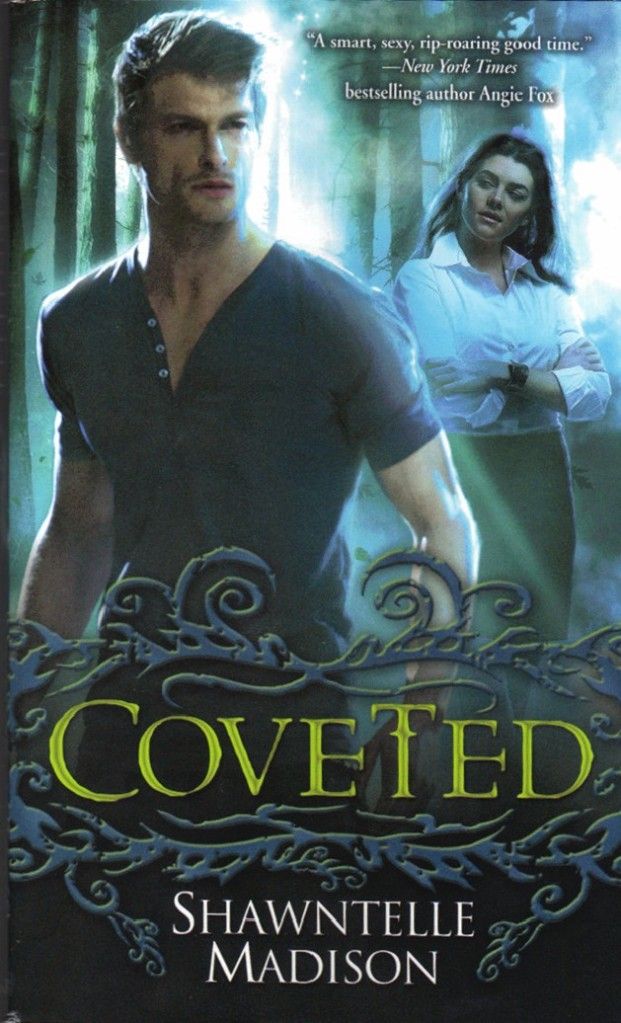
Now that I've waded out from under (most) of the summer's workload, I have time to explore the shelves and discover new authors. Because I was a good scribe and got the work done first I think the Book Gods rewarded me by steering me to a number of great reads, beginning with Shawntelle Madison's impressive urban fantasy Coveted.

You know how often you want a well-written book with a great cast of characters and all the elemental perks but a different story line? Not the same old tired tried-and-true genre tropes but genuinely distinctive; something fresh and unique that reaffirms your faith in fiction? Add to that one which makes you happy about what's being written by the next generation of writers? This is one of those books.

To give you a little on the story: Natalya Stravinsky is a werewolf with two problems. One is Thorn, the son of the local pack leader, an old love who has recently come back to town and of whom great things are expected. Unfortunately getting involved with Natalya isn't one of them.

Natalya also has OCD. Please note, she doesn't have the shallow, occasionally mentioned, pretty, put-there-just-to-give-her-a-nice-flaw variety of OCD; this is the real deal. It's woven in her personality, it got her kicked out of her pack, it's filled her house with Christmas ornaments, and it's seriously screwing with her life. Natalya knows this, and she does want to do something about it. So she returns to group therapy with other extraordinary creatures -- among them, a succubus who can't get a date, a mermaid who's afraid of the sea, a giant-size dwarf, and a handsome hoarder of a wizard. The group is run by a therapist who is also a wizard capable of handling both his patients' special problems and providing ways for them find solutions. Only Natalya has a lot more to cope with than simply her disorder. Someone wants her dead.

Coveted is odd, funny, original and not at all what you'd expect. The writing is excellent, the characters come off so realistic they should have their own reality show, and the story is authentic and original (and I believe this is the author's debut novel, which makes it even more impressive.)

And as always, you don't have to take my word for it. In comments to this post, name the last author or book you've read that kept you guessing (or if you can't think of any, just toss your name in the hat) by midnight EST tonight, June July 7th, 2012.* I'll chose three names at random from everyone who participates and send the winners an unsigned copy of Coveted by Shawntelle Madison. This giveaway is open to everyone on the planet, even if you've won something at PBW in the past.

*Added to correct, and sorry about posting the wrong month. Apparently my head is still in June.

Friday, July 06, 2012

Color Pick Your Career

AOL Jobs has an interesting article here on how to determine your career path based on your favorite colors (with a free test you can take on CareerPath.com here).

It's a little late for me to make a drastic career move, but I thought I'd try the test and see if I've taken the right path. Here are my results:

Best Occupational Category
You're a RESEARCHER
Keywords: Independent, Self-Motivated, Reserved, Introspective, Analytical, and Curious

These investigative types gather information, analyze and interpret data, and inquire to uncover new facts. They have a strong scientific orientation, enjoy academic or research environments and prefer self-reliant jobs. Dislikes are group projects, selling, and repetitive activities.

RESEARCHER OCCUPATIONS

Suggested careers are College Professor, Physician, Psychologist, Pharmacist, Chemist, Marketing Research, Inventor, Sales Forecasting, Project Engineer, Dentist, Identifying Consumer Demand, Chiropractor, Dentist, Medical Technician, Optometrist, Research & Development Manager, Respiratory Therapist, Real Estate Appraiser, Chiropractor, Veterinarian, Geologist, Physicist, Science Teacher, Medical Technologist, and Author of Technical Books.

RESEARCHER WORKPLACES
Task-oriented careers where you can become absorbed in the job, be original and creative, and not conform to rigid company rules will work best for you. Unstructured organizations, for example, that allow you to sail your own ship are vital.

Suggested Researcher workplaces are universities and colleges, home office positions, medical facilities, computer-related industries, scientific foundations and think tanks, research firms, and design laboratories.

2nd Best Occupational Category
You're a CREATOR

Keywords: Nonconforming, Impulsive, Expressive, Romantic, Intuitive, Sensitive, and Emotional

These original types place a high value on self-expression. They enjoy working independently, being creative, using their imagination, and constantly learning something new. Areas of interest are far beyond the expected fields of art, drama, music, and writing. There are many occupations that allow creators to express, assemble, or implement ideas and maximize resources.


So it seems I've made the right choice after all.

If you're not inclined to color your own career, this might be a fun test to try for your characters, to consider personality quirks and possibly occupations on the color palettes you've put together for them.

Thursday, July 05, 2012

Can We Talk?

Whether you're a reader or a writer, reading poorly-written dialogue is the same as being a musician and listening to music being played off-key. There's only so much of that you can take before it becomes almost painful -- and I think that's why so often bad dialogue is a book killer.

No one is a master of dialogue; a few authors come close but it's not something I believe can be mastered. We all wrestle with it, crafting it, reading it out loud, listening to it, trying to shape it into what it should be: something effortless and natural on which everyone wants to eavesdrop. If good dialogue is tough to compose, great dialogue is insanely difficult to bring to the page. I'm probably more forgiving than most writers when it comes to encountering bad dialogue because of this. Absolutely I will let pass the occasional "Hi, how are you?" and "Isn't the weather nice?" in order to get to the good stuff -- assuming there is some good stuff.

I wish I could sprinkle every writer with magic dialogue dust, but it doesn't exist. Like everything with writing, dialogue requires thought, practice and hard work. For me dialogue comes from a combination of listening and picking up rhythms in real life, letting that constantly percolate, and then pouring all of it into the characters and allowing them to draw on it to speak to me rather than me putting words in their mouth. While I'm listening to the character, I also have to be in their head, in their point of view, which puts me literally inside and outside the character. This is why head-hopping never works for me -- I can't switch back and forth within a scene; I'm too invested in the POV character.

Like any story element dialogue can be over-thought and over-written, and when that happens it loses the natural rhythm of speaking and engaging and becomes trapped atop a soapbox of stilted monologue-type speech making. Everything is grammatically correct, all the i's are dotted and the t's crossed, and it looks perfect because it is. The problem is none of us speak perfectly. We use bad grammar. We drop and pick up thoughts in mid-sentence. We bitch, we complain, we laugh through the shouts and we sob between the whispers. We're emotional creatures, often we don't think before we open our mouths, we react. Those reactions are raw and imperfect and real.

Every person has a distinct voice, too; what we say is unique to us, like a fingerprint. Ask twenty people to describe to you an event they all attended, and you'll get twenty different descriptions. Their word choices, statement structures, tonal emphasis, focal points and memories will all be slightly different. Some will go on and on about one thing; others will be more general. Their emotions will play a part as well. Did they event excite them, bore them, make them happy or push them into despair? What did they bring to the event? Was it after a bad day, a great day, or a nothing day in their lives? Were they happy to get out of the house, or did they wish they'd never left?

If you want to tap into your subconscious, which is where I think all great dialogue originates, considering all these very conscious things should happen before you begin writing. Let it all process, but when you begin writing, set the conscious things aside entirely. Put your characters in the scene, watch them, listen to them, and record it on the page. Once you've finished, take a break and disengage. Then, when your head is out of the story, edit the scene.

The primary dialogue litmus test I use for dialogue is my own awareness of it. If I know I'm reading dialogue, then I flag it. If I forget I'm reading and hear the characters in my head, I don't. The dialogue should flow across the page. If it doesn't, I don't fiddle with it too much; I don't think flow can be forced. When I find a line I don't like, I usually delete it. Once I've edited the rest the scene, I go back to the beginning, re-read and put myself back in the character's head to again listen and record what I hear from them.

For writing practice, you might take a pen and pocket notebook with you the next time you're going to be around a lot of people. Eavesdrop (discreetly) and jot down every interesting thing you hear someone else say. I do this all the time; here are some lines I overheard during my travels just the other day:

I wish I had them power tools.
You can fit anything into the bags. A truck if you wanted.
Those eggs look a little dark.
No more nuts. I mean it. Not a one.
She's been waiting a while so I'm gonna take her before you.


When you get home, take the best lines you heard in the real world, and turn them into a conversation between two of your characters. Another lesson I often give my students is to watch a recorded, new-to-them movie or television show, stop it in the middle of a conversation and write the rest of it as they imagine it might go, then start the show again and compare the results.

Emerson said In good writing, words become one with things. If dialogue should be one with anything, it's your ear. Don't just write it, listen to it, the way you would music, or birdsong, or the beat of a heart -- it should sound just as natural, and just as real.

Related links:

PBW's Ten Things to Help Writers with Dialogue and Ten Things I Think about Your Dialogue Tags.

Author Amy Rose Davis talks about the rhythm of dialogue here.

When does dialogue overwhelm a story? Editor Beth Hill has some suggestions in her blog post Dialogue ~ My Characters Talk Too Much.

Julie Musil's blog post Dialogue ~ Make It Matter invokes how-to author James Scott Bell and offers some interesting tips on what dialogue should do for your fiction. (Added: sorry about the link not working; I messed up the code -- it should take you there now.)

(outside links gleaned from the wonderful writers' search engine over at The Writers Knowledge Base)

Wednesday, July 04, 2012

Wishing You

Tuesday, July 03, 2012

The Gems

An update on our latest front yard drama; Octomom decided to deposit another egg in her nest to make this her third batch of twins:


She also really didn't care for me snapping shots of her with the camera, so I left her alone for the last weeks of June. During which time these little darlings hatched:


Like their many sibs before them, the babies are very quiet and never utter a peep. Their mom leaves them alone for only short periods of time so I had to be quick and take these pics when she left one morning to grab breakfast.


This nest is in a tricky position, so in order not to disturb them I've stopped watering the plant. It may not survive this time, but one look at these little faces makes it worth losing one sweet potato vine.


Because they're so identical I've named them Castor and Polydeuces. Cute, yes?

Monday, July 02, 2012

Sub Ops Ten

Aurora Regency, an imprint of Musa Publishing, has an open call for Regency romance fiction submissions: "Do you have a sweet, traditional Regency romance that you've written but haven't found a publisher that specializes in Regency romance any longer? Do you have a rights reverted traditional Regency that you'd like to see back in publication? Have you always wanted to write a traditional Regency but didn't spend the time to do it because you thought no one published them any more? Aurora Regency is actively seeking submissions for ALL traditional Regency romance for our 2012/2013 release schedule." Editor also notes: "Traditional Regency romance, which means sweet. No pre-marital sex, and the bedroom door is firmly closed for the final *ahem* event." and "We will consider reprints to rights reverted stories." and "Also ***Special call for Christmas and New Years' themed Regencies!*** Please submit by July 31, 2012 for Holiday 2012 release consideration." Length: 5-120K, Payment: Not specified, but I pulled this from the publisher's web site: "Musa is a royalty-paying small publisher. Musa does not charge fees for set up, printing, or anything else. Money flows to the author, not the other way around." [PBW notes: before you submit you might first query on what percentage they pay and terms.] Obviously reprints okay, electronic submissions only, see call to submit post and publisher's web page for more details.

Editor Silvia Moreno-Garcia has an open call for Exile Editions' Dead North, an anthology of zombie stories set in Canada: "Smart, quirky and unique takes on zombies. Silvia loves stories with strong heroes, non-linear plots and multicultural characters. Yes, we want to know if the Inuit would cope with the zombie apocalypse with no major issues or if Chinese-Canadians have a secret recipe to deal with zombie disasters. Was the wendigo really a zombie? Was the Great Fire of 1886 started by zombie hunters? Would zombies freeze in the Manitoba winter? Would a hockey stick make a good defensive weapon against the undead? You tell us. Canadian writers, Aboriginal writers, culturally diverse writers, new generation writers, Francophone writers and female writers are strongly encouraged to submit." Length: 2-10K; Payment: "2 cents (CAD) per word and two contributor copies." Reprints okay, electronic submissions only, see guidelines for more details. Deadline: September 30th, 2012.

White Cat Publications has an open call for romantic fiction submissions to be published in their upcoming debut quarterly Insatiable ~ the Magazine of Paranormal Desires print and e-zine: "We are accepting all manner of supernatural, paranormal, weirdness, oddities, and whatnot so long as there is a romantic plot element. Time period is not a sticking point. Modern, period, complete fantasy/alternate reality all will be looked at. We want imaginative, well-written stories that are crafted with care. Not to knock it because there is a place for every good word out there, but porn without plot will not be accepted. Sex is good and natural and fun but it must move the plot forward. We at Insatiable are more interested with emotional content and that “oomph” that good writing evokes in the reader. Also, we are not afraid of humor. Just because there’s love involved doesn’t mean it can’t be funny." Length: up to 5K (query for longer); Payment: "3 cents per word. For reprints, we pay 1 cent per word." Reprints obviously okay, electronic submissions only, see guidelines for more details.

Kaleidotrope magazine's summer reading period opened July 1st, and here's the sort of submissions they'd like to see: "Kaleidotrope tends heavily towards the speculative — towards science fiction, fantasy and horror — but we like an eclectic mix and are therefore always eager to read interesting work that falls outside those categories. Man does not live on space ships, elves and ghostly axe murderers alone, after all. We’d suggest picking up a recent issue to familiarize yourself with the zine, and/or checking out other work by our past contributors, to get a sense of what we’re looking for and what we like. In the end, what we want is interesting and unconventional work, well-written stories and poems that surprise and amuse us, shock and disturb us, that tell us things we didn’t know or reveal old truths in brand new ways. We want strange visions of distant shores, of imaginary countries and ordinary people, and work that doesn’t lose sight of entertainment and the joy of good writing." Length: "We have no maximum word limit, although anything over 10,000 words may be a tougher sell. We do like well crafted flash fiction, too, although preferably not under 250 words." Payment: "we will pay $0.01/word (1 cent a word) USD. For poetry, we offer a flat rate of $5 USD per accepted piece; for artwork, $10." Query on reprints, electronic and snail mail submissions okay, see guidelines for more details. Current reading period closes in September (no particular date specified so I'd assume the 1st.)

Lamplight, a Horror annual print and quarterly e-zine, is likewise looking for submissions: "We want your best. But then, doesn’t everyone? We print both short stories and flash fiction. We are looking for horror, dark speculative fiction and noir. No specific sub-genres or themes, just good stories. That being said, we prefer the Shining over the Dark Half. Excessive gore and sexuality should be avoided unless it is essential to the story. We are not taking vampire or zombie stories at this time. The quarterly is published as an ebook, and at the end of the year all the quarterlies are bound together in an annual collection. We are asking for non-exclusive, worldwide, serial rights to your work for both electronic and print. We want to publish it, we don’t want to own it. Length: "1000 words or less, consider it flash fiction; 2000 words or more, consider it short story. In-between? Send it over and we can talk." Payment: "For short stories we pay $150 per story. For flash fiction, we pay $50." Reading periods: "As Lamplight is a quarterly, there are some reading dates associated with it. While we take submissions year round, there are cut off dates for the individual issues: Spring – 15 January; Summer – 15 April; Fall – 15 July; Winter – 15 October. Reprints okay, electronic submissions only, see guidelines for more details.

Luna Station Press is looking for submissions from female writers only: "We publish speculative fiction by women writers. (Sorry, Gents!) We love stories in any form, novels, novellas, short stories, etc. and we think women have strong, but unheard voices in speculative literature. Help us give them a voice. We also publish select poetry collections and are open to all forms, with the only criteria being that we like it. Science fiction and fantasy poetry, fairy tales in poetic form, or straight-up introspection, we’d love to see it. Finally, we publish non-fiction. We do our best to hunt down quirky, interesting and unique books and authors with unique voices. Have something interesting and unique to say to the world? Let us know. We accept short story collections, novels, novellas, and just about everything in between, so long as it’s woman-authored. Series will be considered, but please note if your manuscript is part of one and include details on your thoughts for the rest of the series (length, basic plot ideas, etc.). Speculative fiction is preferred, but we will leave what defines ‘speculative’ up to you. Space Opera, Cyberpunk, Slip Stream, Sword and Sorcery, Steampunk, Magical Realism, etc. all are welcome. Young Adult titles are welcome, too! Stuff we don’t want to see: Anything biased toward any religion, race or moral preference; Extreme gore or sexual content (everything in moderation); Fan Fiction (original stories only, please); Bad grammar/punctuation (please proofread and watch your sentence structure!); Plagiarism. Otherwise, just about anything goes. Poetry Guidelines: Have something a bit unusual to share? Awesome. Send it, we would love to see it. Genre poetry collections are welcome, as are more traditional forms. We would love to publish someone’s epic tale in verse form. Non-Fiction Guidelines: Once again, just about anything goes. Crafting books, memoirs, travel diaries, guidebooks, creative non-fiction, etc. Your manuscript can be a concise treatise on a particular topic, or as wide and rambling as a life fully-lived. Payment: "Our payment terms are simple. Authors get 50% of the NET profits. That’s not the list price, that’s factoring all the weird fees charged by distributors, that’s regardless of format (electronic or paperback). If you google around a bit, you will find that we offer a great royalty rate. We do this because we think it’s fair, taking into account the work we put into everything we produce and the work you have already put into your art. Royalties are paid quarterly via PayPal or Amazon Gift Card. Totals under $10 will rollover to the next quarter, but will payout the following quarter, regardless of total." No reprints, electronic submissions only, see guidelines for more details.

Nightmare e-zine wants horror submissions: "Nightmare is seeking original horror and dark fantasy stories of 1500-7500 words. Stories of 5000 words or less are preferred. We pay 5¢/word for original fiction, on acceptance. To see which rights we're seeking, please view our contract template (PDF) for original fiction. All types of horror or dark fantasy are welcome; if in doubt, go ahead and submit it and let our editors decide. No subject should be considered off-limits, and we encourage writers to take chances with their fiction and push the envelope. We believe that the horror genre's diversity is its greatest strength, and we wish that viewpoint to be reflected in our story content and our submission queues; we welcome submissions from writers of every race, religion, nationality, gender, and sexual orientation." Payment: 5 cents per word for original fiction, 1 cent per word for reprints, electronic submissions only, see guidelines for more details.

Specutopia e-zine would like to see submissions of: "...stories by talented writers who are as proficient at the art of writing, as they are the craft. We want beautifully written stories that are skillfully and expertly executed--stories that are powerful, exhilarating, tragic, moving, insightful, edgy, unique. Solid writing mechanics, stunning prose, imaginative settings, compelling characters, and well-thought out plots are all equally important. We're only looking for the best stories from serious writers. We want writers who are not only adept at creating theme, plot, character, and setting, but also able to masterfully intertwine these elements in a way that results in a seamless, cohesive whole. Stories should start strong, develop purposefully, be well paced, and finish with a satisfying and complete ending. Most importantly, a story has to be engaging and impactful. It has to have a consistent and captivating voice. Technical aspects and elements are ultimately employed to support the overall effect of a well-told story. Proficient construction without emotion and meaning fails to achieve the main goal: conveying a story that says something. We're interested in all types of speculative fiction. However, we want stories where the speculative element is clear, meaningful, and integral to the story. By speculative we mean science fiction, fantasy, and the myriad hybrid and cross genres they include. We are not interested in horror. Genre is secondary to quality. What We Don't Want: We don't want trite or gimmicky stories. We don't want stories from writers who are still learning the basics of writing. We don't want stories that aren't polished, edited, or proofread. We don't want clones of other published stories, fan fiction, or clichéd characters, plots, and settings. We don't want stories that have no purpose or meaning. We don't want stories that haven't been sweated and bled over. We put no limitations on tense, viewpoint, or structure. We don't want to limit the creative possibilities of skillful writers. Our philosophy is that any approach can be used well by an experienced writer. And, often, stories require a particular approach to be written most effectively. We are fine with strong language, sexuality, and violence. However, we don't want erotica, rape, or gore for its own sake." Length: Unspecified; Payment: 1 cent per word. No reprints, electronic submissions only, see guidelines for more details.

Undina Press wants submissions of "...well-written, erotic short stories in the science fiction and fantasy genre." Length: "Stories need to be between 4000 and 15,000 words." Payment: "We pay an upfront advance ranging from $20-30 per story for electronic only rights, and then we pay 50% royalties on the sales price for sales from our website, or 50% of what we receive from sales from our third party vendors. We hold these rights for two years with an option to renew." Query on reprints, electronic submissions only, see guidelines for more details.

UFO Publishing has an open call for their anthology Unidentified Funny Objects — An Anthology of Humorous Science Fiction & Fantasy: "We’re looking for speculative stories with a strong humor element. Think Resnick and Sheckley, Fredric Brown and Douglas Adams. We welcome quality flash fiction and non-traditional narratives. Take chances, try something new, just make sure that your story is funny. Puns and stories that are little more than vehicles for delivering a punch line at the end aren’t likely to win us over." Length: 500 words to 4K; Payment: Upon acceptance, "$0.05 per word + contributor copy." No reprints, electronic submissions only, see guidelines for more details. Deadline: August 31, 2012.

Most of the above sub ops were found among the many marvelous market listings over at Ralan.com.

Sunday, July 01, 2012

More Pages

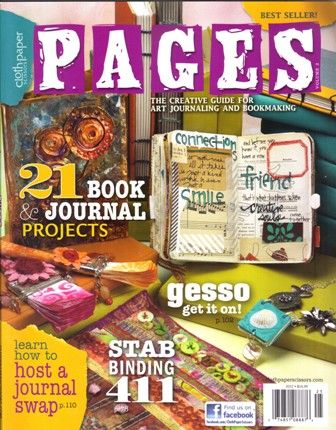
The 2012 issue of Pages, the creative guide for art journaling and bookmarking from the publishers of Cloth Paper Scissors, has just hit the newstands. I fell in love with the premiere issue last winter so there was no question I'd grab the second volume.
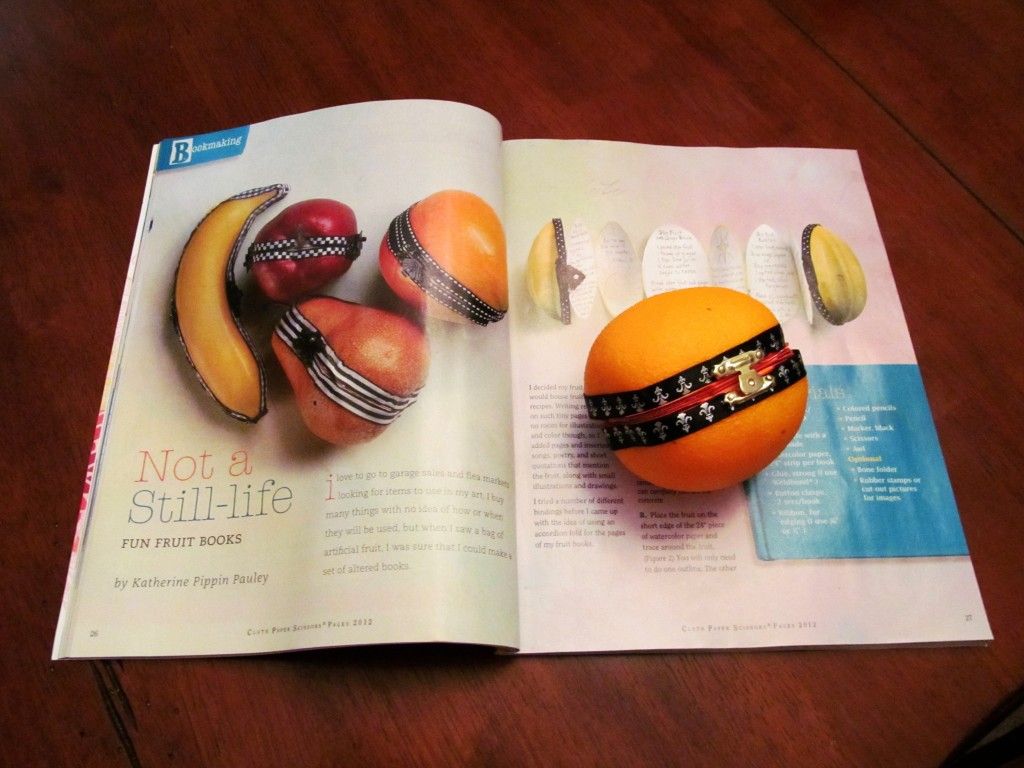
This one has several whimsical projects in it, from creating tiny wearable books to fusing and stitching plastic shopping bags into covers. There's also a mini-workshop on Japanese stab binding which I'm going to study, as I've gotten a little bored with coptic stitch and want to stretch my binding horizons.

If you have art journal maker friends, there's a good article on how to host a journal swap using pages rather than entire books (which could result in a neat collaborative project if you belong to an art group.) If you're a pack rat, there's an excellent project on creating a keepsake album made entirely of envelopes (this is another one I might try as I have piles of tiny ephemera stashed that I'd like to sort and keep categorized.) One artist shows you how to make wall-type paintbrushes into books by removing the bristle block and replacing it with decorated pages. I thought that one was absolutely ingenious.

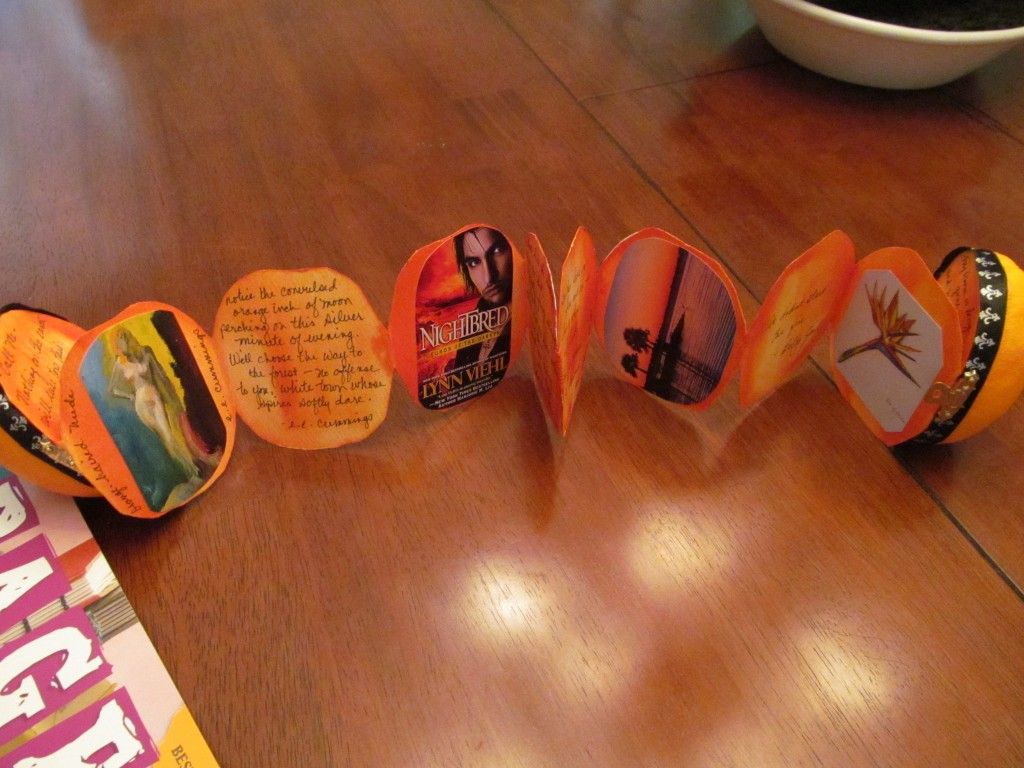
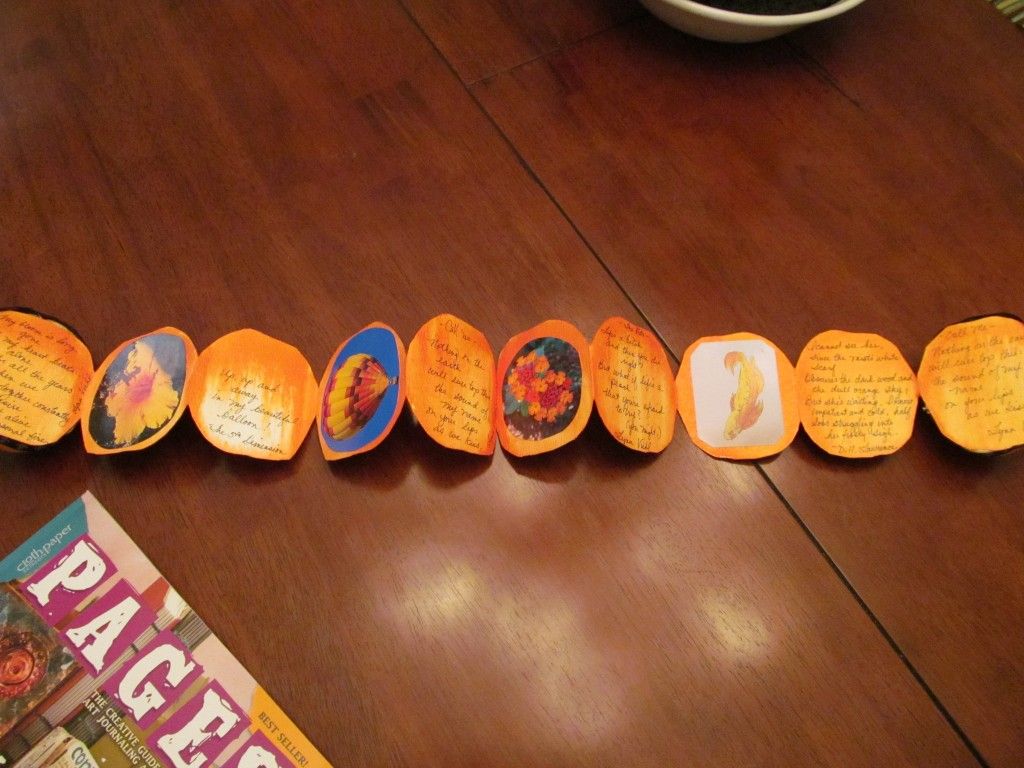
I was so tempted by Katherine Pippin Pauley's project Not a Still-life, which shows how to make books out of fake plastic fruit, that I had to give that one a try right away. She used hers as recipe booklets -- each themed by the sort of fruit she used, but I decided to make mine into a poetry and photo album that paid homage to the color of my fruit.


Although it looks simple enough there were some tricky parts; cutting the fruit in half evenly requires a very sharp blade, and the accordion-folded pages have to be precisely trimmed to fit. Still, I made the book in a couple of days, and what I learned from my first attempt now has me eyeing other objects I might turn into books.

Once again the editors included a nice range of projects suitable for beginners to advanced book-makers. They're also keeping it green by emphasizing the use of recycled materials. One artist made a travel art journal out of an old sweater; another fused and stitched tiny bits of scrap fabric to create some impressive abstract covers.

I think Pages is breathing new life into a very old craft. Book-making has always been a serious, sober art, and while there's nothing wrong with that -- I have enormous respect for the traditionalists -- I think opening it up and bringing an element of play to the table makes it more accessible. Back when I took my class in book-binding we were lectured on using the proper materials and following techniques that really hadn't changed much since the seventeenth century. I've made some lovely traditional books, but I'd like to stretch my range and explore some new territory. Pages magazine is definitely taking me there.

Saturday, June 30, 2012

Seeing Story

Storytellers have two sets of eyes. There's the pair we use every day to navigate our way through the world, and then there are our inner eyes, through which we see all the possibilities around us. All that's needed to switch between the two is a little imagination.


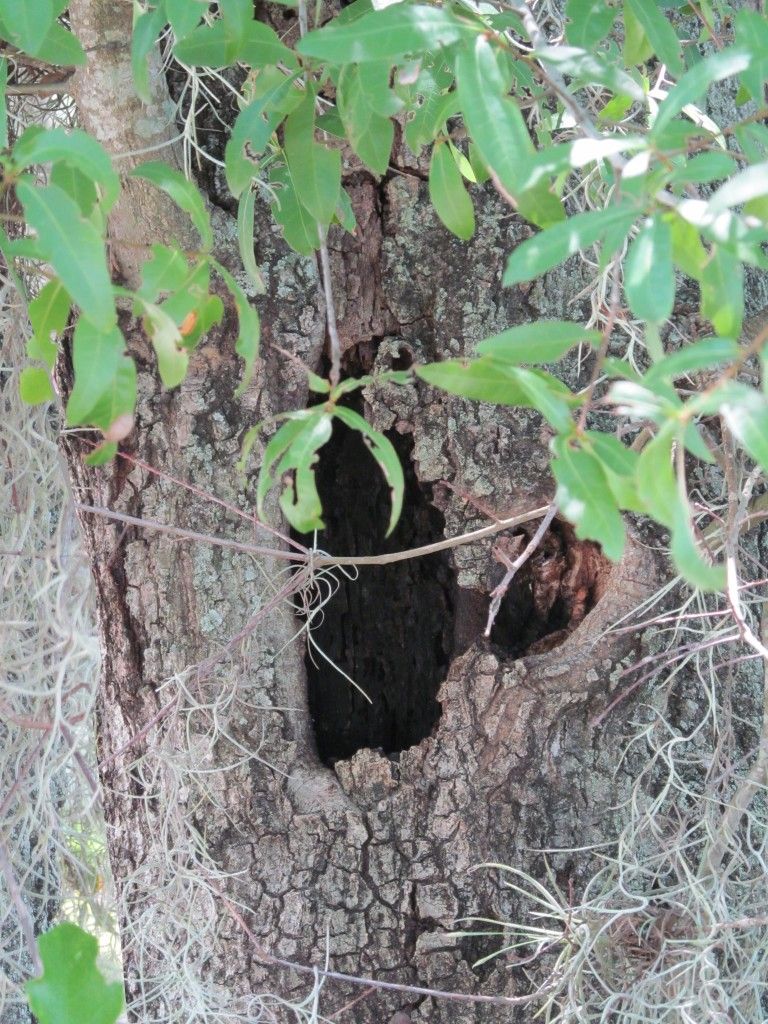
Take this tree. To everyone else it's an old tree with a hollow. To the storyteller it's a palace of surprises and secrets. What's in the hollow? A sleepy owl, a nest of baby birds, the diary a girl hides there because she never wants anyone to read it? If you reach inside the hollow, will you find a squirrel's nut stash, an old bottle containing a mysterious note, or another hand that tugs at yours?


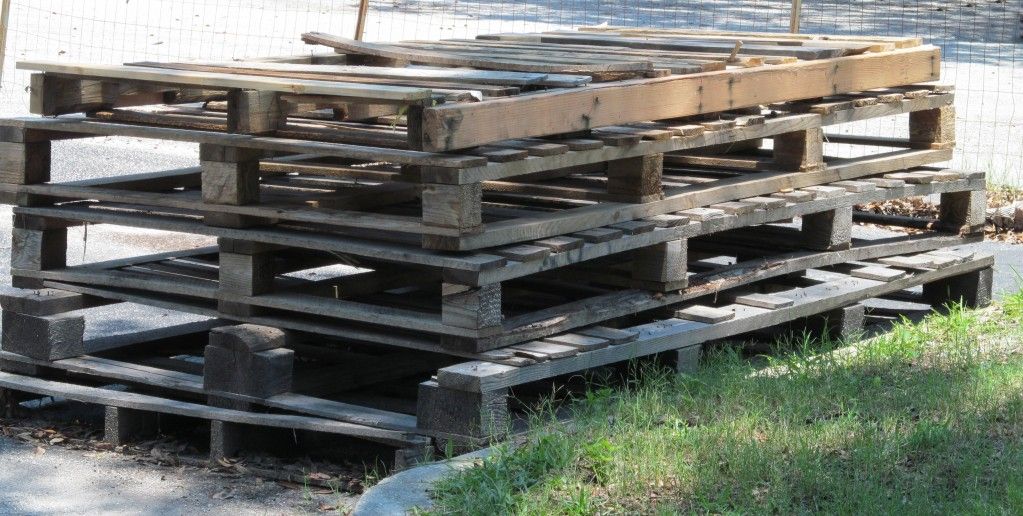
An old stack of beat-up shipping palettes isn't very exciting. Unless you're a mouse, then it's a castle, a labyrinth, a sanctuary. Or for a kid, it's the mountain they can be king of (until someone knocks them off) -- or something much more dangerous. When I saw this I had a memoir moment, because when I was a child I climbed a stack of palettes just like this. At the time I was also barefoot, and stepped on a rusty nail. I was so worried about being scolded that I hid the wound from my mother for a week, until the fever and the red streaks running up my leg betrayed me. If Mom hadn't been as observant as she was, I might have died of blood poisoning -- all from a stack of old boring shipping palettes, just like this one.


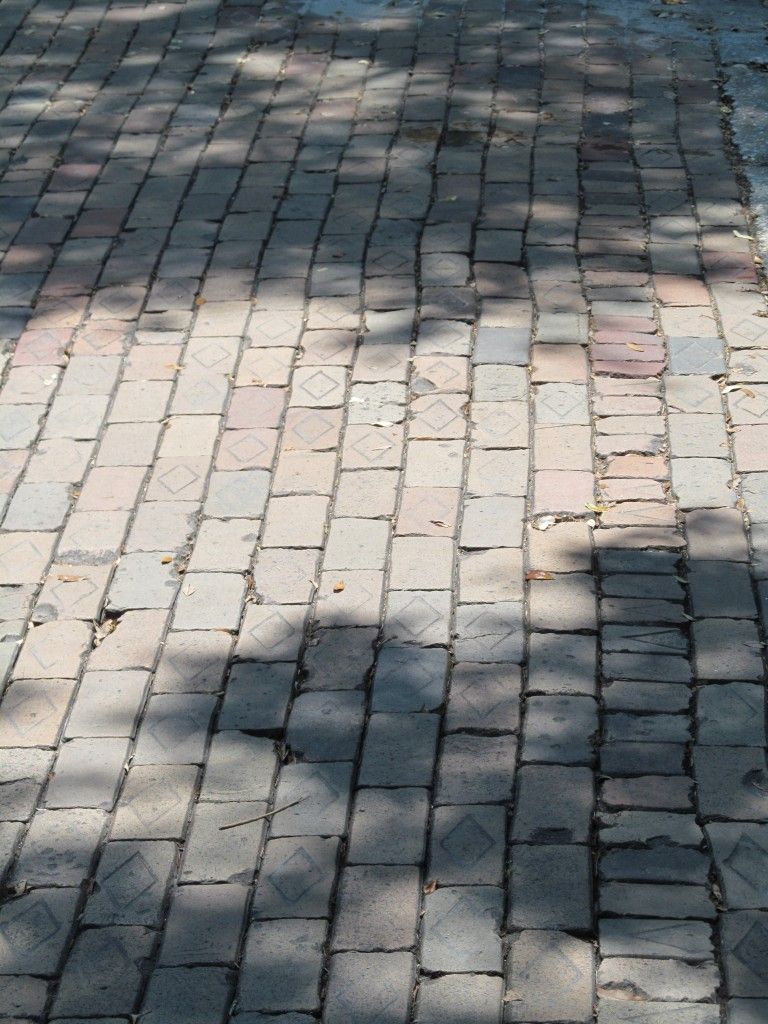
It's not a yellow brick road, but it could be. The diamond shapes want to be counted, encoded, decoded. A game of dodge car and hopskotch, all in one. Perhaps one of the bricks is loose, and when you pry it up there will be something hidden under it, or written on the underside. When the street pavers come, as they inevitably do, what happens to all the old bricks? Do you nick some from the road construction dumpster, a couple at a time, and take them home to build something?

Story inspiration is all around you -- you just have to look at it through your other pair of eyes.

Friday, June 29, 2012

Not So Blank Books

I'm on a new quest. Yes, another one. As most of you know I've been keeping handwritten journals since 1973, and I go through a lot of them. Lately I've been making my own or buying them from journal artists over on Etsy, so it's been a while since I've checked out the mass produced variety at the book stores.

While I was shopping at BAM last weekend I raided the discount bins for books and discovered a pair of journals that were a bit different than the usual ruled-page blank books. This intrigued me, so during my next visit to the big B&N in the city I checked out their journal section, and found a couple more that were quite different.

I learned from my experience working with teens on Keri Smith's Wreck This Journal that a journal that comes with ideas and instructions and prompts can be more inviting to novice writers than a journal filled with empty white pages (which, let's face it, can be intimidating.) Quotes and prompts and artwork also provide focal points for the journaler to respond to versus inventing something on their own. There is no better way to get someone into the journaling habit than providing them with a guided experience. Once they build confidence, I think they'll be more prepared to take the leap onto the dreaded empty page. Thus I thought it might be fun to hunt for different types of blank books the summer and report on what I find.


At BAM I found "The Sayings of Mark Twain" journal, published by Piccadilly, with quotations from Mr. Clemens printed on each page. The book is hardcover/spiral bound, and the pages are a nice weight, college-ruled and tinted a very light blue in keeping with the journal's color scheme. There were also other journals of the same design in different colors offering the sayings of Rumi, Buddha, and Jesus. I got my Twain for $7.97 discounted.


In the same bin at BAM I found "Map Your Destination", a blank book published by Retired Hipster Inc. This one is a hardcover, with color-themed bordered pages that were both ruled and blank in clusters of eight (which would make it a cool travel journal.) Nicely discounted at $5.00.


Over at B&N I noticed Parragon Books' "My Life Journal" that had decorated pages and writing prompts on at least every other page. Hardcover with really attractive pages, some filled with artwork, quotations, objects and other visual prompts that reminded me of scrapbook art. This would be an excellent journal for someone who wants to try art journaling but isn't ready to make their own pages. $6.28 with my membership card discount.


My favorite find from B&N was Sabrina Ward Harrison's The True and The Questions ~ a Journal. This is the first hybrid blank book/art book I've ever seen; it's made up partly of the author's own finished and half-finished journal pages, and pages for the reader to compose, complete or alter at will. It's an oversized trade paperback but the pages are like lightweight cardstock so it's likely very durable. If you ever wanted to collaborate on a journal with another writer or artist, this is the blank book for you. $15.25 with my membership card discount.

Have you ever used a not-so-blank book as a journal? Any type you can recommend? Let us know in comments.

Thursday, June 28, 2012

Short Story Sins

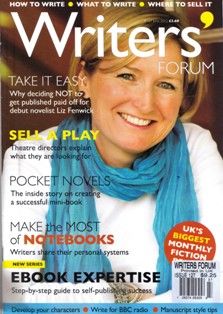
I'm currently reading the June '12 issue of Writers' Forum, a UK trade mag for writers that I found while rifling through the racks at my local BAM. Why it was there I can't say, except that this one BAM carries a nice selection of international mags as well as the usual domestic suspects.
The majority of the articles are geared toward working writers, which I liked, and while there were a few of those "Make Millions Self-Pubbing" ads the content was very refreshing -- like The Writer used to be before they went the way of Writer's Digest. There was even an article spread on using notebooks -- the write-in kind -- in different ways to aid with the work. Made me tear up a bit, to be honest.

Writers' Forum also holds a monthly fiction contest with three prizes that sounds interesting. There's a small entry fee involved (discounted 50% for subscribers) but since the magazine awards three prizes (£300, £150, and £100 respectively) each month, it might be worth it to subscribe if you're a short story writer or actively pursuing the UK markets.

In this issue the judge of the mag's monthly writing contest wrote an article on why she chose the entries that won, and in a box provided a checklist of what the mag is looking for as far as winning stories: "Originality ~ Good storytelling ~ Pace, momentum, immediacy ~ Attention-grabbing openings ~ Satisfying endings ~ Action ~ Convincing characters with their own voices ~ viewpoint control."

The judge's checklist made me ponder what I think kills a short story, which led to me putting together my own list ala the seven deadly sins:

Convention Skirt-Flouncing: How do I describe thee? Let me count a few ways: the writer refuses to use quotation marks; surreal elements that have nothing to do with the story pop up randomly, like great big honking pink elephants; there's a chick with green hair who isn't a blonde who just got out of an over-chlorinated pool -- you get the general idea. Yes, to some it's artistic, it's tres chic, whatever; it doesn't work for me. Most of it comes off less like style and more like posturing. If you're more worried about what people think of you than the story, this might be a problem.

Dull Characters: There's hardly any time for me to get to know the story's population, so in some way/shape/form they'd better knock my socks off from page 1. Too often they simply don't. To figure out if your characters are absorbing, give someone half the story and see if they come after you demanding the rest of it right now or they'll hurt you.

Improper Length: Any story over 15K words always feels to me like it's trying to be a novel, it wasn't enough to make into a novel, or it wasn't edited properly (sometimes all three.) On the flip side, unless they're perfectly structured very short stories (usually under 2K) feel unfinished. A litmus test for this is if your reader feels bored halfway through (too long), or pissed after reading the last paragraph (too short.)

Sketches Instead of Stories: About half of the short stories I read disappoint me because they're glorified character/event/setting outlines or narratives instead of real stories. The big tell for this is when you take a hard look at the action -- if you reach the end of the story and realize nothing has actually happened, you may be sketching instead of storytelling.

Tellers: the writer is so proud of the neat things that they've invented that there is no story, there's just the writer nattering on about all the stuff they think is cool. The red flag for this one is how many pages you've filled with narrative. More than 60%? Possibly a teller.

Unsympathetic Buttons: The writer wants my sympathy for an unsympathetic situation. Example: it's so horrible to be rich, privileged, summer in the Hamptons, winter in Aspen and have Daddy write a check to pay for college, yes? Maybe it is, but from my perspective and life experience, no, I don't think so. I don't want to tell anyone they are obligated to write about the downtrodden; I'm willing to believe wealthy people suffer just like the rest of us. There should be more to that suffering, however, than a pitch of woe-is-me-I'm-too-entitled.

What is the Point?: I just finished two pretty terrible anthologies (neither were written by anyone who stops in here, so relax.) Both left me feeling as if I'd squandered two decent reading days and about thirty bucks of my hard-earned $$$ for nothing. They didn't enlighten me, they didn't amuse me, they didn't teach me and they didn't even attempt to entertain me. Mostly they made me feel tired (although one tried to sneer at me, the lip-curls weren't very convincing.) If that was the point, it worked, but it's not going to sell me any more books. Unless my insomnia flares up again.

So what are some of the sins you encounter in the short stories you read? Let us know in comments.

Wednesday, June 27, 2012

Soggy But Back


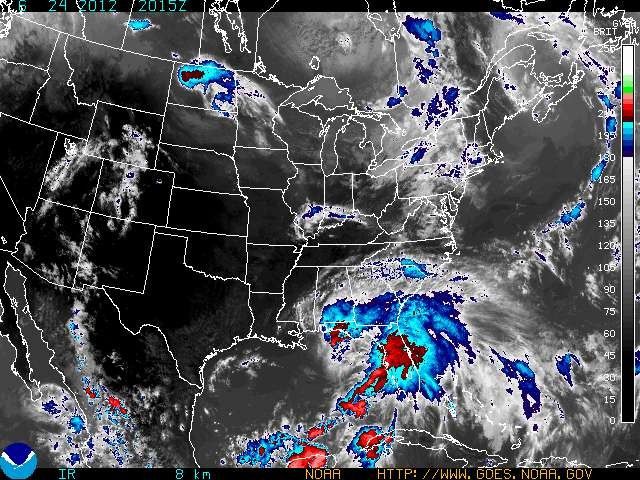
Tropical Storm Debby is still slogging her way over to the Atlantic, but we made it through okay. Lots of wind, lots of rain, but not much more than a bit of thankfully temporary flooding, and some minor tree debris scattered on the roads. The big loss was my keyboard, which weirdly decided to fry itself when I powered everything back up, but it was about time for me to get a new keyboard anyway. I hope everyone else in the storm's path made it through all right.

I've got a couple of sub ops and a self-promo op to pass along today; I got a heads-up from Rob over at from Circalit for two new writing contests they're holding, and I'll quote him here:

Launch Your Sci-fi Story into the Cosmos

"Cosmos, founded in 2004, is a literary science magazine that reaches 40,000 readers every month around the globe, and covers everything from science fact to science fiction. Cosmos are now on the lookout for innovative science fiction short stories that that make you think about the future in a different way. The winning short story will be printed in the next issue of Cosmos Magazine, and the two runners-up will see their work published on Cosmos Online." Entry is free, and you can read more info about the contest here.

Eclectica Flash Fiction Competition

"Eclectica, founded in 1996, is one of the longest running online literary publications, publishing a wide range of fiction from all different genres. Now Eclectica have teamed up with Circalit to host a flash fiction competition. Simply write a story on any theme in under 800 words and get your flash fiction published in the October/November issue of this notable ezine." Entry for this one is also free, and you can read more info about the contest here.

I also received an e-mail from the Australian Romance Readers Association about a self-promo op for authors interested in sending goodies or books for their convention in Brisbane, to be held March 1-3 next year:

"All authors are welcome to send (or bring) promotional items for display on goodie tables at ARRC2013. These items will be available to all delegates throughout the convention. Items might include bookmarks, bookplates, pens, badges, or any other promotional items. If you would like to send books, we will use these for door prizes and prize packs for games."

Our pals over in Australia are terrific folks who read a LOT of books and are very supportive of the genre, so this is a great chance for romance and romance-friendly authors to reach out to a wider audience with your promo. If you can't spring for the cost to ship actual books (which admittedly can be expensive) you might consider putting up a free story online and send bookmarks with the link. If you'd like the ship-to address and/or contact info, they can be found over at ARRA's website here.

Monday, June 25, 2012

Off to Hunker Down


Debby is shaping up to be our first tropical storm of the 2012 season, so we're shutting down all the computers and devices and otherwise getting things ready here. We don't expect much more than some flooding and power outtages, but our region will likely remain under a tornado watch until it passes. I'll check in when I can. NOAA's latest advisory on Tropical Storm Debby can be found here.

Image Credit: NOAA/National Hurricane Center

Sunday, June 24, 2012

Summer SF Contest

Here's an interesting op for those of you who want to write SF but are having trouble finding receptive markets: Redstone Science Fiction is holding their 3rd Annual Fiction Summer Contest with a hopeful future via scientific advancement theme: "Read Sarah Einstein’s column in June 2012, RSF #25 to learn what we are looking for – “show (us) a hopeful future made better by scientific advancement.” Length: up to 5K (firm); the winning author "will be paid 5 cents per word" and their winning story "will be published in the September 2012 issue of Redstone Science Fiction." Electronic submission only, see contest page for more details, deadline August 15th, 2012.

Saturday, June 23, 2012

More on Smart Edit

Last week I mentioned the freeware program Smart Edit as a potential helper for writers who want to improve their editing skills. Since I can always use that, I decided to give it a personal test drive and downloaded it with no problems.

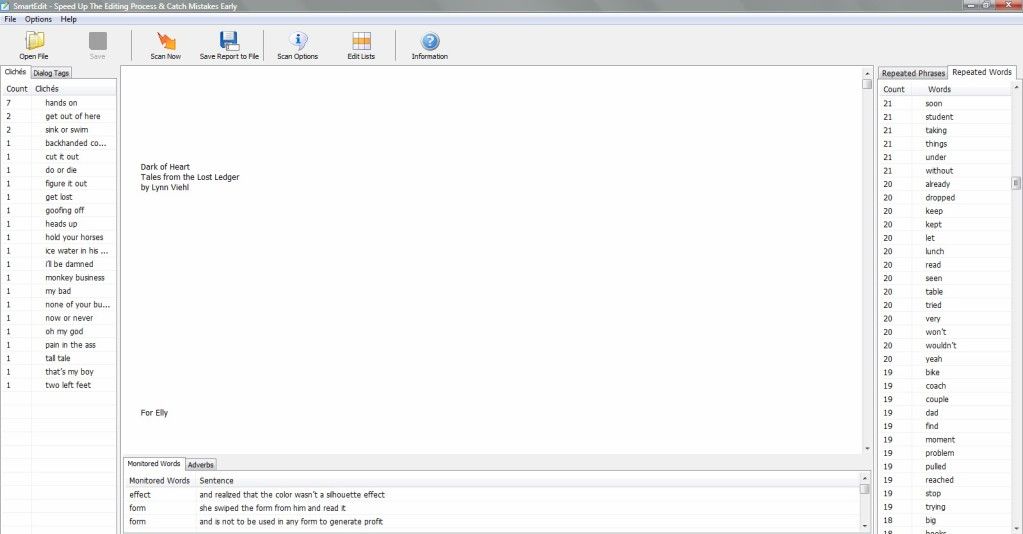
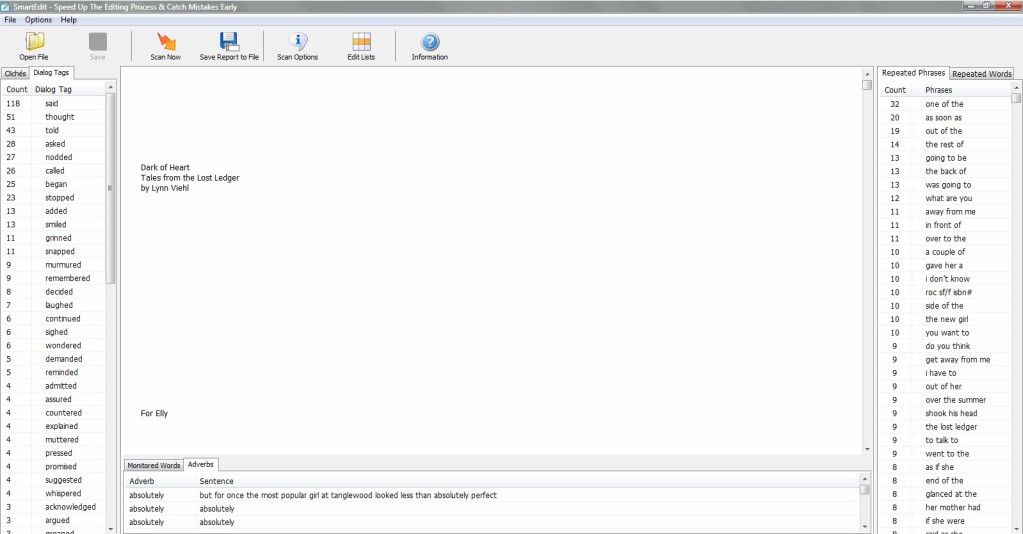
Rather than test it on a manuscript I've worked on with a professional editor (which tend to be pretty clean) I thought a better test run would be to use it to scan one of my freebie e-books, which are edited solely by me. I first converted the .docx file for Dark of Heart to text format -- the program accepts .rtf and text files -- and opened it in the program (the manuscript text appears in the center window on the program screen.) I then hit the Scan Now Icon and let it run.


The program finished scanning the novella in about thirty seconds, and gave me several windows of information with different tabs: Cliches and Dialogue Tags in the left window, Repeated Phrases and Repeated Words in the right window, and Monitored Words and Adverbs in the bottom window (to see another, larger screen shot of my file in the program, click here.) Double click on any of the words in any of the lists and the program takes you to the first time you've used it (at which point you can delete the offending phrase and move on to the next instance of use. You do have to delete or change the phrase before you can double-click to move on to the next one.) I also discovered I could save the scan report, open it in Word and print out a copy, which was really handy as the tabbed windows with the info are small and take awhile to scroll.

The scan report came back with 20 different cliches and the number of times I used them in the novella. Apparently I'm very fond of "hands on" as I used that seven times, and "get out of here" showed up twice. The remaining eighteen phrases were only used once, and I know most of them were used in dialogue lines, so I think I did fairly well there (but if I'd had this program while I was editing the novella, I definitely would have weeded out some of those "hands on".)

I thought I also fared well on dialogue tags; I used "said" 118 times, "thought" 51 times, "told" 43 times, "asked" 28 times and "called" 26 times; all of which I think are perfectly acceptable tags (I don't belong to the school of You Must Only Use Said.) What I didn't like seeing were the 27 times I used "nodded", the 13 times I used "added" and the 11 times I used "grinned"; those are not words I like to use as frequent dialogue tags and I would have yanked them out (and I am going to look over the ms. for exactly where I used "nodded" because I don't think I used it specifically as a dialogue tag; it was probably a physical action phrase to replace one, which I'm prone to do when I get tired of said.)

I did so-so on repeated phrases; my biggest offenders were "one of the" (32 times) and "as soon as" (20 times). My single words with the most repeats surprised me; other than the main character's names (which I think should be at the top of the list) I used the word "down" 122 times, "like" 121 times, "didn't" 116 times, "before" 112 times and "could" 103 times. Two of my ongoing problematic weed words, "eyes" and "door" both came in at 37 repeats which was less than I expected but more than I liked seeing.

The one list that didn't bother me much were the adverbs I used; I didn't have that many in the novella and I'm not allergic to any of the others I used. I know there are writers who spit on adverbs and won't let a single one sully their prose; I never got that memo so I think they can be used sparingly. One thing I did want to mention is that the adverb list never printed out on the scan report, so that may be a minor bug in the program.

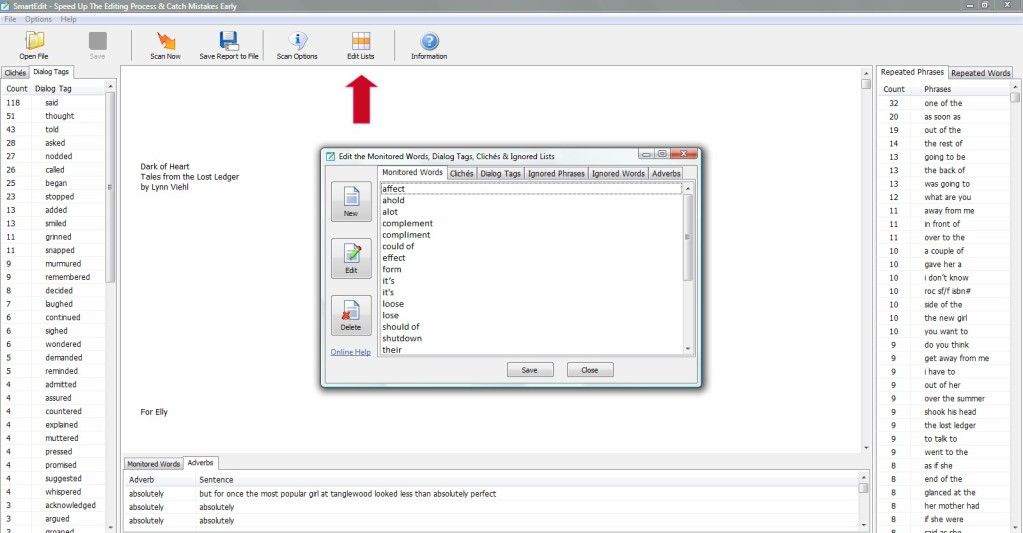
You can edit the words and phrases lists that the program uses for scans; you click on "Edit Lists" and when the smaller options screen appears you pick the tab for the list you want to edit to remove or add anything you want to that portion of the scan (which you can see in this screenshot.) You can also customize your scans as to what you specifically want to search for by checking or unchecking the boxes in the Scan Options window (which you can see in this screenshot.)

Smart Edit won't ever replace a real live editor, and it won't take the job of editing completely off your hands. But I do think it can be helpful for analysis purposes, not only for finding problem words and phrases you may have missed but also by identifying the ones that we as writers are prone to regularly overuse or misuse.

Friday, June 22, 2012

Wandering for the Well

After two months of working sixteen hour days to finish up the Lords of the Darkyn trilogy, outline some new proposals, deal with family dropping in, the computer crashing, the nesting dove dive-bombing anyone who came near the front door and various and sundry other domestic crises, I needed a day off. Mostly I needed to shut off the computer, turn off the phones and leave the house so I could reset my head, recharge my batteries and restock the well.
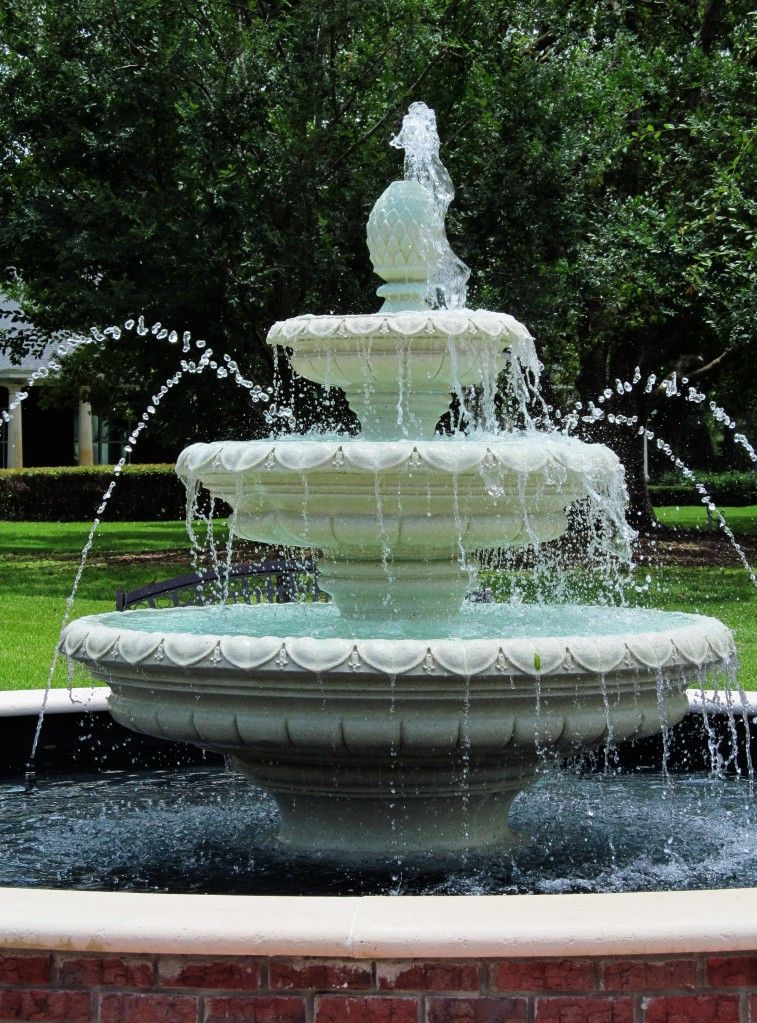
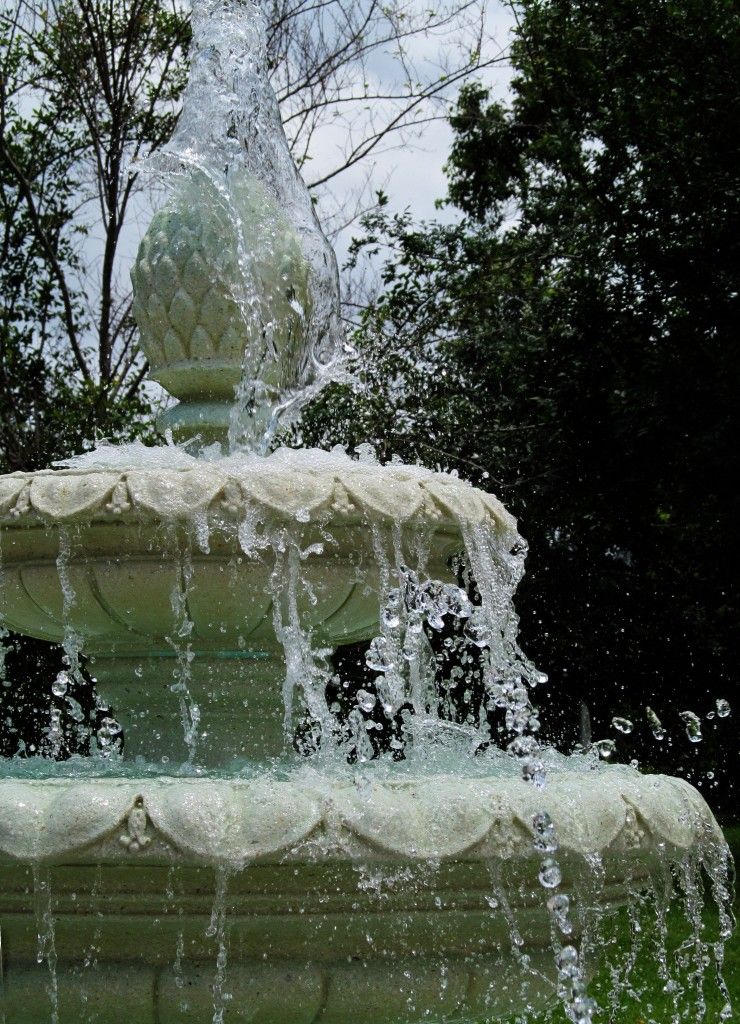
You know that term writers always use for random inspiration: everything is grist for the mill? That one has never worked for me because as demanding as writing can be, the inspiration for it has never been grinding or crushing. It flows, like water from the world to a fountain within. My creativity also feeds itself, in the same way a fountain works. I get a rush of ideas, I pour them out, they pool and percolate and recirculate and then pour out into another rush of new ideas. As a storyteller I'm never finished, not really. One thing always leads to another, and even when I'm ending one thing there's already something else in the works or brewing or that I'm prepared to begin. I don't question or mess with this because it's my natural process and frankly I don't want to jinx it.

My well has never run dry, but it does work overtime and every now and then it needs repriming. I get bored and I need something fresh to add to the waters. Going out into the world and searching for it is fun and keeps me from becoming stagnant. I also have a proposal that I need to finalize and get to the agent, one that I wanted to let percolate. So when I decided to take my day off, I grabbed my kid and we spent a day out together shopping and hanging out and generally wandering around doing nothing in particular.

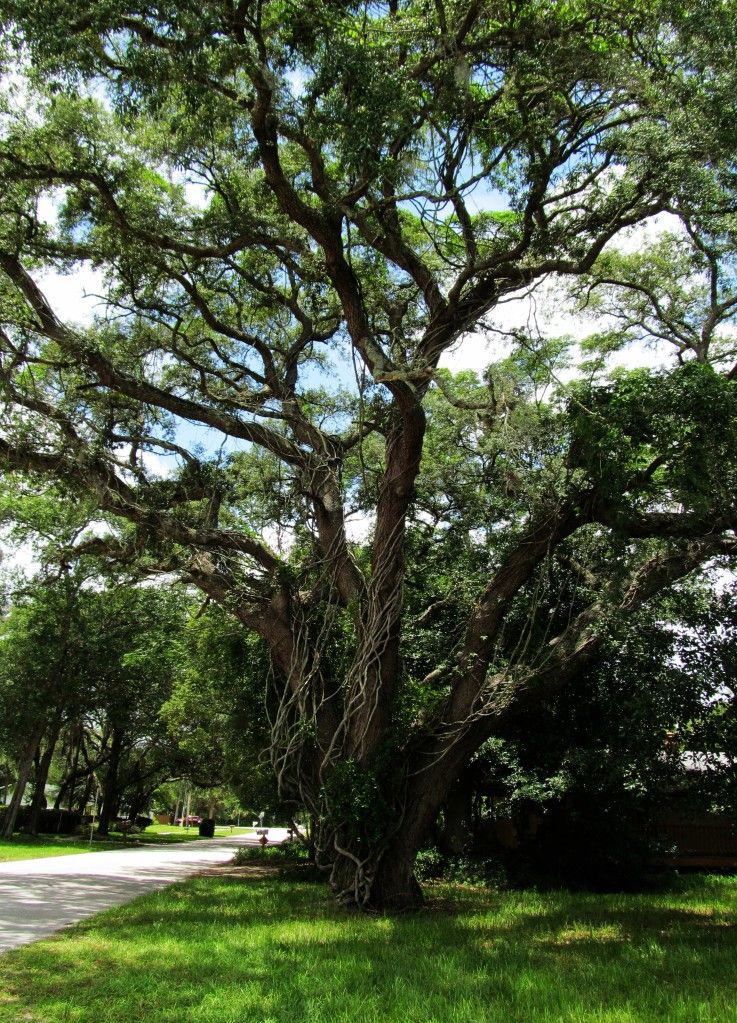
When you open yourself up to the universe of possibility around you, wherever you are, you'll find inspiration. Mine came in the form of a little out of the way park where we spotted this interesting tree. It was huge, old, and appeared to be engaged in a battle with some sort of vine. I'm not an expert, but I think the vine already lost, because when we walked up to it the vine appeared dead, and the tree looked pretty smug.
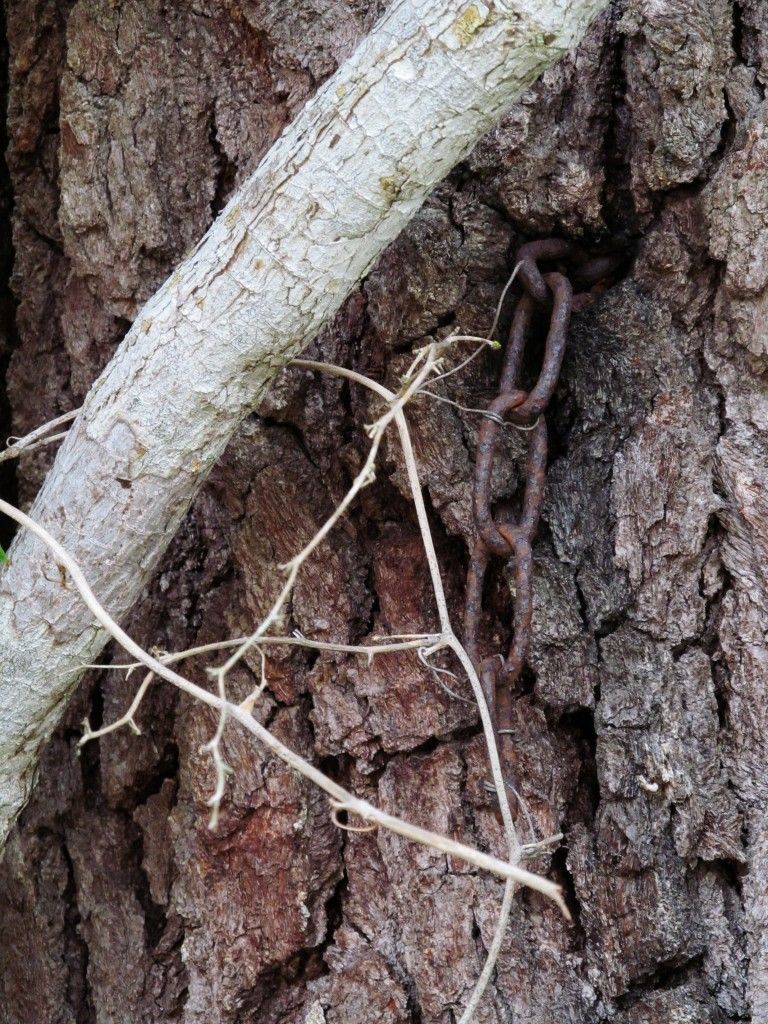
While I was taking photographs from different angles, my daughter noticed something, and called me over. There was a short length of rusty chain embedded in the trunk of the tree. The chain was on the road side of the tree, and there were no other trees nearby, so it couldn't have been from a hammock. I didn't think anyone heartless enough to chain some poor pup to the tree would do so within a few feet of a road, either. The chain was an interesting mystery, especially because it looked like there might be more of it inside the tree -- and as I thought that, I thought of the proposal idea, and how I could use the ideas from the tree to cement one side of the story.
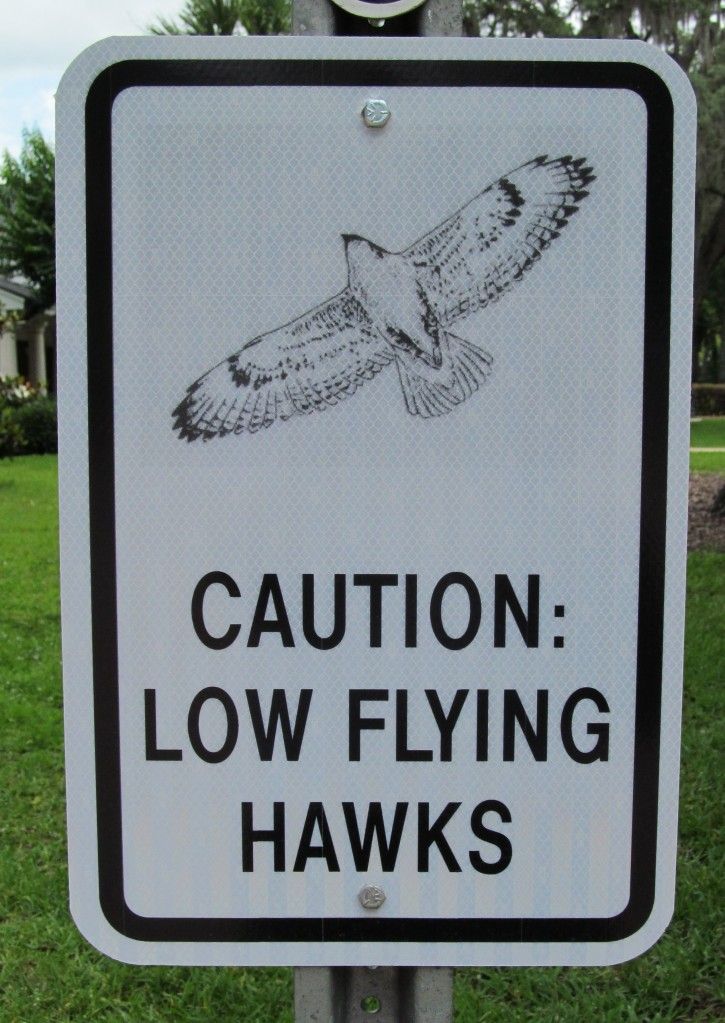
From there we walked through the park, where we came across several signs warning us of low-flying hawks. I've never seen a warning sign for birds, so this tickled me. I want one for my dove now. And sure enough, as we made our way along the walk we saw a beautiful hawk soar over our heads, and paused to listen to its piercing call. Why were the hawk and his pals hanging out in this pristine, pretty little park? What if it had something to do with that old warrior tree? And in my head, another side of the story idea went from slightly muddled to almost painfully clear.

A few minutes later we came upon a sudden burst of bleeding heart vines, all tangled up with the otherwise politely manicured landscaping:


The splash of color and the chaos of blooms brought me to a standstill. Unless he was lousy at his job, the groundskeeper couldn't have planted them like that, not with everything else so perfectly arranged and trimmed. Seeing this beautiful, delicate thing growing wild twined itself around the third and final side of the story triad I'd been unhappy with, and the proposal crystallized. If I'd had a computer with me, I could have written it right there and e-mailed it off to New York.

The rush of all these new ideas tempted me to tackle one final problem I'd been having with the proposal, namely the series title. I've been tinkering endless with that, and I came up with one that was almost, but not quite, fitting. It's a single word, I coined it myself, and it names the universe, the storyline, the setting, the characters, the whole shebang -- almost.

Even as great as my day had been going, I wasn't getting my hopes up. I'd spent almost a month hammering away at that title, and I'd been so close to nailing it that I could practically feel the right version of it hovering in the back of my head. I felt like I was pushing it, too -- I'd gotten plenty for the well and my story from the tree and the hawk and the flower, but to expect the universe to hand me the perfect series title during my day off? That was never going to happen. Never. Never.

And then, just like that, I had the title.

Tomorrow I'm going to clean my house, catch up on laundry, spend time with my family, and not rush to the keyboard to type up everything in my head. It's tempting, believe me, but it's also foolish to rush the rush. The well is definitely refreshed, and ready to pour itself out on the page, but all the new ideas need time to cascade and pool and percolate and cycle through a few times. I do, too. I want to spend a few days resting and relaxing and wondering a bit more. The well isn't going anywhere, and neither am I.

Wednesday, June 20, 2012

Much Better Now

I'm (finally!) back online and now dealing with all the work stuff and e-mails that piled up while I was tinkering.

While I'm catching up, here is an artful video about a bookmark with a secret life. It has background music, amazing animation and the best ending ever:

Much Better Now from Salon Alpin on Vimeo.

Monday, June 18, 2012

Off to Tinker


I have to replace the hard drive on my internet computer today, so I'll be unplugged until I download all the updates and transfer my backups (have you backed up lately? If not, go, do it now.) I should be back up and running by tonight, and I apologize for any inconvenience this causes.

Sunday, June 17, 2012

A Request

I've been trying all day to think of humorous spin I could put on the story of this dude who deliberately shot himself to promote his book, but it disturbs me on so many levels that I can't think about it without feeling sick. There is nothing wrong with self-publishing, or self-promoting, or taking a shot at any dream you have. Everyone has the right to pursue their dreams. Taking a shot at yourself because you think it's a nifty shortcut to fame/fortune/success, however, is not the way to get there.

Writing is a solitary art, and I've always been grateful to the internet for making it less lonely. When I was chasing my dreams I didn't have other writer people to hang with, so for me it's always been a privilege to be here. I practically witnessed the birth of the online writing community, from the first day I logged on to Prodigy and started reading the message boards back in '94. At the time I was too shy and scared to talk to anyone, but it still seemed like a miracle, to be able to read other writers' stuff and follow discussions and know that it wasn't just me doing this.

When digital self-publishing became available for free to anyone, I knew it would change the industry. I even made some predictions about it. I also saw this evolution/revolution dividing the writing community into separate camps, exactly as e-book publishing did when it joined the market twelve years ago, and that happened, too. Sometimes I get so disgusted with the name-callers and the snobbery and this "every writer for themselves" attitude that I start thinking everyone in the industry is like that, and I know they're not. You all have taught me that.

Reading the story about the guy who shot himself for self-promotion confused me. I thought to do something like that he must have no friends at all. Or if he does, he doesn't talk to them anymore. Or he got so caught up in this crazy idea that he cut himself off from everyone. I don't know. I'm a pretty solitary, independent soul, but even I can't wrap my head around it.

Anyway, because of this story I come to you today with a favor to ask. It's not a big one, and it will only cost you a few minutes of your time. When you have a chance, get in touch with someone else in the writing or reader community. It doesn't matter who it is; pick someone you know at random if you like. Send them an e-mail, drop a comment on their blog, Twitter them, Facebook them, whatever is convenient for you. And when you do this, try to share something positive. Tell them a joke. Recommend a great book you've just read. If you can't think of anything, ask how things are going with them. Basically, be their online friend.

For all the changes we're going through, we're not alone in this. We are a community, and we do care about each other, and sometimes I think we need to be reminded of that.

Saturday, June 16, 2012

No-Nos for the Nasty

Ten Excuses for Your Paranormal Heroine Not to Have Sex with Your Paranormal Hero

A hell-gate will open and release a demon army to ravage the earth, starting with the two dummies snoring in the bed just in front of the hell-gate.

Any child born of such a union is guaranteed to become the Anti-Christ. P.S., Ms. Absent-Minded keeps forgetting to take the pill she was prescribed to regulate her monthlies.

As sworn enemies, their people are consumed by eons of pent-up frustrations and hostilities, but prevented from battling by an iron-clad truce that can be broken only if one side is caught physically fraternizing with the other.

Either the hero or the heroine will lose their abilities, which the other will absorb, turn evil and use to destroy the planet.

Her virginity was promised long ago to the Prince of Darkness, who is also her fiance, eats heroes for a mid-morning snack and has set up a closed-circuit monitoring system in her headboard.

He has long been lusted after by an insanely jealous and incredibly powerful stalker, who has been posing as a harmless family friend while bugging his phone, GPS'ing his car, and keeping a silent alarm on that condom tucked in his wallet.

His manly sweat/her delicate sheen will cause the other partner to shift into a mindless, ravenous, slavering beast-demon with razor-sharp talons/teeth/scales, and whose last meal was a quivering, stringy, under size rabbit two months ago.

Mom and Dad be demi-gods who hath sworn to guard their only child's pulchritude by any means necessary, and smite unto death anyone who messeth with it.

She is unaware that she possesses a glittering but secretly evil hoohah that will suck the soul/life/goodness out of the hero, and then laugh while his lifeless husk withers away.

The obnoxious immortal deity, who needed a little leverage to insure her subjects' chastity, gave permission for a "Will They Do It?" pool, the winner of which will be awarded an indestructible sword of immense power against which there is no defense. P.S., the villain picked tonight.

Friday, June 15, 2012

Network Your Notebook

I'm off again taking care of some work stuff. In the meantime, while hunting around for any online alternatives for the novel notebook, I found this freeware:

Piggydb is "a Web notebook application that provides you with a platform to build your knowledge personally or collaboratively. With Piggydb, you can create highly structural knowledge by connecting knowledge fragments to each other to build a network structure, which is more flexible and expressive than a tree structure. Fragments can also be classified with hierarchical tags. Piggydb does not aim to be an input-and-search database application. It aims to be a platform that encourages you to organize your knowledge continuously to discover new ideas or concepts, and moreover enrich your creativity" (OS: Multi-platform, requires Java Runtime Environment.)

I'm going to test drive it when I have a chance and I'll report back on how it works for me. If you collaborate online with a writing or creative partner, and need to build a novel notebook or series bible, this freeware might be particularly useful.

Thursday, June 14, 2012

Free Quilt Design Online

I rarely see any free online stuff for quilters, so I'm going to hijack today's post for my quilter pals and anyone out there who likes to sew and design.

The August '12 issue of American Patchwork & Quilting has some interesting patterns in it, and while I was figuring out yardage for a neat maze quilt I noticed a little ad on the page for "free online quilt design" with something called Quilter's Toolbox. The advertiser, Thousands of Bolts, also called it "a new way to shop for fabric."

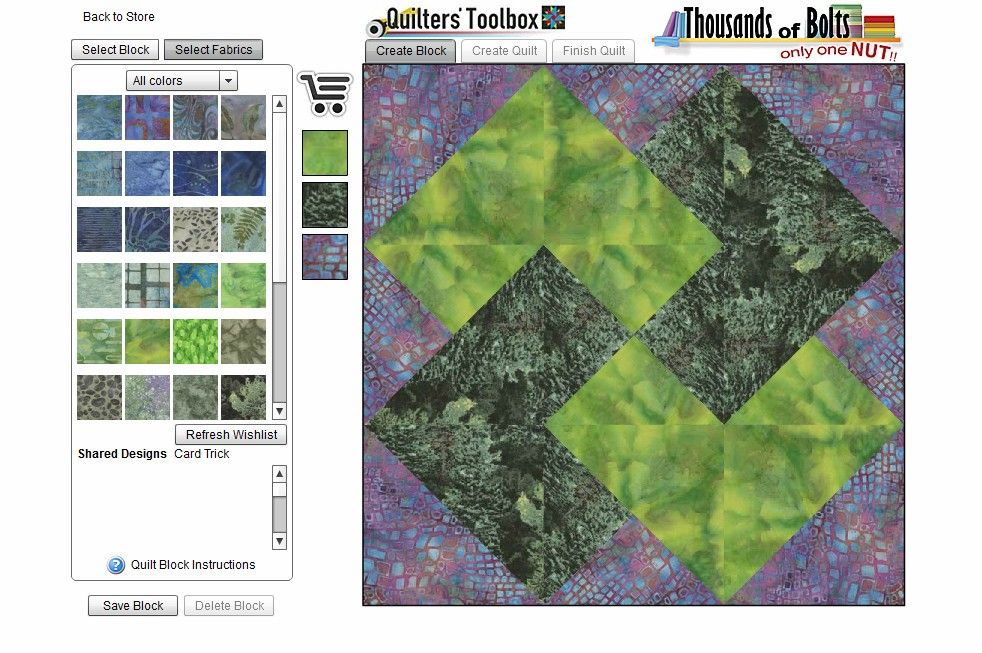
I figured it was some kind of fabric picker thing, but I decided to visit the site and see what the deal was. Turns out they offer an actual block and quilt generator that you use with swatches of fabrics you can buy from the site. Once you register and choose the fabrics you like (it's free, and you just add the fabrics you like to your wishlist) you can begin using the toolbox right away.

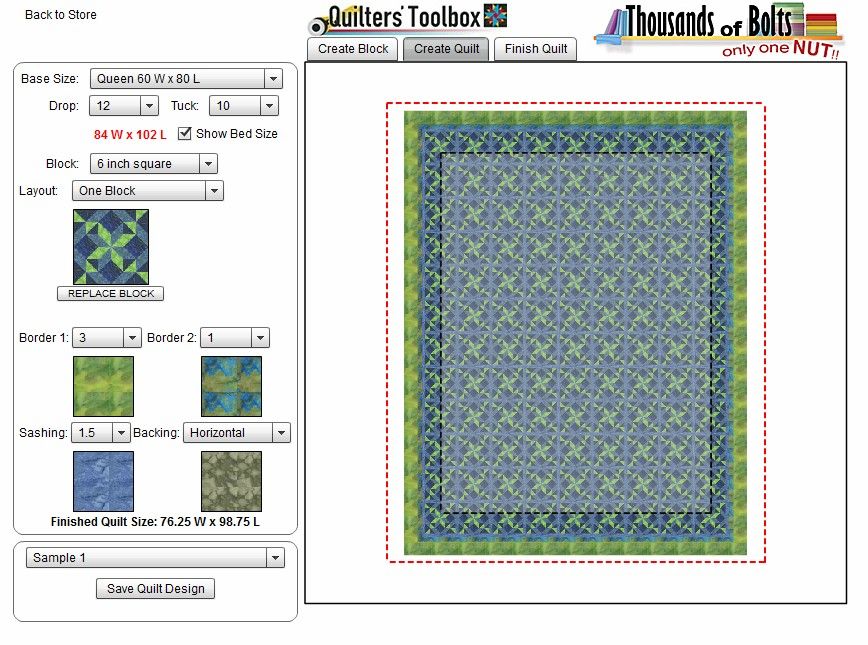
The toolbox, which allows you to drop-and-drag fabric swatches from your wishlist into a variety of patchwork block templates, is extremely cool and very easy to use. In less than a minute after registering I designed this:


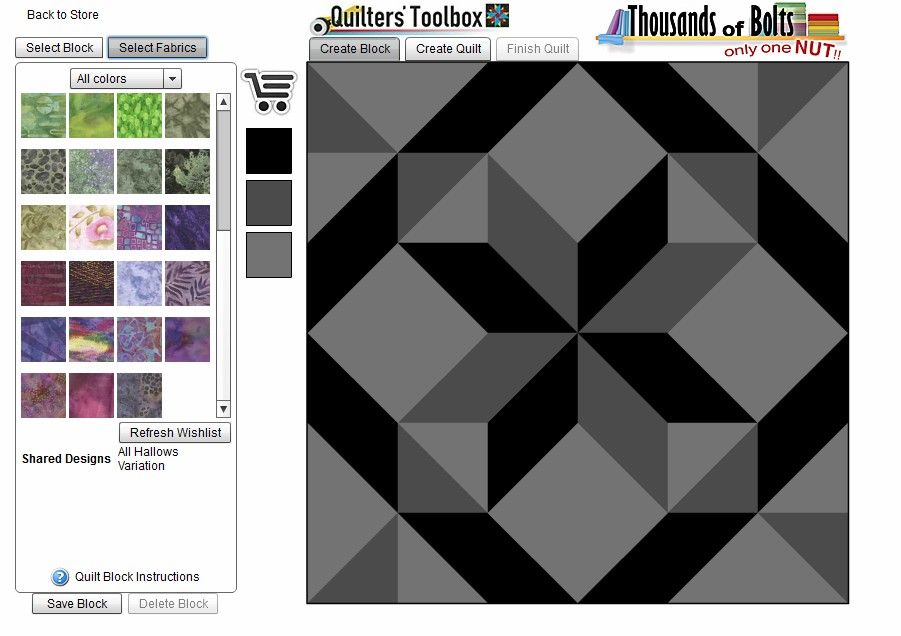
The block design screen looks like this:


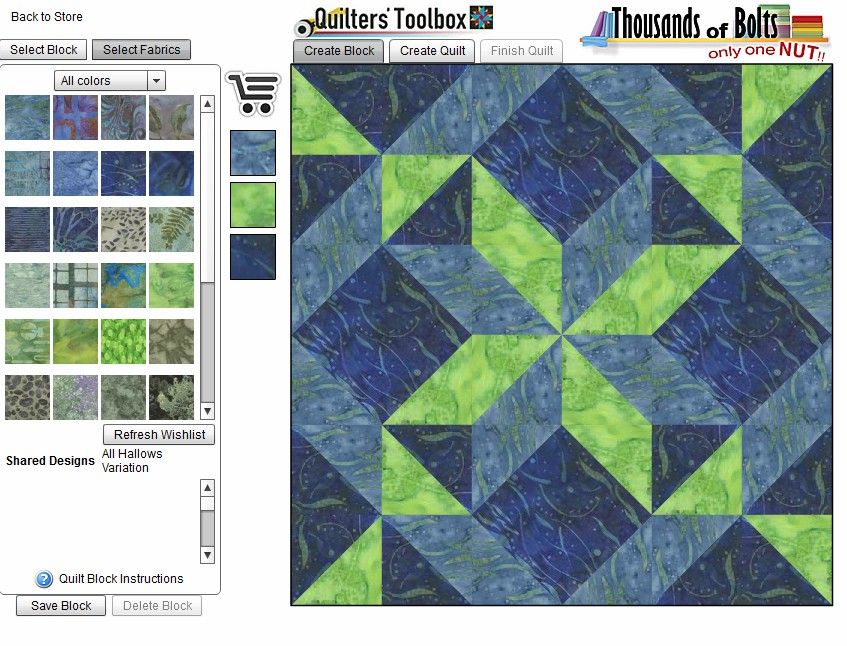
And when you drag and drop your fabric choices, changes to this:


Once you're happy with your quilt block, you can then use it to design a quilt:


You can save your block and quilt designs, keep them private, or share them with the site's community, which makes it an excellent generator for friends or groups who want to collaborate on the piece. This is also so incredibly neat for anyone who has ever wanted to try quilt designing by computer but didn't want to invest in the pricey design software. It's most definitely a new and excellent way to shop for fabric.

To use the toolbox, I recommend you watch the two-part video tutorial first (part one is here and part two is here). Also, if you don't have a pattern for or know how to make the block you're designing, no worries there -- click on the little blue question mark beside "Quilt Block Instructions" at the bottom of your wishlist window and complete instructions on how to make the block will come up on your screen.

Wednesday, June 13, 2012

The Art of Making

I'm taking off today to take care of some business. To make your stop here worthwhile, do check out this video by Dimitris Ladopoulos, who creates short but gorgeous films about people who make things by hand. This one features the crafting of a flamenca guitar (with the same music playing in the background):

Tuesday, June 12, 2012

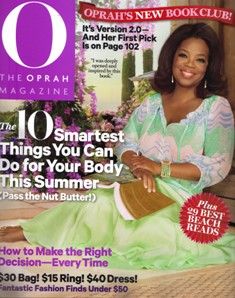
O Boy

About three months ago I started receiving O, Oprah Winfrey's print magazine, in the mail. I have no idea why, either. I didn't subscribe to it, and everyone who might have purchased a gift subscription for me swears they didn't (any of you want to confess? E-mail me, it's driving me crazy.)
The magazine is very nice, as big and glossy as the lady herself, with lots of pictures. Unfortunately I'm not too interested in fashion, make-up, changing my throw pillows monthly, or the wisdom imparted by Dr. Phil or Dr. Oz or Finance Suze. Celebrity experts make me too nervous; I'd rather stick to the garden variety who aren't worried about their next close-up. I've also never watched Oprah (even back in the eighties when I did watch some television, I skipped it) so all of the show references are likewise lost on me.

I wanted to get something out of this magazine, so I've checked out the recipes in each issue. While they're very photogenic and apparently quite nutritious, my family would not willingly consume any of them. Some of them I don't think my crew would touch even if you held them at gunpoint. Imagine my guy coming home after a long, hot day working in noisy equipment rooms to the delights of grilled peaches with yogurt and pistachios, or the perfect summer salad of heirloom lettuces, wild arugula and fennel drizzled in a apple cider vinegar/raw garlic/Dijon mustard-based dressing. I can almost hear him asking me if my menopause has restarted just before he sneaks out for Bob Evans.

On a side note, when did lettuce go heirloom? I thought they only did that to the poor tomatoes. Is no vegetable safe from these people?

Of course then there are the books. Oprah does love books, and there is plenty to be read about what you should be reading. The July '12 issue is jammed packed with recommendations, articles, a bunch of cute young thang authors all dressed up pretty, and the inevitable beach reads (perverse soul that I am, I hardly ever read anything at the beach; I pick up shells, take pictures of the birds and check out the really interesting graffiti.) Oprah has also started a new book club, which seems to be the e-book version of the old club.

I don't buy the books that Oprah recommends, and I think I know why; simply reading the blurbs depresses me. Not that I have anything against books of the horrible-personal-event-that-I-bravely-survived sort, or the horrible-ficitional-event-that-ends-very-badly-for-everyone-involved-but-should-make-you-feel-better-about-your-crap-life-unless-you're-so-depressed-after-reading-the-book-that-you-decide-to-end-it variety. Evidently these alligator tear jerkers are considered moving and inspirational, so if that's your poison, by all means, drink it.

Actually I have read one book that Oprah recommended some years back with Ye Old Book Club, a book she in fact made very famous (not because she did; I had to read it as kind of a professional courtesy. Long story.) When I limped to the finish of that one -- and it was one long-ass nightmare of a slog, let me tell you -- I felt a bit like a deer frozen in the headlights of an unmanned freight train carrying several dozen tanker cars filled with corrosive toxic chemicals about to derail and wipe out a town in Pennsylvania. For only the second time in my life I wanted to shout at everyone I knew to run from a book.

Since the Os started arriving I've been sticking them in the guest room, but honestly, I don't want my guests reading this stuff. I have no heirloom lettuces, no arugula, no pistachios. And I hate yogurt. After Dad died I didn't shoot up heroin or walk my way across the Pacific Northwest, tempted though I was. My poor opinion of O's content could be envy-born, though. I mean, the tremendous amount of thought and research and craft that must be involved in writing such classic articles as $30 Bag! $15 Ring! $40 Dress! is frankly beyond me and my modest writing superpowers. Yes, I think that's probably it. I'm jealous.

When it comes to gifts I know it's the thought that counts, and I am genuinely touched that someone thought enough of me to send me a subscription to O. If that is the case, it didn't turn out to be a good match, but maybe next time you could check the gift-script box for Archaeology or National Geographic or even Popular Mechanics. Until then, I thank you on behalf of me and all the patients waiting in the lobby at my physical therapist's office, who will be reading my Os from now on.

Monday, June 11, 2012

Hang Me Ten

Ten Things I Made Into a Slideshow
(because no one will believe this without proof)

Sunday, June 10, 2012

A Virtual Free Editor

According to the designer's website, SmartEdit is "an automated tool that scans your finished novel or your work in progress and highlights areas that might need closer attention. It runs five individual checks, such as highlighting words or phrases marked by you for monitoring, counting the different dialog tags you have used, and searching out over-used phrases, words and clichés. It's not a word processor - its sole purpose is to assist you when you edit your work, much like a grammar or spell checker."

At present it's available as freeware for Windows 7, Vista & XP, so any of you with those systems who would like a free editing program might want to give this one a test drive.

Saturday, June 09, 2012

In Demand

Educational book publisher Saddleback has announced that they've partnered with On Demand Books to make their catalog titles available via On Demand's Expresso Book Machine, currently the only digital-to-print service with which customers can push a button and print, bind and trim a paperback book in under four minutes (a .pdf of the press release can be read by clicking here.)

When I read this I had one of those glimpse-of-the-future moments and imagined EBMs or something like them in every book store in the country. If all publishers made their catalogs available to print on demand in this fashion, customers could walk up, pick a title, press a button and have a new copy of any book they want in a couple minutes. It would redefine the brick and mortar store; reducing the number of physical copies they'd have to carry while making every book available (no more waiting a week for the store to get a copy from a distributor or their warehouse.)

I'd like to see the same kind of partnership evolve between On Demand and independent authors who want to sell print copies of their digitally-published works. Having these titles made available via EBMs would relieve the author of having to invest in printing and storing physical copies plus dealing with the ordering/payment/shipping headaches. It would also eliminate the portion of the profits the author currently has to pay online booksellers for selling print copies; the EBM would be a soup-to-nuts solution. We just need more EBMs now.

Friday, June 08, 2012

Winner

Making journals is one of my favorite arts, so I really enjoyed reading all the suggestions you guys offered for the Art of Journaling giveaway. I hope everyone will get a chance to try out an idea or two in the future, too.

We cranked up the magic hat tonight, and the winner is:

Atropa, who wrote: I once thought of making a journal/photo album for a friend of mine out of CDs.

Atropa, when you have a chance please send your full name and ship-to address to LynnViehl@aol.com so I can get your package out to you. My thanks to everyone for joining in.

Thursday, June 07, 2012

Always There

As many of you have heard, author Ray Bradbury passed away yesterday at the age of 91. His novels have been beloved by millions of readers all over the world; as a writer and creative soul he has had an enduring influence on me and countless other storytellers.

This is something he wrote about death:

Everyone must leave something behind when he dies, my grandfather said. A child or a book or a painting or a house or a wall built or a pair of shoes made. Or a garden planted. Something your hand touched some way so your soul has somewhere to go when you die, and when people look at that tree or that flower you planted, you're there.

It doesn't matter what you do, he said, so long as you change something from the way it was before you touched it into something that's like you after you take your hands away. The difference between the man who just cuts lawns and a real gardener is in the touching, he said. The lawn-cutter might just as well not have been there at all; the gardener will be there a lifetime.


I haven't the slightest doubt that Ray Bradbury's work will continue to thrill readers and inspire other writers for many more generations. And Mr. Ray? Thank you for changing me. God speed and safe journey.

Wednesday, June 06, 2012

The Art of Journaling

Lynne Perrella's Artists' Journals & Sketchbooks was an online impulse buy I made mainly because it's published by Quarry Books. I'm building a nice little collection of Quarry's art titles, and not one of them have yet to disappoint me.

The book arrived today, and after looking through it I was quite impressed. Being a writer and an artist often means I have to choose between the two; Ms. Perrella's book speaks to both sides of my creativity by adressing not only design but content.

The book contains works by over forty different artists as visual and inspirational examples, covering a wide variety of styles, materials and approaches. Every time I turned a page I was surprised by how beautifully visual the ideas were, without having that over-done, overly-complicated look to them. Most of the examples included found objects and recycled items such as cigar boxes, antique photo slides and aspirin tins. One artist even made a journal skirt that could be worn as clothing.

Some years back, when I first began making my own journals, I was very intimidated by the concept. I did take a class in book-making and binding, but I still struggled with certain aspects of it, especially art and design. I wish I'd had this book to start out with, because it doesn't have all those endless rules and weird material lists and complicated techniques. There really aren't any rules in this book. And while there are plenty of ideas for the advanced journal and sketchbook artists, I think Lynne Perrella has something here for anyone who wants to try art journaling. If you've ever been afraid it's too difficult, or you don't believe you have the artistic talent to pull it off, I think you're going to find something in this book that speaks to you and convinces you to give a real try.

As always, you don't have to take my word for it. In comments to this post, name any object you think could be made into an interesting journal or sketchbook by midnight EST on Thurday, June 7, 2012. I'll choose one name at random from everyone who participates, and send the winner an unsigned copy of Artists' Journals & Sketchbooks by Lynne Perrella along with a surprise. This giveaway is open to everyone on the planet, even if you've won something here at PBW in the past.

Tuesday, June 05, 2012

Neo 2 Neatness

The folks at Renaissance Learning are offering a couple of neat incentives for their new Neo 2 smart keyboard/mobile writing device:

Send them your old Alpha-Smart (any model, age or condition) and they'll give you $25.00 toward the purchase of a Neo 2. Renaissance is planning to recycle and donate the old models you trade in, too.

Buy a Neo 2 before July 1st and they'll send you a nice-looking portfolio to protect it at no charge.

These smart keyboards are terrific; you can store around two hundred manuscript pages in their memory. They're also incredibly durable and portable, and much cheaper than a laptop. The Neo 2 weighs less than two pounds, and will run for up to seven hundred hours on three AA batteries (you can also buy a model that runs for up to 200 hours on rechargeable batteries.) They're great for writers who want to work without any distractions, and perfect for meetings, conferences or an evening session at your favorite coffee shop.

Monday, June 04, 2012

Uh-oh

I am taking off today to spend time with my mama, who is visiting for a few days, but I thought I'd share this:

The Guardian reports that an autobio/cookbook manuscript, written by Kentucky Fried Chicken founder Colonel Harland Sanders and (allegedly) discovered only recently in KFC's corporate vaults, will be published online and given away via Facebook.

I avoid fried foods and fast foods these days, but I do think it's nice that the company is giving away the book instead of selling it; free books always get a gold star from me. Certainly Colonel Sanders was a self-made man, and can be considered one of the earliest, iconic founders of American fast food, so it might even be an interesting read from those perspectives (I won't know; I'm not on Facebook.)

Thing is, the man's been dead for thirty-two years, and evidently he didn't choose to publish this work while he was alive (or it would be in print, yes?) Based on what I've read quoting his opinion of KFC's food (scroll down to the bottom of this page for an angry tirade about the gravy) I wonder if he really would have wanted his opus to be used by the KFC corporation for any reason.

Yet another reason to destroy before you die anything you don't want published posthumously -- it might end up being part of a Facebook fast food marketing campaign.

Sunday, June 03, 2012

For the Letter-Writing Lovers

In this age of e-mail and texting no one writes letters anymore, and Stephen Elliott and the folks over at The Rumpus are trying to change that by introducing literary authors to readers via their Letters in the Mail project.

The Rumpus has also begun connecting their readers by offering them a chance to write to each other. Even better, the latest Letters to Each Other is open to anyone, not just subscribers to Letters in the Mail.

The basics: you write a one-page letter (double-sided is fine), send it along with a self-addressed stamped envelope and $2 to cover postage to the address specified in the post. The folks at the Rumpus make five copies and mail them to five other people who participate in LTEO. If you want the folks who receive your letter to write back, you include a return address in your letter.

I participated in the first LTEO, and I had a lot of fun replying to the letters I was sent. Do be aware that this is an entirely random chance sort of thing, what with the shuffling of letters and not knowing where they go. Think of LTEO as a way of sticking a message in a bottle and tossing it into the sea of the universe -- who knows where it will land?

Saturday, June 02, 2012

Quilt or Innocence

Back in March I mentioned discovering The Writer's Knowledge Base, author Elizabeth S. Craig's site that provides among many neat things a search engine specifically geared toward writers. They also put out a free monthly newsletter, for which they kindly interviewed me in April as their featured blogger.

Since then I've been shamelessly rifling through the links on the site, and while reading Elizabeth's blog post Covering Our Bases I noticed her June release had quilts in the art and one in the title: Quilt or Innocence. Fiction featuring quilts is pretty rare to begin with, but this one is the first novel in a mystery series set in the North Carolina mountains, and features a retired art museum curator turned amateur sleuth.

Here's some copy on the book from the author's web site:

As the newest member of the Village Quilters Guild, Beatrice has a lot of gossip to catch up on—especially with the Patchwork Cottage quilt shop about to close. It seems that Judith, the landlord everyone loves to hate, wants to raise the rent, despite being a quilter herself…

But when Judith is found dead, the harmless gossip becomes an intricate patchwork of mischievous motives. And it’s up to Beatrice’s expert eye to decipher the pattern and catch the killer, before her life gets sewn up for good.


The quilt-themed books I encounter are generally of the memoir, angsty Amish or bestest-girlfriend/lafemmance variety, so I was happy to order a copy from B&N. Buying it also gives me an opportunity to show my support for an author who provides free resources for writers on the internet, aka practicing what I preach.

What authors have you discovered via their support for their peers? Let us know in comments.

Friday, June 01, 2012

Road Trip

What would you see if you travelled 5158.3 miles in two weeks, chasing the colors of your dreams? (warning for those of you at work, some background music)


5158.3 Miles by Jorge Gonzalez