Showing posts with label self-promo. Show all posts

Wednesday, June 27, 2012

Soggy But Back


Tropical Storm Debby is still slogging her way over to the Atlantic, but we made it through okay. Lots of wind, lots of rain, but not much more than a bit of thankfully temporary flooding, and some minor tree debris scattered on the roads. The big loss was my keyboard, which weirdly decided to fry itself when I powered everything back up, but it was about time for me to get a new keyboard anyway. I hope everyone else in the storm's path made it through all right.

I've got a couple of sub ops and a self-promo op to pass along today; I got a heads-up from Rob over at from Circalit for two new writing contests they're holding, and I'll quote him here:

Launch Your Sci-fi Story into the Cosmos

"Cosmos, founded in 2004, is a literary science magazine that reaches 40,000 readers every month around the globe, and covers everything from science fact to science fiction. Cosmos are now on the lookout for innovative science fiction short stories that that make you think about the future in a different way. The winning short story will be printed in the next issue of Cosmos Magazine, and the two runners-up will see their work published on Cosmos Online." Entry is free, and you can read more info about the contest here.

Eclectica Flash Fiction Competition

"Eclectica, founded in 1996, is one of the longest running online literary publications, publishing a wide range of fiction from all different genres. Now Eclectica have teamed up with Circalit to host a flash fiction competition. Simply write a story on any theme in under 800 words and get your flash fiction published in the October/November issue of this notable ezine." Entry for this one is also free, and you can read more info about the contest here.

I also received an e-mail from the Australian Romance Readers Association about a self-promo op for authors interested in sending goodies or books for their convention in Brisbane, to be held March 1-3 next year:

"All authors are welcome to send (or bring) promotional items for display on goodie tables at ARRC2013. These items will be available to all delegates throughout the convention. Items might include bookmarks, bookplates, pens, badges, or any other promotional items. If you would like to send books, we will use these for door prizes and prize packs for games."

Our pals over in Australia are terrific folks who read a LOT of books and are very supportive of the genre, so this is a great chance for romance and romance-friendly authors to reach out to a wider audience with your promo. If you can't spring for the cost to ship actual books (which admittedly can be expensive) you might consider putting up a free story online and send bookmarks with the link. If you'd like the ship-to address and/or contact info, they can be found over at ARRA's website here.

Thursday, January 27, 2011

Vision and Visibility

Last night I had an epiphany moment while I was re-reading Journaling Without Borders, an article Carrie Todd wrote in the Summer 2010 issue of Art Journaling. I'd gone back to the magazine to study a technique, and then read the rest just for fun. See, I don't save all these magazines for nothing, I do re-read them. It only takes a couple years to work my way through the collection.

Anyway, on one of her journal pages in the issue Carrie had glued a surrealistic circus figure, the word "bizarre" in all caps, and had written a short passage about her own reaction to another article in Rolling Stone about U2's frontman Bono, and the motto he lives by: "Vision over Visibility" (a bit more on that here.) Magazines, especially creative-theme ones, often have that quasi-droste effect: one good article always makes me want to read another.

The motto poses an interesting dilemma for a writer: Which comes first, your vision, or your visibility?

Vision has been a cornerstone of professional writing, or at least it was before visibility became so important. The first time I read an agent talking about the vital importance of a writer's "platform" over the work itself, I knew vision had taken a backseat to visibility. If things keep going in that direction, craft, quality and personal commitment will be joining it. Or at least the old lady storyteller inside me is muttering that under her breath.

Publishing wants visibility over vision. It's the foundation of the business attitude, and it makes a lot of money. We might not like it, but no one can deny that visibility is important to us as well. As professionals we want to sell what we write, and if no one notices what we've published, we don't sell. Every year the market becomes more crowded, and now that no-cost digital self-publishing has successfully eliminated the submission process, I expect the number of titles available will soar right out of the stratosphere.

I think you can have the best of both worlds -- vision and visibility -- if you don't compromise on one for the sake of the other. If you are so exhausted from spending all your time networking and socializing and getting your name out there, you're not going to write well, if at all. Same goes for walling yourself away in your ivory writing tower and spending all your time with the work -- you lose touch with the market, what the competition and the publishers are doing; you fall behind the times.

I'm not in either camp. I believe one can combine vision and visibility and make them work together. You're looking at what I do almost every day to have a professional presence online. It's simply one thing, and I know every other author does a lot more, but sometimes just one thing is enough. PBW has become an integral part of my writing life, one that allows me to be visible and yet do exactly what I want at the same time. Over the years doing just this one thing has not only brought new readers for my books, it's provided me with a global circle of friends and colleagues who share their visions, too.

Just last week I got an e-mail from a writer who is being published for the first time. The story will appear in an anthology that had an open call I listed in one of my sub ops posts last fall. That's visibility. The writer discovered the opportunity here, wrote a story for it, and now is turning pro. That's vision.

It goes both ways, too. A comment one of you left here about a year ago led me to a piece written by an editor I didn't know. It was a terrific piece, and impressed me so much that I printed it out and put it in my editor info file. I keep that file because I never know who I might be working with, and having a little info in advance helps. A few weeks ago when I lost my editor, I pulled my file, re-read that article, did a bit more research and decided to request that editor. Now we're working together. It definitely wouldn't have happened if I hadn't read that article.

Now it's your turn: which do you think is more important, vision or visibility? How are you juggling them, if at all? Let us know in comments.

Sunday, September 13, 2009

The Promonator

EXT. LIT-HEAD'S BAR - OVERPRICED NY HOTEL HOSTING NAT'L WRITER'S CONFERENCE - NIGHT

Silence. Gradually the sound of writers arguing and getting drunk becomes audible. Soiled bookmarks and discarded freebie books litter the sidewalk. An agent runs out of the bar, followed by three romance writers seeking representation and Mr. Cover Art 2009, who thought he was cute.

INT. LIT-HEAD’S BAR - NIGHT

The roaring fire from the free books handed out during the writer’s conference and now being burned behind the bar is spreading fast. The air is thick with smoke, laughter, and too much designer knock-off perfume. Deese throws his copy of Publishers Weekly into the fire. He hauls the lolling has-been SF writer off Sahara Conrad and reaches for her.

DEESE: Come with me if you want to make a living.

CUT TO: EXT. LIT-HEAD'S BAR/HOTEL - NIGHT

The Promonator is rising calmly to his feet. Shreds of bad reviews drift from him, except where they get caught in the wads of cash sticking out of his suit pockets. He collects a crumpled contract from the ground and retrieves his calculator and scattered business cards.

CUT TO: INT. LIT-HEAD'S BAR - NIGHT

SAHARA, feeling a bright arrow of terror greater than she could ever imagine in any black moment scene as the Promonator’s cold gaze fixes on her.

PROMONATOR: Sahara Conrad. You did not sign. I need a retainer check. Where is your web site? You must have a web site. And book videos. Many book videos.

SAHARA (awed whisper): Oh no . . .

PROMONATOR climbs over an intoxicated editor, back through the window and stalks through the flames toward SAHARA. DEESE seizes SAHARA as he runs, dragging her with him toward the back exit door. REVERSE ON PROMONATOR, DOLLYING as he kicks burning wreckage out of his path and pursues them.

CUT TO: INT./EXT. EXIT CORRIDOR/ALLEY - NIGHT

Deese and Sahara burst through the outside door and into the alley. Sahara bangs into garbage cans, and Deese pulls her along ruthlessly. Behind them Promonator is moving with non-human speed, as agile as a hyena, leaping over the garbage cans and other obstacles. As they reach a chicklit author's pink sedan Deese shoves Sahara inside, climbs in, hot wires it and takes off.

CUT TO: INT. PINK SEDAN - NIGHT

Sahara is in a muddle, her face white, her hands tightly clutching her AlphaSmart and her homemade bookmarks in her lap as she glances back at the alley.

DEESE (calmly): Are your feelings hurt? Are you blocked?

Sahara doesn’t reply. He reaches over and runs his hands over her smart keyboard, trying to find the Open File button. Sahara shrieks and slaps his hand away before she tries to open the door. Deese slams her back in the seat.

DEESE (continuing): Write exactly what I say. Exactly. Don't reread unless I say. Don’t open a new chapter unless I say. And don’t you dare try to get on Twitter and tell your critique partners where you are. Do you understand?

Sahara doesn’t respond.

DEESE (shouting): Do you understand?

SAHARA (cowering): Yes. Please, don’t hatchet job me.

DEESE: I’m not a critic, I'm here to help you. Deese, Sergeant/Tech Anti-Con, DN38417, assigned to protect you. You've been targeted for self-promotion.

SAHARA (hoarse whisper): This is a mistake. I haven't published anything yet.

DEESE: No. But you will. And it's very important that you keep writing.

SAHARA: I can't believe this is happening. How could that man get up after you battered him by reading all those horrible PW reviews?

DEESE: Not a man. A machine. A Promonator. Scriberdyne Model 501.

SAHARA: A machine? You mean, like a robot?

DEESE: Not a robot. Scriborg. Scribernetic Organism.

SAHARA: But...he was bleeding. I saw the paper cuts you gave him when you swatted him with this month's sucky SF section.

DEESE: All right. Listen. The Promonator's an author bank account infiltration unit. Part human, part machine. Underneath, it's a hyperalloy advance-sucktration chassis, micromarketing-controlled, fully armored. Very tough. But on the outside, it looks like it’s alive. Flesh, skin, hair . . . blood. Grown in corporate labs for the Scriborgs.

SAHARA: Look, Deese, I know you want to help me make the lists, but . . .

DEESE (cutting her off): Pay attention. The 400 series had rubber briefcases and phony Florsheims. We spotted them easy. But these are new. They look like real publicists. Sweat, bad breath, everything. Impossible to tell the difference. I had to wait 'til he tried to make you write him a check before I could zero him.

SAHARA: Hey, I'm not stupid, you know. Publishers can't force us to self-promote like that.

DEESE: Not yet. Not for about forty years.

SAHARA: So, it's here from the future of Publishing, is that right?

DEESE: One possible future. From your point of view in this genre . . . I never wrote time-travel stuff.

SAHARA: And you're from the future of Publishing too?

DEESE: Yeah.

They come to a red light and Deese stops.

SAHARA (patronizingly): Man, I've heard some pickup lines before, but this . . .

She tries to get out of the car, but Deese grabs her arm and drags her back inside. She bites his mouse clicking finger, but his grip doesn't change.

DEESE (coldly): Scriborgs don't feel pain. I do. Don't . . . do that . . . again.

SAHARA (weakly): Just let me go back to the conference.

DEESE: Listen. Understand. That Promonator is out there. It can't be reasoned with, it can't be bargained with. It doesn’t care how much you’ve suffered while pursuing publication, or how many bills you haven’t paid, or how much this dream means to you. It doesn’t feel empathy, or remorse, or shame. And it absolutely will not stop. Ever. Until you are broke.

SAHARA (quietly): Can you stop it?

DEESE: Maybe. With these contracts your publisher is offering, I don't know. They've already started demanding platforms and book videos and con appearances from their signed authors. Three-piece bastards.

Deese grabs Sahara and pulls her down to duck out of sight. A moment later a bookseller spotlight flashes across the seats above them, projecting the latest bestsellers at 40%.

SAHARA: Deese . . . why me? Why does it want me to self-promote?

DEESE: There was a Marketing war. A few years from now. Everything went nuclear. The whole industry. All the opportunities, the hope --

He gestures toward her AlphaSmart and crappy bookmarks, Hudson Street, and the Publishing world.

DEESE (continuing) -- are gone. Just gone. There were survivors. Here. There. Nobody knew who started it. (pauses) It was the suits, Sahara.

SAHARA: I don't understand...

REESE: Corporate publishing. New. Powerful. Hooked into everything that made it into print. Trusted to do right by their authors. They say a senior editor got smart . . . a new order of intelligence. Then the suits saw all authors making a living by writing as a threat, not just the ones on the lists. They decided our future in a microsecond . . . self-promotion until bankruptcy.

SAHARA: You saw this?

DEESE: I didn't see the war. I started writing after, in the industry ruins. Sneaking online to post anonymously on writer discussion boards. Starving for well-written books. Hiding from the B-K's.

SAHARA: The B-K's?

DEESE: Buzzkillers. Patrol machine hatchet-jobbers, built in automated promo factories. Most of us were rounded up anyway; what money we had sucked out of us, and our remainders put in shredders for orderly disposal.

Deese shows Sahara a ten digit number branded on his forearm.

DEESE (continuing): My last ISBN. Burned in by laser scan. In my time, they make you tattoo it on your body. Sometimes on your forehead. (pause) Some of us were kept on the con circuit to fool the others into signing with and endorsing their advance checks over to the Promonators. Nothing was being marketed. All we really did was dump their unsold, miniscule first print run into shredders a week after release. The paper-chewers ran night and day. We were that close to going back to our day jobs forever . . .

SAHARA (weakly): Oh, my God.

DEESE: But there was one man who made us do the right thing, the only thing we can do well: write. To focus on the story. To stop spending all our advances on mindless, useless self-promotion and instead to give the reader a great book so they'd want more. He was the one who taught us to storm the writer conferences and drag other authors out of there. To smash those moronic cash-suckers into junk. He turned it around, brought us back from the brink. (pause) His name is Conrad. Joseph Conrad . . . your son, Sahara. Your unborn writer son.

SAHARA (indignantly): I'd never name my son that. I hated reading Joseph Conrad in high school. I even thought about changing my last name because his stories annoyed me so much.

DEESE (waggling eyebrows as he delivers the plot twist): But he's my favorite author.
Sunday, March 08, 2009

ATCs

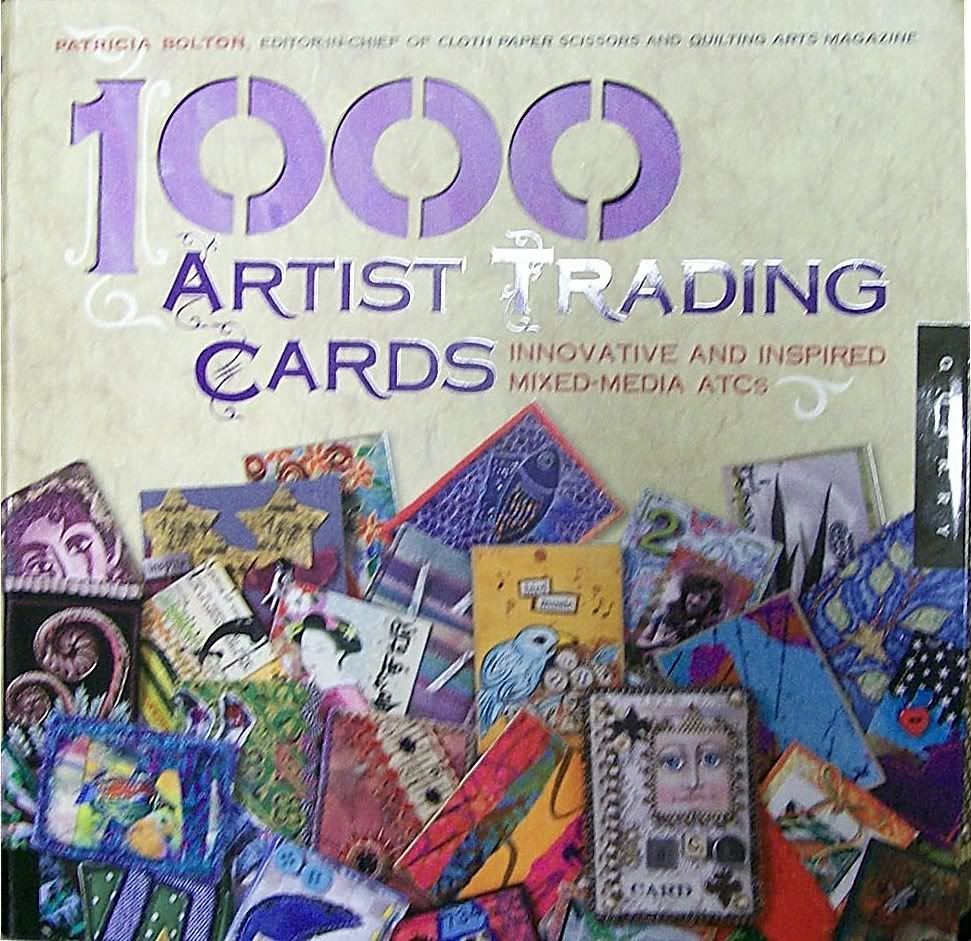
1000 Artist Trading Cards by Patricia BoltonLast year I began collecting ATCs, or artist trading cards. Those of you who hang out at sites like Etsy.com or Quilting Arts are familiar with these miniature wonders, which are 2-1/2" X 3-1/2" one-of-a-kind works of art. Recently I snagged a copy of Patricia Bolton's 1000 Artist Trading Cards, which offers detailed photographs of, yep, one thousand ATCs along with some helpful instructions on how to make them from different materials.
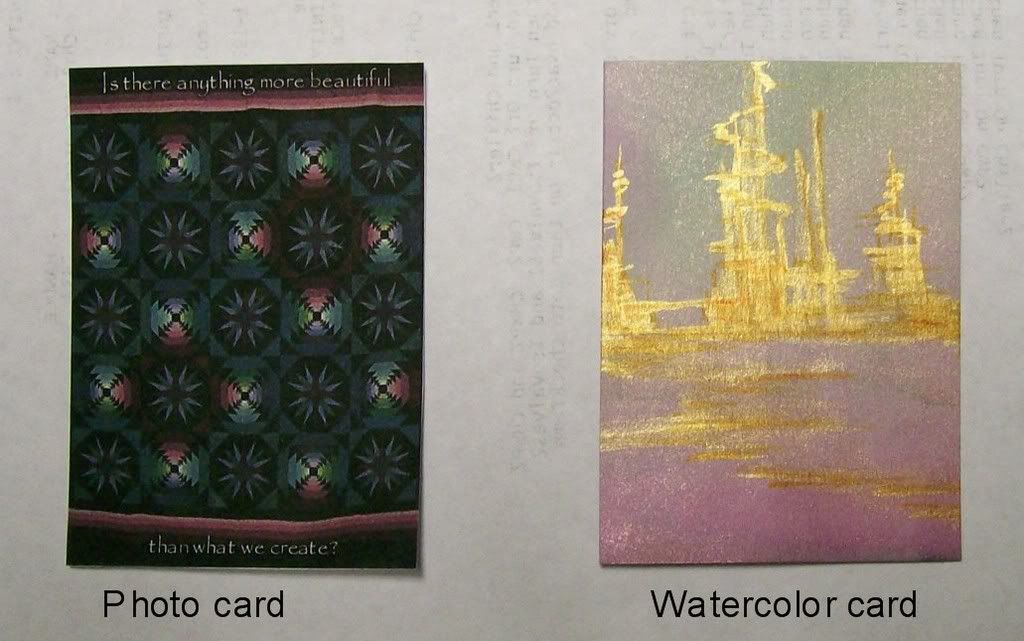
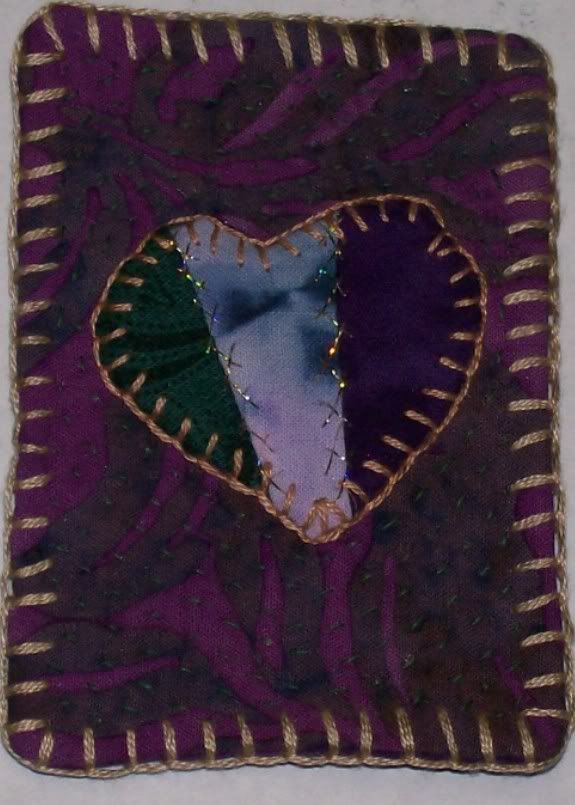
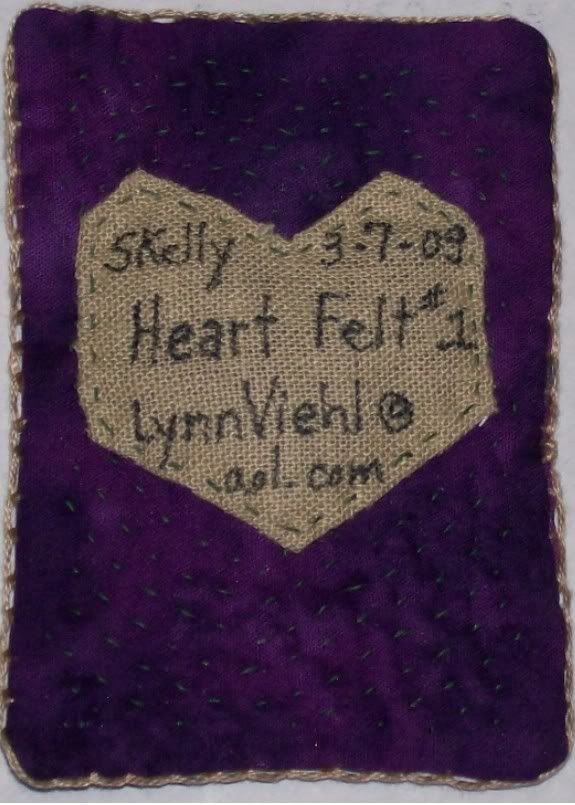
I've also been fooling around with making my own watercolor, photograph and quilted ATCs (click on the images to see larger versions):


This has mostly been just for fun, but the more I think about ATCs, the more I want to see what writers and bloggers can do with them.

Last year we talked about using an online generator to make character cards as a fun way to remember our character stats and possibly to serve as a form of self-promo to hand out at signings and conferences. I think we can get more out of it, though; possibly come up with a writer's version of the ATC -- a writer's trading card.

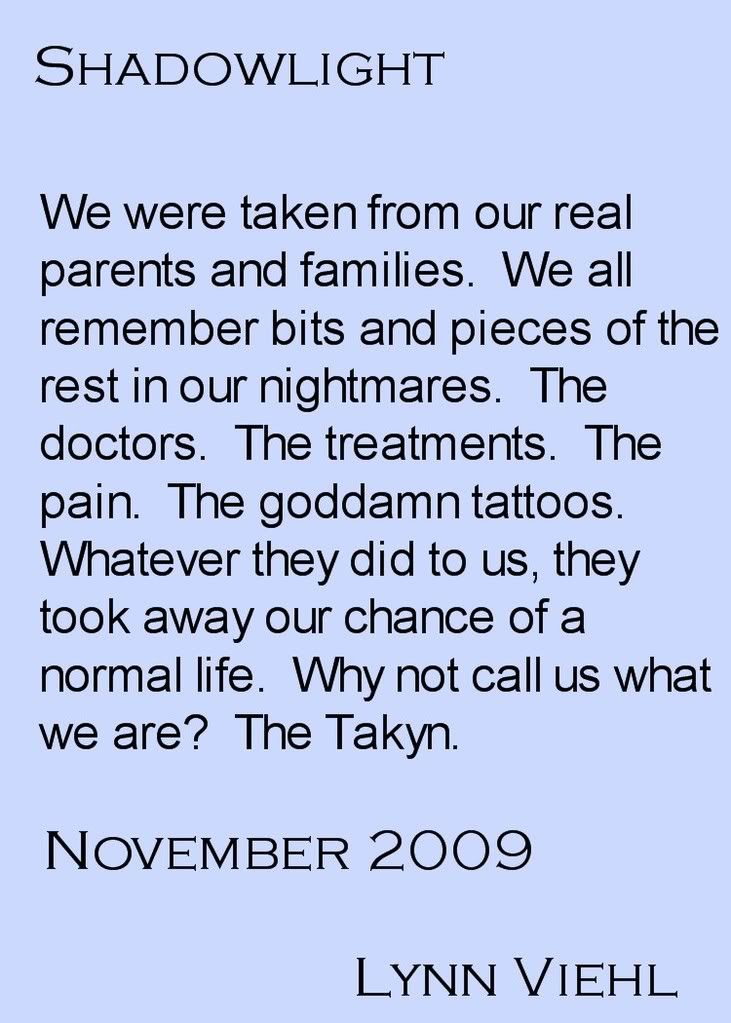
I've seen writers handing out business cards and fridge magnets with cover art, release dates, ISBN#s and so forth, but I've never had a writer hand me a card with a quote or mini-excerpt from a story on it. Since words are our art form, I tried making a card with some of mine:


One problem is size -- you can't fit a lot of text onto trading card. Even with the smallest readable font, I'd say fifty to seventy-five words, max. With such a small space, the temptation is to write a teaser instead of using an actual excerpt. You could fit on a card a URL to an author's website, blog or an longer excerpt posted online -- but what's going to make the recipient curious enough to check it out? A great hook line or hot premise, i.e. "She knows your darkest secret" or "See what everyone is hiding" Or maybe a one-line joke? "This is why I didn't get the laundry done for three months."

Another problem is the visual aspect -- words aren't exactly colorful or attention-catching. I think using weird fonts in other-than-black shades makes the text hard to read, and any background image would have to be very light, semi-transparent or somehow muted to keep it from overwhelming the words. Unless you used an image on one side and words on the other.

I don't know. I've been thinking it through for a couple days now, and I'm a bit frustrated. It's as if there's an answer dancing just outside my brain's reach. What I do know is that these cards would be simple for a writer to make, print out, swap and otherwise distribute. The trick is to figure out what to put on them to make them a) one of a kind, b) irresistible to readers and c) potentially collectible.

I probably need to let the idea percolate for a while, but in the meantime, what do you guys think? Good idea, bad idea?

Related links:

Author Joumana Medlej has an amazing page with all you ever wanted to know about ATCs: Art in Your Pocket: ATCs.

Artist Trading Cards ~ a Collaborative Cultural Performance

Added 3/13/09: I removed the acronym for writers trading cards because a visitor reminded me of what else that acronym stands for, and I apologize for not realizing it until after it was mentioned.

Saturday, February 02, 2008

Sunday, January 27, 2008

Face Generator

While I was hunting around for some links to go with the character cards post, I came across the Morphases Editor, an online composite face generator. I put a link in comments, but this one is so interesting and potentially helpful in creating character portraits that I thought I'd put up a finished example, too, to show you all what can be done with it:

Will Scarlet, composite face made online with Morphases Editor

This is something like my vision of my character Will Scarlet. I took elements from five different faces and manipulated them to generate the composite, so it's my creation and does not require a model's release form for me to use the image. If I decided to use this in a promotional character card, it would need more work -- I'd like to run it through photoshop to clean up the image, change the length of his hair, even out his skin tone, pack up those dark bags under his eyes and otherwise fiddle with it -- but it's a very good place to start.

Saturday, January 26, 2008

Character Cards

I've been looking around for a character worksheet or template that would be useful and easy for every one to use, no matter where they are with their story. A lightbulb went off when my son was talking about the Yu-Gi-Oh tournament he's playing in this weekend: trading cards. We have them for RPGs, baseball players and enemies of the Bush admnistration, why not fictional characters?

What better way to remember important character stats?

I made this one in a hurry with an online Trading Card Maker, but I imagine you could come up with your own design, images, links to your web site, ISBN#'s and so forth. You authors out there, this would be a very unique and inexpensive way to do promo on your series novels or backlist; something you could hand out like bookmarks but way more fun.

What do you all think? Also, could we use these for something other than characters?

Tuesday, December 04, 2007

Not in 2008

I was just over at J.A. Konrath's blog reading this post (thanks to L. for the heads-up). It's all about his and his visitors' goals for 2008. Most of it sounds like very ambitious, worthy stuff.

Over the years I've become a less is more person, especially in regard to my profession. I've trimmed down what I am willing to do as an author to: writing my novels, maintaining PBW, and doing the occasional favor for a reader, colleague, editor or book buyer. Aside from what I do around here, which is infrequent and clumsy at best, I'd say that I'm pretty much through with self-promotion.

And look -- lightning didn't strike me as I typed that. Incredible.

In 2008, I'd like to be the writer who just writes books. If my novels go on to be bestsellers, great. If they don't, that's the way it goes. Maybe the self-promotion advocates are right, and you have to get out there and pimp yourself or you won't get anywhere in this business. But if I ever get "there" I'd like it to be on the strength of the work, not how often or loudly I clamored for everyone to buy it.

No offense to anyone who feels differently, either -- I think self-promotion does have some merit, especially when it's done creatively. And you all are still going to buy Evermore in January, right? Ha.

Let's put a different spin on J.A.'s post -- what are you all not going to do in 2008?

Monday, November 19, 2007

Demo Slide Show

I came across a link for a free online slide show service over at The Generator Blog that I thought some writers could use to have some fun with their cover art or photos from conferences, booksignings, etc.

To see how hard it was to use, I made a demo slide show with the cover art from the Darkyn books. I uploaded my own .jpgs, made simple captions and picked a stock song to play in the background. It took about fifteen minutes altogether. You do have to register with the site to be able to edit your slide show, but that's also free (although it seems to work fine on Blogger, this widget is really designed for MySpace users, and if you've got one of those pages they give you precise instructions on how to add it to your page.)

Once you create the slide show, you can use a remote link folks can click on to go to see it over at the Slide.com site, like this, or get the embed code to put the slide show on your web site or weblog, as I did over on the fiction blog here (the background music may not play on some browsers.)

It's not exactly a substitute for a proper book trailer, but I bet some of the more inventive, creative minds out there can figure out a way to make it work just as well. If you decide to use this widget make your own slide show, post a link in comments so we can see what you do with it.

Saturday, July 14, 2007

VW#5: Seducing vs. Slapping ~ Self-Promotion Styles and Strategies

The winners of VW#3 giveaway are:

Katherine Hazen

bamabelle

Winners, please send your full name and ship-to address to LynnViehl@aol.com, and I'll get these goodies out to you. On to the workshop:

I. Disorderly Conduct

A friend and I were playing the "What psychological problem does your online behavior reveal?" game, and trying to decide if one chronic offender was displaying a borderline or narcissistic personality disorder. My friend decided the excessive dependency on ego-feeding indicated borderline, but the exaggerated sense of self-importance made me go with narcissistic. We're waiting for a third pal who was a psych major to make the final call.

Yes, this is what we do when we're not playing Amazon.com review poker. We profile jackasses.

It got me to thinking, though, about the psychological aspects of self-promotion. Being the obsessive-compulsive organizer I am, I decided to come up with a classification system. When it comes to self-promotion, writers tend to fall into one of three general categories:

A. Avoidant: for whatever reason, these writers dislike or resent self-promotion intensely, and thus try to avoid it. Like anything, you never know how good you are until you give it a shot. These folks would rather never know (and this would be my category.)

B. Dependent: these writers are submissive types who lack self-confidence and do whatever self-promotion their publisher, writer friends, or writing organization tell them to do. They rely almost entirely on others to make decisions for them. These writer may be good at promoting, but they never think they are, so they follow the herd (the most prevalent category of self-promoting writer.)

C. Obsessive-Compulsive: self-promotion is one of the secret handshakes these writers believe exist, so they obsess over it, go to extremes, and take on more and more of the responsibility for promoting their books. Like the dependent, they may actually be good self-promoters, but they're never happy with the results, and escalate until they blow up, burn out or give up (this one is always a heartbreaker to watch.)

I think we need a fourth option. One that doesn't require us to be control freaks, herd followers or conscientious objectors. One that permits us to promote intelligently and effectively without feeling shame, dependency or disgust.

And I'm still working on what that option is.

II. Trends

Self-promotion follows as many trends as publishing does. Whenever a few authors start doing a new type of affordable self-promotion, and it looks like it's working for them, every other author online jumps on the bandwagon. When I was blogging back in 2001, I knew maybe a dozen other authors who were doing the same. Now it seems like everyone in the biz has a weblog, and a MySpace.com page (okay, I don't, but I also avoid anything that requires me to learn new HTML.)

This doesn't just happen with the low-cost self-promotion, either. Having a professional book trailer, which can cost thousands of dollars, made for your book became a trend for a while. The quality ranged from excellent to counter-productive. Virtual blog tours, which also have a hefty price tag, were another popular trend.

I keep thinking of that thing our moms used to say: If all your friends jump off a cliff, that doesn't mean you have to.

It surprises me, too, because writers have such creative minds and are talented problem-solvers. Our books are all different, we're all different, yet the general strategy being used for self-promotion is to clone what everyone else is doing? That makes no sense to me. There is no safety in numbers, not in publishing.

Look at it this way: if you're a tree, and you want to stand out in the forest, the last thing you try to do is look like all the other trees.

III. Take My Book, Please

I can't tackle all the problems with self-promotion in a single workshop, so let's focus on one issue: tone.

The tone of your self-promotion says a lot about you the writer. If the reader percieves your self-promotion to be strident, demanding, egotistical, phony, tentative, clumsy, etc., they will apply that opinion not only to your work, but to you as a person. We all think SPAM is irritating, impersonal and offensive, and when an author SPAMs us, we think the same about them.

When appropriately presented, well-crafted, genuine and artistic self-promotion has the same effect. A beautiful, thoughtful or sincere presentation says great things about the author, especially if they created it. Personally when I see writers doing innovative things with their self-promotion, I respond to it by buying their books and talking about them here on the blog.

Achieving the right tone is tricky. Even defining it is problematic. It's like Supreme Court Justice Potter Stewart's infamous quote about obscenity given in his opinion on Jacobellis vs. Ohio -- I know it when I see it. What I do know from my observations is that people largely respond to how they perceive they're being addressed as much as the content of the address. Some examples:

A. Love Me, Love My Book -- authors often objectify themselves in their self-promotion by tossing out lists of awards, professional achievements and other forms of special recognition to portray themselves as successful industry icons. Everyone loves a winner, and this does impress some readers, but it only works on a large scale if the writer actually does have the professional clout to back it up.

B. Buy My Book Before I Starve -- self-promotion that involves the writer confessing their personal or financial straits in relation to their book sales can create reader empathy and a desire to help. This can be dangerous, though, because there are authors who use this approach with every book they promote, and readers get tired of hearing how desperate they are, or perceive them as liars trying to get a mercy read.

C. You're Not Smart Enough to Read My Book -- this is my personal favorite; also known as the Stone Soup approach. Authors who use it actually try to persuade readers to buy their book by convincing them that only extremely intelligent people will be able to understand it. And yes, a few people with low self-esteem fall for it, but I think most readers have a pretty solid sense of how smart they are, so it can backfire on the author.

D. Don't Buy That Idiot's Book, Buy Mine --
The gleeful online trend of schadenfreude self-promotion depends on people's need to vent some hostility to generate sales out of comraderie, gratitude and support. Most of us do respond to authority figures, especially if they present themselves as judges, but often the author's anger and self-righteousness slips into unreasonable outrage whenever they are judged and found wanting, which makes them appear largely hypocritical, and can quickly disperse their following.

IV. Honey and Vinegar

As much as I avoid self-promotion, I have learned a few things from watching it over the years. Readers are book lovers, and they don't want to be ridiculed, kicked, punched and slapped by a potential new flame. They want to be respected, intrigued, involved, appreciated, and seduced.

It's the classic honey vs. vinegar situation. If you want to catch more flies, you don't put out a dish of vinegar.

The fact is that readers seem to respond most to sincerity, humor, honesty and a certain level of enthusiasm. The problem is that all of these things can't be faked, or not for long, anyway. So to find the right tone for your self-promotion, you have to think about how you feel about your readers, and how much of your real self you want to share with them.

Then? Get real.

For a chance to win one of today's two Left Behind and Loving It goodie bags, in comments to this post ask a question or share your view on self-promotion, or just throw your name into the hat by midnight EST on Sunday, July 15, 2007. I will draw two names at random from everyone who participates and send the winners a tote filled with a signed copy of my novel Dark Need (paperback), as well as unsigned copies of The Grave Tattoo by Val McDermid (hardcover), The Writer's Portable Therapist ~ 26 Sessions to a Creativity Cure by Rachel Ballon (paperback), Deborah's Story by Ann Burton (paperback), Tied to the Tracks by Rosina Lippi (trade paperback), Working Man by Melanie Schuster (paperback), Hunting the Hunter and Hunter's Salvation by Shiloh Walker (paperbacks), the July 2007 issue of Scientific American magazine and some surprises. This giveaway is open to everyone on the planet, even if you've won something here at PBW in the past.

Other sources on self-promotion:

Astrid Cooper's Marketing and Self-Promotion

Self-Promotion Means Always Having to Say You're Somebody by Morris Rosenthal

Self-Promotion by Robert J. Sawyer

Barbar Stahura's Shameless Self-Promotion

Other virtual workshops now in progress:

Joely Sue Burkhart's Do You Know the Secret?

Gabriele Campbell's How to Make a Battle Come Alive on the Page, Part 1 and Part 2

LJ Cohen's Organize your Novel with a WIKI

Rosina Lippi's Workshop Day 1: The Story Machine, Workshop Day 2: Ask Your Characters, Workshop Day 3: Rev Your Engines, and Workshop Day 4: Mix It Up

Jordan Summers talks about writing outside the traditional boundaries of romance, and her own trials and triumphs as an example of what roads are available and how to avoid some of the potholes

Shiloh Walker's Heat with Heart Day 1, finding that missing emotion, Exploring that Backstory (where she briefly grills me)

Friday, July 06, 2007

Friday 20

Using humor to promote a novel can get through to readers who are bored with the usual "Love me, love my book" approach. People remember you when you make them laugh, and they generally appreciate you for it, too.

Here's a letter I wrote for Borders Group, Inc., which was supposed to be published in one of their May e-mail reader monthly newsletters (have no idea if it was, actually):
-----------------------------------------------
I loved reading comic books when I was a kid, and often had a crush on some larger-than-life figure whose job it was to save the world. I'm pretty sure that I spent most of the sixth grade writing “Lynn + Aquaman” inside little hearts in my notebook.

As I got older, however, I realized that what makes a great hero would probably make him a lousy boyfriend. For example:

1. Batman: only wants to play with his gadgets.

2. Captain America: refuses to wear anything that isn’t red, white and blue.

3. Iron Man: can’t take long romantic walks in the rain.

4. Spiderman: always picks fights with your exterminator.

5. Superman: faster than a speeding bullet? Pass.

6. The Incredible Hulk: always looks queasy or jealous.

7. Wolverine: Cuddling shouldn’t require a trip to the E.R. afterward.

In my novel “Night Lost,” the hero, Gabriel Seran, belongs to the Darkyn, my vampire-like immortals who have unusual psychic powers. If you don’t think a vampire would make a good boyfriend, consider this:

He won’t mind if you have a day job.
He never has garlic breath.
He doesn’t need to rent a costume for your Halloween party.
You don’t have to worry about what to make him for dinner.

Vampires may not be traditional heroes, but they certainly keep things interesting for me. I hope this month that you’ll pick up a copy of “Night Lost” and discover a whole new breed of hero: one who just might keep you occupied all through the night.
--------------------------------------

Besides climbing onto my little soapbox and making the case for other-than-traditional heroes, I felt more comfortable writing a mild parody about superheroes than blathering on and on about my novel. It may seem like a waste of publicity space to the purists, but I think my letter has a better chance of establishing rapport with a reader versys the author who writes the typical phony I'm SURE you'll love reading my WONDERFUL novel as much as I ADORED writing it for you, tee-hee!

Besides, I already know that you'll love reading my wonderful novel. :)

That's all from my corner of publishing this week. Are there any questions out there for me?

Thursday, June 28, 2007

Self-Promotion That Doesn't Suck

Author Mindy Klasky is running an interesting reader poll on her LJ about what promotional tools prompt people to buy a book. Not surprisingly, the top three responses so far are:

1. Previous familiarity with author's other work
2. Recommendation of friend
3. Reading about book on another person's blog or website


On the other hand, widgets, postcards and SPAM hardly induced anyone to make a purchase. These things are the definition of self-promo that sucks: anything you spend money, time and/or effort on that does not result in sales.

Let's examine the three things that evidently do work:

#1: I can already hear the rookies groaning over "previous familiarity with author's other work" as a no-go for them, as they have no backlist. Well, this is why God created free e-books and posting excerpts and short stories on websites. Offer readers something for free, and some of them will buy your print novels. Author Peter Watts did with his novel Blindsight, and it helped increase his sales of the print version.

#2: Friend recommendations may also seem to writers to be another impossible-to-get self-promo tool. Word of mouth cannot be bought. However, if you politely ask your readers when they enjoy one of your novels to let other people know, they will. I put that request at the top of every bibliography I send out, whether it's for my books or another writer's.

#3: Rosina Lippi's Tied to the Tracks meme contest is a fun example of how, with a little creativity and modest investment, a writer can get the word out about a new release, and readers can hear about the book on another person's blog or website.

Spending a pile of money on widgets no one wants, schmoozing with the right people who could care less about you and your career, or killing yourself doing things you hate is not successful self-promotion. It's what everyone else in the herd is doing, and it's not working for them, so save yourself some grief and don't even go there.

Instead, look at your main strength: you're a writer. If you can convince me that a male stripper and an ex-nun can fall in love, or that the singularity will arrive in the form of a computer-eating toaster, or that fire-breathing dragons can shapeshift into squirrel-chasing kittens, or that your private investigator still gets away with wearing a silk fedora and calling men pals and women broads, you should be able to use that talent to persuade me to buy a book.

Just as a story with a fresh, unique spin stands out in a genre, a writer who tackles self-promotion with an approach that is as individual as they are is bound to grab more attention. Determine a dollar figure for the self-promotion you can afford to do, then sit down with a writer friend and bounce ideas around on how to best spend that money. A single ad in a big industry trade rag may cost you a thousand dollars, but sell an interview or article on writing to that same rag, and you get paid for it.

You don't have to go it alone. Pooling your resources with another writer or group of writers for self-promo gives you more of a budget to work with, and a partner or partners for figuring out the different angles. We've seen how well the group blog works, how about applying the same theory to a group self-promo project?

There's one more thing I harp on quite a bit: the fun factor. Whatever you do self-promotionwise should be something you enjoy. Because if you're not having fun, your resentment is going to end up running the show and giving you an ulcer.

Have you guys any examples of self-promotion that doesn't suck? Let us know in comments.

Tuesday, February 27, 2007

Is That Your Self-Promo in my Face, Or....

Janet Elaine Smith had an interesting piece about her methods of self-marketing in the December issue of Writer's Journal, titled How Bold Are You, Really? I've been pondering it along with some other articles I've gathered on the topic. Janet's enthusiasm for self-promotion led a fellow writer to call her a "brazen hussy," which Janet then promptly turned around and used as a title for a Yahoo group she started on self-promotion.

I like that kind of attitude. It tempts me to rename this place. I can't remember which names that I'm not supposed to know about, though, so I'll save it for the industry expose. In any event, being the reserved, quiet soul that I am -- shut up, Jean -- I couldn't do what Janet does, but I admire her energy and enthusiasm. It takes a lot to get out there and do the self-promo dance. There was one tip she mentioned that bothered me, and I'll quote from the article:

"Don't be afraid to interrupt, politely -- even on the internet. If someone in a thread mentions something that pertains to your book, jump in with a bit of BSP (blatant self-promotion)."

I think interrupting a discussion thread solely for the purpose of self-promo is transparently rude. Working in a mention of your book when it's directly related to a topic of discussion, on the other hand, isn't. The line between the two? Very thin.

I'm not against self-promotion. I avoid it whenever possible. Seriously, writers who maintain blogs solely for the purpose of self-promotion, and never post about anything but themselves, their struggles, their work, their releases, their glowing reviews, their personal appearances, etc. are fine with me. If that's all you care about, or all you have to contribute to the publishing blogosphere, go for it. Your weblog will have huge appeal for your readers, and if it's all about you and your work, you'll be safe. With all the ire directed at the writer who dares express an opinion these days, it's probably the smart thing to do.

That said, when you visit another writer's blog or discussion board, you're a guest. If you went to a party at that writer's house in real life, would you jump in the middle of conversations or derail them to talk about yourself? How about walking away from someone who is talking to you the minute the subject is no longer about you, or you've finished pimping yourself to that group and have moved on to the next?

The internet may seem impersonal because we're not talking face-to-face, but that doesn't mean that it is. Insincerity has a very distinct smell to it, even on the web.

Given all the pressure publishers are putting on us to self-promote, what do we do? Maybe we should stop viewing other writer (or any type) weblogs as self-promo opportunities, and see them more as neighbors. Over the years we've become a very large, diverse online community. Do we really want to be reduced to filtered, programmed, self-absorbed Stepford Bloggers, air-kissing each other in comments? Don't we have enough of that going on already?

If you really get involved in a discussion versus playing your own publicist, chances are some of the other visitors will take an interest in you. People who like what you have to say track down your blog or site, stop in to participate in your blog discussions, and best of all, invest in your books. Or, to put it simply, be sincere, and be yourself, and keep your self-promo in your pocket until it's the right time to share.

What do you guys think?

Saturday, August 12, 2006

Free with Every Novel

I've been seeing advertising all over the place for Chocolate, the new Verizon phone/MP3 player. I don't need another phone -- I don't use the ones I already own -- but if it were an MP3 player and, say, an M&M dispenser or mini s'mores maker, I'd buy one in a heartbeat.

Interesting trademark move, too. Whoever thought up the slogan "Everybody loves chocolate" ignored the fact that lots of people including my daughter loathe chocolate, but as an easily-remembered tag line it works well. Now I wonder, does this mean I have to ask permission of Verizon every time I want to use the word chocolate? That's going to be a bit of a pain. Doesn't Hershey's already own it? (Where is Bill Peschel when I need him?)

I'm not a phone person, but I do like items that serve more than one purpose, because they save space and time. I love my handheld organizer, which doubles as an MP3 player and does just about everything else but shop for groceries for me. My DVD player, which also plays my old VHS tapes and records them on DVDs and downloads stuff from my digital and video cameras, is probably secretly realigning the Hubble telescope right now.

I like bonuses and extras, too -- I recently gushed about Paste magazine because they send me free music CDs and sometimes video DVDs in every issue. We need some of that in publishing.

Nonfiction books often include CDs, especially any computer or techno ref books, but an excerpt or preview of the author's next book is about the best freebie that most fiction books offer now. Yet if Elle can put eye-watering perfume sample strips and little packets of liquid pancake makeup in every issue, then why can't we figure out a way to add a little extra bonus for our readers?

Harlequin has been great about giving their subscription service readers something extra over the years; everything from wineglasses to crystal pendants. They're currently offering three free books if you buy six (see ad in the back of Harlequin Presents novels out this month) or one free book online with Free Book Fridays on their shopping page (if you buy two books on Friday, you get their weekly featured title free.)

If the Publishing Fairy gave me carte blanche to add something free to my novels, I'd include a CD of the music that inspired me, or an e-book set in the same universe, or a poster of a painting or other artwork I love (the fold lines of the print would, of course, magically disappear the minute the reader unfolded it.) If I could get a bag of M&Ms or a Hershey you-know-what bar in there without it melting on the pages, that would be cool, too. Or a quilt, magically packed into one of those tiny sponge-animal capsules you drop into hot water for one minute. A queen size wedding ring quilt beats a green sponge T-Rex or blue sponge Raptor every time, right? You might want to drop the magic quilt capsule in the bathtub instead of a glass of water, though . . .

How about you -- if you could get freebies with any novel, or add one or more to your own, what would you like to give or receive?