With all the biz emphasis on costly MFAs, seminars, workshops and what have you in regard to learning how to write fiction, I think the next generation of writers may not always consider or even understand the merits of self-education.
Before I start offending the academics out there, I don't think there's anything wrong with formal education in general. For the medical, technical and scientific professions obviously it's a must. Most of us attend public or private schools as kids, so usually the first thing we think of in regard to learning is continuing that type of education. Also, many people do learn a great deal by going through traditional/institutional forms of education. I'm sending one kid to college this fall and the other to vet school in a couple of years, and I'm paying for all of it. I wouldn't waste my hard-earned money on something I thought was utterly worthless.
That said, I am a completely self-taught writer, and I don't think there's anything wrong with that. I've made it work fairly well for me, so I thought I'd pass along some of the benefits and perks of teaching yourself:
Internet access + public library card = 100% free education. This works for writers who do not have wealthy parents, spouses, partners, an unused fifty grand sitting in the checking account, or the ability to qualify for those hefty student loans. Also for anyone who would rather spend their money on the little luxuries like food, shelter, clothing . . .
You don't have to quit your day job or give up your daily responsibilities to attend classes, and you can attend whenever you want wherever you want for as long as you want. Not everyone decides to become a professional writer at age 18; sometimes the calling comes much later in life. I didn't decide to seriously pursue publication until I was 28, and I was pregnant or had babies in diapers while I taught myself what I needed to know. If you're already employed, a stay-at-home parent, an elderly caretaker or simply have an insanely chaotic life, self-education can be the best fit for your busy schedule.
You work at your own pace, and can take as long as you need to master a concept or element of writing. Some people can master an idea in a split second. The rest of us mortals generally need to spend a little time wrapping our brains around it, trying it out, etc.
You custom-design your education by by choosing what information you want to study from what resources. Unlike what was hammered into our heads in school, this means things like no required reading. Which means if you don't like Chekhov, you don't have to read Chekhov. Or Conrad. Or Hawthorne. You're tingling already, aren't you? I can tell.
No grades involved whatsoever. Aside from the fact that traditional grading systems are corrupt, inaccurate and wholly inappropriate ways of motivating the learner, you don't have to worry about showing your mom your report card because there isn't one.
You can choose what works for you and discard what doesn't by testing it out yourself. Like on-the-job training it works beautifully, plus you won't have to cater to the preferences of some professor who thinks Melville is timely or that every author born after Salinger should be shot.
You learn independently, so you don't have to rely on anyone else, their schedule and what they think you should or shouldn't know. I think this helps make a writer a better self-starter and problem-solver. It also frees you from dependence on others becoming a necessary part of your writing process (aka writing by committee.)
No pressure to audition, be accepted, perform or obtain any sort of official certification. One thing I've noticed about some of the more critically-acclaimed writing workshops is the fact that you have to first audition for them; then they decide who they want to teach (aka students who most likely are already 90% the way there.) Nothing wrong with this, it's good PR: if you want your writing program to look highly successful, definitely stock it with only those writers who demonstrate that they are already very accomplished and only need a bit of buffing and polishing. How many of us fit that profile when we start out on the road to publication? I certainly didn't.
Self-education is not the easy road. What you learn depends on how determined you are to pursue your own education. When you teach yourself you're not just the student; you're also the teacher. You have to be part hunter-gatherer as well, because in order to acquire your course materials, you have to get online or go to your library and look for them, analyze them and figure out how to work with them. As with working at home, studying at home can be a real challenge, too.
Another thing to consider when contemplating what sort of writing education you want is the likelihood of whether or not you will become a full-time writer.
According to the U.S. Department of Labor/Bureau of Labor Statistics: "Median annual wages for salaried writers and authors were $53,070 in May 2008. The middle 50 percent earned between $38,150 and $75,060. The lowest 10 percent earned less than $28,020, and the highest 10 percent earned more than $106,630." This sounds great, until you consider that these statistics are for salaried writers who probably work for a company. As a freelance/contracted writer you don't receive a weekly salary; you're paid for what you sell. There is no guarantee that you will sell everything you write every time.
If you're careful the expenses involved with writing don't have to be crushing, but few people can make a living working as full-time writers. For the newly-published writer, the industry standard advance of $5K per book, an agent who collects 15% of your earnings, and the heftier taxes you have to pay as a self-employed worker does not add up to a lot of income. If you're not an overnight success, under those circumstances you could be looking at writing and selling 4+ books per year just to get within spitting distance of that lowest 10% figure the Labor Department cites. Now imagine that level of income while you have yourself and possibly a family to support as well as 100K in college loans waiting to be paid off.
Only you know if you have the resources or the inclination to continue on or go back to school for writing, so I can't tell you what to do. All I can say is that self-education is always there if you can't go the formal route, and for that reason it's definitely worth considering. Teaching yourself won't reward you with a diploma, or credentials you can display in a signature block acronym, but if you stick with it, you may find you end up with everything you need to become a successful professional writer. For free.
Related links:
2010 Average Salaries for Writers and Editors by John Hewitt
50+ Open Courseware Writing Classes from the World's Leading UniversitiesLearn FreeTen for Free
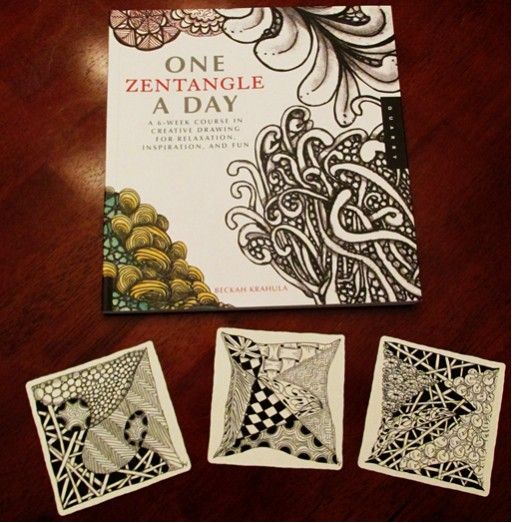 Zentangles are a meditational art form created by doodling repetitive patterns in a small space. While I've been making this sort of art since childhood I've never taken any formal/proper instruction, so I found my way to One Zentangle a Day by Beckah Krahula. this how-to book. I picked it up primarily because of the subtitle: A 6-Week Course in Creative Drawing for Relaxation, Inspiration and Fun, but when I flipped through the pages at the book store I also liked the simple format of the lessons, all of which are accompanied by several illustration and photo examples.

