Showing posts with label in the trades. Show all posts

Thursday, January 02, 2014

First Reads of 2014

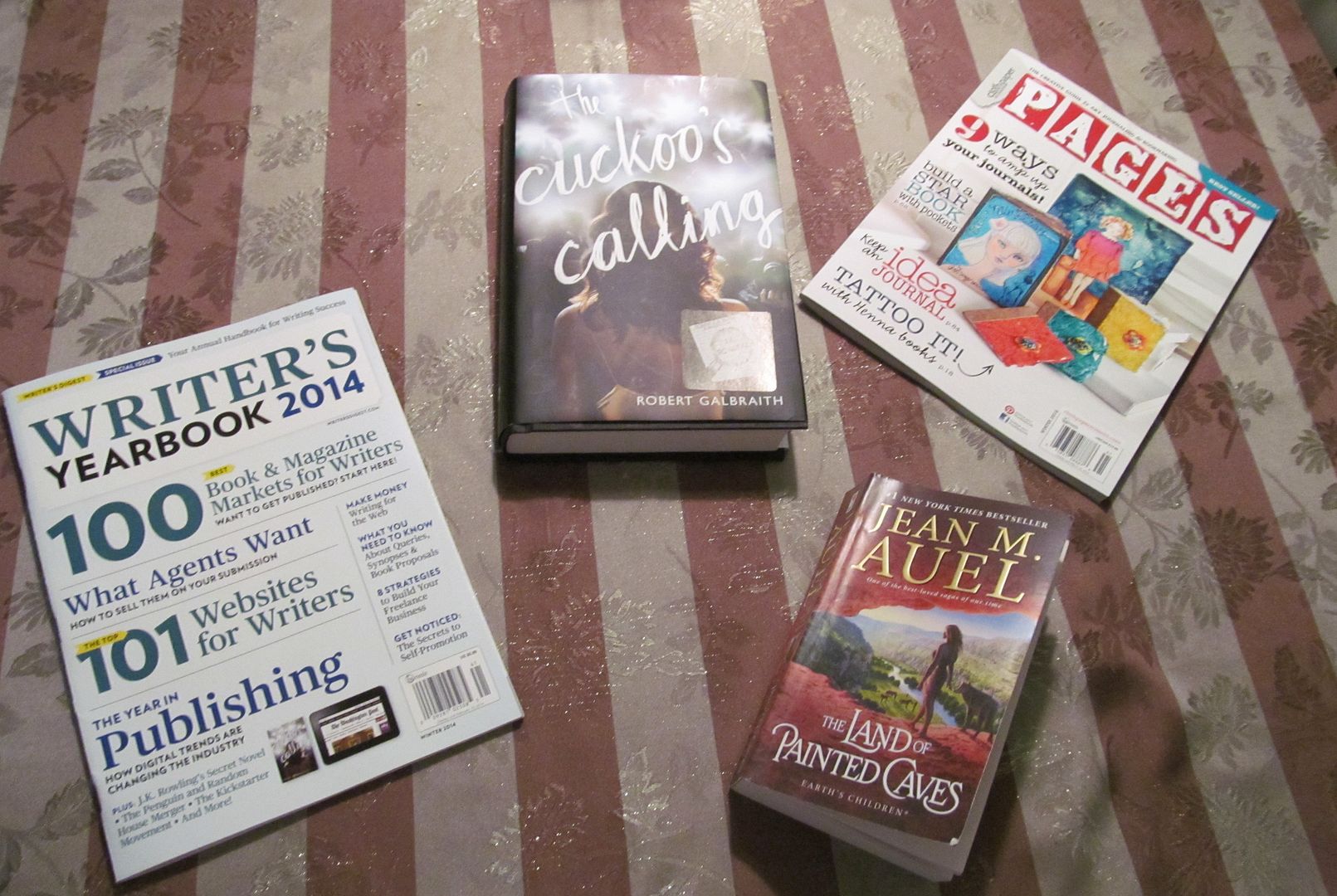
I thought I'd kick off my 2014 reading year with books and mags I was given or bought during the holidays. Here's what I picked:


And, what I thought:

I picked up a copy of Writer's Digest Writer's Yearbook 2014 special issue because of the market listings; I needed the info for some future sub op posts. Kevin Kaiser has a decent article with some smart strategies on self-promotion for those of you who are looking more for theory, but the rest isn't all that new or interesting. I do think the market listings make it worth the cover price, though.

The Cuckoo's Calling by J.K. Rowling (at first pretending to be a guy writer named Robert Galbraith until the publisher realized no one was buying the book and accidentally/artfully spilled the beans) is a private detective mystery. It's easy to sneer over a book that didn't sell until everyone knew who really wrote it, but I thought it was okay. Middle of the road, earnestly-written -- like a lot of popular hardcover crime fic, in fact (disclaimer: I'm not really a P.I. mystery fan, but I started with P.D. James's Dagliesh novels, so as a result I expect my reading bar is a bit higher than most.) There were a few size references for the protag that also made me envision that kindly giant character Hagrid from Harry Potter, but otherwise it seemed to be entirely Hogwart-free. I would not recommend it for youngsters due to the violence, language and certain themes -- J.K. does sprinkle the eff word about quite liberally -- but fans of Michael Connolly and his sort might find it mildly diverting.

Land of the Painted Caves by Jean M. Auel. How do I describe this reading experience, besides regret over the large chunks of three days of my life spent plowing through it that I'll never get back? I had wondered why so many of you had nothing good to say about the book when I mentioned it last year, and hindsight says I should have listened to you. It's true that I haven't really loved the series since the end of The Mammoth Hunters, but I was hanging on until we could get to the last novel, you know? I even waited an extra two years before I cracked this puppy so I'd be emotionally ready to let go.

Am now quite ready. Fasten your seatbelts, friends.

Probably the most annoying thing was all the repetition, repetition, rep -- I mean, how many times did we really have to hear the Mother's song in its entirety? I'm thinking not twenty-seven, how about you? Or what it was like to bring the horses into a strange camp and calm people's fears about them (fifty times), or show them how to pet Wolf and feel his neck fur (ninety times), or be introduced to Ayla and hear all her titles (two hundred times), or see the same fricking boring cave paintings of horse heads and elephant heads and what have you over and over (I'm not counting those. After the third cave, I just skipped over those scenes.) I think some of you mentioned that, too.

And what was with the kid and whipping her out of the carrying blanket so she could pee on the ground? Why, exactly, did I have read that four hundred times? Jean, honey, I've potty-trained a daughter. After the first perfectly-timed piddle it's just not that impressive. And that's in real life -- but in fiction? Even less.

I know how difficult it is to end a series, so I think I could have forgiven all the repeats and dragginess, but whoever was playing the part of Ayla in this book was not the Ayla I know from The Valley of Horses. That Ayla would have never stood around so much, or uttered all this housekeeping dialogue, or treated Jondalar like an unreliable babysitter instead of the love of her life, or perpetually kissed the First's butt for reasons I'm still not straight on (and don't get me started on that portion of the story. Your seatbelt will snap.) No, my Ayla would have packed up her sling and dragged Jondalar back to the Mamutoi and gone on thrilling hunts and invented more cool stuff and tamed some more critters and kept me from falling asleep. This Ayla was about as engaging as Zzzzzzquil.

No reunion with Durc, so that was a huge disappointment. I should have expected that, but I really wanted Ayla to see her kid again, one last time. I was led to believe it would happen. Remember the dream she had where her Clan son meets her Other son and they fight or something? I think that was in The Mammoth Hunters. What happened to that coming true?

Then, toward the end, in the last part . . . I won't get into specifics so I don't totally spoil the end, even though I want to, but Jondalar and Marona? After what that witch did to Ayla in Shelters? Okay, maybe my disbelief might have eventually stretched to accomodate that drop into fictional relationship hell -- Jondalar could have had a complete lobotomy at the Big Summer Meeting, right? -- but then to follow it up with Ayla and Laramar? Really? Laramar? No, really? Laramar? Laramar?

JM&J. I never like to caps-yell, but the next time you all tell me not to read a book, I swear, I AM GOING TO LISTEN TO YOU.

To end on a positive note, the Winter 2014 issue of Pages magazine has just hit the racks, and this one has another great assortment of ideas and projects for your handmade books, journals and art journaling. I was amused to see the "Pocket Star" journal (have to make one of those for my editor) but I thought Gina Lee Kim's Washi Tape Art Journal project and Shayna Butler's article on what to put in an idea book were especially inspiring. I also applaud the editors for continuing to provide fresh new projects, many of which use recycled materials, for those of us who love to make books.

So what have you read so far in 2014? Let us know in comments.

Wednesday, January 02, 2013

Writer Trades Roundup

I'm off on a road trip this week, and since most of the time I will be unplugged from the internet I'm going to disable comments until I get back (I will enable them on my return, I promise.) I apologize in advance for any inconvenience this causes.

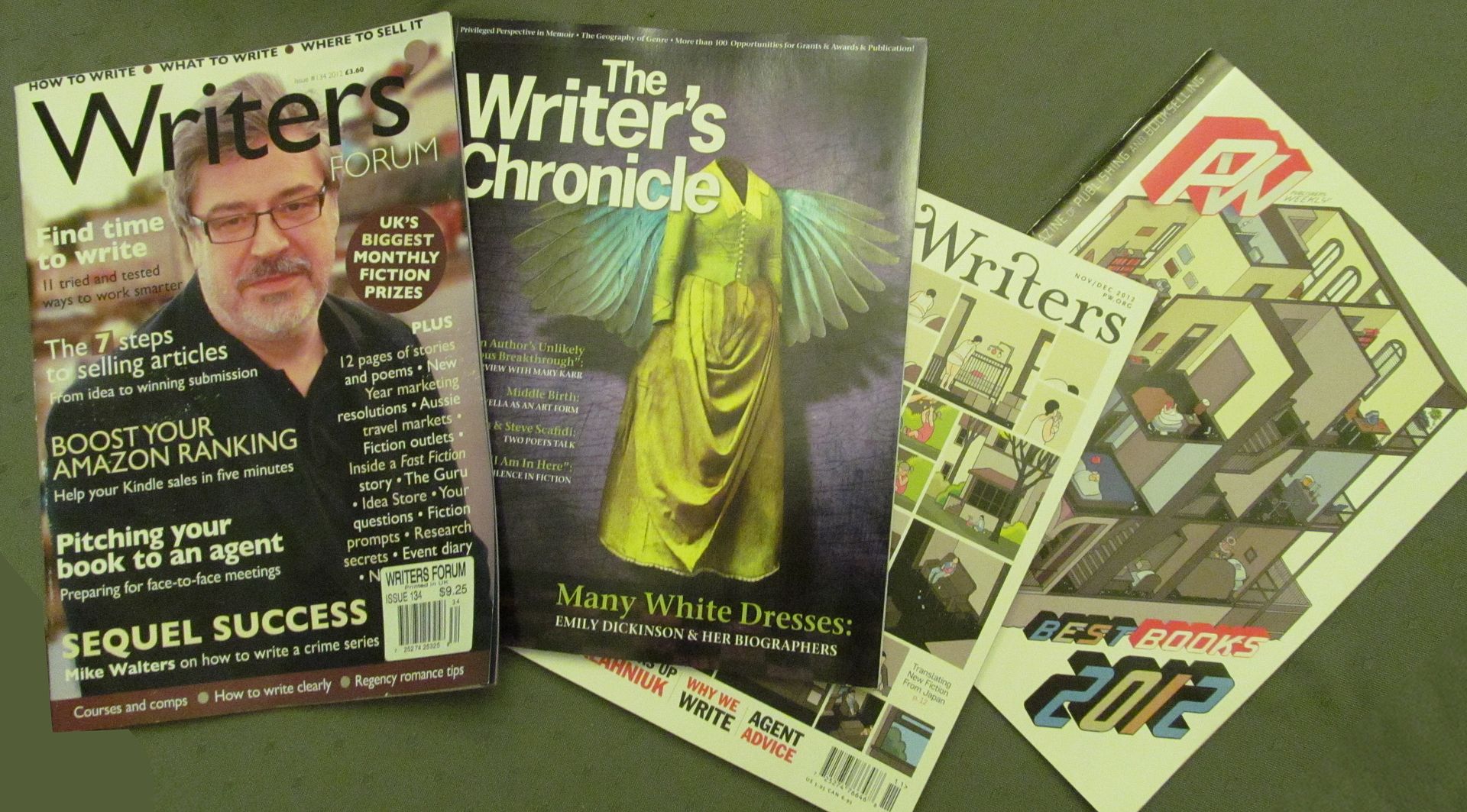
It's been quite a few months since I purchased any writer mags, so while I was out shopping for books I invested in a few to read on my trip. Here are some thoughts on the four I picked up:

I've never subscribed to a magazine published outside the U.S., but reading the marvelous December issue of the UK trade The Writers' Forum convinced me it's time. In this issue I read not one but five articles that were directly helpful to me as a working writer, discovered a couple dozen new markets and contests, and enjoyed a sense of being spoken to instead of being peddled something (the kind of class that disappeared from U.S. mags ten years ago.) Since I'm a Yank it will be a bit more expensive, but I think it's worth it. I'm also worried my BAM will stop carrying it and I'll be cut off from one of the better sources of writer info that I found last year.

According to the 11/5 issue of Publishers Weekly, 22% of all book spending in the second quarter of 2012 went to purchasing e-books. Since their source for the stat is Bowker Market Research you can probably bank on it. Jim Milliot has a piece on the Random Penguin merger and how it will work that is mostly PR but has a couple of promising promises. Otherwise this issue's theme of the best books of 2012 is literary-spawned, genre-snubbing, and really not worth the $5.99 newstand price.

Alix Ohlin has an interesting article on silence in fiction in the December issue of The Writer's Chronicle, and explores how to make the most of the parts of your story when none of the characters are talking. I haven't been through more than that so I'll read the rest of the issue on the road.

Benjamin Percy's article Don't Look Back in the Nov/Dec issue of Poets & Writers takes on the issue of backstory with a vengeance, and I'll quote here: When my students as me how much backstory they're permitted to include in a story, I say, "How about none?" None is a good start. (He actually doesn't suggest we abandon our backstories, but he does make some very good points on how to use it effectively versus piling it around in heaps or glutting the story with it.) As with the Chronicle I haven't read any more than that, but I'll review the market and contest listings while I'm away and see if there's anything fee-free that I can glean for a future sub ops post.

Wednesday, August 08, 2012

Last of the Trade Gripes

Since I've gotten hooked on the UK's writer trade magazine Writers' Forum I grabbed the August issue when I stopped by BAM yesterday. As it's also been some time since I test drove the U.S. writing trades I also picked up copies of the July/August issue of Poets & Writers; the July issue of The Writer to do some comparisons.

At 128 pages Poets & Writers seems a bit heftier this month, but I noticed there were far fewer contest, residency and market listings in the back, which has always been the primary draw for me. Of the content, I liked Dark Room Redux, a short piece on the origins of a twenty-five-year-old society of poets and writers of color, (online for free reading here); Network by Jami Attenberg, a primer on how to use Tumblr blogs to connect with readers (online for free reading here); and Practical Poetry by Margaret Wolfson, one of the best articles I've read in a long time that explains the creative roots of many well-known name brands, and offers some intuitive observations on why the brands were such excellent marketing tools.

I appreciate that P&W makes some articles and much of their market info available online for free reading, but I'd still like to see more of the "My Journey/Struggle/Pain" -type content trimmed and replaced by info that is actually useful to writers working in the lit end of the market.

The Writer continues to shrink; at 50 pages it was the real lightweight of the trio. This volume, which is touted as the "How-to" issue, had only three pieces I felt were worth the trouble of reading: For the mystery writers, Hallie Ephron's The Secret is in the Secrets, which offers seven tips on how to plot a page-turner, has some decent ideas; for the travel writers, Diana Tonnessen's 8 Secrets to Selling Your Travel Stories likewise has some practical tips on how to approach travel publishers. The third was Kelly James-Enger's piece on the 8 biggest mistakes e-book authors make, which identifies and offers a quick fix for common problems (and I can't comment on the value of this as I don't self-publish for profit.)

Some of the content was pretty lightweight, too, like the articles on 30 Twitter feeds and Facebook feeds to watch. Of the 8 contests listed in the market section, all required fees, and some were pretty hefty. As for the Freebies for Writers resource column, it listed only six resources, none of which are anything new, and four of the six were listed only by name. It was nice to see author Lynne Connolly credited for her rec of WordWeb; maybe next time the editors could provide the actual link to what she recommends?

As a trade useful for the working writer, Writers' Forum was the clear winner by comparison. I found three very valuable bits of market info in among the interesting items in the News section. Indie author Mike Hillier has been writing a article series to help self-pubbing writers, and this month he tackles how to format your ms. to make it readable on all e-readers (aka exactly what every aspiring indie author needs to know.)

Even the smaller pieces, like Emily Carlisle's article on online writing groups, Barbara Dynes's piece on actually starting writing (as opposed to sitting around and thinking about it), and Alison Baverstock's advice on how to handle a book launch party, were great. Sue Moorcroft also has an excellent article, The Bad Guys, which with much practicality discusses how to handle writing antagonists and unsavory characters. This is exactly the kind of content that should be in The Writer's how-to issue.

Over the years I've been so frustrated with the trades that I've considered starting up a writers' trade online of my own in order to publish the sort of information I want to see out there for working writers. Earlier today I seriously mulled it over again, and then I realized something. Last year I re-registered Paperback Writer as an electronic serial periodical with the Library of Congress. I've never thought about it before, but this blog is my writers' trade, one I've been writing for going on eight years now. So instead of subscribing to the others, or complaining about their content, I'm going to put more energy into writing up articles, checking out how-tos, and finding as many decent no- or low-cost resources as I can for the writers who stop in here. Thus this will be my last gripe about the trades.

Tuesday, May 15, 2012

Found at B&N

Over the weekend I got a chance to visit the big Barnes & Noble store in my region, and in the process found a trio of interesting things:
Creative Journal Writing ~ the art and heart of reflection by Stephanie Dowrick: I have plenty of books on journal-making and journal art, but not too many on journal content, so this caught my eye immediately. I'm working my way through it slowly, but from what I've already read it's a bit like a journal coach, in that it helps you get started, gives you reasons to keep going and offers some interesting directions to follow. I like that writers who actually journal are frequently quoted in the book; I tend to relate better to someone else who is actually working at the same thing. The author is an Australian writer who according to her bio is a #1 bestseller of fiction and nonfiction in her country ($14.95).

Tree-Free Journal: The cover of this blank book provocatively informs the buyer that it's made from recycled underwear and tee-shirt scraps (from a manufacturer of the same, so we can assume these clothing items were unused.) Although no trees were harmed during the making of this journal, it does look and feel just like a real book with real paper pages. This one was made in India by World Paper Inc., which supports traditional crafts through development and trade ($9.95).

The Writer's Chronicle Magazine: This is the Summer 2012 issue of a magazine for writers I've never before seen, so naturally I had to test-drive an issue. It's big and glossy and well put together, and there are pages upon pages of contests, grants, sub ops, conferences, etc. The articles were a mix of topics; one about author Shirley Jackson's distinguished and all-but-forgotten husband, an interview with a prize-winning literary author, and one pretty neat piece on modes of conveying emotion in writing. It's kind of a cross between The Writer and Poets & Writers minus the obnoxious bits, and I like the market listings most of all, so now I'm thinking about subscribing to it. Ironically, unlike every other magazine I buy or subscribe to, there were no mail-away subscription cards in the issue ($5.95).

What interesting things have you found at your local brick-and-mortar lately? Share some with us in comments.

Saturday, July 17, 2010

Write Noise

In my endless pursuit of practical writing advice for the working writer, I have to plow through a lot of material online, in books and in the trades. A good chunk of it seems to be written by academics with impressive credentials but little to no industry experience, near or current retirees who like to reminisce about the good old days (which, remind me, were when?) and, of course, the newbie who has it all figured out before the ink dries on their first contract.

In reality it doesn't matter to me who offers it up. I don't care how many books are on your brag shelf, what is or isn't on your C.V., or if you even have a writing career to speak of. I'll listen, and if it's really good, I'll probably use it. As we all know, the Publishing biz has very little to do with the art of writing, and not all writers pursue publication. But this advice? Had better be real, and useful, and not something else in disguise.

What don't I want to read? Top of the list: Self-promo dressed up in a flimsy advice costume and holding out its empty goodie bag. Trick or treat, buy what I'm really selling: my book/workshop/seminar/editing service etc. Or the career mini-memoir. Yes, I'm sure that walking barefoot forty miles through the snow to mail a query letter by Pony Express to NY was a horrific ordeal, but knowing this helps me how? I'm especially tired of the rule issuers; I think we should make them fight cage matches: Write What You Know Nick vs. Don't Write What You Know Donald. Slow Is Better Than Fast Fanny vs. Fast Is The Way To Go Gloria. Plot it Paul vs. Organic Arthur.

Now that I think about it, the rule people would make pretty cool action figures, too, wouldn't they? Plot It Paul could come with his own whiteboard, fifteen notebooks, four hundred sticky note pads, a bottle of Mylanta and tiny bundles of index cards stuffed in all his pockets. Organic Arthur's accessories would include a little broken comb for his beard, a Jack Kerouac T-shirt with the sleeves torn off, wee empty whiskey bottles to pile around the base of his desk (if you can find it under all those dusty, unfinished manuscripts) and a button on his back you could push that makes him say, "I can't do that, I'm an artist and it would ruin the story for me."

Sorry. Sometimes I can't help myself.

But if all else fails, please, God, give me some ancient, threadbare, outdated, endlessly recycled and quoted gem o'wisdom that I've heard a couple trillion times, uttered by some Big Name before they had to worry about tax shelters, 12 step programs and botox injections. I mean, really, how can I go on if I don't make my writing mantra what Big Name thought was relevant back when Laurie McBain was raking it in?

Who is Laurie McBain? See? You're already feeling my pain.

When I consider offering writing advice, the first thing I think about is how helpful it will be to someone in the trenches. I can talk shop all day long -- who can't? -- but if it doesn't provide some kind of workable insight, what's the point? Once I feel like I have something that is worth talking about, I then attack the topic from a working writer's perspective, and ask myself a lot of questions, like: how practical is this? How much is it going to cost in writing time, resources, income, creative energy? Is it efficient and user-friendly? Does it provide real methods and/or tools the writer needs? Most important of all, does it really work?

I probably need to take a break from how-to for a while, especially the writer trades. Don't get me wrong, now and then I don't mind reading an open love letter from an author to an imaginary/nameless/highly-idealized reader, a glossary of lofty literary terms I use maybe once a leap year, fond memories from more successful writers on what the biz was like back when dinosaurs roamed the earth, or yet another pointless viewpoint on the Amazon-Publisher e-book pricing wars. But is it writing advice? No. Can I use it for myself or the blog? No. Should I pay for it? Why?

Thursday, March 11, 2010

3 Magazines

I've been very good about controlling my addiction to magazines, and have reduced my subscriptions to just five that I can't live without, which is much better than the twenty-seven I was subscribing to a few years ago.

As a reward now and then for my good behavior I let myself buy a few from the racks; here are the latest three I thought might be of interest to other writers (not that I'm trying to get you hooked or anything):

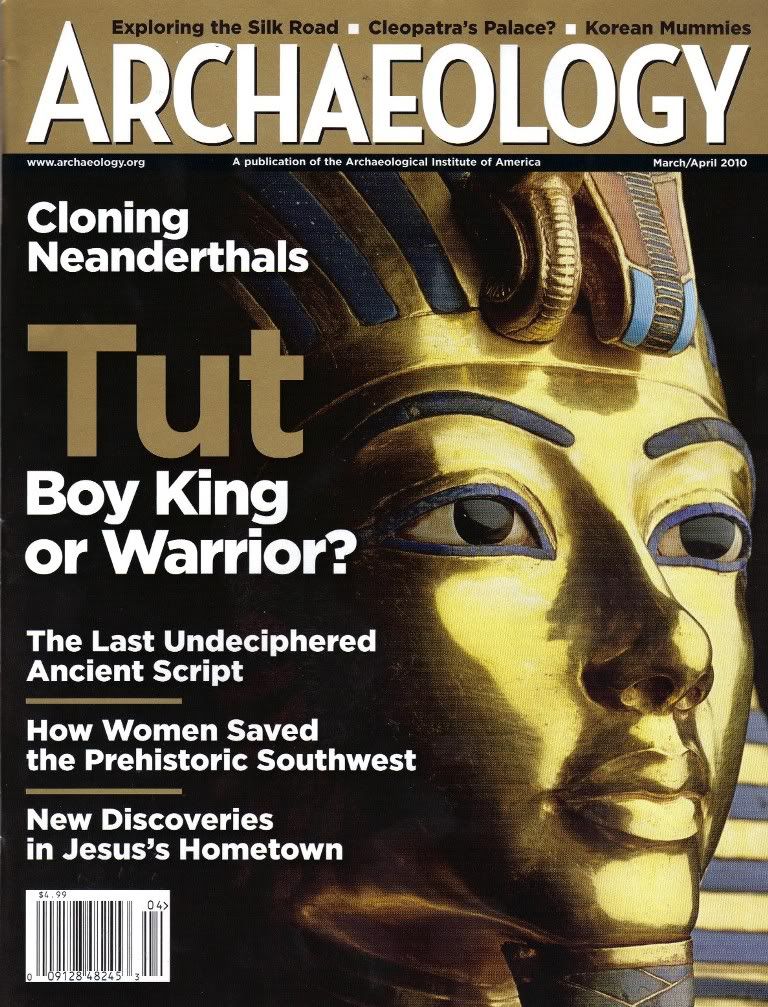
The March/April '10 issue of Archaeology magazine has some particularly fine articles in it; anyone who is interested in the debate over whether we should clone Neanderthals (which may soon be possible) should really love this issue. One other article that ethralled me was written by Hyung-Eun Kim about the discovery and translation of family letters and personal items placed with entombed body of a Korean gentleman who died in the 16th century. One of the 424 year old letters, written by his pregnant, devastated wife, was used to cover the body like a shroud. Love and loss never changes; despite the centuries that have passed the letter sounds as if it were composed yesterday.

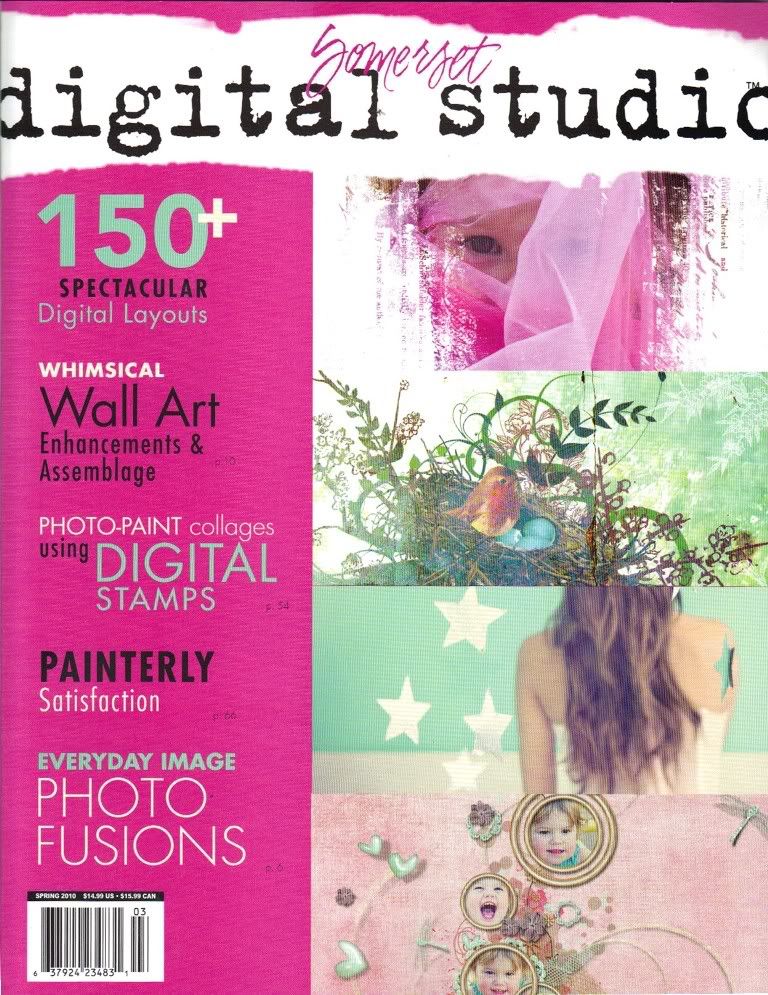
I am quickly becoming addicted to just about everything Stampington & Company publishes, and their Spring 2010 issue of Somerset Digital Studio has so much phenomenal digital art it should be on the must-buy list of all digital artists and writers who create their own cover art. I got some great ideas of how to move in some different directions with my digital art, especially with layering, which I've always been a little timid about trying. Also of particular note: The Charm of Darkness and the Search for Precision, an article showcasing Maro van Middendorf's art (you can see some of the images in his website gallery here) as well as a great look at Vanessa Paxton's incredible photography (I dare you to look at Invisible Walls on page 83 and not be inspired to write something.)
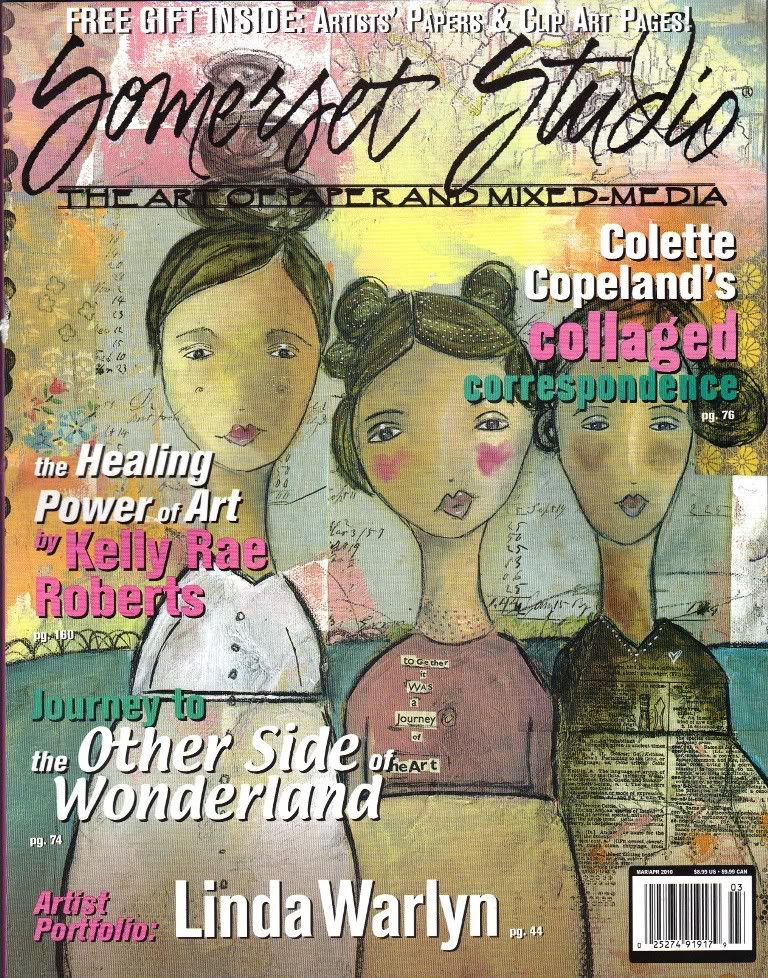
Finally, one of the magazines that has been extremely helpful in transforming my art journaling, Somerset Studio, has the usual great variety of content. I've been picking up magazines and books about mixed media for a while now as I am trying to do more non-traditional art quilts. I'm also about to start on my first assemblage piece and frankly I'm terrified, so anything helps. Why I think this issue is also good for writers is one of the best articles I've read in a long time about the healing power of art by Kelly Rae Roberts. If you ever doubt the meaning what we create has for others, you really need to read this.

What magazines do you read and/or subscribe to that inspire you? Let us know in comments.

Added: Ayla mentioned in comments that it is tough to impossible to get some magazines overseas, so I did some hunting and found that Vanessa Paxton also has a Flickr account. Here's where you can see Invisible Walls online.

Saturday, January 23, 2010

In the Trades

The February issue of The Writer was a bit of a wash this month. Several articles in the issue focused on self-publishing, but I didn't feel they presented the reality and downsides as well as they might have. It's nice to hear about the handful of authors who make it big via self-publication, but hard stats on how many don't make it, how few writers earn back their investment, and exactly how time-consuming and aggravating the self-pub process can be would have provided more balance.

On the plus side, there are the six pages in the back with 47 concise agent listings with the latest contact info, query specs and so forth. It was a last-minute redemption, but it saved the issue for me.

Poets & Writers magazine was also a downer this month, as their Jan/Feb inspiration-themed issue was not at all genre-friendly. Granted, they're celebrating their 40th anniversary, and they're firmly entrenched in the lit pit, but I think genre deserved at least a nod (and of course, I'm prejudiced, but there you go.) I think the pages devoted to congratulating winners of grants and awards should be eliminated entirely. Vanity year book pages were cute in high school; in a writer's magazine they're a waste of good space.

What saved this issue from the trashcan was one article about writer's block by Dennis Cass, How to Get Unstuck (checking P&W's site to see if they have a free copy of it online. And they don't, rats.) Dennis explains the psychology of writer's block from a cognitive perspective, and the exact mechanism of thought that may cause so many writers suffer from it. I'm not a fan of writer psychology, because a lot of it seems to me like dressed-up excuses for Lazyass Syndrome. That said, this is the first time the problem has been defined in such a way that I finally understand and see it as a legit process. I'll also never look at a pair of pliers the same way again.

Regarding the shrinkage of the trades in general, I know most print magazines now are a lot thinner because they're not getting as many advertisers. This is good and bad; I can live without the ads but there are several magazines I don't want to see disappear, and The Writer and P&W are two of them. At the same time, I think both magazines could up the practical quality of their content. So:

P&W: It's all well and good to wax-on wax-off about how wonderful and frightful and life-changing the literary experience is, but enough already. If we want more, we'll just go hang with the laptop coffee shop brigade. FYI on your list of the 50 most inspiring living authors, there are plenty of genre authors who have also shaken up the industry, started trends, created readers where there were none before and inspired innumerable other writers. Off the top of my head: Sue Grafton. John Grisham. Thomas Harris. Linda Howard. Stephenie Meyer. And for that matter, you put Susanna Clarke on your list, but not J.K. Rowling? Not that I mean to be rude, but really, what planet are you guys living on? This eye-to-ceiling whistling you do while you pretend genre isn't in the room is unworthy of you.

The Writer: You've been better than most of the writer trades, so don't blow it now and turn into another Writer's Digest. Please, we beg you. One is already one too many. As working writers we want facts, market info, tools that actually work and a practical GPS for the career. The nuts and bolts stuff is the reason why most writers buy or subscribe to the trades, and now more than ever we need that kind of content. Writers are poor, and we can't afford magazines that don't work for us. So quit with the advertiser-slanted stuff and work for us.

Not that I think anyone is going to listen to me, but just in case Kevin Larimer or Jeff Reich are Googling their names today, there are my two pennies.

Thursday, August 27, 2009

P&W This Month

The Sep/Oct '09 issue of Poets & Writers magazine is a particularly good one; there's an article on and interview with Georges Borchardt that is worth the entire cover price. Mr. Borchardt has been a literary agent for more than 50 years, and has represented or worked with writers like Elie Wiesel, Samuel Beckett, and Jean-Paul Sarte. He's really seen it all, and has a lot of fascinating observations about the biz. If you can't get the print issue of the mag, you can read the interview with him for free online here.

Independent presses got a special section of their own in the mag, along with an article on chapbooks, chapbook publishers looking for work, nine notable indies accepting submissions, and two illustrated tutorials on how to stab-stitch bind or tape-bind a chapbook of your own. For you literary short story writers, they have a profile on Tin House magazine, along with insight from the editors and specific advice. Lots of stuff for you poets out there, too. More can be found and read for free online at P&W's article index here.

Sunday, April 19, 2009

Flash Me

The May issue of The Writer has an insider's guide to flash fiction by Mary Miller, along with a short list of info on seven flash fiction markets: Elimae, Hobart, Juked, Quick Fiction, Smoke Long, Subtropics, and Wigleaf. No payment info offered, but if you're a flasher, check out the web sites for more details.

Our blogpal Simon Haynes got a double mention in this issue as well; Scott Rhoades listed his yWriter and Sonar freeware in his article Great Software that Won't Cost You a Dime.

Poets & Writers magazine May/June issue has a big splashy article on author Jay McInerney and his well-publicized woes and trimuphs, but I liked the indepth article about author Joe Meno and how he survived what was supposed to be the end of his writing career. He did it by selling a novel his former major publisher and twenty others had passed on to an indie upstart publisher. What's interesting about Joe's story is that he's a literary writer, but was considered washed up after his first two novels sold fewer than 3K copies each. I've heard of that happening with four or five books, and once in a while with three, but given only two shots? Given the amount of competition, especially in the lit end of the biz, and the fact that very few books earn out anyway, I think that's unrealistic.

I'm just curious -- how many chances (as in published books) do you guys think a writer should be given to turn a profit for a publisher?

Monday, February 02, 2009

Agents In the Trades

The February 2009 issue of The Writer magazine has a couple of very useful features this month: 53 detailed listings for agents, including contact info and what they're looking for in submissions (if you're shopping for an agent, this alone makes it worth the cover price.) There's a mini-interview with my agent, Robin Rue of Writer's House, included in the section. They've also interviewed five agents and asked them for advice on what they think writers can do to succeed in a tough market (like it was ever easy.) Kelly James-Enger has an excellent article on blogging for bucks that explains a couple of ways to break into the online market, and Deborah Niemann-Boehle has a short article with valuable tips on how to become a stringer for your local newspaper.

I've always liked The Writer even when they fly off into WriterLaLaLand, but in this issue they've really shown a committment to addressing more of the issues working writers have. I hope this trend continues.

In the Jan/Feb 09 issue of Poets & Writers, Jodie Ferrari-Adler talked with four young literary agents: Julie Barer, Jeff Kleinman, Renee Zuckerbrot and Daniel Lazar (Daniel is also with Writers House; he's the handsome guy in the center on the front cover pic) about the writing they want to see, where they're finding it, what they love, hate, and ten things writers should never do. But even if you don't want to hear what agents say after they've been wined and dined, about half of P&W is devoted to grants & awards and market listings, which they feature every month.

P&W is definitely geared more toward the literary writer, and I doubt that will change, but they're classy and informative, something you usually don't find at that end of the market. I think they also offer more market, grant and awards listings than any of the other trades.

I'm going to send my copies of both issues to one of you guys; in comments to this post name something related to writing or publishing that you'd like to read about or find more information on (or if you can't think of something, just toss your name in the hat) by midnight EST on Tuesday, February 3, 2009. I'll draw one name from everyone who participates and send the winner both magazines (read once by me) as well as a surprise. This giveaway is open to everyone on the planet, even if you've won something here at PBW in the past.