Ten Things to Help with Creating Character Names
Briam Klems's 7 Rules of Picking Names for Fictional Characters.
Use the search engine at Behind the Name to find the origin and meaning of a first name.
The Character Name Generator will help you generate a name and a personality for your character (you can also customize with several ethnicities and birth eras.)
To figure out who your character is (which can help you come up with a good name for them) try Rick Hamper's Character Profile Sheet.
How writer Mervyn Love uses maps to name his characters (which has historic roots in actual, real-world naming.)
Need a name that means something secret or mysterious? Here you go.
Find out what your naming personality type is with this name quiz from Name Nerds.
Seventh Sanctum has twenty-four different generators here to help you name everything from an angel to a vampire.
Try my telephone book name game here to exercise your character profiling skills.
Find names from all over the globe at YeahBaby.com.
Monday, June 30, 2014


Sunday, June 29, 2014
A Dovely Visit
So far this year we haven't found any birds nesting on our property, likely due to some recent construction nearby and a persistent hawk who has taking a liking to our backyard. On one hand it's nice to have a break from worrying about the babies tumbling out of the nests their Mamas build in strange spots, on the other I do miss seeing the little ones born and grow and take their first flight. But something I saw the other day made me think the doves haven't forgotten us:

From her color and size I think she's one of last year's youngsters, come to visit the old nest (which I did ask my guy to clean off but he forgot and then I forgot to remind him.) She sat up there for quite a while, and didn't show any fear of me when I came out to snap a few shots:

Will she be raising her own brood in the old nest? I'm not sure, but she certainly has that look in her eye:

From her color and size I think she's one of last year's youngsters, come to visit the old nest (which I did ask my guy to clean off but he forgot and then I forgot to remind him.) She sat up there for quite a while, and didn't show any fear of me when I came out to snap a few shots:
Will she be raising her own brood in the old nest? I'm not sure, but she certainly has that look in her eye:
Saturday, June 28, 2014
Finished (For Now, Anyway)
After much dithering I decided to edit and finish my Just Write Thursday story, Managed, now retitled Breath of Ice. I also made it into an e-book, which you can get in .pdf format by clicking on the cover art:

I'm not finished Yet -- okay, couldn't resist the pun -- so I'll probably extend this into a novella or novel, or make it the first of a story trilogy (the possibilities need to percolate a bit longer.) In the meantime, I've also uploaded a copy of my story edits here with tracked changes, in case anyone wants to see what I do with a rough draft.
This was a lot of fun; I've had Steph and Yet in the back of my mind for a long time, and it was good to get them out on the page and see what they could do.
I'm not finished Yet -- okay, couldn't resist the pun -- so I'll probably extend this into a novella or novel, or make it the first of a story trilogy (the possibilities need to percolate a bit longer.) In the meantime, I've also uploaded a copy of my story edits here with tracked changes, in case anyone wants to see what I do with a rough draft.
This was a lot of fun; I've had Steph and Yet in the back of my mind for a long time, and it was good to get them out on the page and see what they could do.
Friday, June 27, 2014
Sew True
To make this video Christophe Thockler used 10,000 photos, 1 km of thread, 73,000 embroidery stitches, 6 kg of scraps of fabric and 100 needles and sewing pins. I think he also took a peek at some of my dreams (includes music and singing, for those of you at work):
Thursday, June 26, 2014
Just Write
Today I'm off to write something new and post it online before midnight. Everyone inclined to do the same is invited to join me.

For more details on Just Write Thursdays, click here to go to the original post.
My Link: Managed Part 4 (you can read Part 3 here, Part 2 here and Part 1 here)
Image credit: Sergey Nivens/Bigstock.com
For more details on Just Write Thursdays, click here to go to the original post.
My Link: Managed Part 4 (you can read Part 3 here, Part 2 here and Part 1 here)
Image credit: Sergey Nivens/Bigstock.com
Wednesday, June 25, 2014
Sub Op
Dark Opus Press has an open call for their upcoming fourth annual antho, All That's Left of Yesterday, and they want to see "stories of the apocalypse, whether it be caused by disease, natural disaster, economic collapse or something else entirely, it's up to you. However, we won't be looking for zombie stories. Zombies will be saved for another anthology. As usual, we will not be accepting poetry, reprints or artwork for this anthology. Our guidelines are simple. All stories must have a dark bent to them and be between 2,000 and 5,000 words." Payment: "Payment for accepted works will be a 1 cent a word US, plus one copy." No reprints, electronic submissions only, see guidelines for more details. Reading period opens July 1st, 201; do not submit prior to that date. Deadline: July 31st, 2014.
Tuesday, June 24, 2014
By the Book
Reading a book in order to learn to do something is nothing new; throughout history knowledge has been preserved and passed along to future generations in book form. People who are book learners tend to seek instruction and understanding of something that they might not otherwise encounter in the course of their daily lives; it's also a very economical form of education for those who can't afford the formal variety.
When a book is both classroom and teacher much of the stress of learning can be eliminated from the equation. A book doesn't give you detentions for not getting your homework done; it always allows you to absorb information at your own pace. There is no competition for the book's attention, either; you're always its only student. Unlike a teacher a book also has no opinion of you, so it is the most unbiased of instructors.
The only major downside I see to learning anything from a book is that you have to be fully committed to learning by reading, and keep that committment. As in the book is not going to call your mom and rat you out for not doing your lessons.
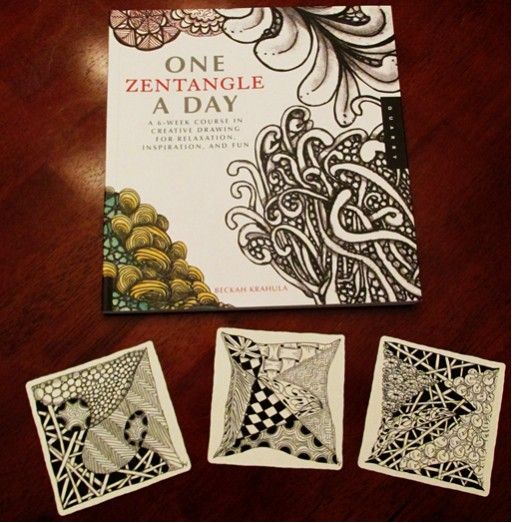 Zentangles are a meditational art form created by doodling repetitive patterns in a small space. While I've been making this sort of art since childhood I've never taken any formal/proper instruction, so I found my way to One Zentangle a Day by Beckah Krahula. this how-to book. I picked it up primarily because of the subtitle: A 6-Week Course in Creative Drawing for Relaxation, Inspiration and Fun, but when I flipped through the pages at the book store I also liked the simple format of the lessons, all of which are accompanied by several illustration and photo examples.
Ms. Krahula begins with an introduction the defines Zentangles and the art supplies she uses to create her own. She also talks about the spiritual comfort she gained from practicing meditational art. She began Zentangling while recovering in the hospital from a major health issue, and that provided some invaluable insight into the benefits of the artform for me. I doodle most when I'm under a great deal of stress, as it's naturally relaxing for me. Now I know why.
I read the entire book before I began the lessons, and with each day's instructions Ms. Krahula offers great tips and technical discussion for the entire six weeks. The materials needed to work through each lesson are listed along with a detailed breakdown of whatever technique she's teaching along with example pictures. The instructions for the day's lesson are very simple and flexible and I think anyone, no matter what sort of experience they have with art, can easily follow the course. With the book pic I've posted you can see three examples of the Zentangles I've made while following the lessons. I think the most valuable things I've learned so far are consistency, how to give up control in order to be more spontaneous (a real challenge for me) and strategic shading to improve the look of the end result.
Art resets me emotionally to a better perspective and gives me a sense of well-being unlike anything else I do creatively, probably because I do it just for myself. Creating art can be stressful for others, especially if their past artistic efforts have left them feeling unskilled or otherwise inadequate, so this might not be a good book for anyone who actively avoids art for those reasons. If you haven't been successful with art in the past but are still open to learning, however, I think Zentangles are a wonderful way to try again.
When a book is both classroom and teacher much of the stress of learning can be eliminated from the equation. A book doesn't give you detentions for not getting your homework done; it always allows you to absorb information at your own pace. There is no competition for the book's attention, either; you're always its only student. Unlike a teacher a book also has no opinion of you, so it is the most unbiased of instructors.
The only major downside I see to learning anything from a book is that you have to be fully committed to learning by reading, and keep that committment. As in the book is not going to call your mom and rat you out for not doing your lessons.
Zentangles are a meditational art form created by doodling repetitive patterns in a small space. While I've been making this sort of art since childhood I've never taken any formal/proper instruction, so I found my way to One Zentangle a Day by Beckah Krahula. this how-to book. I picked it up primarily because of the subtitle: A 6-Week Course in Creative Drawing for Relaxation, Inspiration and Fun, but when I flipped through the pages at the book store I also liked the simple format of the lessons, all of which are accompanied by several illustration and photo examples.Ms. Krahula begins with an introduction the defines Zentangles and the art supplies she uses to create her own. She also talks about the spiritual comfort she gained from practicing meditational art. She began Zentangling while recovering in the hospital from a major health issue, and that provided some invaluable insight into the benefits of the artform for me. I doodle most when I'm under a great deal of stress, as it's naturally relaxing for me. Now I know why.
I read the entire book before I began the lessons, and with each day's instructions Ms. Krahula offers great tips and technical discussion for the entire six weeks. The materials needed to work through each lesson are listed along with a detailed breakdown of whatever technique she's teaching along with example pictures. The instructions for the day's lesson are very simple and flexible and I think anyone, no matter what sort of experience they have with art, can easily follow the course. With the book pic I've posted you can see three examples of the Zentangles I've made while following the lessons. I think the most valuable things I've learned so far are consistency, how to give up control in order to be more spontaneous (a real challenge for me) and strategic shading to improve the look of the end result.
Art resets me emotionally to a better perspective and gives me a sense of well-being unlike anything else I do creatively, probably because I do it just for myself. Creating art can be stressful for others, especially if their past artistic efforts have left them feeling unskilled or otherwise inadequate, so this might not be a good book for anyone who actively avoids art for those reasons. If you haven't been successful with art in the past but are still open to learning, however, I think Zentangles are a wonderful way to try again.
Monday, June 23, 2014
Offline for Now

It's June, which means it's either raining, thundering, lightning or all three here -- and our broadband doesn't like any of them. Once I can keep a connection long enough to upload my posts I'll be back to catch up. My apologies for any inconvenience this may cause.
Sunday, June 22, 2014
Winner
The winner of The Gift of You giveaway is:
Faithrenfield, who wrote A gardening journal would be great inspiration for me during the long, cold winter months. It's something I vow to do each year, but then when warmer weather hits, I instead spend all my free time in the garden instead of writing about my few triumphs and my many gardening failures. But if the journal were already there, a gift that I'd feel compelled to use . . . .
Faith, when you have a chance please send your ship-to info to LynnViehl@aol.com so I can get this package out to you and start compelling you to journal. :) My thanks to everyone for joining in.
Faithrenfield, who wrote A gardening journal would be great inspiration for me during the long, cold winter months. It's something I vow to do each year, but then when warmer weather hits, I instead spend all my free time in the garden instead of writing about my few triumphs and my many gardening failures. But if the journal were already there, a gift that I'd feel compelled to use . . . .
Faith, when you have a chance please send your ship-to info to LynnViehl@aol.com so I can get this package out to you and start compelling you to journal. :) My thanks to everyone for joining in.
Saturday, June 21, 2014
The Gift of You
Now that I've shown you probably more than you ever wanted to know about journaling, I'm going to wrap up Journal Week with a giveaway. Not just yet, as I'm not quite finished with the nagging part.
Lots of writers have kept journals, but you don't have to be a writer to keep a journal. You don't have to be an artist, either. You don't even have to handwrite it; you can type your journal. Or dictate it in audio form, if you prefer. The only requirement of journaling is for you to be you, and to preserve some of who you are, what you experience, think, feel, believe, create, witness, dream -- and if you're not sure what that is, all the things that go on behind your eyes is a good place to begin looking. So is the world around you. And all those other people in your life, they can go into it. The work you do, the places you go, and anything that has meaning to you are likewise excellent material.
Or not. You can make up everything as you go along. Your journal is a journey into yourself, and no one else is involved, so it can be anything you want. For Paulus Beresohn it's a portable studio. For me it's a neverending story of me and my world (and for once I never have to come up with an ending.)
Why is this so important? For starters, there is no one out there in the world like you. In fact there never has been, and there never will be again. In this time you're alive and working and doing things, and I bet you hardly ever think much about how singular you are. You may not think you're important, and you may even worry that you have no particular gift for anything so it's not worth keeping a journal -- but you're wrong. As I was telling a friend last week, you are the gift you bring to this world.
How precious is the gift of you? I can't tell you because I don't know. And you'll never know, either. Just as Anne Frank could never know how many millions of people would read -- and be inspired -- by her diary. Or Samuel Pepys could imagine his journals would survive over three hundred years to open a window to the distant past for historians. Anne and Samuel had an advantage over us, you know. Nothing in their times was digital or virtual so they had to write it down on paper.
That's the other thing. Sometimes I wonder how much of our lives and our time the world will lose if all this lovely technology one day goes boom and can't be recovered. This week Facebook shut down for a couple of hours and people completely freaked; what if it all goes away forever? What will be lost for eternity because someone couldn't be bothered to print it out -- or write it down?
It isn't so much about the world for me as it is what happens when my time here is finished. I write my journals for myself, but when I go, I'm leaving part of myself behind in them. I don't know how long they'll survive me, and frankly? I can't know that so I don't care. If they provide some comfort and insight and inspiration to the loved ones I leave behind, that's great. If they help someone else further down the line, even better.
I don't expect everyone who reads this to start a journal tomorrow. What I hope is, you'll think about it. Seriously. Nagging finished now.

As inspiration for one of you I've put together this giveaway, which includes a copy of the Summer 2014 issue of Pages magazine, Zentangle workbook edition #9, a Strathmore Mixed Media Visual Journal, a Zentangle pen & pencil & tile set, a pocket edition of Keri Smith's Wreck This Journal, and this gorgeous handmade needle-felted journal from beautifulplace. If you'd like to win the lot, in comments to this post name something you'd write about in your journal by midnight EST tonight, June 21, 2014. I'll choose one name at random from everyone who participates and send the winner all this cool journal stuff. This giveaway is open to everyone on the planet, even if you've won something here at PBW in the past.
Lots of writers have kept journals, but you don't have to be a writer to keep a journal. You don't have to be an artist, either. You don't even have to handwrite it; you can type your journal. Or dictate it in audio form, if you prefer. The only requirement of journaling is for you to be you, and to preserve some of who you are, what you experience, think, feel, believe, create, witness, dream -- and if you're not sure what that is, all the things that go on behind your eyes is a good place to begin looking. So is the world around you. And all those other people in your life, they can go into it. The work you do, the places you go, and anything that has meaning to you are likewise excellent material.
Or not. You can make up everything as you go along. Your journal is a journey into yourself, and no one else is involved, so it can be anything you want. For Paulus Beresohn it's a portable studio. For me it's a neverending story of me and my world (and for once I never have to come up with an ending.)
Why is this so important? For starters, there is no one out there in the world like you. In fact there never has been, and there never will be again. In this time you're alive and working and doing things, and I bet you hardly ever think much about how singular you are. You may not think you're important, and you may even worry that you have no particular gift for anything so it's not worth keeping a journal -- but you're wrong. As I was telling a friend last week, you are the gift you bring to this world.
How precious is the gift of you? I can't tell you because I don't know. And you'll never know, either. Just as Anne Frank could never know how many millions of people would read -- and be inspired -- by her diary. Or Samuel Pepys could imagine his journals would survive over three hundred years to open a window to the distant past for historians. Anne and Samuel had an advantage over us, you know. Nothing in their times was digital or virtual so they had to write it down on paper.
That's the other thing. Sometimes I wonder how much of our lives and our time the world will lose if all this lovely technology one day goes boom and can't be recovered. This week Facebook shut down for a couple of hours and people completely freaked; what if it all goes away forever? What will be lost for eternity because someone couldn't be bothered to print it out -- or write it down?
It isn't so much about the world for me as it is what happens when my time here is finished. I write my journals for myself, but when I go, I'm leaving part of myself behind in them. I don't know how long they'll survive me, and frankly? I can't know that so I don't care. If they provide some comfort and insight and inspiration to the loved ones I leave behind, that's great. If they help someone else further down the line, even better.
I don't expect everyone who reads this to start a journal tomorrow. What I hope is, you'll think about it. Seriously. Nagging finished now.
As inspiration for one of you I've put together this giveaway, which includes a copy of the Summer 2014 issue of Pages magazine, Zentangle workbook edition #9, a Strathmore Mixed Media Visual Journal, a Zentangle pen & pencil & tile set, a pocket edition of Keri Smith's Wreck This Journal, and this gorgeous handmade needle-felted journal from beautifulplace. If you'd like to win the lot, in comments to this post name something you'd write about in your journal by midnight EST tonight, June 21, 2014. I'll choose one name at random from everyone who participates and send the winner all this cool journal stuff. This giveaway is open to everyone on the planet, even if you've won something here at PBW in the past.
Friday, June 20, 2014
Soul's Kitchen
Why journal? Why make journals? I'll let Paulus Berensohn explain (narrated by the artist and his students, with some background music, for those of you at work):
Soul's Kitchen from TOTM Film on Vimeo.
Thursday, June 19, 2014
Just Write
Today I'm off to write something new and post it online before midnight. Everyone inclined to do the same is invited to join me.

For more details on Just Write Thursdays, click here to go to the original post.
My link: Bequest part 1
Image credit: viczast/Bigstock.com
For more details on Just Write Thursdays, click here to go to the original post.
My link: Bequest part 1
Image credit: viczast/Bigstock.com
Wednesday, June 18, 2014
One-Sheet Journal
For Journaling Week I decided to test-drive Rachelle Panagarry's mini-zine project from the Summer issue of Pages magazine. There is no binding, gluing or any special technique involved except folding, and it's so simple I think anyone can do it.
Here's a slideshow of my first try, along with simple instructions to go with each pic.
1. To make this you'll need a sheet of letter-size paper and a pair of scissors. I used some old printer paper.
2. Fold your paper in half both ways, which divides the paper into four equal sections.
3. Fold the long ends of your paper over so that the ends are even with the center fold, and create eight rectangular sections.
4. Fold your paper by the long ends and cut the center fold up to the next intersecting fold. Stop there.
5. Open and refold your paper the other way (by the short ends) and stand it up like a tent.
6. Take the ends and push them toward the center to form a plus sign with the paper.
7. Place your plus sign down and press flat.
8. Fold over in half.
9. You've got a mini-journal.
10. The reason this project is so cool is that you can unfold your journal once it's finished and copy it (which is why Ms. Panagarry makes hers into little zines to share with friends.) Here's my first picture journal, and the two copies I made for extras:
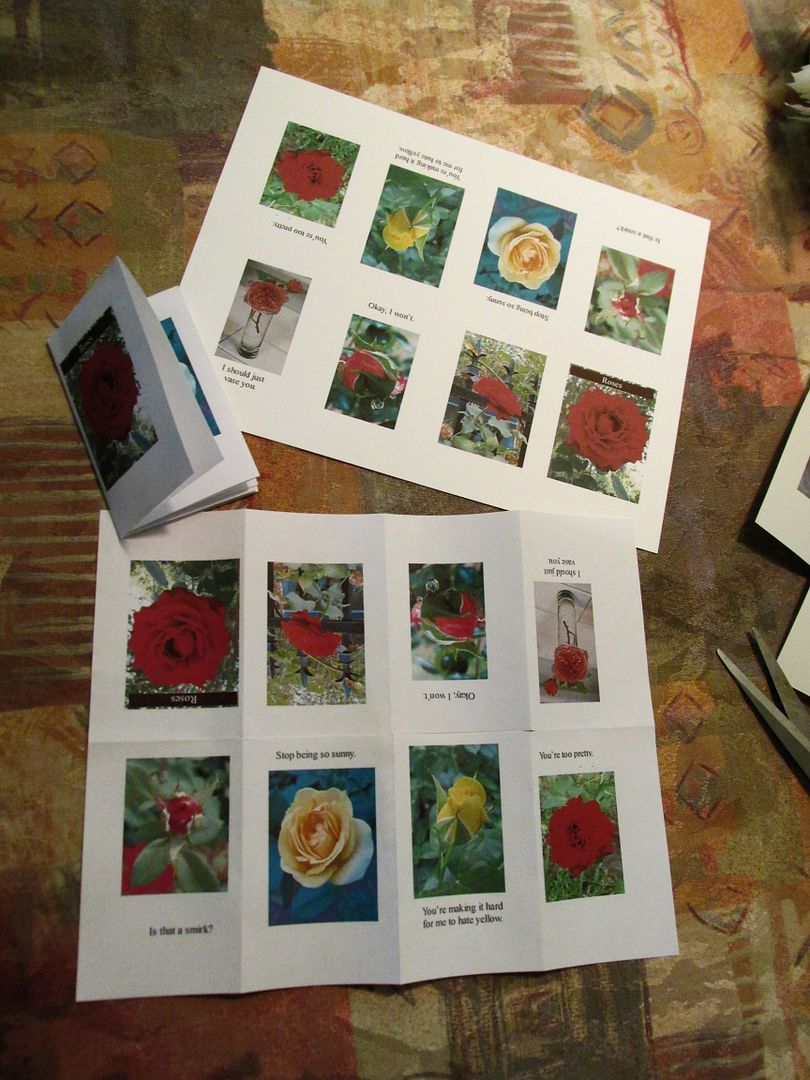
Some project tips: for best results, match your edges exactly and crease your folds well. If you're making a journal out of something that already has content printed on it, your content should be face-down as you do steps 1-3, then face out from steps 4-8. Do one blank book first to figure out how the pages are oriented (front and back covers are the first two rectangles on the upper left side of the paper, for example. Also, half your pages are upside down to the other half.)
If you want to print something on your paper before you fold it, you might so a black and white version first to make sure you have everything arranged correctly (I didn't size a couple of my pics correctly, so this saved me some color ink.)
Here's a slideshow of my first try, along with simple instructions to go with each pic.
1. To make this you'll need a sheet of letter-size paper and a pair of scissors. I used some old printer paper.
2. Fold your paper in half both ways, which divides the paper into four equal sections.
3. Fold the long ends of your paper over so that the ends are even with the center fold, and create eight rectangular sections.
4. Fold your paper by the long ends and cut the center fold up to the next intersecting fold. Stop there.
5. Open and refold your paper the other way (by the short ends) and stand it up like a tent.
6. Take the ends and push them toward the center to form a plus sign with the paper.
7. Place your plus sign down and press flat.
8. Fold over in half.
9. You've got a mini-journal.
10. The reason this project is so cool is that you can unfold your journal once it's finished and copy it (which is why Ms. Panagarry makes hers into little zines to share with friends.) Here's my first picture journal, and the two copies I made for extras:
Some project tips: for best results, match your edges exactly and crease your folds well. If you're making a journal out of something that already has content printed on it, your content should be face-down as you do steps 1-3, then face out from steps 4-8. Do one blank book first to figure out how the pages are oriented (front and back covers are the first two rectangles on the upper left side of the paper, for example. Also, half your pages are upside down to the other half.)
If you want to print something on your paper before you fold it, you might so a black and white version first to make sure you have everything arranged correctly (I didn't size a couple of my pics correctly, so this saved me some color ink.)
Tuesday, June 17, 2014
The Art of Journals
 There is an art to journaling, but there's also an art to making journals. Kristen Evans of FirebirdHouse is reinventing books by hand-making journals, and she's got a wonderful approach. Here you can see an example of her craft; a lovely little hand-stitched pocket journal that fits neatly into a wonderful antique tin box. I recently acquired this one when I discovered FirebirdHouse on Etsy.com via a search for handmade journals, which is something I do all the time.
 Sometimes I give these journals away (and I do think handmade journals make excellent gifts, especially for kids) but mainly I buy them for myself. I use journals every day, and my entries are not what you'd call brief. When I can hand-write in them I do, or I'll dictate an entry to the computer, print it out and glue it onto a journal page. My journals serve as my repositories for my photos, sketches, various bits of life ephemera, lists, story ideas -- pretty much anything I can fit into them. I also write letters to some of my writer pals in journal-form. I usually have at least two and often three journals going at once, and I can fill one up in as little as two or three days, so I am constantly in need of new journals.
Because I use so many during the year I've always purchased mass-produced blank books or made my own. Since art journaling became popular, however, I've discovered and come to appreciate the fine art of journal-making, and this resulted in a neat little collection. A journal doesn't have to be arty to be useful, but it adds something to the mix. I know from those I've made myself how much thought and time and care goes into this kind of handwork. Adding my content also makes me feel less like I'm using something to write and more like I'm collaborating with another artist.
Here's one of the more unusual journals in my collection:

This lovely little bundle is a needle-felted wool journal from beautifulplace, and it's absolutely a work of art. Here's a look inside:

I have never seen anything like beautifulplace's enchanting journals; they seem more dream-spun than made.
Because I like unusual journals I often look for something different, like this recent acquisition from LaVerne Johnson at Riverside Studios:

LaVerne took a vintage book, turned down the pages and formed them into pockets, in which you can save all sorts of bits and pieces. Repurposing an old book like this is a terrific way to recycle unwanted things into new art.
In addition to the arty kind I also like very precisely-made journals, and I've yet to find anyone who can turn out a better-made book than Jodi Green at Levigator Press. Her artwork is amazing, her binding is phenomenal, and the corners on her journals are trimmed to perfection. She also frequently uses unusual, recycled papers in her journals so they're always a surprise, and provide interesting spaces in which to write:


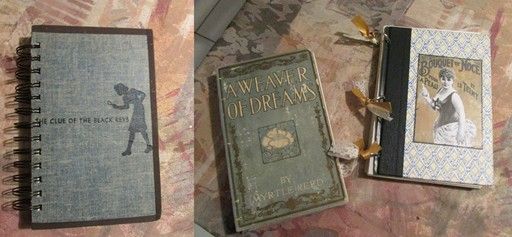
Of all the journals I collect I probably invest most often in those that in someway use recycled materials like Jodi's work; I especially love journals made from old books. Here are some examples of those (from left to right, a repurposed Nancy Drew novel journal by Heavensentcrafts, a hand-stitched journal with repurposed book covers by FirebirdHouse and a ring-bound mixed-media journal by LovelyFever):
As I mentioned I make my own journals, too, primarily by recycling or repurposing materials. I like to challenge myself, so I've made journals out of index cards, playing cards, and even a spiral-bound mini notebook. I think my best/most original project was the journal I made by painting the pages of an old book with regular and metallic watercolors:

Prices for handmade journals are generally higher than what you'd pay for the mass-produced variety, and some can be very expensive (leather-bound journals tend to be very pricey), but to me owning something handmade by an independent artist is worth some extra $$$. If you can't afford to invest in one right now, stick around -- at the end of this week I'll be holding a giveaway that will include a handmade journal from one of my favorite artists.
Monday, June 16, 2014
Journaling Week Ten
 I have a theme for this week on PBW, and it's all about journals -- types, how to make them, starting one, where to buy them, software, what to put in them, why they're important, etc. You're already riveted, I can tell. Stick with me anyway; I think you'll enjoy it. Meanwhile, let's start off with
 Ten Things about Diaries and Journals
Largest? The record for keeping the world's longest (or largest) personal diary might belong to Reverend Robert Shields, who on a whim began one in 1972 and wrote in detail about himself and every day of his life until 1997, when a stroke disabled him. He then turned his opus, which had to be packed up in 91 boxes, over to a university. Exactly how long is it, and is it a good read? Actually it'll be a while before we know. Rev. Shields donated it to the university in 1999 with the stipulation that no words would be counted and it would not be read until 50 years after his death.
Longest Run: Not all journals are personal; some are medical or even scientific, like The Philisophical Transactions of the Royal Society, which has been published continuously since the first issue came out in 1665. Contributors to the journal include some guys who went on to become pretty famous, like Charles Darwin, Michael Faraday and Isaac Newton.
Edited: Alice in Wonderland author Lewis Carroll, aka Charles Dodgson, kept diairies for most of his life. However, since his death some of them have disappeared, and others show signs that pages were deliberately removed. No one knows what happened or who was responsible for this, but scholars think his family should be blamed in what was likely an effort to remove controversial content, possibly relating to his fascination with Alice Liddell, the eleven-year-old inspiration for his famous character. Or maybe Dodgson arranged to have it done for the same reasons? We'll probably never know.
Everyone Has a Copy: With 31 million copies sold in 67 languages, The Diary of a Young Girl, aka The Diary of Anne Frank is often said to be the second-most widely read book in the world (Number one? The Bible.)
Nothing Personal: Artist and all-around Renaissance dude Leonardo da Vinci kept notebook-style journals all his life, and may have produced as much as 80,000 pages of notes, sketches and ideas on art, architecture, anatomy, botany, engineering, inventions, landscapes, mathematics, painting, perspective, philosophy, physiology, proportion, warfare and zoology. Basically Leonardo never met an idea he didn't put in his journal. Yet in all of those that survived, he wrote only two things in them about his personal life -- and both related to the death of his father.
Oldest: Since a number of ancient journals have survived there's a great deal of debate on what is the oldest still in existance. I vote for the diaries that were kept by the Babylonians; they date back to 652 BCE.
Pricey: Leonardo da Vinci's Codex Hammer journal was sold at auction in 1994 for $30,802,500. Who was the buyer? Microsoft's multigazillionaire Bill Gates, who three years later released a digitally scanned version to share it with the rest of the world. Nice going, Bill.
Strangest: In addition to penning and illustrating a 15,145-page single-spaced fantasy fiction manuscript (which was pretty disturbing on its own), reclusive outside artist and author Henry Darger also wrote an eight-volume autobiography entitled The History of My Life. For the first 206 pages Darger actually did write about his childhood before he fell off the wagon, slipped back into his fantasy world and wrote another 4,672 pages of fiction about a tornado he witnessed in 1908, which he called "Sweetie Pie."
The Pepys Code: No doubt you've heard that one of the most historically important diaries ever written belonged to 17th century English businessman Samuel Pepys, who used it to chronicle ten years of his life. The reason this diary is so important is that it provides a first-hand account of what life was like in London during the 1660's. What most people don't know is that Pepys wrote the diary in a type of shorthand of his era called tachygraphy, and before anyone could read what he wrote it had to first be translated into readable English.
Writerly Habit: Many other authors have been devoted journalers; among the more notable are Ray Bradbury, Joan Didion, Franz Kafka, C.S. Lewis, Anaïs Nin, Sylvia Plath, Susan Sontag and Virginia Woolf. Why do authors journal? Maybe Jonathan Franzen, another journal addict, explained it with this quote: I had started keeping a journal, and I was discovering that I didn’t need school in order to experience the misery of appearances.
Image credit: Sergey Nivens/Bigstock.com
Sunday, June 15, 2014

Saturday, June 14, 2014
Sub Op
Here's an open call from Circlet Press for their upcoming YA urban fantasy antho Schoolbooks & Sorcery, and the editor is looking for "YA urban fantasy stories which incorporate the themes of sorcery, magic, and enchantment. The magic can come from within, as an intrinsic ability or a family trait, or from without, in the form of talismans, training, or teaching. Protagonists can be wizards, witches, sorcerers, magicians, shamans, apprentices, or practitioners of more esoteric traditions. Whether they pick it up on their own (accidentally or on purpose), learn from a master, or go to school for institutionalized training, they’ll be involved with magic to some degree. Or, of course, the protagonist could be without magic, and stumble into a world beyond their immediate knowledge. If authors wish to set something in a magical school of their own devising, or in a previously-established setting, that’s perfectly fine. But it doesn’t necessarily need to be set at a school, magical or otherwise, so long as the main characters are of the right age set." Length: 2-7K, Payment: "Payment will start out at 2 cents a word. However, this is just the minimum. Once the anthology is completed and the Table of Contents either finalized or close to finalized, we will be running a Kickstarter campaign to boost sales, create pre-release buzz, attract pre-sales, and to acquire the funds to pay 5 cents a word." No reprints, electronic submission only, see guidelines for more details. Deadline: August 15, 2014.
Friday, June 13, 2014
Painting with Fire
Topping my list for highly creative use of unexpected materials, artist David Sena paints with fireworks (narrated by the artist, with some background music, for those of you at work. Also, just a suggestion from someone who has treated way too many burns, eye injuries and blown-off digits from mishandled fireworks, please do not try this yourself at home):
Thursday, June 12, 2014
Just Write
Today I'm off to write something new and post it online before midnight. Everyone inclined to do the same is invited to join me.

For more details on Just Write Thursdays, click here to go to the original post.
My Link: Managed, Part 3 (you can read Part 2 here and Part 1 here)
Image credit: Subbotina Anna/Bigstock.com
For more details on Just Write Thursdays, click here to go to the original post.
My Link: Managed, Part 3 (you can read Part 2 here and Part 1 here)
Image credit: Subbotina Anna/Bigstock.com
Wednesday, June 11, 2014
Summer Pages
 The Summer 2014 issue of Pages magazine has just hit the newstands, and naturally I grabbed a copy as soon as I saw it at my local BAM. I've been waffling on a couple of journals I want to make and really needed a good shove in the right direction. Definitely got that and then some from this issue.
 While this installment of Pages may not offer as much in the way of whimsical projects as some of the previous editions, I liked it probably more than all the previous issues I've read. Don't get me wrong; I love the idea of turning a paint brush into a journal-like art object, but it's not really a practical project for someone who uses all the journals she creates for actual journaling. Still, for those of you who do like the fun stuff, there's a piece on creating a niche for the little books you make, as well as a way to turn tissue boxes (as in Kleenex tissue) into journals.
As in previous issues the variety of techniques is interesting, and address every aspect of book making. This time around there are several projects that incorporate unusual/non-traditional materials, like encaustic paints, driftwood and shipping tags. The magazine's ongoing committment to featuring projects using recycled materials hasn't evaporated, either; two of the book-making projects use two kinds of old envelopes, and there's an interesting piece on an experimental project that makes art out of an old book that at one point the artist set on fire.
Two articles I found especially interesting:
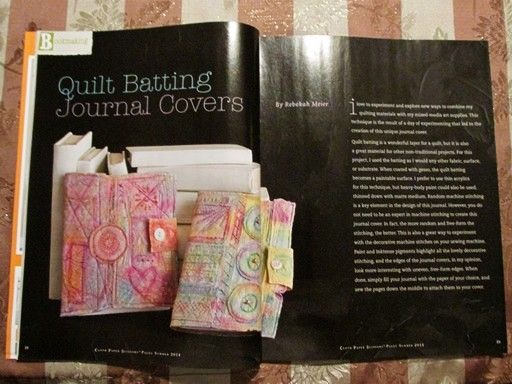
Rebekah Meier has found a way to make journal covers out of quilt batting -- aka the fluffy stuff that is sandwiched between the top and bottom layers of a quilt. Batting is not made to be used as a fabric itself, but that didn't stop Ms. Meier from doing this. I'm fascinated by the project because there is a particular type of soft cotton batting I use that has a luscious feel to it, and I'd love to cover one of my journals with it.

Making a book from a single sheet of paper requires some careful planning and origami-type folding skills, but it's a simple way to make a small book. Rachelle Panagarry uses her one-sheet book making skills to produce mini-books for short stories or as little giveaway zines. This is one of those projects that virtually anyone can do without having to take a book-making class, plus it lends itself beautifully to personal customization. The editors must have really loved it, too, because they've issued a reader challenge in this issue for everyone to follow Ms. Panagarry's example and send in their own mini-zines, the best of which will be features in Pages Winter 2015 issue (and if you want to join in, the deadline is August 19th, 2014; see complete challenge rules on pages 72-73 of this issue.)
Subscribe to:
Posts (Atom)
