I spotted another writing kit the last time I was at BAM, and decided to buy it to play with in December after NaNoWriMo (nothing is getting between me and my novel this month.) Naturally I had to open it to see all the bits and pieces, and there were some books and a pack of cards, and it all seemed pretty nice (I'll write up a real post about it after NaNo, when I've had a chance to test-drive it.)
The only problem I saw was that it is basically more of the same thing I've seen before, which boils down to a self-starter kit: "What to write if you're depressed, blocked, or otherwise completely clueless as to what you should write." As those are definitely not my usual problems, it made me think about the sort of kits for writers that I'd like to see put on the market. More realistic, genuinely helpful stuff for writers who don't need a jumpstart would have to cover a lot more ground, I think.
My first pick would have to be this one: 1001 Ways to Describe Your Novel Setting Without Falling Asleep and Drooling All Over Your Keyboard. Then maybe one for unruly characters who don't want to follow my outline: The All-Purpose Make 'Em March to Your Tune Character Repair Tool Box. I wonder if Dremmel could make an attachment for that. I should call them.
I'd absolutely need this one for those days when the pups want to play more than they want me to write: Placating Pet Strategies for Busy Writers (manuscript-shaped chew toys included!). Also one for the high school kid: 200 Pre-recorded Variations of "Those Other Girls Are Just Jealous of You" "Your Nose is Not As Big as a Toyota" and "You Are Wearing That to School Only Over My Dead Body". I think I'd need some bonus ear plugs in that one.
It doesn't have to be a kit per se, either. I'd love to see a lovely Quick Recovery From a Bad Writer Friendship gift basket, or some nice Stop Backtracking and Editing Before You Ruin The Damn Thing velvet-lined blinders and handcuffs. Wouldn't those make terrific holiday gifts for writer friends, too? I think a Ignoring the Indifferent Editor motivational CD would be a hot seller, as would a Getting Even with My Evil Critique Partner planner. A My Agent Doesn't Hate Me, He's Just Not Returning My Calls Because He's Really, Really Busy pacifier might work if it can't be chewed through, but the Surviving Horrible Cover Art wubbie would have to come with a bunch of extras (I'd donate the chocolate-covered Valium). So would the Hatchet Job Review First Aid kit.
All right, it's your turn: what sort of realistic writer kit would you like to see on the market? Tell us in comments.
Tuesday, November 02, 2010


Monday, November 01, 2010
Winners & NaNo Begins
Before I unofficially dive into NaNoWriMo here at PBW, we kept the magic hat home on Halloween night and wouldn't let it trick-or-treat until it selected the winners of the Wild for Writers giveaway, and they are:
Darlene Ryan
Nadia Lee
Tracy Sharp
Deb Salisbury
bunnygirl
Winners, when you have a chance please send your name and ship-to info to LynnViehl@aol.com so I can get your books out to you. My thanks to everyone for joining in.

Today NaNoWriMo officially begins, and from now until December 1st I'll be writing along with everyone who participates. As in 2009 I'll be updating daily my NaNo wordcount widget over on the sidebar here as well as my writing log over on the Stories blog.
Because I had a little trouble deciding which story I was going to tackle in November, I took some time to write in advance a fairly detailed synopsis for my NaNo novel. Mapping out the story really helped, too; I feel now like I know my vision of it inside and out. Since I'm already in love with my protags and the storyline, it should be interesting to see how that translates on the page.
Are you ready to NaNo? Any last-minute jitters, or are you raring to go? Let us know in comments, and if you'd like some fellow NaNo'ers to drop in please post a link to your website or blog. Good luck to everyone.
Darlene Ryan
Nadia Lee
Tracy Sharp
Deb Salisbury
bunnygirl
Winners, when you have a chance please send your name and ship-to info to LynnViehl@aol.com so I can get your books out to you. My thanks to everyone for joining in.
Today NaNoWriMo officially begins, and from now until December 1st I'll be writing along with everyone who participates. As in 2009 I'll be updating daily my NaNo wordcount widget over on the sidebar here as well as my writing log over on the Stories blog.
Because I had a little trouble deciding which story I was going to tackle in November, I took some time to write in advance a fairly detailed synopsis for my NaNo novel. Mapping out the story really helped, too; I feel now like I know my vision of it inside and out. Since I'm already in love with my protags and the storyline, it should be interesting to see how that translates on the page.
Are you ready to NaNo? Any last-minute jitters, or are you raring to go? Let us know in comments, and if you'd like some fellow NaNo'ers to drop in please post a link to your website or blog. Good luck to everyone.
Sunday, October 31, 2010
Wishing You
I am unplugging this weekend for the holiday, so winners of the Wild for Writers giveaway will be announced tomorrow. In the meantime . . .
Saturday, October 30, 2010
Inventing Your Wordrobe
Recently I encountered three interesting, new-to-me words and word phrases: gender resistance (source: NPR), helicopter parenting (source: online article about bullying) and gynobibliophobia (source: Paul McFeries's Word Spy blog, while I was looking for a term to use for my post title.) I jotted down all three because they intrigued me, and I'm almost sure I'll use the first two in conversation if not fiction. As interesting as gynobibliophobia is, though, it sounds like a fear of gynecologists with books, or books with gynecologists, not the meaning it was given (a dislike of women writers.)
When you want to invent some new stuff for your wordrobe, you should always keep in mind that coined words must be comprehensible not only to you but anyone who reads them (and remember, you're probably not going to be there with the reader to explain things.) Wordnut Randy Parker blogs here about inventing an advertising term for a commercial client, and mentions how to do this: Most of the time, words coined in advertising are combinations of existing words or parts of words, so that the meanings are still understood. This is really the first law of word-coining for any field.
You may be hesitant to dive into adding new things to your wordrobe, but coining words becomes easier with practice, too. I found a simple random word generator with an option to choose the level of obscurity, and began generating nouns and combining them into words and phrases with my own definitions. In ten minutes I had put together these seven:
Fumetruth: the honesty we display when we are furious
Fuzzyshed: pilled bits that have come off an old sweater in the wash
Honesty Hell:: where we end up when we tell the truth a little too often
Inkclaim: a hand-written deed proving ownership of property on a fantasy world
Joydump: what a person who has had remarkable luck gives you in the process of informing you about it
Maze-Minded: someone whose thought processes are lengthy, convoluted and rarely provide results
Sigh Processor: someone who always tries to interpret the meaning behind the non-verbal sounds you make.
When you coin words for stories, look at your worldbuilding, your characterizations and details from your plot. These are all excellent sources of keywords and concepts, some of which will jump out at you when you're thinking about words to invent. Once you've made a list of the words that have the most appeal to you, start playing with them. Chop them up, recombine them and see what happens. I like fusing two words together to form a new/third meaning, but I'm also an anagram junkie.
What's in your wordrobe?
When you want to invent some new stuff for your wordrobe, you should always keep in mind that coined words must be comprehensible not only to you but anyone who reads them (and remember, you're probably not going to be there with the reader to explain things.) Wordnut Randy Parker blogs here about inventing an advertising term for a commercial client, and mentions how to do this: Most of the time, words coined in advertising are combinations of existing words or parts of words, so that the meanings are still understood. This is really the first law of word-coining for any field.
You may be hesitant to dive into adding new things to your wordrobe, but coining words becomes easier with practice, too. I found a simple random word generator with an option to choose the level of obscurity, and began generating nouns and combining them into words and phrases with my own definitions. In ten minutes I had put together these seven:
Fumetruth: the honesty we display when we are furious
Fuzzyshed: pilled bits that have come off an old sweater in the wash
Honesty Hell:: where we end up when we tell the truth a little too often
Inkclaim: a hand-written deed proving ownership of property on a fantasy world
Joydump: what a person who has had remarkable luck gives you in the process of informing you about it
Maze-Minded: someone whose thought processes are lengthy, convoluted and rarely provide results
Sigh Processor: someone who always tries to interpret the meaning behind the non-verbal sounds you make.
When you coin words for stories, look at your worldbuilding, your characterizations and details from your plot. These are all excellent sources of keywords and concepts, some of which will jump out at you when you're thinking about words to invent. Once you've made a list of the words that have the most appeal to you, start playing with them. Chop them up, recombine them and see what happens. I like fusing two words together to form a new/third meaning, but I'm also an anagram junkie.
What's in your wordrobe?
Friday, October 29, 2010
Journal-Wrecking
Handing out blank journals to kids of all ages is one of my annoying habits, but it helps infect them with handwriting as well as journaling, two things I don't want to see disappear off the face of the earth. Lately I've been suggesting they also make great places for teens to practice texting, plus a handwritten journal doesn't require batteries, never needs to be recharged and can never be accidentally sent to their parents' phones. I can usually keep a straight face as I say this, even when the kids give me suspicious looks.
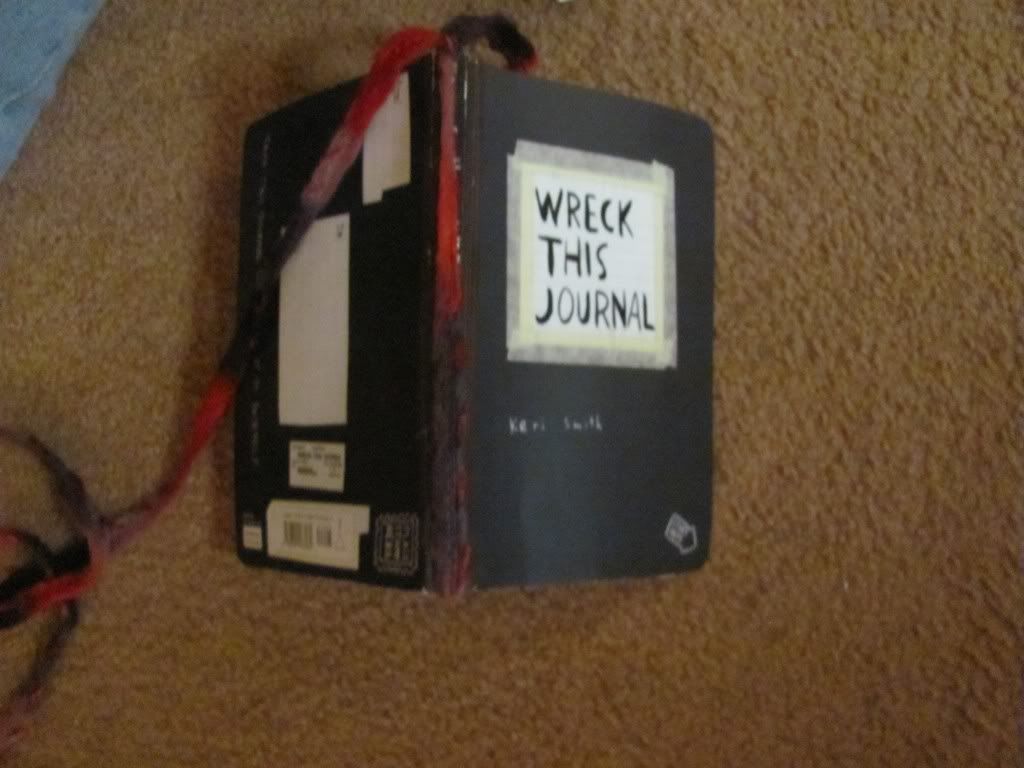 All those empty pages can be intimidating, though, so I also employ guided journals (blank books that come with writing prompts in them) whenever I can find any that are kid-friendly. That's how I discovered Keri Smith's Wreck This Journal, which celebrates creation through destruction by instructing the journal's user to do all sorts of non-writing activities with the journal's pages. These include jumping up and down on it, tying a string to it and dragging it around, making a page and the journal into a golf game, and throwing it against the walls (there is also much cutting, ripping and scratching of pages.)
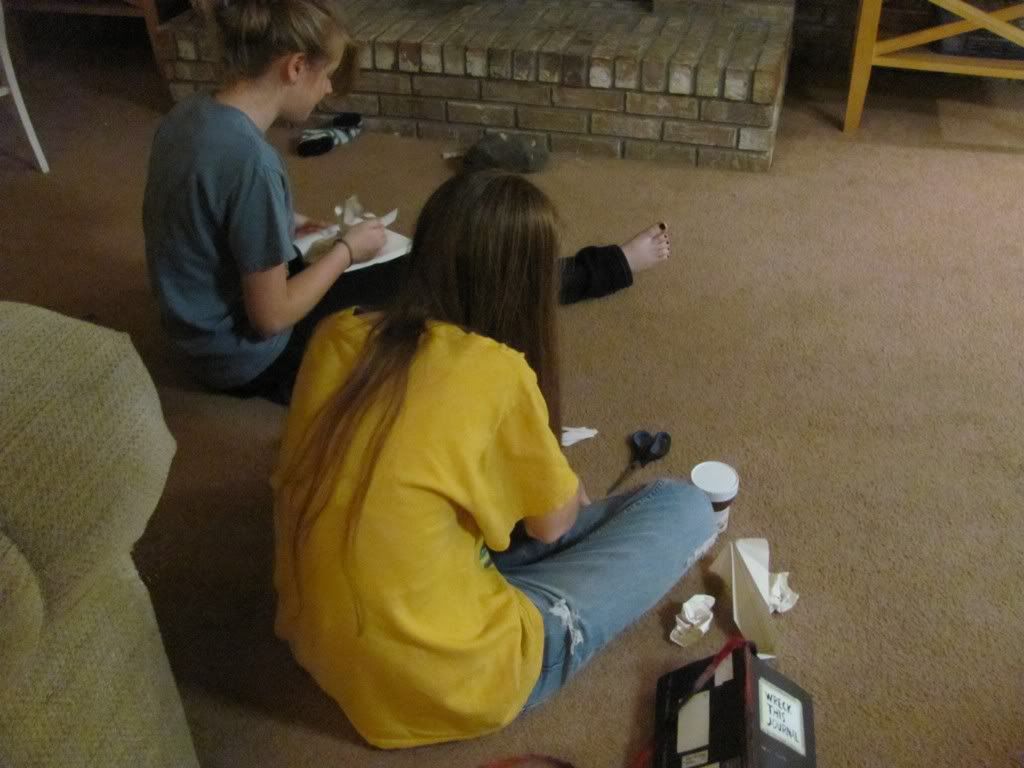 Since then I've given copies to other writers and younger kids, but I've never tried it out on older teens (or myself for that matter.) As I'd like to incorporate it into some of the writing classes I teach, I decided to give it a personal test drive via a controlled experiment. I bought three copies of the book, and gave two to my daughter and her best friend. I then challenged them to join me and work on wrecking the journals this winter with a goal of finishing every page by January 1st, when we'd trade them and see how each other's turned out.
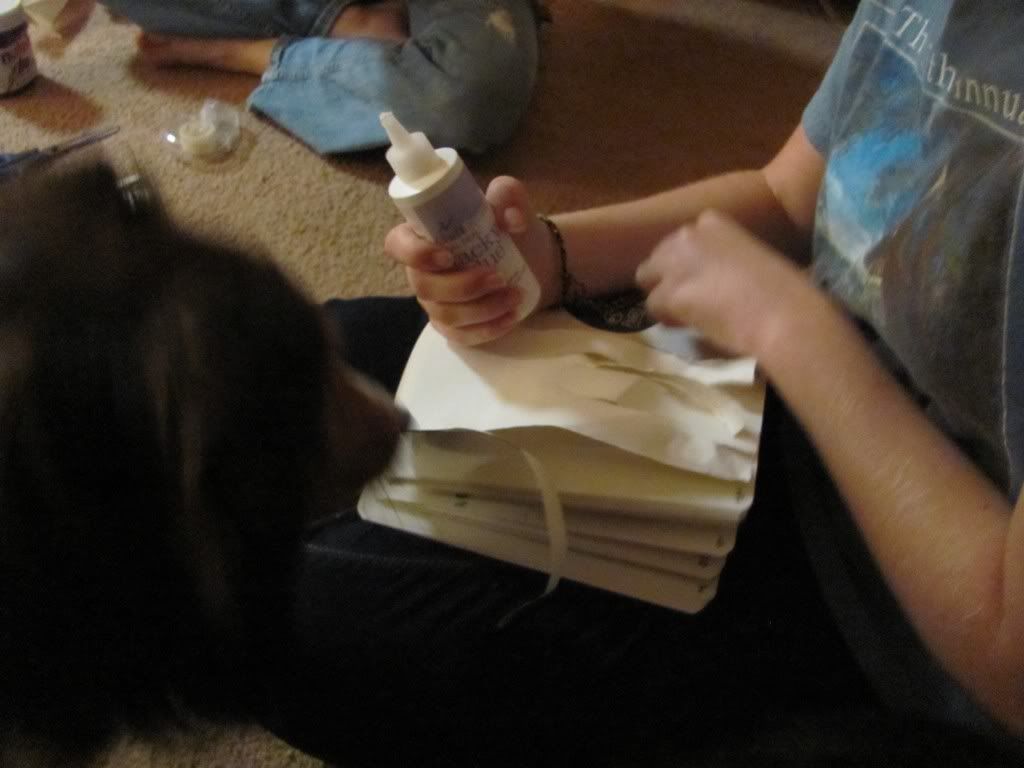 The girls thought it was a neat idea, but they were obviously in no hurry to get started on their journals. I suggested they look through them to see some of the activities involved, and then I left them alone. Within five minutes they were both sitting on the floor with their copies of the journals. They spent a good hour laughing and making suggestions as they ripped, tore, glued and wrecked different pages.
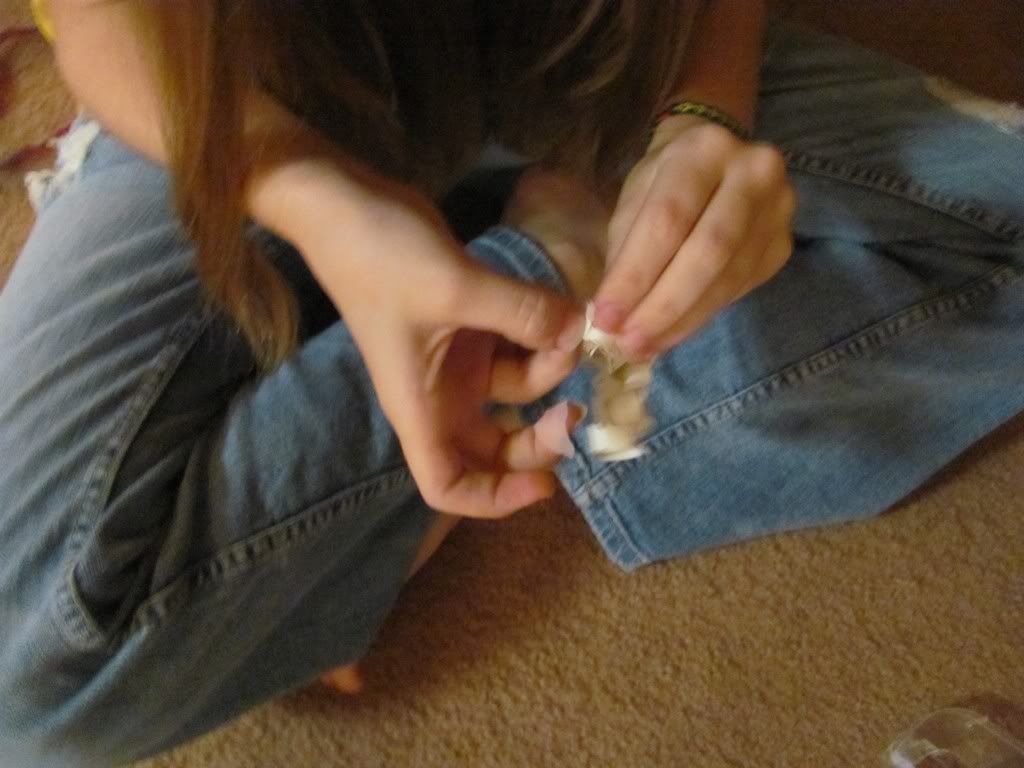 I'm not sure why this guided journal is so much fun, only that I've been pulling my own copy out daily to creatively deface at least one page. I believe books should be protected, not mangled or destroyed, but I think having the author's permission -- and specific instructions on how -- to wreck the journal directly bypasses my lifelong inhibitions. With every page I wreck the journal seems to be morphing into an art project, and while I don't think book-wrecking will ever become my thing, it's weirdly delightful to follow Keri Smith's path of artful havoc.
All those empty pages can be intimidating, though, so I also employ guided journals (blank books that come with writing prompts in them) whenever I can find any that are kid-friendly. That's how I discovered Keri Smith's Wreck This Journal, which celebrates creation through destruction by instructing the journal's user to do all sorts of non-writing activities with the journal's pages. These include jumping up and down on it, tying a string to it and dragging it around, making a page and the journal into a golf game, and throwing it against the walls (there is also much cutting, ripping and scratching of pages.)Since then I've given copies to other writers and younger kids, but I've never tried it out on older teens (or myself for that matter.) As I'd like to incorporate it into some of the writing classes I teach, I decided to give it a personal test drive via a controlled experiment. I bought three copies of the book, and gave two to my daughter and her best friend. I then challenged them to join me and work on wrecking the journals this winter with a goal of finishing every page by January 1st, when we'd trade them and see how each other's turned out. The girls thought it was a neat idea, but they were obviously in no hurry to get started on their journals. I suggested they look through them to see some of the activities involved, and then I left them alone. Within five minutes they were both sitting on the floor with their copies of the journals. They spent a good hour laughing and making suggestions as they ripped, tore, glued and wrecked different pages.I'm not sure why this guided journal is so much fun, only that I've been pulling my own copy out daily to creatively deface at least one page. I believe books should be protected, not mangled or destroyed, but I think having the author's permission -- and specific instructions on how -- to wreck the journal directly bypasses my lifelong inhibitions. With every page I wreck the journal seems to be morphing into an art project, and while I don't think book-wrecking will ever become my thing, it's weirdly delightful to follow Keri Smith's path of artful havoc.
Thursday, October 28, 2010
Gotta Have Faith
I mentioned in comments to yesterday's post that I finally came up with the title for my NaNo novel. I didn't have one until now because I've already changed my mind three times about what I'm going to write in November. After much thought I decided the haunted house story needs to percolate a bit longer; I also briefly arm-wrestled the temptation to write a contracted book early versus having fun (fun and I won; the contract work will wait until it comes up on the regular work schedule.)
I did all this by blindly following what felt most right. I may pre-plan just about everything about the books I write, but during the decision-making process the comes before all the planning, I've learned to have faith and ride along with my story instincts.
I don't think story instincts are especially logical. Mine cannot be categorized, alphabetized or otherwise organized (I know. I've tried.) I don't know how they work, where they come from or why I got stuck with them, but I've come to trust them, and they've never let me down. My downfalls have come from not following them, and I've stumbled enough times to put my trust where it obviously belongs.
Once I get in line with my story instincts, everything seems to fall into place. Once I made my decision on what to write, I found my title. I also named my protagonists, created backstories for them and figured out their primary conflict. I went online, shopped around and found what I need for my cover art. Other characters have started emerging from nowhere and are telling me their stories. It's a lot like seeing rain drops fall on still waters and watching the ripples form and spread out, and then another, and then two more, etc. I'd like to take credit for what generates that creative storm, but it's a very enigmatic part of my process over which I have no control whatsoever.
The story instincts don't always kick in automatically, and when that happens I feel like I'm fighting the work instead of serving it. Over time I've come up with a few tricks to jump start things, but what mainly works is relaxing, reading and not thinking about it for a day or two. Then when all the noise is out of my head, I pay a brief, polite visit to my conundrum and try to see it with fresh eyes -- and that's when the story instincts generally wake up and go to work.
The theory I've heard that makes the most sense to me about how we acquire these story instincts is saturation via constant exposure. Writers read and write so much that we could be imprinting ourselves with innumerable bits of data that go on to form and guide our choices. It would explain why it's so hard to define story instincts, as they would exist both on conscious and subconscious levels. I just wish they came with an on-switch so I wouldn't have to spend any time driving myself crazy over what should be a fairly simple and logical decision, but maybe that's part of the process, too.
When do you depend on your story instincts? What do you do when you can't tap into them? Let us know in comments.
I did all this by blindly following what felt most right. I may pre-plan just about everything about the books I write, but during the decision-making process the comes before all the planning, I've learned to have faith and ride along with my story instincts.
I don't think story instincts are especially logical. Mine cannot be categorized, alphabetized or otherwise organized (I know. I've tried.) I don't know how they work, where they come from or why I got stuck with them, but I've come to trust them, and they've never let me down. My downfalls have come from not following them, and I've stumbled enough times to put my trust where it obviously belongs.
Once I get in line with my story instincts, everything seems to fall into place. Once I made my decision on what to write, I found my title. I also named my protagonists, created backstories for them and figured out their primary conflict. I went online, shopped around and found what I need for my cover art. Other characters have started emerging from nowhere and are telling me their stories. It's a lot like seeing rain drops fall on still waters and watching the ripples form and spread out, and then another, and then two more, etc. I'd like to take credit for what generates that creative storm, but it's a very enigmatic part of my process over which I have no control whatsoever.
The story instincts don't always kick in automatically, and when that happens I feel like I'm fighting the work instead of serving it. Over time I've come up with a few tricks to jump start things, but what mainly works is relaxing, reading and not thinking about it for a day or two. Then when all the noise is out of my head, I pay a brief, polite visit to my conundrum and try to see it with fresh eyes -- and that's when the story instincts generally wake up and go to work.
The theory I've heard that makes the most sense to me about how we acquire these story instincts is saturation via constant exposure. Writers read and write so much that we could be imprinting ourselves with innumerable bits of data that go on to form and guide our choices. It would explain why it's so hard to define story instincts, as they would exist both on conscious and subconscious levels. I just wish they came with an on-switch so I wouldn't have to spend any time driving myself crazy over what should be a fairly simple and logical decision, but maybe that's part of the process, too.
When do you depend on your story instincts? What do you do when you can't tap into them? Let us know in comments.
Wednesday, October 27, 2010
NaNo Q & A
 For my last pre-NaNoWriMo post I drafted what I thought was a final, nifty list of NaNo No-Nos, or what everyone should not do during the month ahead of us. I was quite proud of my list, at least until the next day when I went to give it a final edit. By some weird personality transference I discovered that my mother had written most of it. I could even hear her in between the lines:
You can't be excused until you finish the rest of that chapter. I don't care if it's cold and you don't like it. Think about all the poor starving writers in China.
Fun is for rich writers who hire other people to write their books. Real writers have to work for a living.
Don't run with that story! You'll trip and fall and hurt yourself.
I don't know where any of that came from. Maybe I'm worried. My mom is the Sole Ruler of Planet Anxiety, and I automatically default to her on all matters of apprehension, unease and worry. I know a bit about how tough writing a novel can be, and I also want November to be a good experience for everyone who joins in.
I love my mom, but I'm not her. I can't be her. Like most of you, I want to have fun with this writing marathon. In fact, having fun with work and making work fun are two of my life missions. I believe taking a risk can be worth a painful fall. And even if the poor starving writers in China hate me, I can and will throw out a cold, unappetizing chapter without finishing it.
NaNoWriMo starts on Monday. For thirty days, writers around the world will go to work to have fun, take all kinds of risks, and run with story toward that fifty-thousand-word finish line. It's not about Publishing or book sales, who's a pro and who's not, or what anyone else thinks we should do. It's about us, the storytellers, and doing what we love. November belongs to us. Worry can't have it. Neither can the No-Nos.
Instead of a list, what I offer my fellow NaNo'ers today is my experience as a professional novelist and creative writing teacher, ala our old Friday 20 posts here at PBW. This means if you have a question about anything related to writing a novel, post it in comments and I'll do my best to answer it.
And please, do one thing for me in November with your NaNo novel: whatever you want.
Graphic credit: © Yellowj | Dreamstime.com
Tuesday, October 26, 2010
Wild for Writers
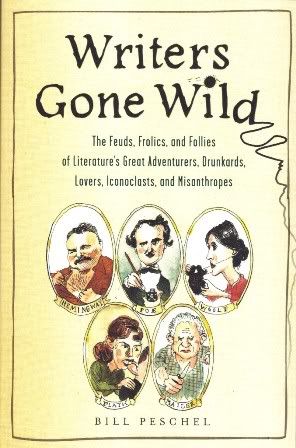 Bill Peschel and I have (virtually) known each other for a number of years, so I hope he forgives me for snatching up a copy of his debut book Writers Gone Wild when BAM put it out on the shelves a bit early. I couldn't help myself; it's a book about the great writers of our time. More specifically (and I'll quote here) "The Feuds, Frolics and Follies of Literature's Great Adventurers, Drunkards, Lovers, Iconoclasts, and Misanthropes."
Resist a book with that kind of subtitle? Are you kidding? I made a bowl of popcorn and sat down with it like the minute I got home from the bookstore.
The first two lines of the intro (George Bernard Shaw inspired this book. Particularly his condoms.) had me grinning. From there Bill relates how Shaw's other side inspired him to make the journey from idea to print. He also mentions how he views this compilation of 200 writer scandals, outrages and cautionary tales, both as illuminating and great fun. I have no doubt he'll get some flack for it from the literati's pedestal polishers, but I think what he's done with this project is worth it.
Bill's writing is as smooth as his wry, intelligent voice, and the result is an effortless read, but I expected nothing less. What I didn't anticipate was how much I didn't know about the Greats, such as Emily Brontë's (failed) attempt to be a teacher, or that Dorothy Parker had been targeted by the FBI. Norman Mailer's misogyny has always been fairly infamous, but for the first time I discovered why so many women writers spit whenever they hear his name.
Not every tale Bill tells is the stuff of great, shocking scandal; many were just plain laugh-out-loud funny, and a few were truly inspiring. I was never aware that Samuel Beckett secretly joined the French Resistance during WWII, and was decorated for his efforts to fight the Nazis. Nor did I have a clue that E.B. White had to endure censorship and a vicious, meddling critic who wanted to ban the much-loved Stuart Little before it was even published. Even little incidents, like the time Katherine Mansfield defended D.H. Lawrence by snatching his book from a jerk who was making fun of it in public, opened my eyes to the real people behind the famous names.
I came away from reading Writers Gone Wild with a better appreciation for the writers who came before us, not as literary greats but as real, flawed, often likeable human beings. I will admit to some satisfaction over a few scandals (I happily crowed over the tale of Joseph Conrad, page 71-72; this because I've hated him since high school) as well as some pangs of sadness (too many brilliant writer minds and lives have been destroyed by alcohol and substance abuse.) More than anything, though, reading this book made me feel a little wiser. I don't think we're doomed to repeat the mistakes of the past as long as we learn from them and take a different path to create healthy, happier writing lives for ourselves.
And it was great fun to read. Bill Peschel really delivered on that promise.
But as always, you don't have to take my word for it. In comments to this post, name a writer from any time with whom you would love to sit down and have coffee and chat (or if you'd rather hang out with non-writers, just toss your name in the hat) by midnight EST on Saturday, October 30, 2010. I'll draw five names at random from everyone who participates and send the winners an unsigned copy of Writers Gone Wild by Bill Peschel. This giveaway is open to everyone on the planet, even if you've won something at PBW in the past.
Monday, October 25, 2010
NaNoTen
 Because we only have one week to go . . .
 Ten Things to Try When Writing Your NaNoWriMo Novel
Arrange Your Writing Time: Let family and friends know that you're participating in NaNoWriMo, as well as what time(s) you'll be writing. Ask them to help you reach your goal by not visiting, calling or otherwise interrupting you when you're working on the novel. Likewise arrange your writing time so it doesn't inconvenience them (for example, getting up an hour early or staying up an hour late allows you to write while everyone else in the house is sleeping. A quiet spot at work where you can write during your lunch hour is also good, so is making your writing time while the spouse is at work and the kids are in school.)
Chase Off the Blues: Depression is pretty common among writers (must be the isolation) and 99% of the time it doesn't help the work. If something in your life has you blue, let NaNoWriMo a thirty-day vacation from worrying about it. Focus on the fun of having a month off to write whatever you want, and if you're inclined, join in some group activities (discussion boards, chat rooms, or list-servs dedicated to NaNo'ers are good places to check out.)
Create a Playlist: A story soundtrack can help inspire you, especially when you're away from your writing space and want to think about your novel (I burn a CD with a special playlist for every one of my books and keep the CD in the car for as long as I'm writing it.) Go through your music collection and the songs that help you visualize the characters, the time period, the setting or some other story element (or if that doesn't work for you, choose songs that simply make you feel upbeat, happy and/or energetic when you hear them, and make a mood playlist.)
Cut the Story Apron Strings: For these thirty days, you should be the only writer in your writing space. So unless you need to reference research materials while you're writing, remove all books from your writing space (this goes for all those wonderful keeper books you read when you're blocked to jumpstart your own writing.) Also to avoid echoing another writer's voice or story, don't read in the genre you're writing in during the month of November.
Dress to Write: Put together some writing outfits that are comfortable to wear while you're working at the keyboard. Avoid things that bind, itch, or constrict your limbs. My feet always get cold easily, and for some reason I can't write when I'm barefoot, so I keep a good stock of warm/soft fuzzy socks.
Eat to Write: Writers often feel sluggish or sleepy at the keyboard, and sometimes this is because they try to write immediately after eating a big meal. If your health and diet allow, have just a light snack before your writing time (or wait until after you're done writing to eat.) Avoid snacking in your writing space to keep those pesky crumbs out of your keyboard, too.
Remove Distractions: Unless you need noise in order to write, anything that makes a sound or projects images (televisions, cell phones, radios, video games, etc.) should be turned off while you're writing. If you can unplug your house phone or have someone in another room answer it, do that, too. If you're a texting addict, let your circle of cell friends know you won't be available during your writing time (Twitter will still be there once you've gotten your words down for the day.)
Reserve Some Think Time: Take a couple of minutes before you start writing to think about the work ahead. Run the scene or chapter you're planning to write through your imagination and try to visualize it. Clear out everything else that is on your mind that isn't related to the novel.
Separate Your Writing and Editing Time: One major roadblock to writing can be backtracking and editing as you write. I know this works for some writers, but if you discover this habit slows you down or prevents you from making any real progress, try dividing your time at the keyboard into two phases: write first, edit second.
Unclutter Your Writing Space: One of the things I found surprising about other writers after I finally met some in RL is how much clutter they acquire and try to work in. Imagine going to an office building and seeing all that crap piled around the people who work there; you'd think they only hired hoarders. Clutter may give a sense of safety, ala nesting, but too much can hamper your ability to effectively use your workspace. So before November try cleaning off your desk and move all the office supplies to a closet or cabinet, and relocate all the buttons, ribbons, paperweights and collages to another room (bookcases are great places to display your stuff.) You don't have to throw out your treasures, but moving all non-essential stuff out of your writing space can provide a feeling of newness or making a fresh start. If your space feels too barren, add one or two bits that will visually inspire you but that you don't have to climb over to get to the keyboard.
Sunday, October 24, 2010
Camera as Well
I've gotten into the habit of taking my camera with me almost everywhere, because the ordinary things I photograph often give me story ideas. For example, this spider (click on any image to see a larger version):
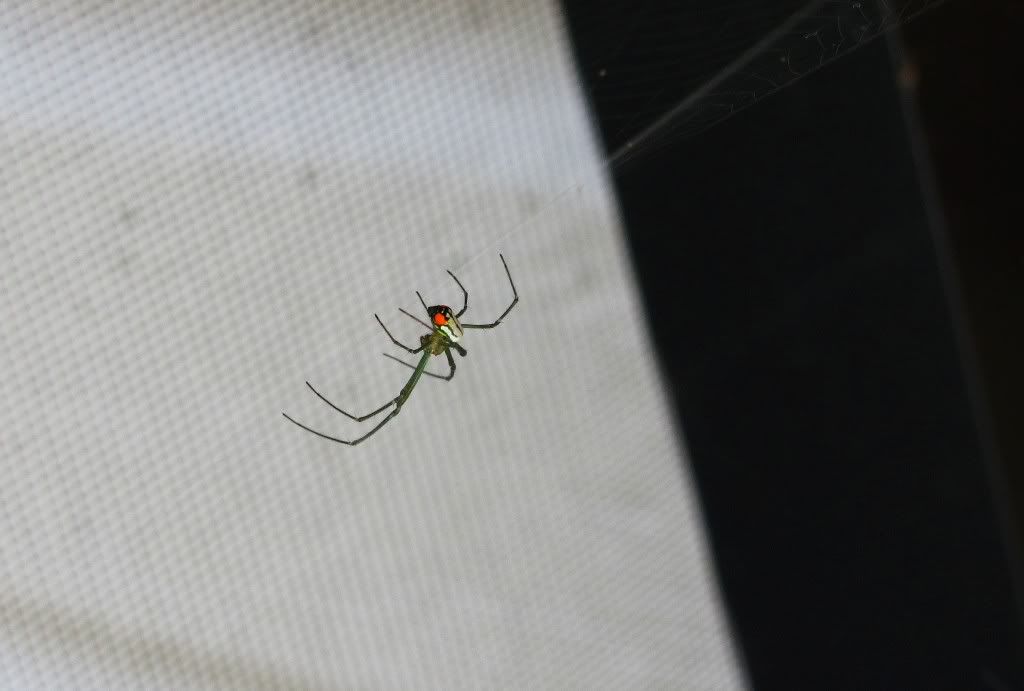
She set up house in one corner of my porch near where I like to write (and before I relocated her, I took a shot to show my guy.) That's when I noticed the little red dot on her butt, which made me think of another kind of bug (the reclusive, unnoticed surveillance variety.) Would you notice a bug on a bug? Probably not. Could you use a bug as a bug? Why not? And thinking about how I'd use her as the other kind of bug ended up in a scene in Frostfire.
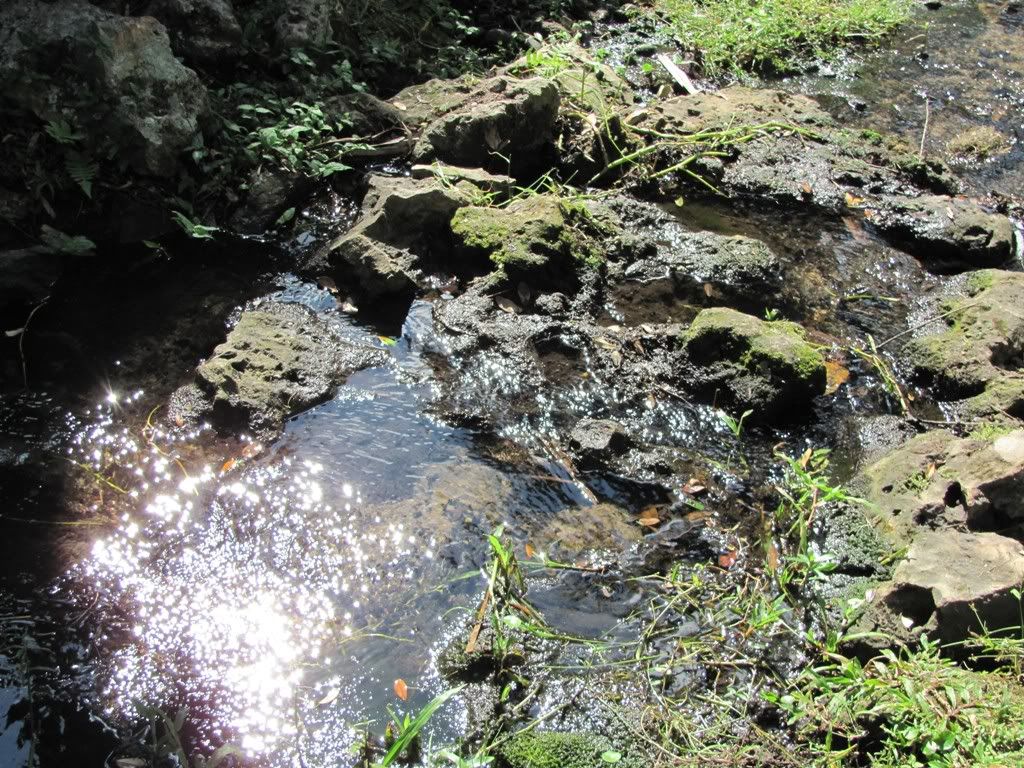
I was in a park with my daughter when I noticed a little artificial spring and decided to take a photo of the water. As soon as I focused on it, the sunlight hitting the surface began shooting bright vertical light beams across my camera's display. It was almost like the transporter visual effect from Star Trek TNG. Despite this, the picture I snapped only showed a modest amount of sparkle confined to the surface of the water. Now I'm sure there's a logical reason why what I saw on the display didn't match what I saw with my eyes, but what I thought of was something I actually needed to up the wattage for a story I'll be writing next year.
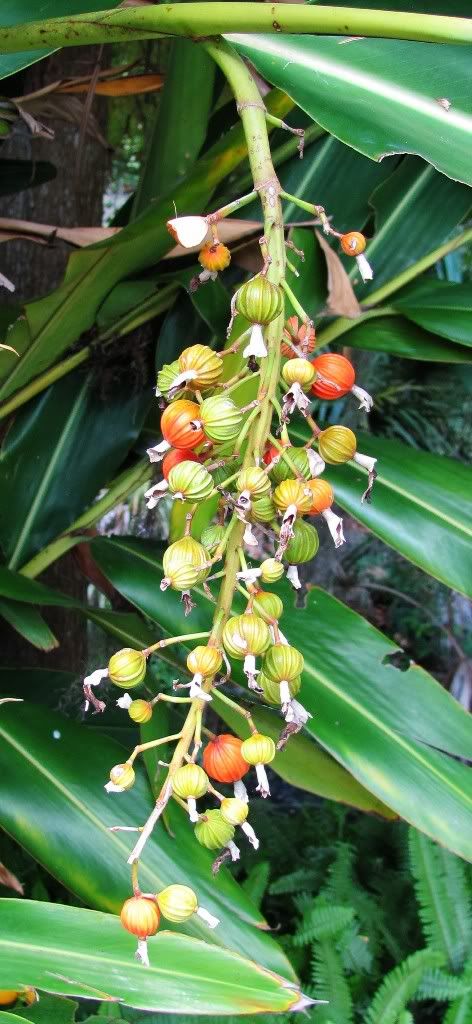 In the same park I also saw these odd wee pods sprouting from a big plant that I didn't recognize. I stopped to admire them because they look just like teeny little pumpkins. If mice ever needed jack-o-lanterns, these would be the perfect size for them. And if mice celebrate Halloween, they'd need little costumes, too. They probably dress up as cats and owls and exterminators before they go out trick-or-treating. I bet on Halloween night all the candy the human kids drop while they're making their rounds ends up in the paws of trick-or-treating mice. Then when it's very late, and all the human kids are back home waiting for their mothers to inspect their bags, the mice gather in the park to swap mini-size candies (everyone wants the Snickers, of course) and have tiny pumpkin-carving contests. They catch fireflies and put them inside to light up their jack-o-lanterns, and just before dawn they dig little holes and plant the pumpkins so the humans don't find them -- and more plants will grow for next year's Halloween for Mice. That would make a cute illustrated children's book. Only this year, one drowsy mouse forgets to plant his pumpkin, and the next morning it's found by . . . and more of that would make a fun young reader book. All of that came from just this one picture.
A camera can be a marvelous tool to create writing prompts for yourself. If you have one and you haven't used it in a while, take it out, dust it off and play with it for a week. Take a shot of anything and everything that catches your eye, then sort through the images and see what sparks your imagination.
She set up house in one corner of my porch near where I like to write (and before I relocated her, I took a shot to show my guy.) That's when I noticed the little red dot on her butt, which made me think of another kind of bug (the reclusive, unnoticed surveillance variety.) Would you notice a bug on a bug? Probably not. Could you use a bug as a bug? Why not? And thinking about how I'd use her as the other kind of bug ended up in a scene in Frostfire.
I was in a park with my daughter when I noticed a little artificial spring and decided to take a photo of the water. As soon as I focused on it, the sunlight hitting the surface began shooting bright vertical light beams across my camera's display. It was almost like the transporter visual effect from Star Trek TNG. Despite this, the picture I snapped only showed a modest amount of sparkle confined to the surface of the water. Now I'm sure there's a logical reason why what I saw on the display didn't match what I saw with my eyes, but what I thought of was something I actually needed to up the wattage for a story I'll be writing next year.
In the same park I also saw these odd wee pods sprouting from a big plant that I didn't recognize. I stopped to admire them because they look just like teeny little pumpkins. If mice ever needed jack-o-lanterns, these would be the perfect size for them. And if mice celebrate Halloween, they'd need little costumes, too. They probably dress up as cats and owls and exterminators before they go out trick-or-treating. I bet on Halloween night all the candy the human kids drop while they're making their rounds ends up in the paws of trick-or-treating mice. Then when it's very late, and all the human kids are back home waiting for their mothers to inspect their bags, the mice gather in the park to swap mini-size candies (everyone wants the Snickers, of course) and have tiny pumpkin-carving contests. They catch fireflies and put them inside to light up their jack-o-lanterns, and just before dawn they dig little holes and plant the pumpkins so the humans don't find them -- and more plants will grow for next year's Halloween for Mice. That would make a cute illustrated children's book. Only this year, one drowsy mouse forgets to plant his pumpkin, and the next morning it's found by . . . and more of that would make a fun young reader book. All of that came from just this one picture.A camera can be a marvelous tool to create writing prompts for yourself. If you have one and you haven't used it in a while, take it out, dust it off and play with it for a week. Take a shot of anything and everything that catches your eye, then sort through the images and see what sparks your imagination.
Saturday, October 23, 2010
News & Sold
 Many of you have been asking if/when several novels in the StarDoc series that are currently out of print would be converted to e-book format and made available for purchase. Thanks to my agent, I finally have an answer for you. To quote the publisher:
Our ebook team is putting the following titles in the queue for conversion: Endurance, Shockball, Rebel Ice, Plague of Memory and Blade Dancer. They should be available in a couple months.
I think that covers all of the series that wasn't in e-format (and Blade Dancer, which is a standalone set in the StarDoc universe, is a nice bonus.)
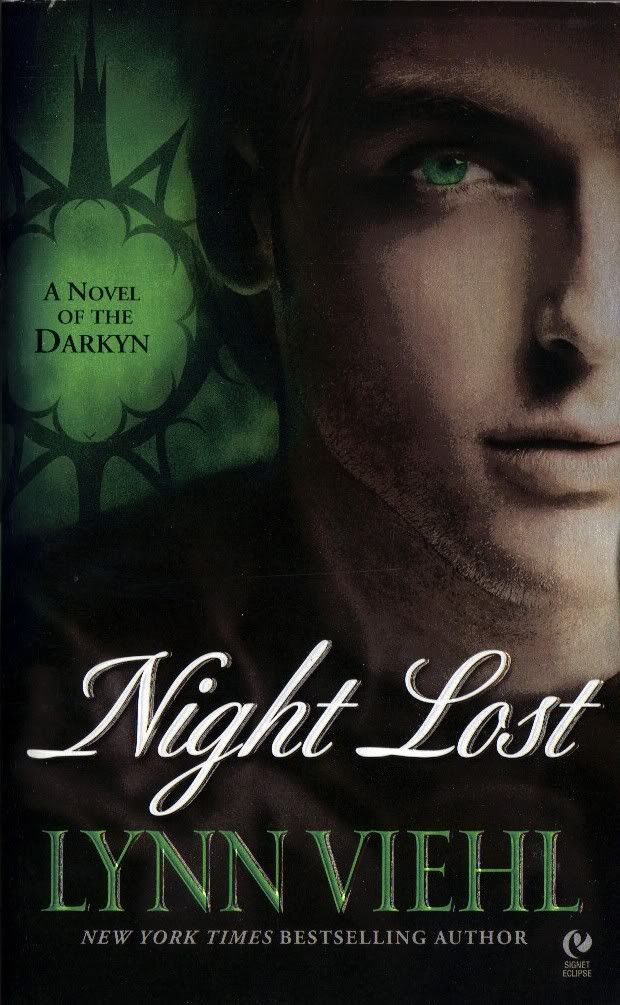 Also some good news for my German readers: my publisher has just made a foreign rights deal for two more of my Darkyn novels; Night Lost (book four in the series) and Evermore (book five) as well as two of my Jessica Hall novels, Into the Fire and Heat of the Moment.
 Last but not least: the final outcome of the idea that became a proposal for three books that became a contract negotiation is this: I've accepted an offer from NAL for the entire trilogy.
Naturally it's not final until it's in contract form, and signed by me and everyone else, but all the major details have been hammered out, so unless something radical changes it's a done deal. Did I mention what I'm planning to write? Maybe you can tell from the (unofficial) series title and theme icon I just put together:
The first novel in my new Darkyn trilogy is tentatively scheduled to be published in Spring 2012.
Friday, October 22, 2010
Unveiling the Youngbloods

This is the cover art for After Midnight, the first novel in my new YA trilogy for Flux. Here's a little about the story:
Sixteen-year-old Catlyn Youngblood isn’t happy about moving to Lost Lake, Florida. While she’s used to living a gypsy’s life with her brothers, there is something very odd about this small backwoods town. But Trick, her oldest brother and guardian, wants to settle down on their new farm and breed horses, and this time Cat may even have a chance to make some friends.
After a disastrous first day at school, Cat meets Jesse Raven, a boy who like her rides his horse after midnight. At first Jesse seems as unreceptive as the rest of Lost Lake, until Cat discovers he's just as lonely and friendless as she is. Troubling warnings to avoid the wealthy, reclusive Ravens worry Cat, as do more problems at school, but not enough to stop meeting Jesse.
Lost Lake is a town of many secrets, however, and when a terrifying attack exposes Cat and Jesse's friendship, their families go to extremes to separate them. Now Cat must unravel the tangled pasts of the Ravens and the Youngbloods so she can understand the strange connection that brought her and Jesse together -- and why someone is deliberately trying to tear them apart.
After Midnight will be hitting the shelves in May 2011.
Thursday, October 21, 2010
Playing with Titles
 A rose by any other name is still a rose. This is because it's a flower, not a book. A book by any other name is one that has a title. Preferably something wonderful. That I spent a couple days/weeks/months thinking about. Because it's a book, not a rose.
 I have met writers who say they never obsess the way I do over titles for their stories. According to them, a title is something they throw together in a few minutes, like salad out of a bag. They claim they're never rattled when a publisher tells them their title won't work. And when their editor suggests a replacement title, they're also fine with having that slapped on their book.
To me these writers are very bizarre people, and I don't entirely trust them.
I admit, I am deeply, madly, totally obsessed with story titles, and we have a very rocky love-hate relationship: I love them, and I hate them. When I hit on a great title I feel like I've conquered a small country. When I talk about it, I sound like Tom Hanks crowing over the first fire he builds in the movie Castaway: Look! I made title! When for whatever reason I get stuck, well, this is why God created the internet, writer friends and hot fudge sundaes.
I'd say 99.9% of the time I decide on a title before I write a single word of the story. The other .01% of the time I make up a decent working title I can live with while I write the story (and think about, make lists of and otherwise obsess over better titles every day until it's finished.) Which I'm sure makes me seem quite bizarre, because from the articles I've read on the subject it seems a lot of writers wait until they finish writing the story before they try to title it. I'd have a nervous breakdown if someone made me do that.
Also, something I should mention because there is always some confusion on this issue: titles cannot be copyrighted, so you never own any title you come up unless you trademark it (read about the details and the law at the government's copyright site here.)
For series writers like me, titles can become a big problem, especially now that most publishers want series books to carry brand-friendly titles. These are interrelated or matchy-matchy type titles that all sound basically the same. For those of us who prefer the creative and original, this is also known as title torture. I've seen one author whose titles are so matchy-matchy they have become literally indistinguishable from each other, something you never want to have happen to your books (and trust me, neither do your poor readers.)
It's always good to have options when you title a story so that you're not fixated on one name, as editors and publishers can and will demand you retitle something to be -- and I'll quote here -- "more marketable." When you think of a title, you might start a list of other titles you can live with if your first gets stomped (this will also keep your editor from suggesting his/her own ideas, which is when you run the biggest risk of getting stuck with an awful title.) Keep adding to your alternative list as you get new ideas as well; I've had editors who have gone through up to thirty ideas I've presented before finally settling on one they liked.
If you're a genre writer, some publishers may press you to have a genre-appropriate sounding title, too. Taking Jezebel was my original title for the first book in my Kyndred series (and I had put together a series proposal with five more just like it) but it didn't sound "paranormal enough" for the publisher, so I had to come up with other options. I went with coining compound word titles that described the Kyndred's abilities (Shadowlight, Dreamveil, Frostfire, Nightshine) which allowed me to retain the original/creative qualities I preferred while giving the publisher what they wanted.
A dazzling title (or series of titles) can be a great selling point, and during the submission stage often will snag the interest of an agent or an editor. You've got to have the quality of work to back it up, but a riveting title broadcasts your creative talent almost like a hot novel premise. On the other hand, nothing says dull and boring than an unimaginative title, or one you've "borrowed" from another writer's work.
Series titles in particular have the most firepower to evolve into a unique brand on the market, which helps create a niche for your work. If you have a forgettable or difficult-to-spell name, or you write in multiple genres under a variety of pseudonyms (I have both problems) a series title can brand your work in the minds of readers.
I always try to have fun with creating titles as it is such a stressful task. Fortunately the internet is a great place to work on them because of all the instant-access resources you can use. Here are some methods and places I recommend:
Finding the keywords: OneLook Reverse Dictionary allows you to input a multi-word concept and returns a list of words it finds related to the concept. This is especially helpful if you have an idea or concept but are running short on keywords.
Poem fragments: I put keywords related to my novel concept or theme into the verse search engine over at Bartleby.com and read what poems contain my keywords. Often a fragment of poetry makes a great title.
Practical fun: Online story title generators (like this one, this one and this one) are mainly for fun, but sometimes they can give your imagination a nudge as well.
Text, reimagined: The Bonsai Story Generator takes whatever text you cut and paste into it and rearranges the words and phrases from it into different pseudo-poetic line constructs. Most of the time the results are a little strange but also very interesting and (for me, anyway) often inspirational.
Wordle It: I came up with a way to use Wordle (my favorite online toy) to generate among other things title ideas from word clouds; read about it on PBW here.
Related Links:
John Floyd's article Choosing the Right Name for Your Story offers some neat ideas on how to construct your title.
I don't think anyone can tell you if you have an instant bestseller based on your title alone, but Lulu.com has a cute online toy that tries to here.
Wednesday, October 20, 2010
NaNoFun
Every Wednesday from now until November 1st I'll be posting some ideas, resources and other info that may be of help to those of you planning to join in NaNoWriMo 2010.
As I did last year, I've uploaded all of the participant badges for NaNoWriMo on my Photobucket account; anyone is welcome to use the image links:
Made my own badges, too, which if you're a NaNoNag or Camp Follower you're also welcome to use:

For those interested in word count widgets for NaNoWriMo but don't want to wait until they post the official links on November 1st:
Last year I used this one to post my counts on PBW: Another Little Progress Meter
LanguageIsAVirus's still has their NaNoWriMo Word Meter available
Need a word count widget plugin for Wordpress? Here you go.
You have to register first (free) to get StoryToolz's Progress Meter, but it looks like you can customize it, too
Svenja has a nice little word count meter with several color options for the progress bar
If you don't trust your word processor's count, cut and paste your text into this online Word Count Tool
Writertopia offers two writing meters; one is simple and the other features a cute cartoon
 Some free stuff for NaNoWriMo'ers, and the first one is from me: in honor of my favorite writing month of the entire year, until December 1, 2010 my OOP how-to writing guide, Way of the Cheetah, will be available here in .pdf format for anyone to read online or download for free.
The NaNoWriMo site has some special offers here, including a NaNoWriMo version of Storyist for Mac (scroll down to where it says special offer) that you can use for free for the entire month of November. It's not available yet, but Scrivener is also promising a NaNoWriMo 2010 Special Trial version for Mac and Windows.
FreelyEducate.com has a post here that details some of the special offers and freebies being offered to you writers out there who are 17 years old or younger and plan on participating in NaNoWriMo's Young Writers Program.
If you have any fun/interesting/helpful links to share, please post them in comments. And get ready, guys, because National Novel Writing Month starts in exactly ten days.
Tuesday, October 19, 2010
Off to the Vet
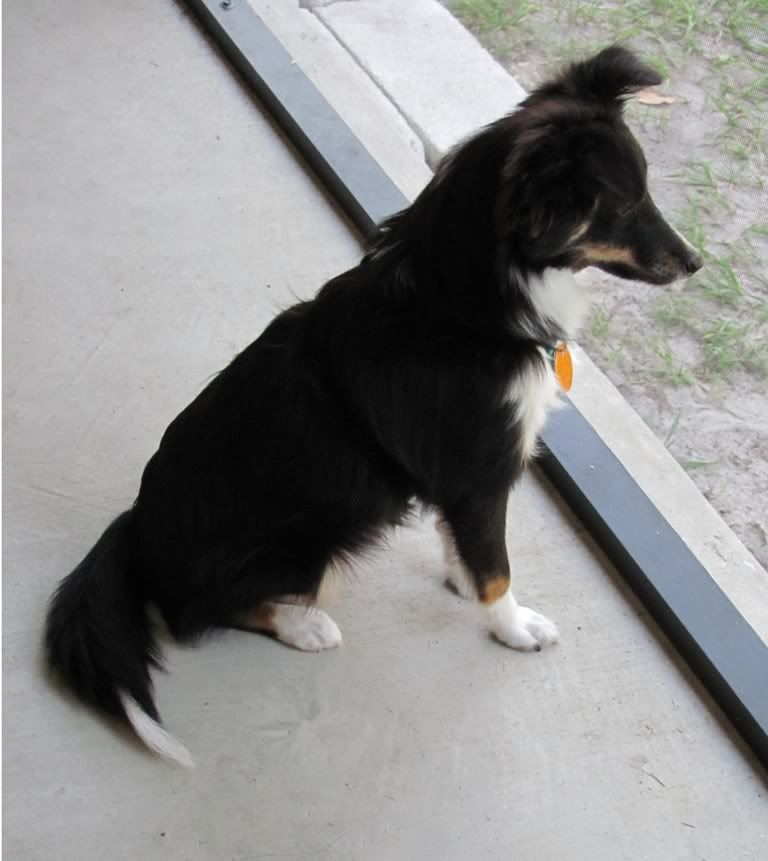
I'm going to bail on you guys today so I can take care of this little lady here. Miss Skye is being spayed* this morning, and when we come home from the vet she'll need some attention and TLC.
I'll be back tomorrow (and this week my Wednesday NaNoWriMo post will include some fun stuff, so stop in if you get the chance.)
*Spaying and neutering our furry friends is an important part of responsible pet ownership. If you don't know why it needs to be done, visit the Humane Society's web site and read this page.
Monday, October 18, 2010
Journal for Free Ten
Ten Things About Journaling Freeware
Freeware caution: always scan free downloads of anything for bugs and other threats before dumping the programs into your hard drive.
Cire is "a free and open-source program designed for keeping an electronic journal or diary, which runs on Linux and other unixes. It is potentially useful for any sort of situation which requires the ability to maintain organized, chronological and encrypted logs or notes. Cire also provides a choice between three different forms of interfaces: a full GTK graphical interface, a command-line ncurses interface, and a simple command-line text interface" (OS: Linux/Unix/*nix)
Diary Book is "software for those who wish to keep a journal, a diary of daily life. The author's goal when writing this software was to make the traditional way we keep a diary even better by utilizing the power of today's modern computers. Not only does the software include a diary editor, but also an event reminder, address book, an alarm, picture manager, built-in mailer, HTML & Web Diary and To-Do List" (OS: Win 9x/ME/NT/2K/XP)
eJournal is "a software journaling tool. It can be used as a personal diary or a project diary. It stores journals as XML files, readable by Internet Explorer. Within the application, you can perform the following: print entries, search entries, create new entries, merge existing entries, delete old entries" (OS: Win 9x/ME/2K/NT/XP; designer notes that you must have Java Runtime Environment installed on your system to run this one)
iDailyDiary "provides a simple interface that immediately gets you started taking daily notes, creating a journal, putting your thoughts into writing and much more. The iDailyDiary editor is "richtext" with the ability to insert graphics, URL's, Hypertext links and links to other diary pages. iDailyDiary is fully searchable so you can always track down those important dates and reminders" (OS: Windows 9x, ME, 2000, XP, 2003, 2008, Vista, 7)
Jarnal is "an open-source application for notetaking, sketching, keeping a journal, making a presentation, annotating a document - including pdf - or collaborating using a stylus, mouse or keyboard. It is similar to Microsoft Windows Journal and to the earlier Mimeo whiteboarding and Palm notepad applications" (OS: Windows, Linux, Mac)
My Daily Journal is "a secure personal journal for everyday inspirational living. Write your daily thoughts, opinions, and life views in your own journal. It also includes a password login dialog box for keeping prying eyes out of your personal business. Insert special characters, emotional icons, pictures, and images into your writing for a more colourful display of your thoughts and ideas. The journal also incorporates an auto save feature for your convenience" (OS: All Windows operating systems)
My Diary is "reliable for storing everyday blogs or journals. Your diary is password protected, and blogs are encrypted using a simple yet powerful encryption algorithm to ensure that your journals are secured. myDiary automatically saves as you type so you don´t have to worry about saving. It´s very simple and easy to use - enter your password, pick a date, start typing" (OS: Win 98/NT/XP/Vista/Windows 7)
qOrganizer is "a general organizer that includes a calendar with schedule,reminders,journal/notes for every day, to-do list. But provides features useful for students such as: timetable and a booklet for marks and absences.It's designed to be easy to use. It represents a new approach to an organizer, with several innovative features" (OS: Windows XP/Vista/7)
RedNotebook is "a modern journal" that "includes a calendar navigation, customizable templates, export functionality and word clouds. You can also format, tag and search your entries" (OS: Win 98/ME/2000/XP/2003/Vista/7)
Xournal is "an application for notetaking, sketching, keeping a journal using a stylus" (OS: Designer notes: "It is free software (GNU GPL) and runs on Linux (recent distributions) and other GTK+/Gnome platforms")
Freeware caution: always scan free downloads of anything for bugs and other threats before dumping the programs into your hard drive.
Cire is "a free and open-source program designed for keeping an electronic journal or diary, which runs on Linux and other unixes. It is potentially useful for any sort of situation which requires the ability to maintain organized, chronological and encrypted logs or notes. Cire also provides a choice between three different forms of interfaces: a full GTK graphical interface, a command-line ncurses interface, and a simple command-line text interface" (OS: Linux/Unix/*nix)
Diary Book is "software for those who wish to keep a journal, a diary of daily life. The author's goal when writing this software was to make the traditional way we keep a diary even better by utilizing the power of today's modern computers. Not only does the software include a diary editor, but also an event reminder, address book, an alarm, picture manager, built-in mailer, HTML & Web Diary and To-Do List" (OS: Win 9x/ME/NT/2K/XP)
eJournal is "a software journaling tool. It can be used as a personal diary or a project diary. It stores journals as XML files, readable by Internet Explorer. Within the application, you can perform the following: print entries, search entries, create new entries, merge existing entries, delete old entries" (OS: Win 9x/ME/2K/NT/XP; designer notes that you must have Java Runtime Environment installed on your system to run this one)
iDailyDiary "provides a simple interface that immediately gets you started taking daily notes, creating a journal, putting your thoughts into writing and much more. The iDailyDiary editor is "richtext" with the ability to insert graphics, URL's, Hypertext links and links to other diary pages. iDailyDiary is fully searchable so you can always track down those important dates and reminders" (OS: Windows 9x, ME, 2000, XP, 2003, 2008, Vista, 7)
Jarnal is "an open-source application for notetaking, sketching, keeping a journal, making a presentation, annotating a document - including pdf - or collaborating using a stylus, mouse or keyboard. It is similar to Microsoft Windows Journal and to the earlier Mimeo whiteboarding and Palm notepad applications" (OS: Windows, Linux, Mac)
My Daily Journal is "a secure personal journal for everyday inspirational living. Write your daily thoughts, opinions, and life views in your own journal. It also includes a password login dialog box for keeping prying eyes out of your personal business. Insert special characters, emotional icons, pictures, and images into your writing for a more colourful display of your thoughts and ideas. The journal also incorporates an auto save feature for your convenience" (OS: All Windows operating systems)
My Diary is "reliable for storing everyday blogs or journals. Your diary is password protected, and blogs are encrypted using a simple yet powerful encryption algorithm to ensure that your journals are secured. myDiary automatically saves as you type so you don´t have to worry about saving. It´s very simple and easy to use - enter your password, pick a date, start typing" (OS: Win 98/NT/XP/Vista/Windows 7)
qOrganizer is "a general organizer that includes a calendar with schedule,reminders,journal/notes for every day, to-do list. But provides features useful for students such as: timetable and a booklet for marks and absences.It's designed to be easy to use. It represents a new approach to an organizer, with several innovative features" (OS: Windows XP/Vista/7)
RedNotebook is "a modern journal" that "includes a calendar navigation, customizable templates, export functionality and word clouds. You can also format, tag and search your entries" (OS: Win 98/ME/2000/XP/2003/Vista/7)
Xournal is "an application for notetaking, sketching, keeping a journal using a stylus" (OS: Designer notes: "It is free software (GNU GPL) and runs on Linux (recent distributions) and other GTK+/Gnome platforms")
Sunday, October 17, 2010
Runaway Trains Part II

Yesterday I talked about the three types of new story ideas that regularly bedevil me; today I'd like to tell you how I calmly and intelligently sort through new ideas, neatly categorize them and only use those that result in bestselling novels. And as soon as I figure out how to do all that, I'm sure I will.
New story ideas are the Viagra of writing; they make you feel like you can nail anything. Inevitably the feeling wears off and you're stuck with a lot of work you don't think you can do. Back when I was a youngster I had a million ideas, and whenever a new one hit me I'd drop everything and work on it. Until I had to stop and do a story for another, better new idea. And just as that one grew tiresome, yet another would whisk me away.
After building a depressing collection of a hundred or so story fragments and partial novels, I knew I had to stop idea-hopping or I'd never finish anything. So I made the vow: I will finish everything I write, and not start anything new until the story is complete. Only my new story ideas didn't go away; they began gathering and organizing and ambushing me. Soon every time I started writing I'd get hit by a barrage of new/better ideas.
Eventually I crumbled, stopped writing the story I was working on, and opened a new file. But by that time my vow had forced me into the habit of plotting and outlining my ideas before I started writing them. I decided to do the same thing with the new idea, only I didn't plot out an entire story. Instead I wrote a brief outline of just the idea itself.
I still felt torn; it's hard to resist something that bright/shiny/new. But: outlining the new idea preserved it, and dispelled my anxiety over losing it to the abyss of Stories Forgotten. That allowed me to return my focus to my current project. There was another side effect, one that didn't become apparent right away: over time the idea I put aside got better.
To illustrate, here is one of my more recent new story ideas: to inherit millions, you have to spend a week in a haunted house. It was such a dinky, run-of-the-mill idea that I ignored it, until two young female voices popped into my head. They wanted to chat about it. And they wanted me to listen. While I was trying to update my business ledger.
Their names were Lucy-Something and Something-Taylor. They were also bestest friends, the sort who honestly believe they are, which made me think if I wrote them I'd have to kill off one of them like immediately. This evil thought did not discourage them or the images that began flashing around them: a reading of a will, a decaying, haunted chateau, and a rather delicious-looking veggie pita.
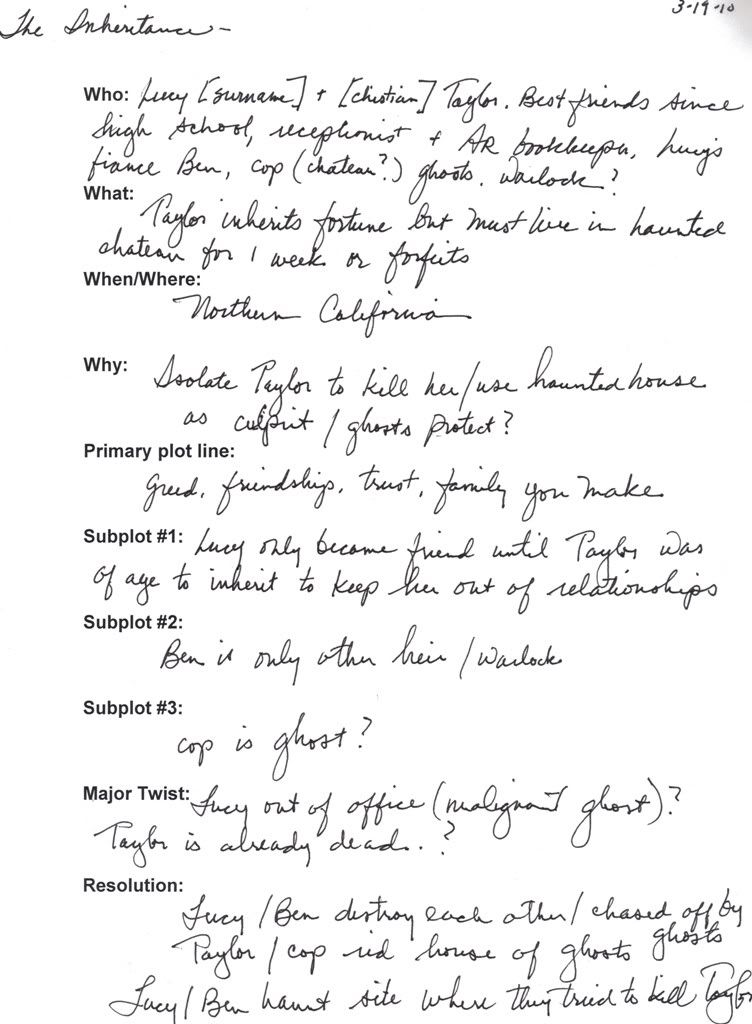 I think it was the chateau that did me in. Or maybe the pita. Anyway, I put aside the ledger, pulled out a plotting template and addressed my twin mosquitoes: All right, you two. You've got ten minutes. What?
It's like being a reporter live on scene, only you don't have to wear makeup, pantyhose or helmet hair. They started over while I listened and jotted down everything on the page (see my lousy handwriting on the left here.) And sure enough, when the ten minutes were up I had a decent one-page outline, a list of ideas and questions to jog my memory when I read it again, and a couple of potential directions in which to take it. I gave it a temp title (The Inheritance) and filed it away in my idea folder, and then I caved in a bit more and wrote out a couple pages of dialogue (the unaltered rough draft of which you can read here.) Lucy and her pal finally shut up, and I went back to crunching my numbers.
Flash forward a couple months to this week. I was talking with a friend about NaNoWriMo and and how I wanted to do something new and completely different this year. The friend (who is used to these conversations) asked what I haven't done yet, and with Halloween already on my mind I said a haunted house story. I love really good haunted house books, the twistier the better. Since I don't personally believe in most of that stuff, writing my own so that it was plausible enough for me while giving it a completely new spin would also be extremely tough, aka a true writing challenge.
I rambled on with some bits and pieces of haunted house/ghost story ideas I've had floating around in my head forever, and she (patiently) listened and gave me feedback. By the time the conversation ended I had worked out what I wanted, just not the who or the why. Also among those bits and pieces were Lucy-Something and Something-Taylor, who I'd thought of occasionally since outlining their idea. They'd had a few months to percolate a bit, so they had more to say to me this time around. A lot more.
All the free-floating stuff in my head began to fall into place to build a haunted chateau. While I made the salad for dinner (and made a note to buy more pitas) I was also building a story outline of my dinky mosquito idea, which now seemed much bigger and faster and scarier. Later I pulled my old outline and the dialogue pages from the idea file, shuffled the story concept around a bit until I began to see the who and the why of it. A train whistle went off, and then it arrived: a big, wonderful who; a dazzler of a why.
If I had started writing the idea back when it first hit me, I probably would have turned out a nice little short story. Dinky, run-of-the-mill, nothing special. Time, thought and serendipity had turned my buzzing little annoyance into a huge steaming iron horse of a story, one I think is going to make a terrific novel.
Related Links (freeware caution: always scan free downloads of anything for bugs and other threats before dumping the programs into your hard drive):
Holly Lisle's Notecarding: Plotting Under Pressure
PBW's Ten Point Plotting Template and Single Novel Plotting Template (link corrected)
Alicia Rasley's Outline Your Novel in Thirty Minutes
Text Block Writer is "a virtual index card program for writers. It can be used to organize research papers, articles, fiction, non-fiction, books and whatever related to writing. It is intended for people like me who use paper index cards to write all the notes and pieces of an essay, and then arrange the pieces and then use that to type them into the computer. With this program, you can type in the notes and arrange them on the computer, and then export them to an rtf document (that can be opened in word, open office, or just about any other word processor)" (OS: Windows; designer notes "This program requires version 2.0 of the .NET framework.")
Image credit: © Christian Lagereek. Fahraeus | Dreamstime.com
Saturday, October 16, 2010
Runaway Trains Part I
I've always thought new story ideas belong in three categories: ravenous mosquito, rose bouquet and runaway train.
Unfortunately the ideas I get most frequently are of the ravenous mosquito variety. Like the insect, this sort of idea is annoying, and there's not much to it, but it's hungry and persistent. This is why it circles your head and distracts you until you feel like swatting yourself with a baseball bat. Mine are forever whining What if...? The only good thing about them is that if you don't feed them anything eventually they do buzz off.
Rose bouquet ideas are much more substantial, and they show up on your mental doorstep like a polite gift from the muse. They're lovely and lyrical, and not pushy at all. Whether you accept them or not, they make you feel appreciated and loved. If you have to set them aside, they're also quite willing to bloom in silence until you're ready to admire and arrange them. Many of my old romances were rose bouquet ideas, and if you plant them regularly they eventually become a garden that is always sprouting new varieties (frankly I never get enough of these.)
Then there are the runaway train ideas. Nothing else is as huge and powerful as these monsters. When they show up, everything else stops. They are often packed with tons of story elements and info, and they are driven by an engine that sounds like it will go forever. When they hit you, they can wreck you for any other story, but if you decide to jump on and go along for the ride, the rush can be incredible.
No matter what sort of new story ideas you have, finding a method of dealing with them is important. Ideas are great, but they can also become such a frequent nuisance that you're never able to finish writing any stories. When you have to commit to a writing schedule (pros are forever under a deadline) it's especially imperative, because new ideas can actually interfere with and even derail your contracted work.
This is where I ran into some problems, because the weird thing about any type of story idea is that I never know how important it is or where it will take me. I've had runaway train ideas that dragged me off to go nowhere fast, and ravenous mosquito ideas that grew into big beautiful stories that seemed quite willing to write themselves. I always thought that after I wrote enough books I'd be able to predict in advance which ideas will work and avoid the ones that won't, but that hasn't happened yet. This also is why I'm also reluctant to banish anything to the void.
Up tomorrow: How I manage story ideas that allow them to develop and grow while I stay sane and on schedule, and what happens when a mosquito idea grows to be the size of a train.
Image credit: © Christian Lagereek. Fahraeus | Dreamstime.com
Friday, October 15, 2010
Off to Sell
The idea I had for a novel trilogy that turned into a proposal has now resulted in an offer, so I'm taking today off to conference with the agent and deal with the negotiations.
A novel proposal usually doesn't turn around this fast, btw; the last trilogy I sold took six months to find the right publisher, and the standalone proposal I wrote up back in April is still making the rounds.
I don't want to jinx it by saying too much just yet, but if all goes well I should soon have some very cool news to share.
Talk to you guys tomorrow.
A novel proposal usually doesn't turn around this fast, btw; the last trilogy I sold took six months to find the right publisher, and the standalone proposal I wrote up back in April is still making the rounds.
I don't want to jinx it by saying too much just yet, but if all goes well I should soon have some very cool news to share.
Talk to you guys tomorrow.
Thursday, October 14, 2010
Birdless
An update on my promise at the end of my Words of a Feather post: I did start reading Bird by Bird by Anne Lamott, and got all the way to page 28 before I finally gave up on it. Turns out my suspicions were valid, but at least (for now) my chapeau is safe.
It's a well-written book, and I know a lot of people have enjoyed it (oh, yes. Of this, I'm sure.) The author is even occasionally funny. So everyone who loves the book should stop reading right here and go to another blog because if you don't I'm probably going to offend the hell out of you.
The problem I had with the book is really on me, not the author. My life experience is very different from hers, as is my tragedy scale. So is my evolution as a writer and my view of the work. I am not unsympathetic, and I'm sure she felt she was being brutally honest.
That said, when you talk about writing to another writer, you should never assume you know what their writing life is like, or tell them how it should be if they want to be a real writer. Employing too much of the neurotic excuse-laden self-pitying ego-stroking so beloved by the literati doesn't score any points with me. Nor does a memoir disguised as a writing book. If you want to be inspirational, you have to sing me more than ye olde ancient tune of the real writer being a booze-soaked, cosmically-tormented artist sans an iota of self-esteem (something I also believe is complete crap.) I have heard it all before, a gazillion times, trust me.
These are some of the reasons why I was bored by bored before the author even finished her introduction. Beyond that I found very little practical advice for the working writer, and no birds at all -- at least, not by page 28.
You know, we all have issues. For some writers, one big issue seems to be the writing itself. It's like a bad marriage to an abusive spouse that never ends; they fight it and wail about it and bleed over it and then crawl into a bottle of booze or pills trying to get away from it, only to go back and be battered again.
This is where I come up short, because writing for me is a non-issue. It's probably an anti-issue. It's the most fun I can have that doesn't involve my guy, several hours and a locked door. It's not always perfect, and I certainly have bad writing days just like anyone else. It's the hardest work I've ever done, and the best job I've ever had. I'm not married to writing, but we've lived together practically my whole life, and (unlike my ex-spouses) it's been utterly faithful and taken very good care of me.
One good thing that came out of trying to read this book was kind of a reality check. I know what I put on the blog carries a certain amount of weight because of my experience as a pro, but I will never know what your writing life is like or what makes someone a real writer. I need to be more vigilant about what I post here so that you never assume I do, because if I'm sure of anything, it's that no one knows. We just do the best we can with what we've been given, and hopefully help each other out when we can along the way.
It's a well-written book, and I know a lot of people have enjoyed it (oh, yes. Of this, I'm sure.) The author is even occasionally funny. So everyone who loves the book should stop reading right here and go to another blog because if you don't I'm probably going to offend the hell out of you.
The problem I had with the book is really on me, not the author. My life experience is very different from hers, as is my tragedy scale. So is my evolution as a writer and my view of the work. I am not unsympathetic, and I'm sure she felt she was being brutally honest.
That said, when you talk about writing to another writer, you should never assume you know what their writing life is like, or tell them how it should be if they want to be a real writer. Employing too much of the neurotic excuse-laden self-pitying ego-stroking so beloved by the literati doesn't score any points with me. Nor does a memoir disguised as a writing book. If you want to be inspirational, you have to sing me more than ye olde ancient tune of the real writer being a booze-soaked, cosmically-tormented artist sans an iota of self-esteem (something I also believe is complete crap.) I have heard it all before, a gazillion times, trust me.
These are some of the reasons why I was bored by bored before the author even finished her introduction. Beyond that I found very little practical advice for the working writer, and no birds at all -- at least, not by page 28.
You know, we all have issues. For some writers, one big issue seems to be the writing itself. It's like a bad marriage to an abusive spouse that never ends; they fight it and wail about it and bleed over it and then crawl into a bottle of booze or pills trying to get away from it, only to go back and be battered again.
This is where I come up short, because writing for me is a non-issue. It's probably an anti-issue. It's the most fun I can have that doesn't involve my guy, several hours and a locked door. It's not always perfect, and I certainly have bad writing days just like anyone else. It's the hardest work I've ever done, and the best job I've ever had. I'm not married to writing, but we've lived together practically my whole life, and (unlike my ex-spouses) it's been utterly faithful and taken very good care of me.
One good thing that came out of trying to read this book was kind of a reality check. I know what I put on the blog carries a certain amount of weight because of my experience as a pro, but I will never know what your writing life is like or what makes someone a real writer. I need to be more vigilant about what I post here so that you never assume I do, because if I'm sure of anything, it's that no one knows. We just do the best we can with what we've been given, and hopefully help each other out when we can along the way.
Subscribe to:
Posts (Atom)
