Showing posts with label scene writing. Show all posts

Tuesday, November 08, 2011

Scene Focus

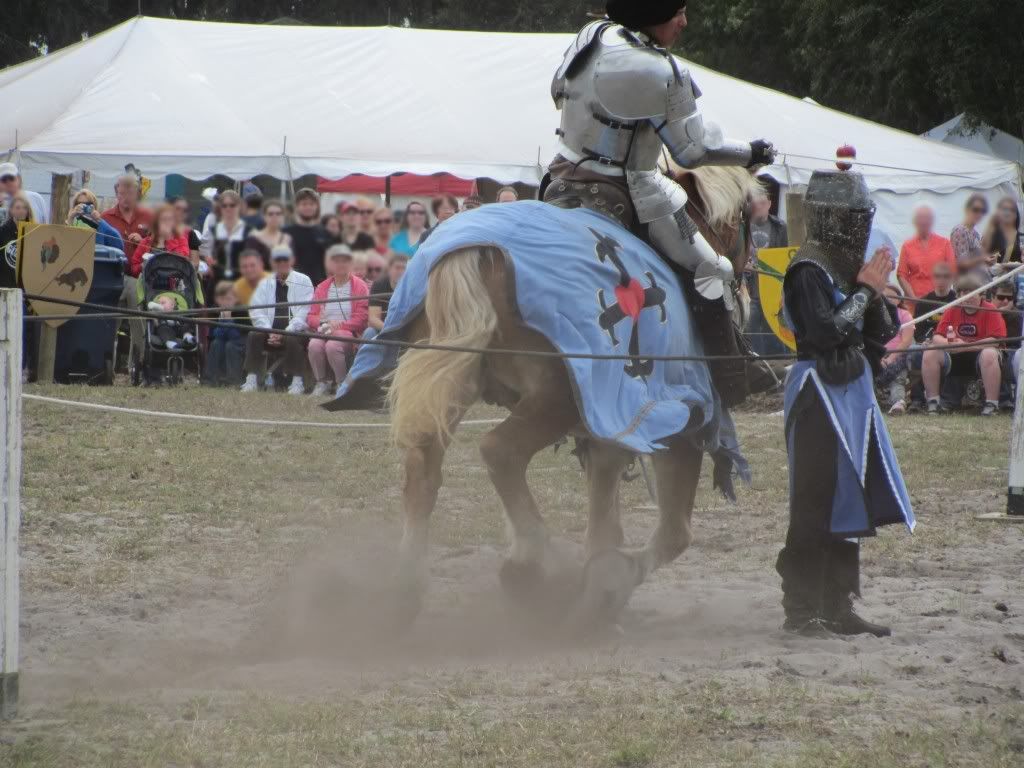
Let's pretend this photograph is a scene in a story:


We'll assume that the Renfaire is the setting, the guy on the horse is the protagonist, the guy in the helmet praying is a secondary character, and all those folks in the background is the rest of the cast. As snapshots go I think the action in this one is fairly self-explanatory. All we have to do know is figure out why this is happening.

At first glance things in the photograph do seem a bit busy -- there's a lot to look at. To make the scene more interesting and give it more impact, the first thing I do is narrow the focus and weed out anything that is unnecessary. I do the same thing with a photo by cropping:
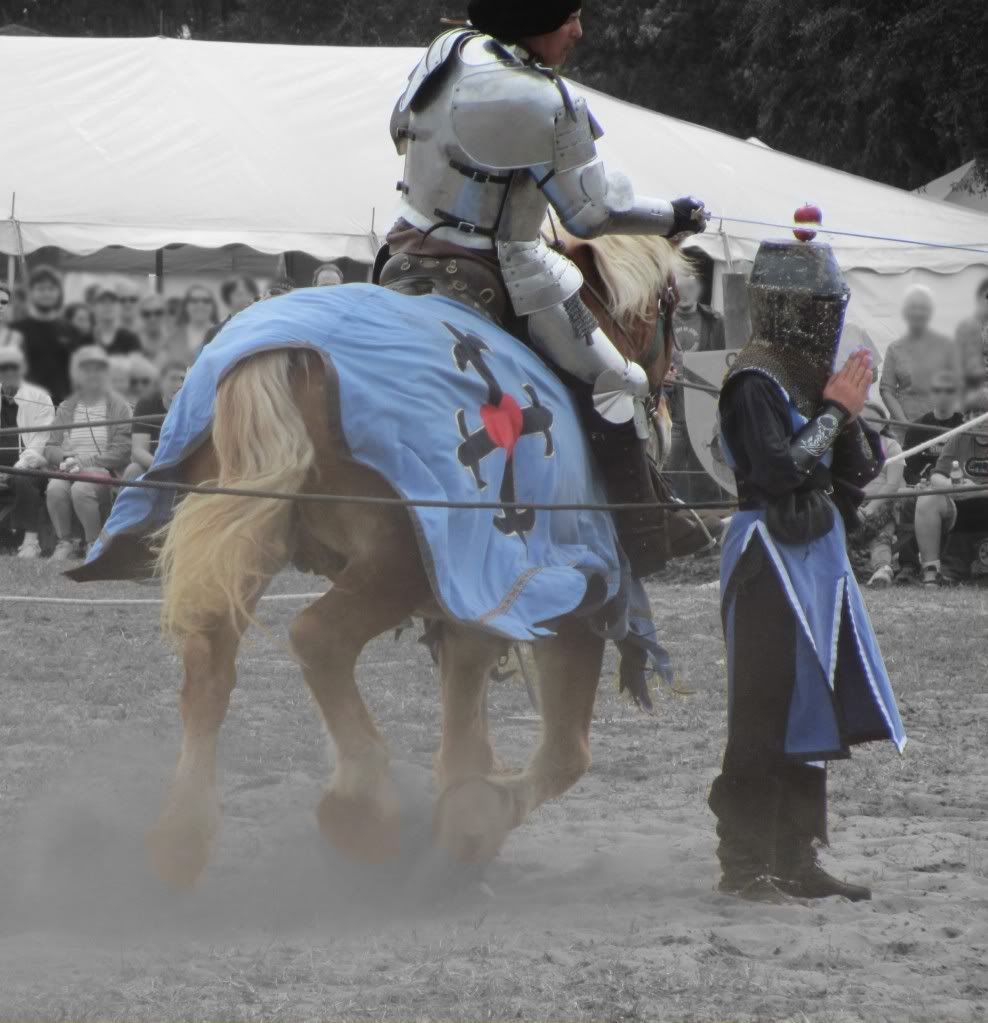


Now it looks a little better, although I felt all those colorful folks in the background were also a distraction, so I toned them down as well by making them black and white (and the facial blurriness among the crowd is also intentional.)

My photo now focuses on the two primary characters and what they're doing. But why is the guy on the horse swinging his sword, and why is the other guy praying? Let's take a closer look:
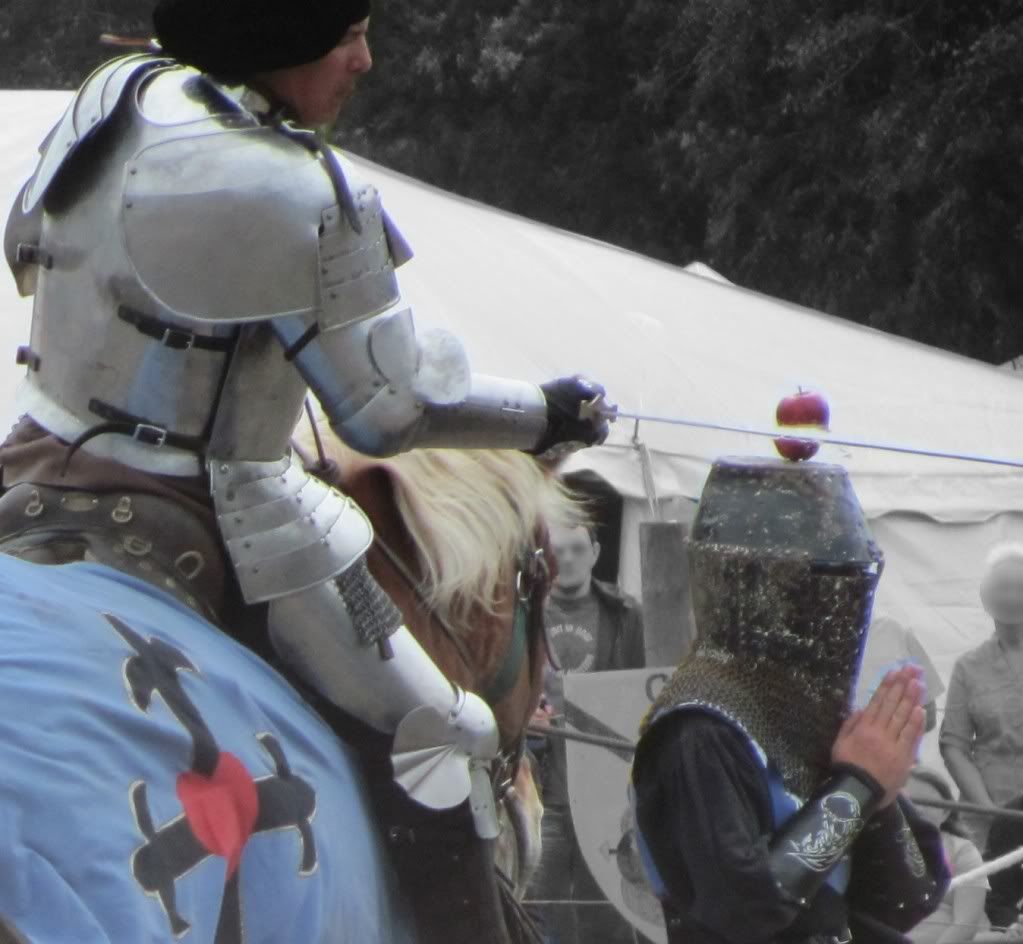


This is the aha moment of the photograph. The protagonist isn't attacking the secondary character; he's taking a swing at an apple on the guy's head. And he's doing that because he wants to . . .
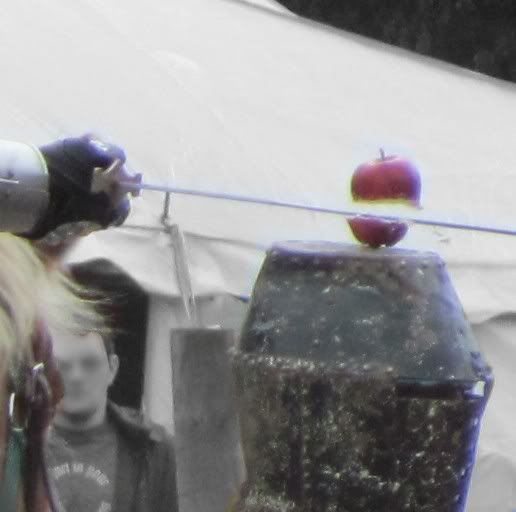


. . . chop the apple in half, of course (and don't ask me how I managed to snap this photo at the precise moment the apple split in two; it was pure dumb luck.)

A scene should illustrate some part of your story as clearly as a series of photographs. When you put together a scene, you need characters, setting, action, and a point to the whole thing. To communicate these to your reader, you need to focus on what is important and enhance that -- while not cluttering up the scene with a lot of unnecessary details.

Here are some scene-focus question to ask yourself (and you can ask these at any time, before you start writing, while you're writing, or when you're editing):

Who's in the picture? Consider how many characters you're showing to the reader in this scene, and determine if they're actually serving a purpose. If they're just standing around do nothing, they're a distraction that can clutter up up the scene and slow the pacing. Put them to work or get them out of the spotlight. You don't have to get rid of all your background characters, but don't shift the reader's focus to them by making them too prominent or colorful.

Who needs to be the main attraction? How are you showcasing the characters who are important in this scene? Are they front and center in your scene, or are they wandering around getting lost in the crowd?

What's happening in this scene? Unless you're writing some abstract literary piece, the reader generally needs to clearly understand the action that occurs. But don't fall in the trap of telling the reader too much via info dumps or As You Know Bob character monologues. When we're watching a scene like this, we don't need to know how much the horse weighs, where it was foaled, the name and home village of the smith who forged the armor, etc.

What's the point? There should be the equivalent to an apple getting sliced in half. It's the reason all of this is happening, and even if you're not ready to come out and explain it to the reader, it still needs to be somewhere in your scene because it is the point.

Got any tips that you want to share on how you keep your scenes sharp and focused? Let us know in comments.

Tuesday, May 25, 2010

Scene On-Call List

I've been trying a couple different things with writing the Kyndred books, and one of them is creating an on-call list of characters for each scene. This is like a crib sheet that breaks down every chapter by scene and POV, along with a list of the characters who should make an appearance (this doesn't always work out; while I'm writing I may add or subtract characters as needed.)

My on-call list looks something like this (note: POV characters' names are underlined):

Intro A: Palace War Room -- Soko imprisoned, accepts fate, kills ambassador, taken to goldworks [Tend, Scribe, Captain, guards, goldsmiths]

Intro B: Malibu Beach House -- Brent's confession to Randa, Emily gets out of bed, Nanny takes Emily upstairs, Randa argues with Brent about selling Emily/threatens to leave, Brent kills Randa [Randa, Brent, Emily, Nanny, hskpr?]

Chap 1A: Deployed Unit Doyle Drive SF -- Charlie and Vince finishing shift, receive 11-81, respond, find victims in road and CHP dead, Limo Guy shouts warning, Vince is shot, Sniper shows himself, jumps from bridge [Charlie, Vince, CHP, 3 GSW vics, Limo Driver, Limo Guy, Sniper/Jumper]

Using an on-call sheet like this is faster than reading the synopsis or even breaking up the synopsis into chapter or scene summaries (which is what I've always done in the past.) Each scene breakdown gives me a brief summary of where I am in the setting, what action needs to take place, and who is on stage or waiting in the wings. This also creates a great checklist for after I finish writing and go back to edit it (i.e. How far is Doyle from the bridge on the map to verify response time? Did I show all the vics? Where did I stage the jumper in relation to the fender bender to check line of fire?)

I've been preparing my on-call sheet for the entire novel in advance mainly so I can think about whose head I need to be in for what. Some scenes have to be told from the POV of a particular character to give them the maximum impact and effectiveness. Also, when you're writing in third person with multiple POVs, you can get caught up in one character's POV and forget that there are other characters who need to take the lead, and end up with eighteen chapters in one character's POV and two chapters in another.

For those who would like a blank worksheet to use for this approach, I've posted one over on Scribd.com here (I could only fit 2 scenes on the one page so you'll have to condense or print extra copies as needed.) Note 9/3/10: Since Scribd.com instituted an access fee scam to charge people for downloading e-books, including those I have provided for free for the last ten years, I have removed this document and temporarily transferred it to Google Docs here. See my post about this scam here.

Wednesday, April 29, 2009

Scene Favorites

Of all the things I like to write, I think the dialogue in action scenes is the most fun for me. I rarely plan dialogue in advance, so it's the most spontaneous writing I do, but oddly enough when there is a lot of action going on in the scene it's also the easiest. People under stress or duress say the damnedest things to each other, and I never get tired of composing it.

Action scene dialogue between secondary characters or a secondary character and the protagonist or antagonist is also one of the better story opportunities to showcase the support cast and avoid them becoming mere window-dressings or sidekicks for the protagonists. Here's one such scene from Shadowlight that I had a lot of fun with.

I wish love scene dialogue were as simple to write; I find that the most difficult to compose. I can handle describing the action, no problem, but cooking up the appropriate lines for the lovers to say to each other is always a challenge. Love scenes with no dialogue aren't as interesting, though, so I try to create and incorporate the right words.

One thing that helps me with writing love scene dialogue is to read some romantic poetry first. I don't quote the poems in love scenes, but they put me in the romantic mindset. Occasionally I'll write a love poem or letter from one character to the other (that helped a lot with writing the dialogue in the love scenes from Evermore.)

What are you favorite scenes to write, and what are your least favorite? Do you have anything you do to help with writing the scenes that are difficult for you? Let us know in comments.

Thursday, January 17, 2008

Weeding Words

Over at Storytelling, Rosina Lippi has an interesting post about descriptive words overused by writers. I'm probably guilty of a whole list of those (off the top of my head: whole, great, terrific, probably and wonderful.)

I tend to notice more the object words I overuse. Like my obsession with doors. If I'm not careful, a door will sprout up like crab grass every couple of pages in my story. As will bodies of water, quilts, window sills, paintings or art of some kind, kitchen tables and (lately) flower arrangements. But mostly I'm plagued by doors.

I can't say exactly why my subconscious keeps trying to add these weed words to every scene. I like doors because they are a focal point in any room and part of the setting that actually does something. Bodies of water, well, I'm a girl who grew up near some of the nicest beaches in the country; that likely has something to do with it. I use window sill imagery in a lot of my poetry, that's a cross-over weed word. The rest are just things I find comforting, I guess.

I always spot my weed words after the book is published, but not always before. During the editing phase I try to remember to weed them out with Word's find and replace tool, but even then I'm a bit blind to them or forget to look for them. You can tell when I've rushed too much on editing one of my novels because of the thirty or more door references in the story.

I used to have a weed words list, but last year I filed it away in a place where I wouldn't forget it and have since forgot where that is. I think I'll make a new one and pin it to the wall or something. You writers out there, what are some of your weed words? How do you all deal with keeping them from spreading from scene to scene?

Thursday, July 05, 2007

Scene Building 101

Novels are made up of scenes, or segments of the story. The average novel can contain anywhere from twenty to sixty scenes, depending on the author's style and creative choices. Every writer defines and writes scenes in their own way, so the way I put together a scene may not work for you. Feel free to adapt and interpret this information to best suit your writing style.

When I compose a scene, I consider what I think of as the five P's of scene-writing:

1. People: Who needs to be in this scene?

2. Place: Where does the scene happen?

3. Plot: What part of the plot is involved in this scene?

4. Progression: How will this scene move the story along?

5. Point: Does the scene serve the story?

I believe thinking through a scene before you write it helps prepare you for the task at hand. Even if you're an organic writer who hates to plan ahead, you can use these points as a sort of mental checklist while you're composing.

#1 & #2: Most writers do consider which characters to put in a scene and where the scene should take place; these are the most obvious building blocks. You have to know the players and where they are. The most frequent problems I see in novels are too many wall flower characters in a scene (they contribute only housekeeping-type dialogue, or just stand around and do nothing) and settings that are so overblown and overwritten that they eclipse the characters and everything that happens in the scene (aka travelogue writing.)

If you experience these problems, my advice is to 1) remove any character who does not serve a defined purpose in the scene, and 2) write your characters, dialogue and action first and your setting last.

#3: Every scene should tie into the plot in some way. If it doesn't, it's pointless filler, and nine times out of ten it's going to bore the reader. Don't try to save scenes like these -- get them out of your novel.

#4: Advancing the plot or moving the story along or whatever you want to call it has to happen, or the novel falls into the Sargasso Sea of Storytelling and goes nowhere (most often this takes place in the middle of the novel, when it's too soon to wrap things up, but too late to introduce new stuff for the reader.) I think the way to avoid novel lag time is to outline the plot a little more carefully before you write, but not everyone likes that approach. So think about adding a subplot or subplots that are resolved at different times during the story.

#5: There has to be a point to writing the scene, as in it does something for the story. Most often the pointless scenes I read are saturated with technobabble, infodumps or a dumptruckload of backstory that could have been better integrated into the story. A scene without a point is like yelling at the reader As You Know, Bob. . . . for five pages.

One scene-organizing trick I teach to my students is the 911 call. If you're not sure how to tackle what happens during a scene, take a tape recorder and dictate the scene as if you're calling 911, i.e.:

"Hello, operator? A huge fleet of alien ships just surrounded this planet. There's like three hundred of them. They're powering up their weapons. They're firing! Wait, they stopped. This guy in charge of the fleet is sending a signal to the surface. He's threatening to fire on the inhabitants if they don't turn over this doctor chick he's trying to capture. The doctor chick is negotiating her surrender. She won't let the people on the planet die protecting her. It really ticked off her ex, but the guy she loves now doesn't seem to care. What a jerk . . . "

How do you guys tackle scene-writing? Have you come up with or found any techniques that help? Let us know in comments.

Related links:

Writing Scenes That Move Your Story Forward

Writing the Perfect Scene (link swiped from Simon Haynes's excellent page on How to Write a Novel

From a screenwriter's POV: John August's How to Write a Scene

How to Write a Great Combat Scene