Ten Online Writing Classes You Can Take for Free
Alison.com's English Writing Skills
Author and Screenwriter Steven Barnes's Free Writing Class
Author Jeffrey A. Carver's Science Fiction and Fantasy Writing
The Crafty Writer's Creative Writing Course
Education Portal's video series Conventions in Writing
Writing Coach Sarah Lovett's Dream It, Write It
Online Creative Writing's Copywriting Clinic
Online Creative Writing's The Challenge (online marketing writing class)
The Open University's Start Writing Fiction
The Open University's Writing What You Know
Showing posts with label online classes. Show all posts
Showing posts with label online classes. Show all posts
Monday, April 28, 2014


Saturday, April 26, 2014
Escape Your Muggles

Any J.K. Rowling fan can now (virtually) attend the famous school from the Harry Potter books, Hogwarts School of Witchcraft & Wizardry -- for free! -- thanks to the ultra-cool website Hogwarts is Here:
Thanks to the Wizengamot, the British and American Ministry of Magics and a handful of tech-friendly professors from Hogwarts School of Witchcraft & Wizardry , a Hogwarts education has now become available online to all aspiring witches and wizards.
You are now able to enroll at Hogwarts, collect your textbooks and begin taking our 9-week courses online. You can now progress through all seven years of schooling and be assigned a professor, homework assignments, quizzes and more.
Meet other students online by joining a House dormitory, chat with others in the Common Room, browse and contribute to the Hogwarts Library, collect chocolate frog cards, earn galleons & house points and so much more.
Thanks to the efforts and resources (plus a little magic) from the Wizard-Muggle Integration Movement, this online Hogwarts experience and education is entirely free. With a lot of passion from fans and with extraordinary creativity, anything is possible.
(Hogwarts link nicked from Gerard at The Presurfer)
Sunday, May 19, 2013
Writsy Stuff
I subscribe to author/quilt designer Carol Doak's monthly newsletter, mainly because I like her how-to books on paper piecing and want to know whenever she publishes something new. This month she mentioned the success she's having with teaching online classes at Craftsy.com, the hot new how-to crafting site. According to her newsletter in about a month she had 3,000 students sign up for her class on paper piecing, and even at the currently discounted price of $29.95 per student that comes close to making $100K in a month.
Startling figures, to say the least. Some disclaimers: I don't know how much of that Craftsy.com takes as commission or any other details involved in teaching one of their classes. It should also be mentioned that Carol is already quite well known in the quilting world as a very talented and innovative writer and artist. I noted that one draw may be that she includes free for her students a companion e-book which is valued at half the price of the class, which is an excellent bonus. I thought I'd mention it primarily for any of you who may have published how-to craft books and want to check out what's involved in teaching a class.
It would be great if there were a Craftsy.com-type site for writers (Writsy!) where you could sign up to learn how to write a proper query, what needs to be in a submission package, how to efficiently edit a chapter or even the real nuts and bolts of how to put together an e-book when going the indie route. There are a couple of obvious problems with that idea; the primary one being that writing does not translate as well to video as something like crafting. Writing happens in your head and on the computer and the page, and even the most basic screenshots quickly become tedious (or incomprehensible) in video's rapid delivery of visuals. Filming writing workshops like the kind put on at conferences might be a solution, as long as the instructor is a gifted speaker and does something besides talk.
The other big problem is that there is no one go-to, this-is-how-you-do-it standard for everything professional writers do. I think it would be tough to get everyone to agree on a standard as well -- a good example is simply how you write a novel synopsis. I learned first what synopses were and how to write them via my subscription to Writer's Digest magazine -- until an editor asked me why I wrote such odd synopses. Once I explaining that I was following examples from WD articles, the editor informed me that my synopses were in fact too short, that I should not put every character's name in all caps and I wasn't detailing my plot twists or my endings. I asked for an example I could follow, but the editor wouldn't give me one, so I began blindly writing longer synopses, ditched capping the character names and revealed all -- until another editor complained that my synopses were too long and too detailed.
The editor after that one wanted to know why I didn't write out the relationship arcs (and then had to explain to me what those were.) Another asked for chapter summaries to go along with the synopsis. The one after that, who started working with me in mid-series, asked for one-paragraph synopses for all the previous books (and if you want a real writing challenge, try to condense a novel series that contains hundreds of characters and settings and plot lines and over a million words altogether into just nine paragraphs.)
To this day practically every editor I work for has a slightly different opinion about what should or shouldn't be in a synopsis. Some want a lot, others just want bare bones, and still others want something I've never before done. That's why I put together a synopses bible on all the books I've sold so I can at least review what I've done in the past that worked. When I teach writing synopses, I also use for examples only the ones which have resulted in contract offers.
Until someone does come up with enough standards for writers to create a Writsy.com there are plenty of online classes for writers. A few weeks back I noted author Barbara Samuel is teaching an online class on voice; the way she has this set up (maintaining a small class size, the triad approach of lectures/exercises/discussions, and offering a scholarship as well as discounts for group) seems like a sensible way to go about it. Before you invest consider all these things as well as what sort of talent and experience the instructor offers, and let that be your guide.
Startling figures, to say the least. Some disclaimers: I don't know how much of that Craftsy.com takes as commission or any other details involved in teaching one of their classes. It should also be mentioned that Carol is already quite well known in the quilting world as a very talented and innovative writer and artist. I noted that one draw may be that she includes free for her students a companion e-book which is valued at half the price of the class, which is an excellent bonus. I thought I'd mention it primarily for any of you who may have published how-to craft books and want to check out what's involved in teaching a class.
It would be great if there were a Craftsy.com-type site for writers (Writsy!) where you could sign up to learn how to write a proper query, what needs to be in a submission package, how to efficiently edit a chapter or even the real nuts and bolts of how to put together an e-book when going the indie route. There are a couple of obvious problems with that idea; the primary one being that writing does not translate as well to video as something like crafting. Writing happens in your head and on the computer and the page, and even the most basic screenshots quickly become tedious (or incomprehensible) in video's rapid delivery of visuals. Filming writing workshops like the kind put on at conferences might be a solution, as long as the instructor is a gifted speaker and does something besides talk.
The other big problem is that there is no one go-to, this-is-how-you-do-it standard for everything professional writers do. I think it would be tough to get everyone to agree on a standard as well -- a good example is simply how you write a novel synopsis. I learned first what synopses were and how to write them via my subscription to Writer's Digest magazine -- until an editor asked me why I wrote such odd synopses. Once I explaining that I was following examples from WD articles, the editor informed me that my synopses were in fact too short, that I should not put every character's name in all caps and I wasn't detailing my plot twists or my endings. I asked for an example I could follow, but the editor wouldn't give me one, so I began blindly writing longer synopses, ditched capping the character names and revealed all -- until another editor complained that my synopses were too long and too detailed.
The editor after that one wanted to know why I didn't write out the relationship arcs (and then had to explain to me what those were.) Another asked for chapter summaries to go along with the synopsis. The one after that, who started working with me in mid-series, asked for one-paragraph synopses for all the previous books (and if you want a real writing challenge, try to condense a novel series that contains hundreds of characters and settings and plot lines and over a million words altogether into just nine paragraphs.)
To this day practically every editor I work for has a slightly different opinion about what should or shouldn't be in a synopsis. Some want a lot, others just want bare bones, and still others want something I've never before done. That's why I put together a synopses bible on all the books I've sold so I can at least review what I've done in the past that worked. When I teach writing synopses, I also use for examples only the ones which have resulted in contract offers.
Until someone does come up with enough standards for writers to create a Writsy.com there are plenty of online classes for writers. A few weeks back I noted author Barbara Samuel is teaching an online class on voice; the way she has this set up (maintaining a small class size, the triad approach of lectures/exercises/discussions, and offering a scholarship as well as discounts for group) seems like a sensible way to go about it. Before you invest consider all these things as well as what sort of talent and experience the instructor offers, and let that be your guide.
Saturday, May 05, 2012
Twinkling H2O's Class
 My art class wrapped up yesterday, and after three weeks of studying and practicing, I think overall the experience was an excellent one.
The class, Mastering Twinks, focused on a product that I've used and loved for five years: Dreaming in Color's Twinkling H20 watercolor line. These paints, which are unlike any I've ever tried, are self-blending watercolors infused with varying amounts and colors of ground mica. This makes them very hard to photograph, but you can see the mica shining in this photo. This makes the colors reflective in various ways, from soft and subtle twinkle to a hard metallic glitter, depending on the shade. Collectively they are dazzling.
I've been experimenting on my own with them on paper and fabric with some amazing results, and I wanted to learn more about the paints as well as techniques I could use with them, so I signed up for the class.
Our instructor, Dion Dior, is a very talented artist, and she conducted the class in three lessons: Twinkling Techniques, Colors, and Masterpieces. All of the lessons came in .pdf form, which we downloaded and followed. We also discussed the various lessons and exercises on a private forum discussion board, and posted our works on a Flickr group account where we also chatted about tips and techniques.
I probably spent two to three hours a day studying and working on exercises and projects for the class, and in the process I learned at least a dozen new techniques. I was familiar with only about half of the other art supplies we combined with the Twinks for our homework, so the exposure to new methods and mediums was excellent. I'd say the most important for me was how to employ masking fluid with watercolor; I've always wanted to try it but felt too intimidated by my own ignorance to give it a shot.
 The work could be as easy or difficult as you wanted it to be; I committed to doing every exercise and project so I could get the full benefits, so it was a lot of work. I also experimented a little on the side and came up with a variation on one technique that allowed me to transfer the impression of a metallic lace into the paint. I tried at first to do my lessons at night, but found I was too tired to produce at my optimum level, and so I switched to first thing in the morning. Starting out every day with a couple of class assignments put me in a great, lasting creative mood that carried over into my writing time.
The class is not super expensive, and with registration you receive a gift card with which you can purchase most of the required colors for the class. Twinks are not cheap, so if you want to buy more of the colors Dion uses in her examples for the lessons you can probably expect to spend another $20.00 - $40.00 on watercolor. The rest of the supplies depend on what you keep on hand for your art. I already had plenty of watercolor paper, brushes and palettes on hand, but I also invested in some supplies that I don't normally use, like gesso and oil pastels and water-soluble crayons. JoAnn's carries a very reasonably-priced art supply line, "Simply Art" which covered most of these needs. I did make a couple of trips to the pro art supply store in the city to get specific, uncommon items like black gesso and hot-press watercolor paper, which were more expensive, but not required (I was really determined to try everything Dion taught in the lessons.)
I didn't know what to expect from the other people in the class; the last time I took an art course was in high school. Back then we were all grumpy teenagers who mostly kept to ourselves. My group in this class seemed very diverse; hailing from all parts of the world. I'd say they were a little shy -- and it's tough to put your work out there for everyone to comment on -- but those who were more active were unanimously supportive. There was absolutely no negativity from anyone, and that did surprise me. Skills ranged from beginner to professional, so it was a good mix.
Dion Dior is a terrific instructor. She said we could ask her any questions, and we did, and she answered all of them. She shared plenty of her personal methods, made astute observations and was universally encouraging to everyone. If she ever gives a real-life art workshop in my area, I plan to sign up and sit in the front row.
As for me being in the class, I didn't try to hide who I am -- I did register as Lynn Viehl -- but I also didn't talk about my profession, and it never came up once from anyone else. That was a nice little online vacation for me, to simply be a student.
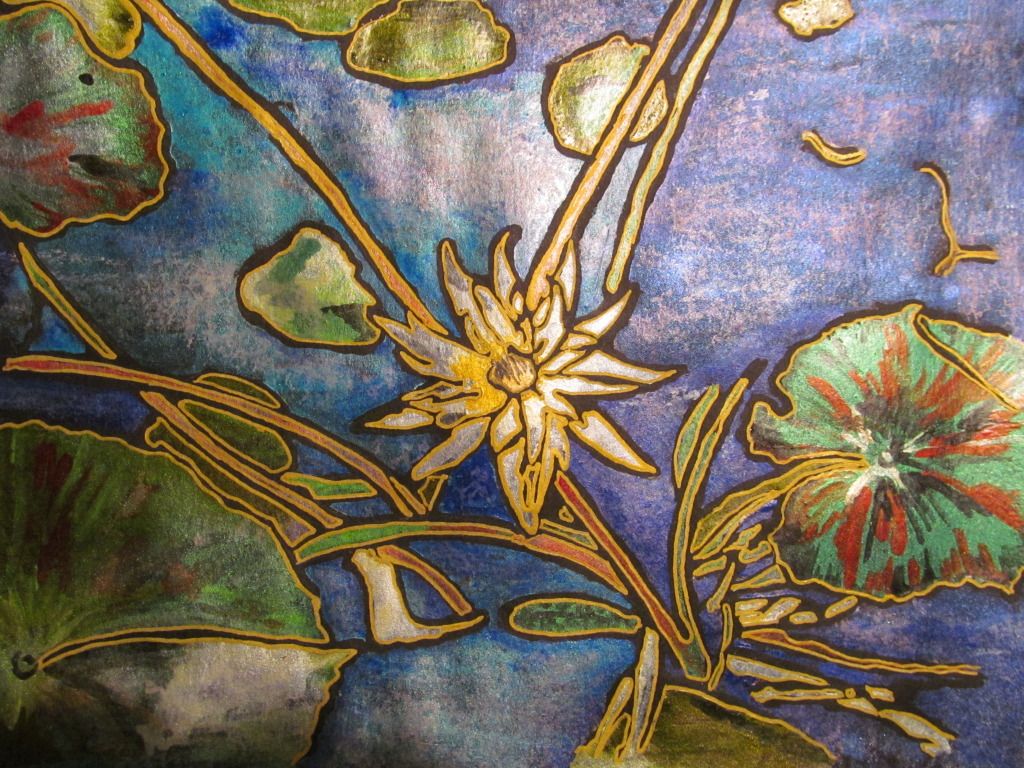 I didn't love all the lessons -- stencils are still not my friends -- but I'd say 95% of them helped me make some real progress with my art. The other 5% were just not for me or were techniques I was already using. That's pretty good for a class using a medium I've already worked with for a long time. The final project was a real challenge, but by the time I reached it I was fully prepared to take it on.
I'd recommend this class to anyone who does decorative art, journaling art, mixed media, or who would like to try something truly different in the realm of watercolor (but if you're anti-sparkle, this is definitely not the class for you.) You'll get a real work out of your existing art skills, and you'll definitely learn quite a few new things.
To see a slide show of more of my work from class, click here.
Tuesday, April 24, 2012
Educationally Free
 Copywriter and Men with Pens blog owner James Chartrand is holding a contest for his Damn Fine Words online writing course; the winners each receive a free spot in the class. To enter, you have to write a blog article, minimum 450 words, on why writing is important to you and how better writing skills would change your business or your life, and post it on your blog, and then do some linking. No entry fee, deadline is May 1 at 7 am EST; see contest post for more details.
I'm at the halfway point of my online art class now, and I feel that I've already gotten twice my money's worth in advice and instruction, so that's working out quite well (and I will be relating more about the class once I'm finished, for those of you who were curious about it.) It's also nice to shed the authorial albatross for a couple of weeks and be a regular person.
Over the years I've been approached by various colleagues and organizations to do pay-for online writing classes, and while I've been flattered I've always declined. It's not that I think there's anything wrong with charging people to learn about writing; talented writers who share their knowledge certainly have the right to be compensated for it, and teaching for money helps them supplement their writing income which for most of them, let's face it, is probably never going to be the stuff of instant retirement.
I'm a child of public education, though, and my university was the local library; I teach for free to honor the librarians and public school teachers who guided me in this direction, and to be there for all the writers like me who could never afford to pay for classes. Aka my little personal Crusade.
My past efforts at online teaching have been both rewarding and frustrating. Early on in my career I moderated an online writer's think tank in a chat room, which made every Friday night a blast, at least until my arthritis grew worse and I couldn't type fast enough to keep up with the questions. My Left Behind & Loving It virtual writing workshops were also a lot of fun; they just got too big too fast to handle on my own. When RWA committed the ultimate irony by promoting me and my fellow writers' efforts to their membership as an alternative to their National conference, I knew it was time to let them go.
Likely the most successful teaching project I've done to date is The Novel Notebook. When I put it together five years ago I thought it might help a couple of writers organize their stuff better, but that was all. I can't tell you how many writers have since downloaded and used it, because I don't track things like that, but it's the most popular free e-book I've ever posted online. Last year during NaNoWriMo I heard that several groups were actually handing out CD and printed copies of it at their meetings, which was very neat.
I don't know yet what my next teaching project will be, but I'd like to do something along the lines of the Novel Notebook (whatever evolves, I promise I will keep it free.) Which makes me wonder: if you could get me to teach something online, what would it be, and how would you want me to teach it? Let me know in comments.
Graphic credit: © Yellowj | Dreamstime.com
Tuesday, April 17, 2012
Student Attitude
Sorry I'm late posting today; I was up late last night wrestling with a project and forgot to queue up my post for publication.
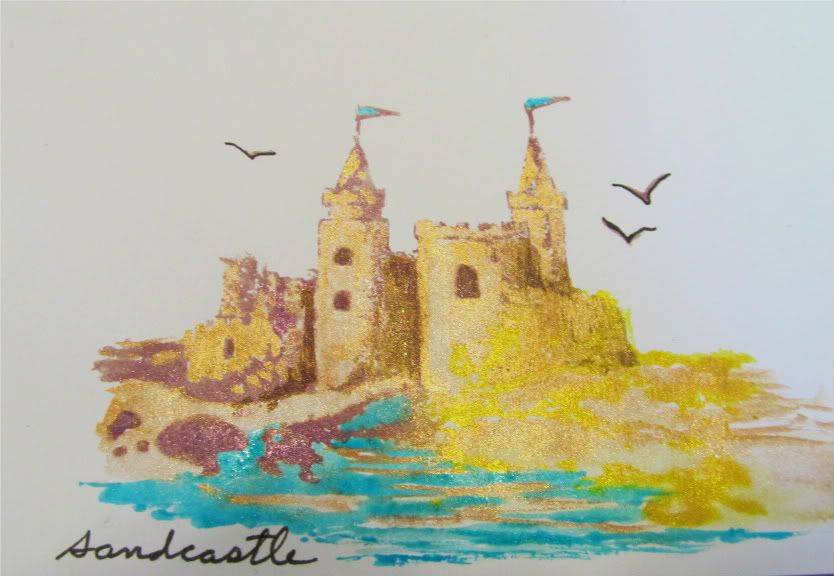 The online art class I'm taking is going well, I think. It's a bit more complicated than I expected, and some of the skills that I took for granted definitely need some rust remover. Lots of work, too, but I'm learning new things, and discovering some old truths: stencils are (still) not my friends; nothing ever turns out like it looks in your head; and if the instructions say wait until the paper is completely dry before you do something, wait until the paper is completely dry.
Being a virtual student is interesting, though. Earlier this year I took a six-week, in-real-life Bible study class with my mom, and while the art class is completely different I can't help comparing the two. When an instructor asks a question, no one ever wants to be the first to answer. There always seems to be someone who doesn't understand the simplest assignment, and someone who already knows everything and probably should be in a more advanced class. No matter what the subject or question is, everyone seems to dread being called on in case they don't have the right answer.
Then there are the personalities. Among real-life students you can always pick out certain types: the over-achiever, the oddball, the suck-up, the talker, the whiner, the fight-picker, the peacemaker. Virtual classes, on the other hand, have the internet as a buffer, and people seem to bring with them their cyber personas, which are all pretty similar.
Not being the teacher for once is also something of a challenge for me, especially when there are questions. My natural inclination to try to problem-solve and provide answers, but that's not my role in this situation, so I have to constantly remind myself to shut up. It's good for me, however, because when you do nothing but teach you tend to forget what it's like to be on the receiving end of the information. I'm seeing that an instructor can easily fall into the trap of assuming everyone knows what they're talking about, which results in leaving behind some people who didn't get it but were too shy to speak up.
I'm taking away from this experience a lot of data on what and how I want to teach in the future as well as how and what I want to pursue as a student. That may be the most valuable part of taking any course online or in real-life.
Now a couple of questions for you guys: What sort of online or real-life classes would you like to take (doesn't matter what subject)? Have you taken any classes either way that you found were particularly helpful? Let us know in comments.
The online art class I'm taking is going well, I think. It's a bit more complicated than I expected, and some of the skills that I took for granted definitely need some rust remover. Lots of work, too, but I'm learning new things, and discovering some old truths: stencils are (still) not my friends; nothing ever turns out like it looks in your head; and if the instructions say wait until the paper is completely dry before you do something, wait until the paper is completely dry.Being a virtual student is interesting, though. Earlier this year I took a six-week, in-real-life Bible study class with my mom, and while the art class is completely different I can't help comparing the two. When an instructor asks a question, no one ever wants to be the first to answer. There always seems to be someone who doesn't understand the simplest assignment, and someone who already knows everything and probably should be in a more advanced class. No matter what the subject or question is, everyone seems to dread being called on in case they don't have the right answer.
Then there are the personalities. Among real-life students you can always pick out certain types: the over-achiever, the oddball, the suck-up, the talker, the whiner, the fight-picker, the peacemaker. Virtual classes, on the other hand, have the internet as a buffer, and people seem to bring with them their cyber personas, which are all pretty similar.
Not being the teacher for once is also something of a challenge for me, especially when there are questions. My natural inclination to try to problem-solve and provide answers, but that's not my role in this situation, so I have to constantly remind myself to shut up. It's good for me, however, because when you do nothing but teach you tend to forget what it's like to be on the receiving end of the information. I'm seeing that an instructor can easily fall into the trap of assuming everyone knows what they're talking about, which results in leaving behind some people who didn't get it but were too shy to speak up.
I'm taking away from this experience a lot of data on what and how I want to teach in the future as well as how and what I want to pursue as a student. That may be the most valuable part of taking any course online or in real-life.
Now a couple of questions for you guys: What sort of online or real-life classes would you like to take (doesn't matter what subject)? Have you taken any classes either way that you found were particularly helpful? Let us know in comments.
Wednesday, May 19, 2010
Teach Thyself
With all the biz emphasis on costly MFAs, seminars, workshops and what have you in regard to learning how to write fiction, I think the next generation of writers may not always consider or even understand the merits of self-education.
Before I start offending the academics out there, I don't think there's anything wrong with formal education in general. For the medical, technical and scientific professions obviously it's a must. Most of us attend public or private schools as kids, so usually the first thing we think of in regard to learning is continuing that type of education. Also, many people do learn a great deal by going through traditional/institutional forms of education. I'm sending one kid to college this fall and the other to vet school in a couple of years, and I'm paying for all of it. I wouldn't waste my hard-earned money on something I thought was utterly worthless.
That said, I am a completely self-taught writer, and I don't think there's anything wrong with that. I've made it work fairly well for me, so I thought I'd pass along some of the benefits and perks of teaching yourself:
Internet access + public library card = 100% free education. This works for writers who do not have wealthy parents, spouses, partners, an unused fifty grand sitting in the checking account, or the ability to qualify for those hefty student loans. Also for anyone who would rather spend their money on the little luxuries like food, shelter, clothing . . .
You don't have to quit your day job or give up your daily responsibilities to attend classes, and you can attend whenever you want wherever you want for as long as you want. Not everyone decides to become a professional writer at age 18; sometimes the calling comes much later in life. I didn't decide to seriously pursue publication until I was 28, and I was pregnant or had babies in diapers while I taught myself what I needed to know. If you're already employed, a stay-at-home parent, an elderly caretaker or simply have an insanely chaotic life, self-education can be the best fit for your busy schedule.
You work at your own pace, and can take as long as you need to master a concept or element of writing. Some people can master an idea in a split second. The rest of us mortals generally need to spend a little time wrapping our brains around it, trying it out, etc.
You custom-design your education by by choosing what information you want to study from what resources. Unlike what was hammered into our heads in school, this means things like no required reading. Which means if you don't like Chekhov, you don't have to read Chekhov. Or Conrad. Or Hawthorne. You're tingling already, aren't you? I can tell.
No grades involved whatsoever. Aside from the fact that traditional grading systems are corrupt, inaccurate and wholly inappropriate ways of motivating the learner, you don't have to worry about showing your mom your report card because there isn't one.
You can choose what works for you and discard what doesn't by testing it out yourself. Like on-the-job training it works beautifully, plus you won't have to cater to the preferences of some professor who thinks Melville is timely or that every author born after Salinger should be shot.
You learn independently, so you don't have to rely on anyone else, their schedule and what they think you should or shouldn't know. I think this helps make a writer a better self-starter and problem-solver. It also frees you from dependence on others becoming a necessary part of your writing process (aka writing by committee.)
No pressure to audition, be accepted, perform or obtain any sort of official certification. One thing I've noticed about some of the more critically-acclaimed writing workshops is the fact that you have to first audition for them; then they decide who they want to teach (aka students who most likely are already 90% the way there.) Nothing wrong with this, it's good PR: if you want your writing program to look highly successful, definitely stock it with only those writers who demonstrate that they are already very accomplished and only need a bit of buffing and polishing. How many of us fit that profile when we start out on the road to publication? I certainly didn't.
Self-education is not the easy road. What you learn depends on how determined you are to pursue your own education. When you teach yourself you're not just the student; you're also the teacher. You have to be part hunter-gatherer as well, because in order to acquire your course materials, you have to get online or go to your library and look for them, analyze them and figure out how to work with them. As with working at home, studying at home can be a real challenge, too.
Another thing to consider when contemplating what sort of writing education you want is the likelihood of whether or not you will become a full-time writer. According to the U.S. Department of Labor/Bureau of Labor Statistics: "Median annual wages for salaried writers and authors were $53,070 in May 2008. The middle 50 percent earned between $38,150 and $75,060. The lowest 10 percent earned less than $28,020, and the highest 10 percent earned more than $106,630." This sounds great, until you consider that these statistics are for salaried writers who probably work for a company. As a freelance/contracted writer you don't receive a weekly salary; you're paid for what you sell. There is no guarantee that you will sell everything you write every time.
If you're careful the expenses involved with writing don't have to be crushing, but few people can make a living working as full-time writers. For the newly-published writer, the industry standard advance of $5K per book, an agent who collects 15% of your earnings, and the heftier taxes you have to pay as a self-employed worker does not add up to a lot of income. If you're not an overnight success, under those circumstances you could be looking at writing and selling 4+ books per year just to get within spitting distance of that lowest 10% figure the Labor Department cites. Now imagine that level of income while you have yourself and possibly a family to support as well as 100K in college loans waiting to be paid off.
Only you know if you have the resources or the inclination to continue on or go back to school for writing, so I can't tell you what to do. All I can say is that self-education is always there if you can't go the formal route, and for that reason it's definitely worth considering. Teaching yourself won't reward you with a diploma, or credentials you can display in a signature block acronym, but if you stick with it, you may find you end up with everything you need to become a successful professional writer. For free.
Related links:
2010 Average Salaries for Writers and Editors by John Hewitt
50+ Open Courseware Writing Classes from the World's Leading Universities
Learn Free
Ten for Free
Before I start offending the academics out there, I don't think there's anything wrong with formal education in general. For the medical, technical and scientific professions obviously it's a must. Most of us attend public or private schools as kids, so usually the first thing we think of in regard to learning is continuing that type of education. Also, many people do learn a great deal by going through traditional/institutional forms of education. I'm sending one kid to college this fall and the other to vet school in a couple of years, and I'm paying for all of it. I wouldn't waste my hard-earned money on something I thought was utterly worthless.
That said, I am a completely self-taught writer, and I don't think there's anything wrong with that. I've made it work fairly well for me, so I thought I'd pass along some of the benefits and perks of teaching yourself:
Internet access + public library card = 100% free education. This works for writers who do not have wealthy parents, spouses, partners, an unused fifty grand sitting in the checking account, or the ability to qualify for those hefty student loans. Also for anyone who would rather spend their money on the little luxuries like food, shelter, clothing . . .
You don't have to quit your day job or give up your daily responsibilities to attend classes, and you can attend whenever you want wherever you want for as long as you want. Not everyone decides to become a professional writer at age 18; sometimes the calling comes much later in life. I didn't decide to seriously pursue publication until I was 28, and I was pregnant or had babies in diapers while I taught myself what I needed to know. If you're already employed, a stay-at-home parent, an elderly caretaker or simply have an insanely chaotic life, self-education can be the best fit for your busy schedule.
You work at your own pace, and can take as long as you need to master a concept or element of writing. Some people can master an idea in a split second. The rest of us mortals generally need to spend a little time wrapping our brains around it, trying it out, etc.
You custom-design your education by by choosing what information you want to study from what resources. Unlike what was hammered into our heads in school, this means things like no required reading. Which means if you don't like Chekhov, you don't have to read Chekhov. Or Conrad. Or Hawthorne. You're tingling already, aren't you? I can tell.
No grades involved whatsoever. Aside from the fact that traditional grading systems are corrupt, inaccurate and wholly inappropriate ways of motivating the learner, you don't have to worry about showing your mom your report card because there isn't one.
You can choose what works for you and discard what doesn't by testing it out yourself. Like on-the-job training it works beautifully, plus you won't have to cater to the preferences of some professor who thinks Melville is timely or that every author born after Salinger should be shot.
You learn independently, so you don't have to rely on anyone else, their schedule and what they think you should or shouldn't know. I think this helps make a writer a better self-starter and problem-solver. It also frees you from dependence on others becoming a necessary part of your writing process (aka writing by committee.)
No pressure to audition, be accepted, perform or obtain any sort of official certification. One thing I've noticed about some of the more critically-acclaimed writing workshops is the fact that you have to first audition for them; then they decide who they want to teach (aka students who most likely are already 90% the way there.) Nothing wrong with this, it's good PR: if you want your writing program to look highly successful, definitely stock it with only those writers who demonstrate that they are already very accomplished and only need a bit of buffing and polishing. How many of us fit that profile when we start out on the road to publication? I certainly didn't.
Self-education is not the easy road. What you learn depends on how determined you are to pursue your own education. When you teach yourself you're not just the student; you're also the teacher. You have to be part hunter-gatherer as well, because in order to acquire your course materials, you have to get online or go to your library and look for them, analyze them and figure out how to work with them. As with working at home, studying at home can be a real challenge, too.
Another thing to consider when contemplating what sort of writing education you want is the likelihood of whether or not you will become a full-time writer. According to the U.S. Department of Labor/Bureau of Labor Statistics: "Median annual wages for salaried writers and authors were $53,070 in May 2008. The middle 50 percent earned between $38,150 and $75,060. The lowest 10 percent earned less than $28,020, and the highest 10 percent earned more than $106,630." This sounds great, until you consider that these statistics are for salaried writers who probably work for a company. As a freelance/contracted writer you don't receive a weekly salary; you're paid for what you sell. There is no guarantee that you will sell everything you write every time.
If you're careful the expenses involved with writing don't have to be crushing, but few people can make a living working as full-time writers. For the newly-published writer, the industry standard advance of $5K per book, an agent who collects 15% of your earnings, and the heftier taxes you have to pay as a self-employed worker does not add up to a lot of income. If you're not an overnight success, under those circumstances you could be looking at writing and selling 4+ books per year just to get within spitting distance of that lowest 10% figure the Labor Department cites. Now imagine that level of income while you have yourself and possibly a family to support as well as 100K in college loans waiting to be paid off.
Only you know if you have the resources or the inclination to continue on or go back to school for writing, so I can't tell you what to do. All I can say is that self-education is always there if you can't go the formal route, and for that reason it's definitely worth considering. Teaching yourself won't reward you with a diploma, or credentials you can display in a signature block acronym, but if you stick with it, you may find you end up with everything you need to become a successful professional writer. For free.
Related links:
2010 Average Salaries for Writers and Editors by John Hewitt
50+ Open Courseware Writing Classes from the World's Leading Universities
Learn Free
Ten for Free
Thursday, January 25, 2007
Learn Free
Thanks to the internet, writers can now attend classes and workshops from any spot on the globe. No classrooms. No spine-rearranging desks lined in wads of used gum. No snotty teacher to grab you by the sleeve and say, Well, Miss Smartie, why don't you stand up and read whatever you've been writing to the whole class?
By the way, kids, if you ever are caught writing an honest ode to your teacher's face, personality and the way she smells instead of watching her slaughter a sentence on the chalkboard, don't read your poem out loud to the class. Instead, recite Shakespeare's 29th sonnet -- she won't recognize it and you'll avoid a referral and a lengthy debate with the principal over your rights under the first ammendment (which I still think I should have won, Mr. Beale.)
Here are some online classes that anyone can afford:
Of interest to journalers and bloggers -- Gerry Starnes offers Conversations Within, an online workshop on journal writing.
Need a critique partner but live in the boondocks? Critters Workshop is described as "an on-line workshop/critique group for serious writers of Science Fiction, Fantasy, and Horror. You get your work critiqued in exchange for critiquing the work of others, both of which are invaluable ways to improve your writing."
The 2007 Crusie Mayer Writing Workshop is "A year-long workshop, updated twice weekly, on the craft of writing a novel presented by NY Times best-selling authors Jenny Crusie and Bob Mayer" (appears to be free; is being used as a test/info gathering exercise for a nonfic writing book the authors are planning to write.)
If you didn't get enough of it in school, the fiends at DailyGrammar.com will e-mail you a "short, fun grammar lesson Monday-Friday. There will also be a quiz each Saturday." Of course. There is always a quiz. No doubt given by the same twisted mind who paired the words "fun" and "grammar."
For 120 classes in a wide variety of subjects and courses, check out Free-ed.net.
Author Steven Barnes has a free writing class online: Lifewriting. He describes it as "the complete text of the 9-week writing class I've taught for years at UCLA."
News University offers some free courses like Get Me Rewrite: The Craft of Revision and Online Project Development for registered users; registration is free.
Paradigm Online Writing Assistant bills itself as "an interactive, menu-driven, online writer's guide and handbook written in HTML and distributed freely over the WWW."
According to the website intro, Storyarts six week on-line writing workshop is geared more toward helping writers who are just starting out; syllabus can be found here.
Now, your turn: what sort of writing classes (topic, length, type of class) would you like to see offered online?
By the way, kids, if you ever are caught writing an honest ode to your teacher's face, personality and the way she smells instead of watching her slaughter a sentence on the chalkboard, don't read your poem out loud to the class. Instead, recite Shakespeare's 29th sonnet -- she won't recognize it and you'll avoid a referral and a lengthy debate with the principal over your rights under the first ammendment (which I still think I should have won, Mr. Beale.)
Here are some online classes that anyone can afford:
Of interest to journalers and bloggers -- Gerry Starnes offers Conversations Within, an online workshop on journal writing.
Need a critique partner but live in the boondocks? Critters Workshop is described as "an on-line workshop/critique group for serious writers of Science Fiction, Fantasy, and Horror. You get your work critiqued in exchange for critiquing the work of others, both of which are invaluable ways to improve your writing."
The 2007 Crusie Mayer Writing Workshop is "A year-long workshop, updated twice weekly, on the craft of writing a novel presented by NY Times best-selling authors Jenny Crusie and Bob Mayer" (appears to be free; is being used as a test/info gathering exercise for a nonfic writing book the authors are planning to write.)
If you didn't get enough of it in school, the fiends at DailyGrammar.com will e-mail you a "short, fun grammar lesson Monday-Friday. There will also be a quiz each Saturday." Of course. There is always a quiz. No doubt given by the same twisted mind who paired the words "fun" and "grammar."
For 120 classes in a wide variety of subjects and courses, check out Free-ed.net.
Author Steven Barnes has a free writing class online: Lifewriting. He describes it as "the complete text of the 9-week writing class I've taught for years at UCLA."
News University offers some free courses like Get Me Rewrite: The Craft of Revision and Online Project Development for registered users; registration is free.
Paradigm Online Writing Assistant bills itself as "an interactive, menu-driven, online writer's guide and handbook written in HTML and distributed freely over the WWW."
According to the website intro, Storyarts six week on-line writing workshop is geared more toward helping writers who are just starting out; syllabus can be found here.
Now, your turn: what sort of writing classes (topic, length, type of class) would you like to see offered online?
Subscribe to:
Posts (Atom)

