I also have an electronic version of the game that allows me to play against the computer. A game takes about ten minutes to play by computer so it's the perfect mini-break past time. I usually win about half the games I play up to the expert level, at which point I always lose, but I do try to be graceful about it. Plus one of these days I am going to beat it; I just have to figure out how to make a word out of Q, J, K, X and three Is (I swear, the expert mode always sticks me with the worst letters.)
A Scrabble® game can be used for other things, too. Tonight while I was playing against the computer these were the first three words that landed on the board:
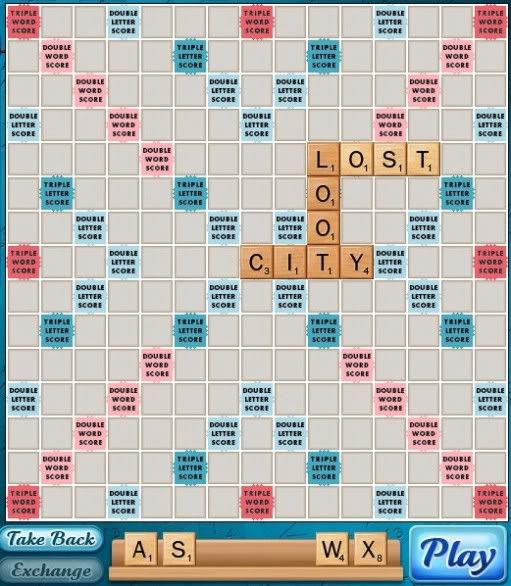
I arranged the words in my head -- Lost City Loot/Loot Lost City/City Lost Loot -- and realized I had three different basic premises for a story: Someone finds treasure from a lost city; a lost city is discovered (and looted); a city loses its treasure. While I probably won't get story ideas from every game I play, from now on I think I'm going to be paying more attention to what lands on the board.
At the moment I'm putting together a trilogy proposal, and I needed six names for the protagonists. My usual methods weren't producing much, so on a whim I took out my hands-on Scrabble® board (Diamond edition, naturally) and started playing with the tiles. I had the first four names I needed in a couple of minutes, and after switching out tiles for a while I hit on the last two. I even got a bonus in the process; the name of the character who brings the final two protagonists together.
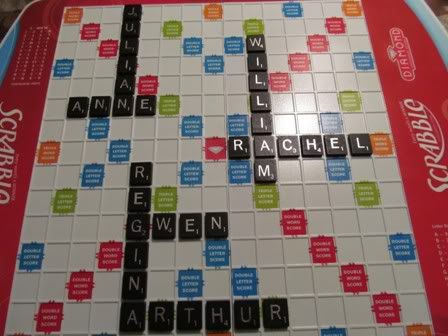
Although the limited number of letter tiles can seem restrictive, I find it's actually a good thing. I think in some cases too many choices can be overwhelming. I had to do some creative thinking while I was working with the letters versus using as many as I wanted, and that helped me focus on what was important. If you want more letters, you can make your own from squares of cardboard, or pick up an extra game from a thrift store just for the tiles.
Other ways you can use a Scrabble® board:
Set up keywords and rearrange them to find new ideas for titles, settings and other named story elements.
Work with the tiles to coin words for world-building purposes.
Sort out the names in your story by first letter and eliminate sound-alike given names (this prevents your cast from sounding like a new branch of the Duggar family.)
Have you ever used a Scrabble® board to work out something with writing? Are there any other ways you can think of using one to help? Let us know in comments.


